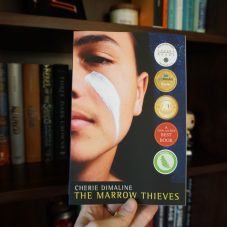
The Marrow Thieves


Rating:  ⭐⭐⭐⭐
Author: Cherie Dimaline
Genres: Science Fiction, Young Adult
Pub Date: Apr. 2017 (Read Mar. 2017)

“Sometimes you risk everything for a life worth living, even if you’re not the one that’ll be alive to see it.”

This was a beautiful book! I’m so glad it’s in the Canada Reads shortlist this year because I think it’s unlikely I would have discovered it otherwise and that would have been a shame because the writing is so gorgeous!

The Marrow Thieves is a short novel by Métis author Cherie Dimaline about a dystopian Canada that has been ravaged by climate change and disease and a large portion of the population has been wiped out. In the aftermath, everyone but indigenous peoples have lost the ability to dream. In an attempt to discover why the government starts constructing new schools (that mirror the old residential schools) to study indigenous peoples. It turns out that the ability to dream comes from your bone marrow and the government starts rounding up and experimenting on indigenous peoples to harvest their bone marrow.

Frenchie has slowly lost everyone in his family and finds himself alone in the woods. He follows his family’s plan to head North and eventually runs into other bands of ‘Indians’ who are slowly treking their way North as well and he is adopted into a new family and they travel together. Their group consists of an elder, Minerva; their leader, Miig; and several other young people who have lost their families. Miig tries to preserve the old ways through story-telling and everyone has the opportunity to tell their own ‘coming-to’ story.

I loved the writing in this book and learning everyone’s story – hearing about their struggles and how they came to end up part of this little adoptive family. They all come from different backgrounds and families, but they have retained their ability to dream and their desire to survive in the angry world around them. Miig teaches them how to hunt, cook, fight, and survive in the wild and how to connect back to their original roots.

I really liked this because I thought by telling this horrifying, dystopian story, Dimaline was able to convey some of the horrors that have been committed against indigenous peoples in the past in a way that enabled you to empathize emotionally with them and better understand how they felt. On paper, everyone knows about the residential school systems and the struggles of indigenous peoples to retain their culture, but that part of history feels a degree removed and it’s shameful so I think people generally avoid thinking about it.

It reminded me a little of Tim O’Brien’s book, The Things They Carried, in it’s ability to use exaggeration to convey emotion. The Things They Carried is a book about O’Brien’s experience in the Vietnam War that is written to read like a memoir, but is actually partially fabricated. O’Brien’s essay about being drafted and his internal debate about whether he would defect to Canada to avoid going to war is one of the best essays I’ve ever read. It reads like non-fiction and is an exaggerated account of O’Brien’s experience, but it is so effective because the exaggeration is what enables to you really feel his despair, frustration, and hopelessness. Dimaline’s horrifying account of the marrow thieves is what enables you to relate and empathize with the persecution of indigenous peoples throughout Canada’s history. I mean, I obviously empathized with them before and thought the residential schools were horrifying, but this book uses science fiction and exaggeration to evoke a much stronger emotional reaction.

Indigenous peoples are obviously incredibly tenacious and this book re-iterated that. It is really a pretty simple story about family, love, and the bonds we build with those around us. Who are we when everything else is stripped away from us? What can we become when faced with adversity, antipathy, and violence? Is family blood or the bonds we build we those we love? I thought this was a thoughtful, well written novel and I would definitely recommend to all Canadians! I read both The Boat People and The Marrow Thieves and while I really liked them both, I think this was my favourite of the two.

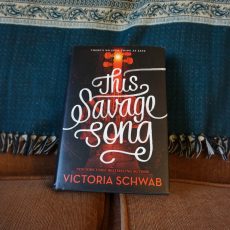
This Savage Song


Rating: ⭐⭐
Author: Victoria Schwab
Genres: Fantasy, Science Fiction
Read: Mar. 2018

This Savage Song is the second book in my March Challenge to read 3 fantasy novels and the first book that has disappointed me this year as part of my monthly challenges.

I had mixed feelings about Schwab’s Darker Shade of Magic series because while I did like it and thought she had some really great characters, I never really felt that engaged while I was reading it. But afterwards, even though I hadn’t totally loved the series, I just couldn’t stop thinking about it and think fondly of Kell, Lila, Rhy, and the whole London gang.

I don’t know if that will be the case with this series as well. Again, I liked the characters and I did fly through reading this, but I was never super into the story. Maybe I just don’t love Schwab’s writing style? I honestly don’t know. This is another beloved series, but despite all the monsters and the high stakes, I just never got into it.

This Savage Song is an urban fantasy that I pictured as being set in America, but now I can’t actually remember if it was or not. Either way, it’s a kind of post apocalyptic world where monsters have risen up out of the darkness and the country has been divided into 6 different realms, all separated by the lawless “waste”. Verity is one of those realms and Verity City is fractured in two between Harker and Henry Flynn (North City and South City). Harker has made some kind of deal with the monsters whereby they won’t harm anyone who pays to be under his protection. On the other side, Henry’s Flynn Task Force is trying to rid the city of evil.

Kate Harker has been kicked out of boarding school after boarding school and her father has finally allowed her to return to V-City. However, the truce between North City and South City is fracturing, so Henry sends his adopted son, August, undercover into North City to get close to Kate and see if they can use her to their benefit. Kate and August become close, everything goes to hell, and suddenly they find themselves fighting for their lives across Verity City.

The book did have an interesting ending and there’s only 1 more book in this series, so I would like to read it, but I think it’s going to fall pretty far down on my list as there are a lot of other books I’d rather prioritize. I did still like the book, I just didn’t really see anything that special about it. Oh well.

February Summary

You wouldn’t think that 3 days would make that much of a difference, but only having 28 days in February always makes the month go by so quickly!

I’m really happy about the 3 books I challenged myself to read in February as part of my goal to read to 3 books about Canada. I think it would have taken me a while to get to any of these books if I hadn’t publicly challenged myself to do so. To be honest, I even debating dropping the last one from the list and just reading 2, but I’m glad I pushed myself to read all 3 because I really liked them all! It’s only been 2 months, but actually taking the time to do some research and thoughtfully pick my challenges has been paying off with some quality literature.

Anyways, let’s jump right in with my February Summary:

Books read: 9
Pages read: 3,276
Main genres: Fiction, Fantasy
Favourite book: Saga, Volume 8

February started off with a stream of half-star reads. I don’t like giving half star ratings, but it’s a fine line between 3 stars and 4 stars and sometimes you just need to compromise. So I gave my first 3 reads of the month all 3.5 stars.

I started off with Tiger Lily, which is a re-telling of Peter Pan from Tinkerbell’s perspective, featuring Tiger Lily as the main protagonist. I thought this book was actually fantastically written, Jodi-Lynn Anderson’s writing is very beautiful and lyrical, but I struggled to get into the story, hence the 3.5 star rating. I already bought a copy of Anderson’s latest novel, Midnight at the Electric, and I’m excited to check out some more of her writing.

Next I read an advanced reader copy of Lisa Jewell’s latest book, Then She Was Gone, that I got from Netgalley. I’ve been dying to read some of Jewell’s stuff, so I was happy to give this one a try. I liked it in that it was formatted quick differently from any other mystery/thriller that I’ve read, but it was a little bit predictable in parts and I also found it extremely disturbing. However, like Tiger Lily, I’m intrigued to try some more of Jewell’s work next time I’m in the mood for another mystery!

The last of the 3.5 star reads was Eleanor Oliphant is Completely Fine by Gail Honeyman. I have to admit, I really didn’t want to read this one. It sounded a lot like The Rosie Project to me, which I didn’t like, but my book club picked it for our February read and I’ve been seeing a lot of good press about it, so what could I do? This was probably my least favourite of the 3. I found it kind of boring, but I do think it was a well written book (definitely better than The Rosie Project) and I appreciate what the author was trying to do with this novel.

As you can see, I was kind of putting off tackling any of my Canadian reads for my Monthly Challenge, so after I finished Eleanor I decided to tackle The Boat People and The Break. Both of these books were fantastic! I feel like it took me forever to get through The Boat People, but it was a fascinating read about immigration and morality and it really made me think. In contrast, The Break is a family drama about a Métis family and all the hurts and grievances they’ve weathered together over the years. It was a inter-generational read that was just so well written and had so much depth, I thoroughly enjoyed it.

Actually, in between those 2 books I snuck in a quick reading of the latest Saga volume, which came out at the end of December. I slowly worked my way through the first 7 volumes of Saga last year, and while I really liked them all, this one affected me more than the rest. I think Brian K. Vaughan actually went a little more heavy-handed than usual on the social commentary in this one. At first I thought it was a bit much, but I guess I was wrong because this volume just stands out more than any of the others for me and it was pure enjoyment from start to finish. Vaughan tackles abortion, miscarriage, and grief in this volume and it really packed a punch, especially at the very end when parts of the cast are finally re-united.

I was avoiding starting the final book in my February Challenge all month, mostly due to length, so I fit in a quick read of The Lightning Thief. This is the first book in the Percy Jackson and the Olympians series and I’ve been wanting to read this for ages because everyone seems obsessed with everything Rick Riordan writes! This was another book that was just a lot of fun. The writing was hilarious and there was so much action packed into this middle grade book! Percy was witty and I loved his sidekicks, Annabeth and Grover. I would like to read more of these, but I suspect it may take my a while to get to them, but they’re definitely good if you’re looking for a laugh.

The final book in my Monthly Challenge was The Colony of Unrequited Dreams by Wayne Johnston. I admit, I did not want to read this one, but like I said, I’m glad I pushed myself to finish it. I had a lot to say about this one that I don’t want to get into again, so I’ll just say that it’s historical fiction about Newfoundland’s first premier, Joey Smallwood, who helped usher Newfoundland into confederation with Canada. Check out my full length review for more details. This book was meaningful to me as a Newfoundlander and I’m really proud that I finally read it. I gave it 4 stars.

And the last read I squeezed into February was The Power. I’ve been wanting to read this one since it came out at the end of last year since it’s been called the new ‘Handmaid’s Tale’ (along with Red Clocks). It’s dystopian science fiction where women develop the ability to produce electricity and use it through their hands. The book has such a great premise, but I was really disappointed with the author’s follow-through on the premise; I thought the book lacked focus and was poorly executed. It still make me think a lot though, so I gave it another 3.5 stars.

The Power


Rating: ⭐.5
Author: Naomi Alderman
Genres: Science Fiction, Dystopian, Feminist
Read: Feb. 2018

Execution is the key word for The Power. I’ve been dying to read this book since it first came out, but I’ve been seeing it get some mixed reviews and now I can understand why. This book had such a great premise, but I think it was a bit of a miss on the execution, which is so disappointing.

The Power is a dystopian, science fiction novel in which women have developed the power to basically electrocute people and things using their hands. They can take down electrical grids, burn trees and structures, and kill people using the power. The book is told from the point of view of a male historian recounting the events of when women first gained the power. Girls start developing the power at 15 and can awaken it in other women. Their power comes from a skein in their collarbones that all women have, but has never been awakened until now.

As you can imagine, women suddenly developing this power totally flips gender dynamics and this book focuses on the perspectives of 3 women and 1 man from different parts of the world. There’s Margot, an American mayor; Allie, a teenage runaway; Roxy, daughter of a British drug dealer; and Tunde, a Nigerian boy turned reporter. The book definitely had a strong start and I was super into it at the beginning, but I got a bit frustrated as things progressed because I felt like the author lacked an obvious theme or direction. I feel like she had a lot of different ideas and themes and sadly, I thought they were poorly executed and took away from the story. I think she needed a more focused direction.

My biggest struggle is that I just don’t know what the central theme is. Is it that this reversal in gender dynamics just ends up with a reversal of male/female roles? Or that even if women developed the ability to electrocute men, it would still be a huge struggle for them to gain power and men would be just as destructive towards women as they’ve always been? Is the author’s point that power can turn anyone into a monster? That women are just as vicious and oppressive as men have been and don’t deserve power? Or is she just trying to help men better understand the ways they currently harm and hurt women and how obvious these inequalities become through a simple reversal of gender roles?

Maybe I’m too dense to figure it out, but I feel like Naomi Alderman was trying to make all these points, which is why the book fell flat. There are definitely authors out there who can address this many ideas in a novel, but I feel like you need some kind of central theme and that the writing got overwhelmed by the ideas in this book and they just all lacked development. I don’t think the author needed to connect the multiple viewpoints the way that she did in this book. The characters seem to just randomly come across each other and help out each other’s storylines, but I felt that instead it made each individual storyline more disjointed and less impactful.

Disclaimer, the rest of this review contains spoilers. Usually I try and avoid spoilers, but I feel like I need to include them in order to properly discuss this book, so don’t read any further if you’re planning to read this book.

First off, let’s look at some of the things that I liked. I liked the scenes about the Men’s Rights movements and the internet trolls and bombings. They felt very real to me and I had no trouble believing we’d see this kind of backlash if women gained this power. I kind of expected the development of the power to switch gender roles a lot faster than it did, but I felt Alderman’s portrayal of this slow cling to power by men to be very believable. It’s got to be devastating to go from holding all the power to suddenly losing it and becoming oppressed and I have no doubt men would fight back and fight back violently (especially since women were also using violence).

I also liked the uprisings by women and the seedy underside of how some women choose to use their power. I really liked Margot’s story at the beginning, but then I was disappointed to see her basically left out of the second half of the novel. In contrast, I wasn’t really into Tunde’s story at the start, but ending up thinking he had one of the most meaningful storylines by the end of the book.

On the other side, I did not like Allie’s story at all and I only liked a few select parts of Roxy’s story. Allie’s story just felt like a total tangent with the whole religious revolution. I absolutely believe something like this could happen, but I just didn’t think this storyline fit in with the rest of the novel. It reminded me a little bit of the religious zealots in Station Eleven, which is a post-apocalyptic book in which 90% of the world population is killed by one virus. But I think this whole storyline just watered down the themes of the rest of the book and I hated that Roxy got involved because then I just had to read twice as much about it.

I thought Roxy’s story had such a strong start. It was so dark and I couldn’t wait to see where the author would take it, but I really didn’t dig the whole soldier aspect and based on what happened later, didn’t see that point of including it at all. The only other part of Roxy’s story I really liked was the skein removal scene, which was super horrific for an imaginary medical procedure. I felt so bad for Roxy, but it was such a powerful commentary on the lengths men were willing to go to maintain their power

The scenario that plays out in this book could obviously develop in so many different ways and I did like some of the contrasting events that Alderman explores. I thought it was really cool that it was the developing countries where women rose up first to fight back against their oppressors, whereas in America and Great Britain, men did whatever they could to retain power and women did less to fight back and in Margot’s case, actually hid her power. I also liked the contrast between the scene where Darrell first uses Roxy’s power and the other girls rise up against him to protect Jocelyn, whereas in the Romanian jungle, the women were actively hunting down any man, woman, or child who stood in their way and seemed to have no sense of compassion or bond with other women.

I loved Tunde’s story because of that feeling of total powerlessness at the end of the novel. He’s always had an exit plan and then the total despair of being betrayed by those closest to you and watching your life work stolen from you is just devastating. And to then be trapped in the middle of a female revolution with no way to fight back? That had to be so terrifying and I just wanted men to read that to try and understand the oppression and fear so many women feel at the hands of men.

I can see this book being both powerful and dangerous. Powerful because it makes a statement about the inequalities women face and reversing them to affect men can be powerful in helping men to empathize with women. There were so many small but meaningful nuggets at the beginning, like where mothers were talking about how they wouldn’t let their sons out alone on the streets because of the danger of being attacked by women. My disappointment again was that I felt this theme could have been so much more powerful, but I felt like it kind of got lost throughout the novel. On the other side, I can see these ideas being dangerous in that I could see actual MRA’s taking it and saying, “see, look what could happen if we let women have power.”

I struggled with the format of the supposed historian telling this story. I didn’t buy it and I could have done without the whole thing. Why would a historian tell a story like this? I don’t think they would. I thought the letters at the end of the book between the historian and Naomi were fantastic, but again, just so confusing for the execution of this book!

I thought the main theme was going to be that with power, and given a long enough time, women essentially just become men. But in my opinion the actual novel didn’t really support this theme and I was super frustrated that the whole novel covers 10 years of history and then at the end we discover the story is actually being told 5000 years after the fact! The letters at the end totally support the theme that the power just eventually resulted in a total role reversal, but it felt so disjointed because this is not the theme I felt the rest of the novel was promoting.

I wonder if I’m maybe holding this book to a bit of a higher standard because of its relevance to modern day feminism, but I just feel it had so much more potential. In summary, I would give this 3.5 stars because it definitely makes you think a lot, but with more focus and better execution, I really think this could have been a 5 star read, which is why it felt so disappointing.
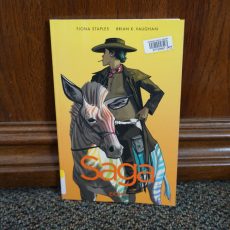
Saga, Volume 8


Rating: ⭐
Author: Brian K. Vaughan, illustrated by Fiona Staples
Genres: Comics, Graphic Novel, Sci-fi
Read: Feb. 2018

I love Saga so much. It doesn’t take very long to read one of these volumes, but they are so reliably fun and enjoyable.

Since I’m 8 volumes in and I haven’t written a review for Saga, I’ll give a brief summary. Saga is a graphic novel set in space that starts off with a bit of a Romeo and Juliet premise. Alana and Marko are from two feuding planets (well one’s a moon), Landfall and Wreath. Alana is from Landfall and has wings, while Marko is from Wreath and has horns. The two fall in love, become pregnant, and are basically chased across the galaxy by other planets and people that don’t want any evidence of their traitorous relationship.

I am just in love with Alana, Marko, and their daughter Hazel. I wasn’t totally into the idea of reading about two soldiers and their tag-a-long baby, but this is a truly fantastic series about love and family and throughout the series Vaughan tackles a lot of different socials issues. It is bit of a bizarre series and definitely NSFW (there’s a fair bit of sex and nudity throughout the series), but Fiona Staples artwork is gorgeous and I love how creative Vaughan is with his characters and storyline. His characters do some pretty bad things and make bad decisions, but he’s still able to make you love them. Each character has their own morality line about what is and isn’t acceptable and it’s interesting to watch them try and stay on the safe side of their line while still trying to protect the people that they care about.

Each volume consists of 6 issues and they’ve recently released 2 books containing 3 volumes a piece. But I’d recommend hitting up your local library for this series. 8 volumes can seem pretty daunting, but they are quick reads and I would highly recommend!