The Underground Railroad

Rating: .5
Author: Colson Whitehead
Genres: Historical Fiction, Re-imagined History
Pub Date: Aug. 2016 (read Apr. 2018)

This book is breaking my heart…. because I didn’t love it…. I didn’t even really like it.

I picked this for my April Challenge to read 3 award-winning books. This won the Pulitzer Prize and the National Book Award for fiction, so I had high hopes that I would enjoy this. It’s definitely a good book, I won’t debate that, but it’s just so unbelievably SLOW! It’s only 300 pages and it took me 2 and a half weeks to read. On average I read a book every 3 days, so this felt like the longest slog ever and I actually had to take a break in the middle to read my book club selection because I wasn’t going to finish this in time.

The Underground Railroad re-imagines the network of people and safehouses that helped black people to escape the south and slavery as an actual underground railroad. It’s an interesting concept, but personally I didn’t really think the railroad had any real impact on this story. Whitehead tells the story of Cora, a young slave in Georgia who after being beaten by her masters, decides to try and escape the cotton plantation where she’s lived her entire life. The plantation has a long and sorry history of slaves escaping the plantation, but they were always caught and returned to the plantation to be killed for trying to escape, except for Cora’s mother Mabel, who abandoned her when she was just a girl and was never re-captured.

Cora begins a journey through many states and is pursued by Ridgeway, a slave catcher who still can forget about Mabel, the one the got away, and is determined to catch Cora to right his past failings. She travels through several states and is witness to the kindness and hate of the people around her, sometimes catching a glimpse of like as a free-woman, and other times forced back into hiding as she continues towards her ultimate goal of escaping to the North.

This is an interesting story, as difficult as it sometimes was to read (content wise, which is sometimes disturbing). But I couldn’t get past the pace of the book and like I said, I thought the whole idea of the underground railroad fell flat. It serves to move our story around, but I didn’t actually find the concept that engaging. I would have liked to know more about the railroad and how it came to be – it was obviously built by slaves, like everything else in America at that time – but we don’t learn that much about it. I understand that this is part of the mystery, but I kind of wondered what the point was. Cora could have travelled between states hidden in the back of a cart and the story wouldn’t have really been any different.

There’s not very many high points in the story. The format was interesting, with Whitehead separating each chapter by a different state and separating the states with short chapters from the points of view of some of the minor characters. I had no idea what the point of the grave digger chapter was, but some of the other chapters were interesting. I was intrigued by Ridgeway’s character and found his and Cora’s relationship interesting.

Maybe I’m too dense for this book, but I just can’t get on board. I appreciate what Whitehead did with this book, but I’m not convinced it was worthy of all the awards. I wanted to love it, but it was just so slow and boring. It had some faster paced parts where I would finally get into the story, but then the chapter would end and everything would change up and be boring again. The story just had no momentum – a disappointing read.

March Summary

I struggled a bit at the end of March to finish my Monthly Challenge, but overall it ended up being my most successful reading month! I read 3 Fantasy Novels for my monthly challenge, a few advanced reader copies of books from Netgalley, and several audiobooks. Here’s my March Summary:

Books read: 13
Pages read: 4,425
Main genres: Fiction, Fantasy
Favourite (new) book: I Am Not Your Perfect Mexican Daughter
Favourite re-read: Beartown

I started off the month with a few ARC’s, which are early copies of books that publishers share with a limited number of readers to provide early feedback before the books are released. I’ve been getting more ARC’s from Netgalley since I started my blog and I’ve been starting to build some relationships with publishers, which has been a lot of fun for me!

The two ARC’s I read this month were The Lost Girls of Camp Forevermore (which came out in early March) and Us Against You (which comes out in June). The Lost Girls of Camp Forevermore was a short read about several girls that get lost in the woods at a summer camp when they were 12 and how it affects them later in life, which I really enjoyed. Us Against You is the sequel to Beartown, which was my favourite book of 2017, so of course I had to re-read Beartown this month as well. I loved Beartown just as much the second time around, but sadly I didn’t love Us Against You as much. I wrote a pretty in depth review about it and I did still really like it, it just couldn’t hold up to the masterpiece that is Beartown. But I’d still recommend reading it and I’m hoping for a third book!

Next I read 2 of books for my monthly challenge, The Thief and This Savage Song. I really liked The Thief, which is a fast read, and I’m excited to read further into the series, but I didn’t really like This Savage Song very much. I have it 3 stars, but as time passes I’m starting to like it less and less and I think it might be more of a 2.5 star read. I can’t quite pinpoint what I didn’t like about it, I just never really got into it and I didn’t think it was that engaging.

I had great success with Audiobooks this month though! I haven’t listened to any audiobooks since November (probably because I stopped running and I recently started again), but I got back into them this month. I was bored with the one I was listening to and I was never motivated to listen to it, so I decided to ditch it and start fresh, which was a great idea because I finished Before We Were Yours this month and absolutely flew through I Am Not Your Perfect Mexican Daughter and The Authentics.

Before We Were Yours was an interesting historical read about the birth of adoption in Tennessee, but I Am Not Your Perfect Mexican Daughter totally blew me away! I didn’t really expect that much from it because I’d read the main character was pretty unlikeable, but I loved the audiobook narrator for this one and I thought the main character was just so well portrayed. I picked my last audiobook, The Authentics, because it had the same narrator and similar themes to I Am Not Your Perfect Mexican Daughter, but while I liked it, it definitely wasn’t as strong a book.

My Book Club’s book of the month was The Child Finder by Rene Denfeld. I gave it the highest rating of the group with a 7 out of 10, but the general consensus of the group was that we liked it, but didn’t love it. It has a fantastic setting and atmosphere, but the mystery plot leaves a little to be desired. I also read The Marrow Thieves this month in an attempt to read another of the Canada Reads shortlist before the debates. The other book I read from the Shortlist was The Boat People, and while I gave them both 4 stars, I liked The Marrow Thieves more. I thought the writing and story were both great and incredibly moving.

I snuck in a poetry reading this month as well and read Milk and Honey by Rupi Kaur. This is her debut novel, but I read her other book, The Sun and Her Flowers, last year and really liked it. I didn’t like Milk and Honey quite as much, but it was still a nice, fast read.

Finally, I thought my last book of the month was going to be my final challenge book, The Fifth Season, because it was taking me forever to get through, but I managed to cram in a reading of Avenged over the Easter weekend (the sequel to Ruined). I didn’t love The Fifth Season as much as I was hoping because it was a pretty heavy read and it took me a while to get into, but I’m optimistic about the rest of the series. Avenged was almost as much fun as Ruined, which I loved. I know the Ruined series is not even on the same level as the Fifth Season, which is quality fantasy writing and world building, but I can’t help but love it because it’s just so fast-paced and fun!

Before We Were Yours


Rating: ⭐⭐⭐⭐
Author: Lisa Wingate
Narrated By: Emily Rankin
Genres: Historical Fiction
Pub Date: June 2017 (read Mar. 2018 as an Audiobook)

I listened to Before We Were Yours as an audiobook. It reminded me a lot of The Alice Network, which I also listened to as an audiobook and had a similar format, alternating back and forth between a present day and historical perspective based on true events. I thought The Alice Network told a fascinating story about a real-life individual, Louise de Bettignies, who ran a spy network in World War I, but I found the second narrative boring, poorly written, and unnecessary to the story. Fortunately I felt differently about Before We Were Yours and while I still thought the writing was a little cliche in places, I thought this story was better done overall.

The whole present day narrator investigating the past is such a common troupe in historical fiction and a lot of the time it’s just not well done (also thinking of The Life She Was Given) but I didn’t mind it too much in this book. In my opinion, this troupe doesn’t always add something meaningful to the story, but I do think this element worked in this book because of the way that families were torn apart and how it took many families generations to reunite, if at all. Audiobooks also tend to make the writing seem a little cheesy and there were definitely parts where I rolled my eyes, but overall this translated well in audiobook and I thought the narrator was fantastic.

Let’s get into the plot. Before We Were Yours focuses on a little known piece of American history that is both fascinating and horrifying. The story starts in Tennessee in 1939 and looks at real-life individual Georgia Tann and her work with the Tennessee Children’s Home. Rill Foss and her 4 siblings have grown up as river gypsies, living in a house boat, running their way up and down the Mississippi River. At the beginning of the novel, their mother is about to give birth with the help of a midwife, but things become complicated when they discover she’s actually pregnant with twins and the midwife forces her to go to a hospital to deliver the babies. The rest of the children spend the night on the river boat with Rill in charge.

However, the following day the police show up and basically kidnap them before dropping them off at the Tennessee Children’s Home. Rill has no idea what happened to her parents or why they’ve been forced to stay at the Children’s Home, but does her best to keep her siblings together, despite the horrors they start to experience.

At the same time, we’re learning about Avery Stafford. A wealthy young lawyer who has returned to her childhood home in South Carolina to be groomed to take over her father’s role as a senator. On a political visit to a senior’s home, she bumps into a old woman named May who seems to know her grandmother and is drawn into a decades old mystery of how these women are connected and what threat this mystery might pose to Avery and the Stafford family in her bid for senator.

Georgia Tann is a real life woman who is often known as the “mother of modern adoption”. She ran the Tennessee Children’s Home, which took care of orphans and children whose parents were too poor to properly take care of them or who turned them over to the state for care. Tann oversaw the care of the children and worked to find them all loving homes (for a price). But what was not known until later is the horrifying conditions the children were forced to live in, the ways they were abused, how they were exploited for financial gain, and the horrifying circumstances through which many of the children were obtained.

While Tann did undoubtedly (indirectly) rescue many children from poor conditions and abusive families and place them in loving wealthy families, she also obtained a lot of the children through shocking means. Some children were kidnapped out of their family homes or off the street, like Rill and her siblings, while others were obtained by tricking the birth mother or parents who were often poor or illiterate. Tann had workers in hospitals who would tell mothers that their newborns had died or trick them into signing papers giving up their children to the state, while Tann would take the children and sell them to wealthy buyers. The extent of the network that Tann had set up is actually shocking and it’s hard to believe that so many people were able to turn a blind eye to the suffering of the children and the birth parents.

Many victims on Tann’s schemes were abused or died while in her care. She did everything to ensure that the children’s families would never be able to find or reunite with their children and separated many siblings, destroying any paper trail that might enable to birth parents to try and get their children back. Equally shocking was that she would sometimes later even harrass the adoptive parents to get further payments from them under the guise of lawyer fees.

Unfortunately Tann was never prosecuted for her crimes as she was very old and sick before they were ever discovered and people generally were of the opinion that the wealthy adoptive families were more fit to raise the children than the poor families would have been anyways. I thought this was a fascinating opinion, although Wingate didn’t explore it very extensively in the novel. I think it’s a question that is still relevant today. Do poor parents not deserve the right to raise their own children just because someone else could better financially provide for their children? Is money all that matters when it comes to raising a child? What is the long term impact on a child who has been stolen away from their biological parents, whether they can remember it or not?

It was a really interesting story and I did find myself engrossed in both May’s story and Avery’s story. Audiobooks aren’t my favourite way to read because I find they are very exposing of an author’s writing, which can sometimes detract from the story. Like I said, this still had some cliche writing, but overall, I did like this book and was fascinated by the piece of history that it exposed.

February Summary

You wouldn’t think that 3 days would make that much of a difference, but only having 28 days in February always makes the month go by so quickly!

I’m really happy about the 3 books I challenged myself to read in February as part of my goal to read to 3 books about Canada. I think it would have taken me a while to get to any of these books if I hadn’t publicly challenged myself to do so. To be honest, I even debating dropping the last one from the list and just reading 2, but I’m glad I pushed myself to read all 3 because I really liked them all! It’s only been 2 months, but actually taking the time to do some research and thoughtfully pick my challenges has been paying off with some quality literature.

Anyways, let’s jump right in with my February Summary:

Books read: 9
Pages read: 3,276
Main genres: Fiction, Fantasy
Favourite book: Saga, Volume 8

February started off with a stream of half-star reads. I don’t like giving half star ratings, but it’s a fine line between 3 stars and 4 stars and sometimes you just need to compromise. So I gave my first 3 reads of the month all 3.5 stars.

I started off with Tiger Lily, which is a re-telling of Peter Pan from Tinkerbell’s perspective, featuring Tiger Lily as the main protagonist. I thought this book was actually fantastically written, Jodi-Lynn Anderson’s writing is very beautiful and lyrical, but I struggled to get into the story, hence the 3.5 star rating. I already bought a copy of Anderson’s latest novel, Midnight at the Electric, and I’m excited to check out some more of her writing.

Next I read an advanced reader copy of Lisa Jewell’s latest book, Then She Was Gone, that I got from Netgalley. I’ve been dying to read some of Jewell’s stuff, so I was happy to give this one a try. I liked it in that it was formatted quick differently from any other mystery/thriller that I’ve read, but it was a little bit predictable in parts and I also found it extremely disturbing. However, like Tiger Lily, I’m intrigued to try some more of Jewell’s work next time I’m in the mood for another mystery!

The last of the 3.5 star reads was Eleanor Oliphant is Completely Fine by Gail Honeyman. I have to admit, I really didn’t want to read this one. It sounded a lot like The Rosie Project to me, which I didn’t like, but my book club picked it for our February read and I’ve been seeing a lot of good press about it, so what could I do? This was probably my least favourite of the 3. I found it kind of boring, but I do think it was a well written book (definitely better than The Rosie Project) and I appreciate what the author was trying to do with this novel.

As you can see, I was kind of putting off tackling any of my Canadian reads for my Monthly Challenge, so after I finished Eleanor I decided to tackle The Boat People and The Break. Both of these books were fantastic! I feel like it took me forever to get through The Boat People, but it was a fascinating read about immigration and morality and it really made me think. In contrast, The Break is a family drama about a Métis family and all the hurts and grievances they’ve weathered together over the years. It was a inter-generational read that was just so well written and had so much depth, I thoroughly enjoyed it.

Actually, in between those 2 books I snuck in a quick reading of the latest Saga volume, which came out at the end of December. I slowly worked my way through the first 7 volumes of Saga last year, and while I really liked them all, this one affected me more than the rest. I think Brian K. Vaughan actually went a little more heavy-handed than usual on the social commentary in this one. At first I thought it was a bit much, but I guess I was wrong because this volume just stands out more than any of the others for me and it was pure enjoyment from start to finish. Vaughan tackles abortion, miscarriage, and grief in this volume and it really packed a punch, especially at the very end when parts of the cast are finally re-united.

I was avoiding starting the final book in my February Challenge all month, mostly due to length, so I fit in a quick read of The Lightning Thief. This is the first book in the Percy Jackson and the Olympians series and I’ve been wanting to read this for ages because everyone seems obsessed with everything Rick Riordan writes! This was another book that was just a lot of fun. The writing was hilarious and there was so much action packed into this middle grade book! Percy was witty and I loved his sidekicks, Annabeth and Grover. I would like to read more of these, but I suspect it may take my a while to get to them, but they’re definitely good if you’re looking for a laugh.

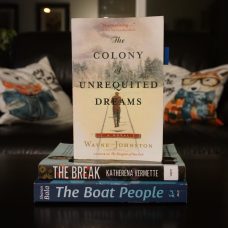
The final book in my Monthly Challenge was The Colony of Unrequited Dreams by Wayne Johnston. I admit, I did not want to read this one, but like I said, I’m glad I pushed myself to finish it. I had a lot to say about this one that I don’t want to get into again, so I’ll just say that it’s historical fiction about Newfoundland’s first premier, Joey Smallwood, who helped usher Newfoundland into confederation with Canada. Check out my full length review for more details. This book was meaningful to me as a Newfoundlander and I’m really proud that I finally read it. I gave it 4 stars.

And the last read I squeezed into February was The Power. I’ve been wanting to read this one since it came out at the end of last year since it’s been called the new ‘Handmaid’s Tale’ (along with Red Clocks). It’s dystopian science fiction where women develop the ability to produce electricity and use it through their hands. The book has such a great premise, but I was really disappointed with the author’s follow-through on the premise; I thought the book lacked focus and was poorly executed. It still make me think a lot though, so I gave it another 3.5 stars.

The Colony of Unrequited Dreams


Rating: 
Author: Wayne Johnston
Genres: Historical Fiction
Read: Feb. 2018

Where to start? This was a very long book that took a lot of motivation to pick up off my shelf, but that I ended up having a lot of opinions about. I was worried that it was going to be really dense, but fortunately, it turned out to be a very well written and engaging book about Newfoundland.

The Colony of Unrequited Dreams is historical fiction about Joey Smallwood, Newfoundland’s first premier who helped to usher Newfoundland into confederation with Canada. He is both a well liked and disliked premier, depending on who you talk to. Johnston definitely takes a lot of liberties with Smallwood’s character in this novel, but the story is still pretty accurately based on his life in terms of what he accomplished.

The story starts with Smallwood as a child in the early 1900’s. His family were shoe salesmen in St. John’s and he lived up on the Brow looking over the Harbour until his uncle decided to pay to send him to Bishop Feild, the prestigious boy’s boarding school of the day. At Bishop Feild, he meets Prowse, grandson of a noted historian, and Fielding, a girl who attends the nearby sister school, Bishop Spencer.

Fielding is the other main character in this story and unlike Smallwood, her character is completely fabricated. Fielding has a cane, walks with a limp, has a wry sense of humour, with sarcasm and irony being her preferred mediums. She’s a bit of an outcast who goes on to work as a reporter for The Telegram, publishing critical articles about all branches and parties of the government. Fielding marches to the beat of her own drum and I really liked her. I loved that she wasn’t afraid to speak her mind and I loved her sense of humour.

This book actually had a lot more humour in it than I was expecting and it had me laughing out loud early in the novel. Below is one of my favourite quotes from the book, which is an argument Smallwood has with his mother, and had me laughing because I also grew up in St. John’s while my parents grew up in rural outport communities. This is pretty much the exact same thing my parents would say to me growing up and the biggest way you could offend my parents would be to call them townies.

“I’m a Newfoundlander, but not St. John’s born, no, not St. John’s born,” he said.
“You’re a bayman and you always will be,” my mother said.

I’ve been living on the West Coast for the last 4 years, so this was super nostalgic for me. Wayne Johnston is not even describing my St. John’s in this novel because it’s set between 1900 and 1950, but there’s something really special about still being able to vividly picture the setting of a story, especially when it’s a place like Newfoundland, which I hold so special in my heart.

I didn’t love Joe Smallwood’s character, but I did like the writing. This was one of my monthly challenge books and I’m glad I challenged myself to read it because I probably never would have gotten around to it otherwise. Johnston does a really great job with the setting. I don’t know how non-Newfoundlanders might feel about this book, but I loved the setting and the atmosphere Johnston created. Especially towards the end when we finally get to the whole business of confederation and the end of independence. I felt like Johnston did a good job of not taking a side and presenting both sides of the story. It really makes you reflect on what Newfoundland gained, what it lost, and what may or may not have been.

I read Greg Malone’s Don’t Tell the Newfoundlanders several years ago and I felt that this book was a good contrast to that. Greg Malone is very clearly anti-confederation, as well as a bit of a conspiracy theorist. While I really liked Don’t Tell the Newfoundlanders, because it has some great history in it and I learned a lot, it is very speculative and I liked that Wayne Johnston presented a more balanced version of history and I feel he left his personal feelings out of it.

For those of you not well versed in Newfoundland’s history, we we’re an independent country up until 1933 when we had a commission of government forced on us by the British as a result of our war debt (even though A LOT of Newfoundlanders lost their lives fighting for Great Britain in WWI – I am a little bitter, yes). I’ve written an entire blog post about Don’t Tell the Newfoundlanders if you’re interested in our fascinating history (to me anyways), but basically we were supposed to get back our independence when we became self-sustaining once more, which we did after WWII. However, instead of just turning governance back over to Newfoundland, it was decided to hold a referendum to let the people choose if they wanted to join Canada instead.

Joe Smallwood wanted nothing more than to do something for which he would be remembered. He dropped out of Bishop Feild and failed at making a life for himself in New York, so he was desperate to have an influence in Newfoundland’s future. He was an avid socialist in his youth, but upon realizing that Newfoundlanders were never going to buy into socialism, he turned his talents to the Liberal government. He helped former Prime Minister Sir Richard Squires with his re-election campaign in hopes of winning the nomination to run himself, but he is jilted by Squires again and again and struggles to get into politics.

In this novel, he is a huge supporter of unions, walking across the entire provincial railroad line to start a rail-workers union, and he later travels all around Newfoundland’s most remote islands, trying to start a fisherman’s union. This really gave me an appreciation for how Smallwood became so popular and influential and why he supported Confederation. He really cared about Newfoundlanders and he spent an inordinate amount of time speaking with the poor throughout his life. He was also the host of a popular radio show that focused on sharing stories of Newfoundland and about Newfoundlanders.

The fisherman were not nationalists of any sort…They would vote for Confederation to get the mother’s allowance and would live by Confederation exactly as they had before…They had starved through a depression that had ended when the war began. Now, they were terrified that another decade like the thirties was on its way.

The crowd from St. John’s, the merchants and the wealthy, were all big supporters of independence. But Smallwood understood from his travels around Newfoundland that the majority of Newfoundlanders were poor fisherman, struggling to keep food on the table. They didn’t care about the government of the day and it rarely affected them. Confederation wouldn’t really change anything for them, except they’d be able to profit from access to Canada’s established public services.

The anti-confederates must have wondered how they lost…They had been to London and they had been to New York, but they had never been to Bonavista or La Poile, and that was why they lost.

Don’t Tell the Newfoundlanders leaves you feeling angry and riled up, but The Colony of Unrequited Dreams gave me an appreciation of what it was really like for Newfoundlanders. Forget the politics and the conspiracies, rural fishermen just wanted to catch a break and this was something I never really understood before. Yet Johnston still presents the other side of the story and makes you feel very nostalgic for what might have been. Personally, I wish we could have seen what might have been had we re-gained our independence, but I do also think it’s likely that we might have ended up joining Canada anyways and I’m proud to be both a Newfoundlander and a Canadian. I think this must be one of the reasons why Newfoundlanders always retain such a keen sense of home no matter where they go. There is something unique about Newfoundland culture that does not come from Canada because we have not always been Canadian.

The ending of this book was heartbreaking for me though. I was a little bit disappointed that Johnston chose to end this book about Fielding. I really liked her, but as a fictional character, I don’t think her story was quite as powerful and it felt very anti-climatic to suddenly jump back into Fielding’s past.

“You all but gave away Churchill Falls, which you had hoped would crown your career as Confederation had crowned Mackenzie King’s”

Johnston touches very briefly on Churchill Falls and I wish he’d explored it more. If this book had been written 10 years later, I’m sure he would have because the Lower Churchill is such a hot topic in Newfoundland right now. But I found this so heartbreaking because Churchill Falls was meant to be Smallwood’s swan song – his legacy – and instead it turned out to be one of the worst deals every made and a real sore spot for Newfoundlanders. Smallwood did not have a successful start as Premier and Johnston portrays him running out of time in office and chasing after Churchill Falls as his last chance to see Newfoundland transformed.

That said, my favourite part of this book is easily the way Johnston writes about Newfoundland. You can tell he has a great love and reverence for the island. I’m sure any Newfoundlander can relate as there’s just something that makes Newfoundlanders have this deep attachment to their homeland. She’s a rocky isle in the ocean, and she’s pounded by winds from the sea, but you just can’t help but love her ruggedness and her people. Smallwood was relentless and he really did want to do something good for Newfoundland. His whole life was dedicated to making Newfoundlander better and I do really think he cared about the poor Newfoundlanders and that they are what ultimately motivated him to chase after confederation.

I have often thought of that train hurtling down the Bonavista like the victory express. And all around it the northern night, the barrens, the bogs, the rocks and ponds and hills of Newfoundland. The Straits of Belle Isle, from the island side of which I have seen the coast of Labrador.
These things, finally, primarily, are Newfoundland.
From a mind divesting itself of images, those of the land would be the last to go.
We are a people on whose mind these images have been imprinted.
We are a people in whose bodies old sea-seeking rivers roar with blood.