The Lost Girls of Camp Forevermore


Rating: 
Author: Kim Fu
Genres: Fiction
Read: Mar. 2018

Thank you to NetGalley and Houghton Mifflin Harcourt for providing me with a free electronic copy of this book in exchange for an honest review.

This was a really interesting read. The Lost Girls of Camp Forevermore just came out in February and it already has a bit of a lowish rating on goodreads, which is usually a deterrent for me, but I’m obsessed with camping and I was really intrigued by the premise, so I decided to go ahead with it anyways.

The Lost Girls of Camp Forevermore tells the story of 5 girls around ages 10-12 who attend a sleep-away camp in Washington State. The girls are from all over the region, including British Columbia. The highlight of the camp is supposed to be an overnight kayaking trip to a remote island, but this kayak trip goes horribly awry and leaves the girls stranded on an island. The book tells the story of what happened to the girls, while simultaneously flashing forward in each of the girls lives to see how they later fared.

The structure of this story was really interesting. Throughout the main story of what happened at Camp Forevermore, we get a short story for each of the girls future lives. These stories don’t really reference what happened at camp and in my opinion could each be viewed as separate short stories, but generally examine how they might have been affected by what happened on that fateful kayaking trip.

Because of this, the novel read more like a collection of short stories to me, but I didn’t mind it because each sub-story felt fully formed and realized and the writing was really beautiful. It didn’t deliver on what I was expecting from this book, but it was still a really nice piece of writing, so I didn’t mind. I think Kim Fu got the atmosphere of the story just right and I think the cover perfectly reflects that atmosphere too.

My complaint would be that it was a bit short. I was really into the main story at Forevermore and I would have liked to see this part of the novel developed a little more. It had a bit of a Lord of the Flies vibe and explored how children act and develop when left alone in stressful situations without adult support and I would have liked to see these themes explored in a little more depth and a bit better tied in with the futures of each girl. I also thought it was a weird choice to tell Kayla’s story instead of Andee’s. Andee is one of the 5 girls on the island, why tell her sister’s story instead of hers? I didn’t really get why the author choose to do this and was one of the reasons I thought the flash forwards could also work as short stories, since some of them seemed to have very little to do with what actually happened at camp.

Overall though, I did really like this, which goes to show you can’t always trust the goodreads ratings. I thought the writing was strong and the story was beautifully told. It’s a bit of a slow-burn novel, but it worked in this context. Plus I love supporting Canadian authors!

March Reading Challenge

I have to admit, I’m pretty pleased with myself and how my January and February challenges have gone. If I hadn’t challenged myself to read them, I don’t think I would have got to any of the books on my February challenge, and they were all really good, so I’m glad I finally set aside time for them.

It can be kind of hard to pick them up sometimes. I like being able to just pick up and read whatever I’m feeling in the mood for, which can be a challenge when I’ve already set myself 3 books for that month, plus my monthly book club read. But it has been paying off, so I’m going to try and stick to it for now.

I’ve got a huge list of challenge ideas, so every month I’m torn about which one to pick, but I’ve been wanting to just do a generic Fantasy challenge, so I decided to go very broad on my March picks. I’ve got a huge pile of fantasy novels at home, so it’ll be nice to set aside some time for them. So my March Challenge is:

Read 3 Fantasy Books

Like I said, I’ve got a huge stack, but I do still want to be intentional about which ones I pick, so I’ve settled on 3 that have all gotten great reviews and that I’d like to finally get to. My only concern is that these are first books in multi-book series, so my TBR will only grow and I have a feeling I’ll be trying to fit some sequels in there too. My March picks are:

  1. The Thief by Megan Whalen Turner
  2. The Fifth Season by N.K. Jemisin
  3. This Savage Song by Victoria Schwab

The Thief is a older fantasy series that was first published in 1996 and had 4 books, but the author just published a 5th book last year, so it seems to have been getting a lot of hype again. To be honest, I don’t actually know what any of these 3 series are about, but they’ve been on my TBR for ages because they’ve all gotten such great reviews. I know The Thief focuses on a thief (duh) who the King has released from prison to try and steal something for him and I believe each of the books in this series are from a different point of view, but are all political fantasy-type novels about a place called Attolia. So I’ll see how accurate my description is and report back!
The second book I want to read is the first in the Broken Earth trilogy by N.K. Jemisin and is called The Fifth Season. Again, all I know about this series is what’s in the goodreads synopsis, but it’s about the world ending and it sounds brutal! I’ve heard so much good stuff about this series and I’m excited to read it because it falls more within the adult fantasy/science fiction genre, whereas most of the fantasy books I read are very much YA fantasy books.
And finally, I’m planning to read This Savage Song, which is the first book in Victoria Schwab’s OTHER series. I read the Darker Shades of Magic trilogy last year and at the time I wasn’t as obsessed with it as everyone else seems to be, but I think I may have just read it at a bad time (mid-summer when I was super busy), because even though I didn’t love it, I can’t stop thinking about it. I keep recommending it to people and I feel like I want to re-read the whole thing. So I’ve decided to try her other series, which is a duology, but has likewise received fantastic reviews. This book has monsters! And embarrassingly that is the extent of what I know, but I promise a full synopsis in my review!

I feel like I should start reading these books right away to leave time to fit in some sequels in between them, but I just received an ARC for the Beartown sequel, Us Against You, which was my absolute favourite read last year, so I definitely have to read that and potentially also re-read Beartown before I can get around to these. So I think this may be a very successful reading month. Winter is almost over in Vancouver and transition seasons tend to be my best reading months because I’ve finished up my winter activities, but the hiking season hasn’t started up yet, so here’s too lots of books!

February Summary

You wouldn’t think that 3 days would make that much of a difference, but only having 28 days in February always makes the month go by so quickly!

I’m really happy about the 3 books I challenged myself to read in February as part of my goal to read to 3 books about Canada. I think it would have taken me a while to get to any of these books if I hadn’t publicly challenged myself to do so. To be honest, I even debating dropping the last one from the list and just reading 2, but I’m glad I pushed myself to read all 3 because I really liked them all! It’s only been 2 months, but actually taking the time to do some research and thoughtfully pick my challenges has been paying off with some quality literature.

Anyways, let’s jump right in with my February Summary:

Books read: 9
Pages read: 3,276
Main genres: Fiction, Fantasy
Favourite book: Saga, Volume 8

February started off with a stream of half-star reads. I don’t like giving half star ratings, but it’s a fine line between 3 stars and 4 stars and sometimes you just need to compromise. So I gave my first 3 reads of the month all 3.5 stars.

I started off with Tiger Lily, which is a re-telling of Peter Pan from Tinkerbell’s perspective, featuring Tiger Lily as the main protagonist. I thought this book was actually fantastically written, Jodi-Lynn Anderson’s writing is very beautiful and lyrical, but I struggled to get into the story, hence the 3.5 star rating. I already bought a copy of Anderson’s latest novel, Midnight at the Electric, and I’m excited to check out some more of her writing.

Next I read an advanced reader copy of Lisa Jewell’s latest book, Then She Was Gone, that I got from Netgalley. I’ve been dying to read some of Jewell’s stuff, so I was happy to give this one a try. I liked it in that it was formatted quick differently from any other mystery/thriller that I’ve read, but it was a little bit predictable in parts and I also found it extremely disturbing. However, like Tiger Lily, I’m intrigued to try some more of Jewell’s work next time I’m in the mood for another mystery!

The last of the 3.5 star reads was Eleanor Oliphant is Completely Fine by Gail Honeyman. I have to admit, I really didn’t want to read this one. It sounded a lot like The Rosie Project to me, which I didn’t like, but my book club picked it for our February read and I’ve been seeing a lot of good press about it, so what could I do? This was probably my least favourite of the 3. I found it kind of boring, but I do think it was a well written book (definitely better than The Rosie Project) and I appreciate what the author was trying to do with this novel.

As you can see, I was kind of putting off tackling any of my Canadian reads for my Monthly Challenge, so after I finished Eleanor I decided to tackle The Boat People and The Break. Both of these books were fantastic! I feel like it took me forever to get through The Boat People, but it was a fascinating read about immigration and morality and it really made me think. In contrast, The Break is a family drama about a Métis family and all the hurts and grievances they’ve weathered together over the years. It was a inter-generational read that was just so well written and had so much depth, I thoroughly enjoyed it.

Actually, in between those 2 books I snuck in a quick reading of the latest Saga volume, which came out at the end of December. I slowly worked my way through the first 7 volumes of Saga last year, and while I really liked them all, this one affected me more than the rest. I think Brian K. Vaughan actually went a little more heavy-handed than usual on the social commentary in this one. At first I thought it was a bit much, but I guess I was wrong because this volume just stands out more than any of the others for me and it was pure enjoyment from start to finish. Vaughan tackles abortion, miscarriage, and grief in this volume and it really packed a punch, especially at the very end when parts of the cast are finally re-united.

I was avoiding starting the final book in my February Challenge all month, mostly due to length, so I fit in a quick read of The Lightning Thief. This is the first book in the Percy Jackson and the Olympians series and I’ve been wanting to read this for ages because everyone seems obsessed with everything Rick Riordan writes! This was another book that was just a lot of fun. The writing was hilarious and there was so much action packed into this middle grade book! Percy was witty and I loved his sidekicks, Annabeth and Grover. I would like to read more of these, but I suspect it may take my a while to get to them, but they’re definitely good if you’re looking for a laugh.

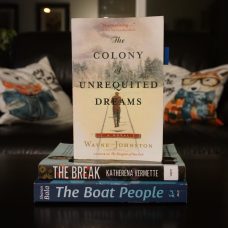
The final book in my Monthly Challenge was The Colony of Unrequited Dreams by Wayne Johnston. I admit, I did not want to read this one, but like I said, I’m glad I pushed myself to finish it. I had a lot to say about this one that I don’t want to get into again, so I’ll just say that it’s historical fiction about Newfoundland’s first premier, Joey Smallwood, who helped usher Newfoundland into confederation with Canada. Check out my full length review for more details. This book was meaningful to me as a Newfoundlander and I’m really proud that I finally read it. I gave it 4 stars.

And the last read I squeezed into February was The Power. I’ve been wanting to read this one since it came out at the end of last year since it’s been called the new ‘Handmaid’s Tale’ (along with Red Clocks). It’s dystopian science fiction where women develop the ability to produce electricity and use it through their hands. The book has such a great premise, but I was really disappointed with the author’s follow-through on the premise; I thought the book lacked focus and was poorly executed. It still make me think a lot though, so I gave it another 3.5 stars.

The Power


Rating: ⭐.5
Author: Naomi Alderman
Genres: Science Fiction, Dystopian, Feminist
Read: Feb. 2018

Execution is the key word for The Power. I’ve been dying to read this book since it first came out, but I’ve been seeing it get some mixed reviews and now I can understand why. This book had such a great premise, but I think it was a bit of a miss on the execution, which is so disappointing.

The Power is a dystopian, science fiction novel in which women have developed the power to basically electrocute people and things using their hands. They can take down electrical grids, burn trees and structures, and kill people using the power. The book is told from the point of view of a male historian recounting the events of when women first gained the power. Girls start developing the power at 15 and can awaken it in other women. Their power comes from a skein in their collarbones that all women have, but has never been awakened until now.

As you can imagine, women suddenly developing this power totally flips gender dynamics and this book focuses on the perspectives of 3 women and 1 man from different parts of the world. There’s Margot, an American mayor; Allie, a teenage runaway; Roxy, daughter of a British drug dealer; and Tunde, a Nigerian boy turned reporter. The book definitely had a strong start and I was super into it at the beginning, but I got a bit frustrated as things progressed because I felt like the author lacked an obvious theme or direction. I feel like she had a lot of different ideas and themes and sadly, I thought they were poorly executed and took away from the story. I think she needed a more focused direction.

My biggest struggle is that I just don’t know what the central theme is. Is it that this reversal in gender dynamics just ends up with a reversal of male/female roles? Or that even if women developed the ability to electrocute men, it would still be a huge struggle for them to gain power and men would be just as destructive towards women as they’ve always been? Is the author’s point that power can turn anyone into a monster? That women are just as vicious and oppressive as men have been and don’t deserve power? Or is she just trying to help men better understand the ways they currently harm and hurt women and how obvious these inequalities become through a simple reversal of gender roles?

Maybe I’m too dense to figure it out, but I feel like Naomi Alderman was trying to make all these points, which is why the book fell flat. There are definitely authors out there who can address this many ideas in a novel, but I feel like you need some kind of central theme and that the writing got overwhelmed by the ideas in this book and they just all lacked development. I don’t think the author needed to connect the multiple viewpoints the way that she did in this book. The characters seem to just randomly come across each other and help out each other’s storylines, but I felt that instead it made each individual storyline more disjointed and less impactful.

Disclaimer, the rest of this review contains spoilers. Usually I try and avoid spoilers, but I feel like I need to include them in order to properly discuss this book, so don’t read any further if you’re planning to read this book.

First off, let’s look at some of the things that I liked. I liked the scenes about the Men’s Rights movements and the internet trolls and bombings. They felt very real to me and I had no trouble believing we’d see this kind of backlash if women gained this power. I kind of expected the development of the power to switch gender roles a lot faster than it did, but I felt Alderman’s portrayal of this slow cling to power by men to be very believable. It’s got to be devastating to go from holding all the power to suddenly losing it and becoming oppressed and I have no doubt men would fight back and fight back violently (especially since women were also using violence).

I also liked the uprisings by women and the seedy underside of how some women choose to use their power. I really liked Margot’s story at the beginning, but then I was disappointed to see her basically left out of the second half of the novel. In contrast, I wasn’t really into Tunde’s story at the start, but ending up thinking he had one of the most meaningful storylines by the end of the book.

On the other side, I did not like Allie’s story at all and I only liked a few select parts of Roxy’s story. Allie’s story just felt like a total tangent with the whole religious revolution. I absolutely believe something like this could happen, but I just didn’t think this storyline fit in with the rest of the novel. It reminded me a little bit of the religious zealots in Station Eleven, which is a post-apocalyptic book in which 90% of the world population is killed by one virus. But I think this whole storyline just watered down the themes of the rest of the book and I hated that Roxy got involved because then I just had to read twice as much about it.

I thought Roxy’s story had such a strong start. It was so dark and I couldn’t wait to see where the author would take it, but I really didn’t dig the whole soldier aspect and based on what happened later, didn’t see that point of including it at all. The only other part of Roxy’s story I really liked was the skein removal scene, which was super horrific for an imaginary medical procedure. I felt so bad for Roxy, but it was such a powerful commentary on the lengths men were willing to go to maintain their power

The scenario that plays out in this book could obviously develop in so many different ways and I did like some of the contrasting events that Alderman explores. I thought it was really cool that it was the developing countries where women rose up first to fight back against their oppressors, whereas in America and Great Britain, men did whatever they could to retain power and women did less to fight back and in Margot’s case, actually hid her power. I also liked the contrast between the scene where Darrell first uses Roxy’s power and the other girls rise up against him to protect Jocelyn, whereas in the Romanian jungle, the women were actively hunting down any man, woman, or child who stood in their way and seemed to have no sense of compassion or bond with other women.

I loved Tunde’s story because of that feeling of total powerlessness at the end of the novel. He’s always had an exit plan and then the total despair of being betrayed by those closest to you and watching your life work stolen from you is just devastating. And to then be trapped in the middle of a female revolution with no way to fight back? That had to be so terrifying and I just wanted men to read that to try and understand the oppression and fear so many women feel at the hands of men.

I can see this book being both powerful and dangerous. Powerful because it makes a statement about the inequalities women face and reversing them to affect men can be powerful in helping men to empathize with women. There were so many small but meaningful nuggets at the beginning, like where mothers were talking about how they wouldn’t let their sons out alone on the streets because of the danger of being attacked by women. My disappointment again was that I felt this theme could have been so much more powerful, but I felt like it kind of got lost throughout the novel. On the other side, I can see these ideas being dangerous in that I could see actual MRA’s taking it and saying, “see, look what could happen if we let women have power.”

I struggled with the format of the supposed historian telling this story. I didn’t buy it and I could have done without the whole thing. Why would a historian tell a story like this? I don’t think they would. I thought the letters at the end of the book between the historian and Naomi were fantastic, but again, just so confusing for the execution of this book!

I thought the main theme was going to be that with power, and given a long enough time, women essentially just become men. But in my opinion the actual novel didn’t really support this theme and I was super frustrated that the whole novel covers 10 years of history and then at the end we discover the story is actually being told 5000 years after the fact! The letters at the end totally support the theme that the power just eventually resulted in a total role reversal, but it felt so disjointed because this is not the theme I felt the rest of the novel was promoting.

I wonder if I’m maybe holding this book to a bit of a higher standard because of its relevance to modern day feminism, but I just feel it had so much more potential. In summary, I would give this 3.5 stars because it definitely makes you think a lot, but with more focus and better execution, I really think this could have been a 5 star read, which is why it felt so disappointing.

The Colony of Unrequited Dreams


Rating: 
Author: Wayne Johnston
Genres: Historical Fiction
Read: Feb. 2018

Where to start? This was a very long book that took a lot of motivation to pick up off my shelf, but that I ended up having a lot of opinions about. I was worried that it was going to be really dense, but fortunately, it turned out to be a very well written and engaging book about Newfoundland.

The Colony of Unrequited Dreams is historical fiction about Joey Smallwood, Newfoundland’s first premier who helped to usher Newfoundland into confederation with Canada. He is both a well liked and disliked premier, depending on who you talk to. Johnston definitely takes a lot of liberties with Smallwood’s character in this novel, but the story is still pretty accurately based on his life in terms of what he accomplished.

The story starts with Smallwood as a child in the early 1900’s. His family were shoe salesmen in St. John’s and he lived up on the Brow looking over the Harbour until his uncle decided to pay to send him to Bishop Feild, the prestigious boy’s boarding school of the day. At Bishop Feild, he meets Prowse, grandson of a noted historian, and Fielding, a girl who attends the nearby sister school, Bishop Spencer.

Fielding is the other main character in this story and unlike Smallwood, her character is completely fabricated. Fielding has a cane, walks with a limp, has a wry sense of humour, with sarcasm and irony being her preferred mediums. She’s a bit of an outcast who goes on to work as a reporter for The Telegram, publishing critical articles about all branches and parties of the government. Fielding marches to the beat of her own drum and I really liked her. I loved that she wasn’t afraid to speak her mind and I loved her sense of humour.

This book actually had a lot more humour in it than I was expecting and it had me laughing out loud early in the novel. Below is one of my favourite quotes from the book, which is an argument Smallwood has with his mother, and had me laughing because I also grew up in St. John’s while my parents grew up in rural outport communities. This is pretty much the exact same thing my parents would say to me growing up and the biggest way you could offend my parents would be to call them townies.

“I’m a Newfoundlander, but not St. John’s born, no, not St. John’s born,” he said.
“You’re a bayman and you always will be,” my mother said.

I’ve been living on the West Coast for the last 4 years, so this was super nostalgic for me. Wayne Johnston is not even describing my St. John’s in this novel because it’s set between 1900 and 1950, but there’s something really special about still being able to vividly picture the setting of a story, especially when it’s a place like Newfoundland, which I hold so special in my heart.

I didn’t love Joe Smallwood’s character, but I did like the writing. This was one of my monthly challenge books and I’m glad I challenged myself to read it because I probably never would have gotten around to it otherwise. Johnston does a really great job with the setting. I don’t know how non-Newfoundlanders might feel about this book, but I loved the setting and the atmosphere Johnston created. Especially towards the end when we finally get to the whole business of confederation and the end of independence. I felt like Johnston did a good job of not taking a side and presenting both sides of the story. It really makes you reflect on what Newfoundland gained, what it lost, and what may or may not have been.

I read Greg Malone’s Don’t Tell the Newfoundlanders several years ago and I felt that this book was a good contrast to that. Greg Malone is very clearly anti-confederation, as well as a bit of a conspiracy theorist. While I really liked Don’t Tell the Newfoundlanders, because it has some great history in it and I learned a lot, it is very speculative and I liked that Wayne Johnston presented a more balanced version of history and I feel he left his personal feelings out of it.

For those of you not well versed in Newfoundland’s history, we we’re an independent country up until 1933 when we had a commission of government forced on us by the British as a result of our war debt (even though A LOT of Newfoundlanders lost their lives fighting for Great Britain in WWI – I am a little bitter, yes). I’ve written an entire blog post about Don’t Tell the Newfoundlanders if you’re interested in our fascinating history (to me anyways), but basically we were supposed to get back our independence when we became self-sustaining once more, which we did after WWII. However, instead of just turning governance back over to Newfoundland, it was decided to hold a referendum to let the people choose if they wanted to join Canada instead.

Joe Smallwood wanted nothing more than to do something for which he would be remembered. He dropped out of Bishop Feild and failed at making a life for himself in New York, so he was desperate to have an influence in Newfoundland’s future. He was an avid socialist in his youth, but upon realizing that Newfoundlanders were never going to buy into socialism, he turned his talents to the Liberal government. He helped former Prime Minister Sir Richard Squires with his re-election campaign in hopes of winning the nomination to run himself, but he is jilted by Squires again and again and struggles to get into politics.

In this novel, he is a huge supporter of unions, walking across the entire provincial railroad line to start a rail-workers union, and he later travels all around Newfoundland’s most remote islands, trying to start a fisherman’s union. This really gave me an appreciation for how Smallwood became so popular and influential and why he supported Confederation. He really cared about Newfoundlanders and he spent an inordinate amount of time speaking with the poor throughout his life. He was also the host of a popular radio show that focused on sharing stories of Newfoundland and about Newfoundlanders.

The fisherman were not nationalists of any sort…They would vote for Confederation to get the mother’s allowance and would live by Confederation exactly as they had before…They had starved through a depression that had ended when the war began. Now, they were terrified that another decade like the thirties was on its way.

The crowd from St. John’s, the merchants and the wealthy, were all big supporters of independence. But Smallwood understood from his travels around Newfoundland that the majority of Newfoundlanders were poor fisherman, struggling to keep food on the table. They didn’t care about the government of the day and it rarely affected them. Confederation wouldn’t really change anything for them, except they’d be able to profit from access to Canada’s established public services.

The anti-confederates must have wondered how they lost…They had been to London and they had been to New York, but they had never been to Bonavista or La Poile, and that was why they lost.

Don’t Tell the Newfoundlanders leaves you feeling angry and riled up, but The Colony of Unrequited Dreams gave me an appreciation of what it was really like for Newfoundlanders. Forget the politics and the conspiracies, rural fishermen just wanted to catch a break and this was something I never really understood before. Yet Johnston still presents the other side of the story and makes you feel very nostalgic for what might have been. Personally, I wish we could have seen what might have been had we re-gained our independence, but I do also think it’s likely that we might have ended up joining Canada anyways and I’m proud to be both a Newfoundlander and a Canadian. I think this must be one of the reasons why Newfoundlanders always retain such a keen sense of home no matter where they go. There is something unique about Newfoundland culture that does not come from Canada because we have not always been Canadian.

The ending of this book was heartbreaking for me though. I was a little bit disappointed that Johnston chose to end this book about Fielding. I really liked her, but as a fictional character, I don’t think her story was quite as powerful and it felt very anti-climatic to suddenly jump back into Fielding’s past.

“You all but gave away Churchill Falls, which you had hoped would crown your career as Confederation had crowned Mackenzie King’s”

Johnston touches very briefly on Churchill Falls and I wish he’d explored it more. If this book had been written 10 years later, I’m sure he would have because the Lower Churchill is such a hot topic in Newfoundland right now. But I found this so heartbreaking because Churchill Falls was meant to be Smallwood’s swan song – his legacy – and instead it turned out to be one of the worst deals every made and a real sore spot for Newfoundlanders. Smallwood did not have a successful start as Premier and Johnston portrays him running out of time in office and chasing after Churchill Falls as his last chance to see Newfoundland transformed.

That said, my favourite part of this book is easily the way Johnston writes about Newfoundland. You can tell he has a great love and reverence for the island. I’m sure any Newfoundlander can relate as there’s just something that makes Newfoundlanders have this deep attachment to their homeland. She’s a rocky isle in the ocean, and she’s pounded by winds from the sea, but you just can’t help but love her ruggedness and her people. Smallwood was relentless and he really did want to do something good for Newfoundland. His whole life was dedicated to making Newfoundlander better and I do really think he cared about the poor Newfoundlanders and that they are what ultimately motivated him to chase after confederation.

I have often thought of that train hurtling down the Bonavista like the victory express. And all around it the northern night, the barrens, the bogs, the rocks and ponds and hills of Newfoundland. The Straits of Belle Isle, from the island side of which I have seen the coast of Labrador.
These things, finally, primarily, are Newfoundland.
From a mind divesting itself of images, those of the land would be the last to go.
We are a people on whose mind these images have been imprinted.
We are a people in whose bodies old sea-seeking rivers roar with blood.