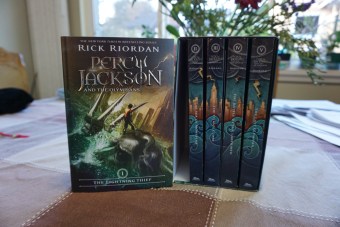
The Lightning Thief


Rating: ⭐
Author: Rick Riordan
Genres: Fantasy, Middle Grade
Read: Feb. 2018

I picked up the entire Percy Jackson box set on a whim when I saw it on sale and decided to give it a try. It’s a middle grade book, but like Harry Potter anyone can enjoy it. I loved it!

It definitely had some similarities to Harry Potter, but it’s also totally different. Percy has always gotten in trouble as a kid by events that seem to be completely outside of his control, but just keep happening to him. He’s been diagnosed with ADHD and dislexia and has been expelled from a dozen schools. When he’s in the 6th grade, mythical creatures start showing up everywhere and attacking him and he suddenly finds himself dropped off at Camp Half-Blood, a summer camp for demi-gods.

That’s right, Percy, along with all the other kids at the camp, are half-blood children of the Greek Gods. Around the 6th grade the monsters start becoming aware of their power and attacking the kids, so they are transported to Camp Half-Blood to train to defend themselves against monsters.

Percy doesn’t know who his father is, but it pretty quickly becomes obvious and he is asked to go on a quest to recover Zeus’ master bolt, which has been stolen, and return it to him before the solstice, only 10 days away. Percy accepts the quest and heads off on adventure with his school chums Annabeth and Grover and gets into a whole lot more trouble along the way.

First of all, Rick Riordan’s writing is great! It is hilarious and I couldn’t help but chuckle to myself from the first chapter onwards. Harry Potter has humour in it, but it has a more serious tone, which is what I was expecting from Percy Jackson, but this was definitely the funnier read and had humorous elements throughout the entire story.

That’s not to say it didn’t have action, it definitely had a ton of action. Percy seems to go from one bad situation to the next and you can’t trust anyone he meets. I really liked both Annabeth and Grover. Annabeth is the daughter of Athena and is a bit of a brainiac and Grover is a Satyr who likes to eat tin cans and provides even more comic relief throughout the story (also, his name is Grover, LOL).

Emotionally, I don’t think this had a whole lot of depth, but it’s the first of 5 books, so I’m expecting a lot more character development in subsequent books and a bit of a darker story line, although please stay funny! I probably won’t get to the rest of the books for a while as I have a million other things on my TBR I want to read, but I think these are quick books I’ll pick up whenever I’m in the mood for a laugh! I wish I’d had these when I was a middle schooler!

FUN FUN FUN!

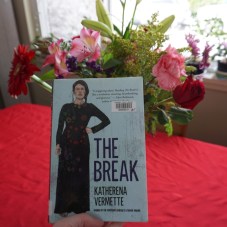
The Break


Rating: ⭐
Author: Katherena Vermette
Genres: Fiction
Read: Feb. 2018

I flew through The Break, which was the second book in my February Reading Challenge.

The Break is written by Métis author Katherena Vermette and tells the story of a Métis family and the struggles and challenges they’ve experienced, both together and apart. The novel opens with young mother Stella witnessing a crime on the break of land outside her house. She is paralyzed with fear and calls the police, but both the victim and the perpetrators have disappeared and law enforcement is not convinced of her story.

I don’t want to run the book by getting to into the plot, but it’s told from a lot of different viewpoints. There are 4 living generations in Stella’s family and they all have a voice in this story. As the police investigate the incident and the family is shook by violence, Vermette examines all the relationships and history that exist in this family. There are some narrators outside of the immediate family, such as the young Métis officer who investigates the incident, but this is really a story about family, the bonds that tie us together and the conflict that can threaten to tear us apart.

First off, the writing in The Break is fantastic. As soon as I started reading it I knew I was going to like it because it is just so beautifully written and the characters emotions are so tangibly felt. This was an insightful look inside the lives of a Métis family and it was very obvious the love this family had for one another, even through all the challenges they’ve had to overcome, the mistakes they’ve made, and the violence they’ve witnessed.

The tone of this story is very sad. Vermette made it easy to empathize with her characters and their pain felt very real. The story is heartbreaking and it was upsetting for me how frequently the women either experienced or witnessed sexual and domestic violence. But the women are what made this story so beautiful. It’s a very fractured family unit in that very few of the men in the family have stuck around or remained present in their families lives, but in the absence of reliable men, the women (sisters, cousins, aunts, grandmothers) have constructed their own family unit that is incredibly close.

The synopsis reads like this is a mystery novel, which it is in some ways, but it’s mostly a slow-burn family drama, which is one of my favourite types of stories. So I really liked this one and I am in love with Katherena Vermette’s writing. A fantastic read!

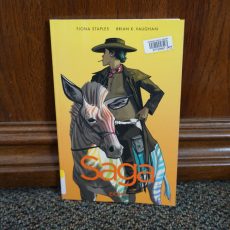
Saga, Volume 8


Rating: ⭐
Author: Brian K. Vaughan, illustrated by Fiona Staples
Genres: Comics, Graphic Novel, Sci-fi
Read: Feb. 2018

I love Saga so much. It doesn’t take very long to read one of these volumes, but they are so reliably fun and enjoyable.

Since I’m 8 volumes in and I haven’t written a review for Saga, I’ll give a brief summary. Saga is a graphic novel set in space that starts off with a bit of a Romeo and Juliet premise. Alana and Marko are from two feuding planets (well one’s a moon), Landfall and Wreath. Alana is from Landfall and has wings, while Marko is from Wreath and has horns. The two fall in love, become pregnant, and are basically chased across the galaxy by other planets and people that don’t want any evidence of their traitorous relationship.

I am just in love with Alana, Marko, and their daughter Hazel. I wasn’t totally into the idea of reading about two soldiers and their tag-a-long baby, but this is a truly fantastic series about love and family and throughout the series Vaughan tackles a lot of different socials issues. It is bit of a bizarre series and definitely NSFW (there’s a fair bit of sex and nudity throughout the series), but Fiona Staples artwork is gorgeous and I love how creative Vaughan is with his characters and storyline. His characters do some pretty bad things and make bad decisions, but he’s still able to make you love them. Each character has their own morality line about what is and isn’t acceptable and it’s interesting to watch them try and stay on the safe side of their line while still trying to protect the people that they care about.

Each volume consists of 6 issues and they’ve recently released 2 books containing 3 volumes a piece. But I’d recommend hitting up your local library for this series. 8 volumes can seem pretty daunting, but they are quick reads and I would highly recommend!

The Boat People


Rating: 
Author: Sharon Bala
Genres: Fiction, Historical Fiction
Read: Feb. 2018

Oh my goodness, I feel like this book took forever to finish! Between going on a ski trip last weekend and the Olympics stealing all of my attention, it took me a bit longer than anticipated to get through The Boat People. But I finally finished!

This was the first book of my February Reading Challenge and I am a little concerned I might not fit them all in this month because I am just completely obsessed with the Olympics! This month I challenged myself to read 3 books about Canada and this was my pick from the Canada Reads 2018 shortlist.

The Boat People is written by Sharon Bala, who fascinatingly was born in Dubai, raised in Ontario, and currently lives in Newfoundland, and it’s about a ship full of refugees from Sri Lanka who landed on Vancouver’s shores in 2010. It was a bit of a thrill to read a book about the place where I currently live, as I don’t read that much Canadian literature, and this was a fascinating bit of history about an event I knew shockingly nothing about.

Sri Lanka has been torn apart by war for decades, driving many people to desperation to escape the violence in any way they can. These 492 Sri Lankan’s board a cargo ship bound for Canada in an effort to seek out a better life. Fortunately everyone survives the journey and they are thrilled when they first see the coast of Vancouver Island, but the welcome party is cut short when they are promptly separated and detained in two prisons while the government fumbles to try and decide what to do about them.

I knew very little about the process for migrants who show up un-announced at the border and this was very eye-opening. Refugees must first seek permission to request asylum and then go through admissibility hearings for their request to be granted. In this case, the government was worried about terrorists being on board and wanted to delay the process as much as possible to assuage the public’s fears. The adjudicators had very little information to go on outside of the refugee’s testimony and because the government wanted to delay the process to dissuade copycat voyages, the refugees were forced to remain in these detainment prisons for months while their hearings were repeatedly denied and postponed.

I did struggle a bit with this book as there’s a lot of legalese in it, a lot of (slightly confusing) Sri Lankan history, and a lot of character names and stories that I struggled to keep straight, but I really liked how Bala wrote this book and she was not shy in tackling a lot of different issues.

The story is told from 3 perspectives: Mahindan, a single father who made the journey from Sri Lanka with his 6-year old son Sellian; Priya, an articling student (of Sri Lankan heritage) who’s firm takes on 5 refugee cases pro bono and has her help out on the cases; and Grace, an adjudicator (of japanese heritage) who is assigned by the xenophobic Minister of Immigration to adjudicate the detainment hearings.

This is a morally-gray book and I appreciated Bala for not making this a straight-forward morality tale. She tackles so many issues in this book; the xenophobia of the Canadian public, the refugee diaspora, the immigration process, Canada’s past failings, the importance of history and remembrance, reconciliation, culture shock, and the list goes on.

The novel first presents us with the refugees, ecstatic to arrive on Canada’s shores, and the brutality of their arrival and immediate imprisonment. In my opinion, you can’t help but empathize with them and think the government harsh. But then Bala gets into the morally gray areas of war and how good and innocent people can be forced and coerced into participating in what western countries view as terrorist organizations.

Are we right to studiously evaluate every refugee who comes into Canada for terrorist affiliation? I think yes, but do we need to steal their humanity from them in the process? No. Do we have the right to deport people when deportation will mean certain torture and death? People may be split on that opinion, but it’s a question that requires empathy and understanding that we will never have by “othering” people and fearing them.

Innocent people are forced to do bad things in wartime, but how to we evaluate those acts and decide if the intent was forced or malicious? What’s direct involvement in acts of “terrorism” and what’s proximate? These are impossible questions to answer and as much as I often disliked Grace’s line of thinking, I could appreciate the pressure that was put on her in these quasi-legal proceedings. All she has to go on is the migrant’s story and how is she to know what is truth? That said, she was an adjudicator appointed by the government in power, which begs the question if she should have the power to make those decisions at all.

However, I liked the contrast of Grace’s story and how Bala demonstrates how cyclical history can be. Grace is the grand-daughter of Japanese immigrants and takes a hard line on border safety and who should be permitted to enter Canada. She is determined to safeguard her daughters freedom to move around without fear, while at the same time struggling with her mother’s declining health. Her mother, Kumi, has Alzheimer’s and is slowly regressing into the past. Her parents had been interned during WWII and lost everything. They never spoke up about the injustice and kept their heads down to give their children a chance to become “true” Canadians. However, now she worries that the apathy of her parents has been passed down to her daughter and grandchildren and that Grace has forgotten the injustices of the past, perpetuating the cycle of oppression.

I thought it was an interesting theme on how people who were once oppressed and othered can learn to be oppressors themselves. And on how important reconciliation is, not just for righting our wrongs, but for protecting against repeating them, to keep fresh an empathy for others.

So while I did feel like it took me forever to get through this book, it was worth it. The Boat People made me think a lot and while it definitely was more ‘liberal-leaning’, it wasn’t a straight forward good vs evil narrative. It’s complex, gritty, and heartbreaking. A fabulous and meaningful debut for a Canadian author.
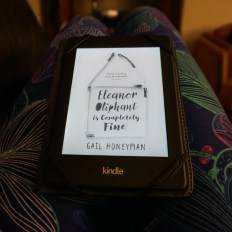
Eleanor Oliphant is Completely Fine


Rating: ⭐⭐⭐.5
Author: Gail Honeyman
Genres: Fiction
Read: Feb. 2018

I think I have a bit of an unpopular opinion on this one. I appreciate what Gail Honeyman did with this book and I actually do think it’s a really good story, but I was just so bored for a lot of this book.

Eleanor Oliphant is Completely Fine reminded me in parts of The Rosie Project (but better) and A Man Called Ove (but not quite as good). Eleanor is seemingly fine; she gets up every day and goes to work, she talks to her mum every Wednesday, and every Friday she purchases a bottle of vodka and spends the weekend alone in her flat. She likes routine, she dislikes emotion, and she believes she is completely fine.

Her routine is disrupted when she meets Raymond, the IT guy from her office, and together they witness an old man, Sammy, have a heart attack in the middle of the street. They take care of him until EMS arrives and check in on him as he recovers in hospital. For the first time in her life, Eleanor finds herself enjoying time with other people – building relationships and miking plans outside of her normal routine.

This is definitely a good book. I don’t want to say any spoilers, so I’ll try and talk in general terms, but I really like Eleanor’s evolution throughout this novel. The changes in her do feel very natural and believable and I didn’t think any of the interactions were forced. The novel climaxes at a very odd spot, about the 70% mark, but I did like watching Eleanor grow and heal throughout the last 30%. I liked that it wasn’t rushed or that she’s not just suddenly better, because that is not believable.

I absolutely loved Raymond. He was so down to earth and accepting. The thing I didn’t like about The Rosie Project was that I didn’t ever really buy into Rose and Don’s relationship, but I had no problem believing Eleanor and Raymond’s. Eleanor is a bit of a social outcast, but she’s also pretty likable and funny and I liked that Raymond was able to laugh with her and accept her little quirks and idiosyncrasies.

Taking the time to write this review and reflect on the book is actually improving my opinion of it (and I still have a book club meeting coming up, which might lower or increase my rating). I do think this is a good story, hence why I’m still giving it 3.5 stars, and it did make me think a lot afterwards. But I just can’t ignore that I was bored for a lot of the reading of the novel.

I know this book is narrated the way Eleanor thinks, which is mostly without emotion, but I am a very emotional person, so I found it really hard to engage in the story and I never felt anything tugging at me to pick this book up again once I put it down. And that’s totally fine. These are still important stories that should be told, it’s just not necessarily for me. It still helped me appreciate the way that some other people experience and move about in the world and I don’t regret reading it. Just not going to be a favourite.