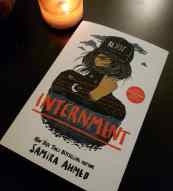
Internment

Rating: ⭐
Author: Samira Ahmed
Genres: Young Adult, Dystopian
Pub date: Mar. 19, 2019 (Read Feb. 2019)

Thanks to Hachette Book Group Canada for providing me with a free advance copy of this book in exchange for an honest review. 

I was really excited about this book, I thought the premise sounded super interesting and appropriate for the current political climate. I read Samira Ahmed’s debut novel, Love, Hate, & Other Filters, last year and didn’t really like it, but I was super optimistic about this book and even included it on my most anticipated books of 2019 list. I’m still really glad a book like this exists, but sadly I was very disappointed with it. I may just not be the intended audience for this anymore as someone in my late twenties, but it really didn’t work for me.

Like I said, the premise of the book is great. It’s about Muslim teenager, Layla Amin. Since the inauguration of the new president, America has seen a lot of changes. Muslims were asked to identify themselves in the latest census and with the creation of the new Muslim registry, Layla has been forced out of school and her parents have been forced out of their jobs. Then one day, the police show up at her home and escort her entire family to America’s first internment camp in the middle of the California desert.

The camp is called Mobius. At Mobius, Muslims are divided into blocks by ethnicity and forced to live in small trailers. Her parents do their best to adapt to this new life and keep their heads down, but Layla misses her old life and boyfriend on the outside and starts to rebel against the camp’s Director and his racist policies. But what will be the cost for her rebellion and as a teenager, does she really have the power to change anything?

I’m really glad a book like this exists and I hope it gets into the hands of the right people. But what I struggled to understand was who the intended audience is? Is it meant for the already liberal-minded? Is it hoping to expand the opinions of those who are unsure where they sit in the current political climate? Is it targeted at the MAGA faction that is scared and hateful towards those who are different from themselves? Or is it just meant to give voice to the rage and pain of American Muslims? As an already liberal minded person, this didn’t really challenge my thinking or offer me any new insights, but I think it could be a great book for younger teens who are confused by politics or whose views may differ from those of their parents and they don’t know where to turn for information. So I’m really glad this book exists and I hope it can help inform teenagers or just support Muslim American teenagers in feeling heard.

The reason I didn’t like it is because it’s so heavy handed. Nothing about this book is subtle and I felt like the author was just trying to beat me over the head with her politics. It’s the prime example of why “show, don’t tell” is so much more effective and enjoyable. I don’t think Ahmed trusts her readers at all. She spells out every single point and action of her characters and doesn’t trust her readers to come to their own conclusions. She is constantly telling us how Layla is feeling rather that letting her circumstances and actions speak for themselves. Layla also didn’t feel like a teenager to me. She felt a bit like a 17 year old espousing an adult’s viewpoints. I like to think teenagers are this woke, but she knew a lot of random historical facts about Japanese internment camps and other politically motivated rebellions around the world. Overall it added to the book, but felt a little forced coming from a teenager who mostly just seems overly into her boyfriend.

I went back to look at my review of Ahmed’s first book and I have similar complaints with this book. I felt like her characters were so 1-dimensional and that the emotional connection to them was just really lacking. Her characters feel more like caricatures and it made it hard to relate to any of them. I was frustrated by how obsessed Layla was with David when she had so many more pressing concerns. All of her relationships felt extremely surface level and I never felt that any of her relationships had any great depth. She talks about how she’s worried about the impact her actions might have on her parents, but I never really felt any tension because I didn’t feel any connection between the characters to begin with.

I thought the Director was the greatest caricature of the novel. He was too classically evil for me to ever take him seriously. I thought the Director represented a great opportunity to influence your readers and hopefully alter their mindsets. But the Director is too much of a villain that he doesn’t incite that feeling of righteous anger or conflict. If your goal is to alter someone’s mindset or opinions, you need a more nuanced villain. Someone who you can almost relate to, but highlights the flaws of conservative America. No one will relate to the Director, so it’s easy to dismiss him as just a hateful asshole. He doesn’t make you question your thoughts or views and that was the main way that this novel failed for me.

I think liberals will read this book and be reminded of why they are frustrated with the current administration, while conservatives will read the book and think it’s ridiculous and Muslims just trying to paint white people as the bad guys. Just to clarify, I do not think that’s what this book is doing at all. I think this is actually a story to give voice to the feelings that Ahmed has about the direction America is going. And if this story gives voice to that rage and pain for Ahmed and for readers like her, then I think this book has achieved something great. I am not American and I am not Muslim, so who am I to say that this book doesn’t have value? I do believe it has value, I just wanted it to be more nuanced because I want white Americans to pick up this book and read a viewpoint that they hadn’t really thought about. I want them to see Muslims as people and that their viewpoints might be changed by reading about this horrifying near-future scenario. I guess I just don’t have very much faith in people’s ability to change and I thought this book was just too surface level to change the viewpoints of people that don’t already agree with this book.

However, it is unfair of me to put that responsibility on the author. She is not responsible to change people’s minds. It’s why I question who her audience is? As an Own Voices book, I can really see this working for some people and I really hope that it does. If you are an American Muslim feeling outcast in your school, or your community, or your country, then I hope this is the book that you needed to pick up to feel seen and understood. This book wasn’t what I was hoping it would be, but I am probably not the intended audience. I fully support the themes Ahmed tackles in this book, her writing style and methods just aren’t for me. I hate to be critical of books like this because I do think they are extremely important and authors need to be supported to write them. But I also don’t want to give good reviews to a book just because I’m glad it exists – I still want it to be a thoughtful and well-written book. I thought this book had so much potential and honestly, I just wanted more from it. But hopefully it will make its way into the hands of the right readers!

One last criticism I have of this book is that I’m uncomfortable with the number of famous quotes and ideas that Ahmed includes without referencing the source material. I think she is paying homage to some great people, but it rubs me the wrong way when those individuals are not referenced. The tagline on the back is “rebellions are built on hope”, which is obvious to me that it’s from the Star Wars Rogue One movie. The characters repeatedly joke about their love of star wars, but this quote is used without every directly attributing it to Star Wars. Two others that I picked up on were that she has one of her characters reference how “if you don’t stand for something, you’ll fall for anything”, which has been attributed to Hamilton and Malcolm X among others, and Layla repeatedly says “the people united will never be defeated”. Please reference these individuals because otherwise it seems like you are trying to pass these ideas off as your own.

The Island of Sea Women

Rating: 
Author: Lisa See
Genres: Historical Fiction
Pub date: Mar. 5, 2019 (read Jan. 2019)

I read The Tea Girl of Hummingbird Lane back in 2017 and really liked it. I’ve been meaning to read some more of Lisa See’s work ever since, but the content is quite heavy, so I keep putting it off. So when I received an early copy of The Island of Sea Women from Simon and Schuster Canada, I was excited to finally read another one of Lisa’s books!

I clearly need to prioritize reading some of her earlier works because I liked this just as much as I like the Tea Girl of Hummingbird Lane, maybe more!! The Island of Sea Women is about a matrifocal community of female divers on Jeju Island. Jeju Island is a large volcanic island located to the south of South Korea. It was under the control of the Japanese until the end of WWII, when it was taken over by the Americans.

What’s interesting about the island and many of its communities, is that they are mostly focused on women. Many of the traditional gender structures still exist in that men own property, the ownership is passed down through the male line, and giving birth to boys is valued because only boys can attend school and perform ancestor worship. However, the women are viewed as the providers and decision makers and the men stay home and raise the children. This is because it is the women on the island who become Haenyeo. Haenyeo are a collective of divers who are widely respected. They row offshore every day to dive in the frigid ocean for sea-life to feed their family and to sell to wealthy Japanese colonizers. The most prized catch is the abalone, but they also dive for sea urchins, octopus, squid, and other species.

See focuses her story on Young-sook. Young-sook is the daughter of a Haenyeo chief, so she learns to dive from an early age and develops a very close friendship with another girl in the community, Mi-ja. The two girls are inseparable and both join the Haenyeo collective when they come of age and travel together as young women to do leave-home diving work. However, as they grow older, their friendship is challenged and circumstances arise to drive a wedge between the two women. This book tells Young-sook’s life story, her friendship with Mi-ja, and the sad history of Jeju Island.

I was really interested in the Haenyeo culture and how they work together as a collective. I thought it was fascinating the ways that traditional gender roles were sometimes switched in this culture, but remained similar in other ways. I find diving to be fascinating (and terrifying) and I really liked learning about the Haenyeo traditions, how they would organize and dive together, and how resilient these women are. But what I really loved about this book was the way it also takes us through South Korea’s history.

I read Min Jin Lee’s book, Pachinko, last year and really liked it. It’s about a Korean family that immigrates to Japan and the challenges they faced there as immigrants. It was a good introduction the the history between Korea and Japan. This book also focuses on that conflict, but from a different angle and perspective; between the two books I learned a lot about Korea and Japan. The history covered in this book is upsetting to be sure, but it is a very good look at how Western countries can tear other countries apart in their own political disputes. Korea was split at the end of WWII, to be governed by the Soviet Union in the North and America in the South. Russia obviously promoted communism and America, democracy.

As everyone knows, American’s were extremely threatened by the rise of communism. I’m still not super familiar with Korea’s history, but from this book, it seems that there was support for communism on Jeju Island, which created conflict between the island and the rest of the Korean mainland. Rebel groups popped up among the mountain tribes on Jeju Island and fighting ensued between rebel groups and the authorities. Korea had a culture of guilt by association, whereby if a member of your family committed a crime, you were considered tainted by association. This resulted in consequential killings in which families and entire communities might be punished for the actions of an individual. The Jeju uprising officially began on April 3, 1948, and resulted in the destruction of many villages and left many people homeless.

I’ll admit, I know very little about Korea’s history, but I loved learning about it from Young-sook’s point of view. The people of Jeju had always had a tumultuous relationship with the Japanese and she observed that little changed within their communities with the end of WWII and that their power mostly just changed hands between the Japanese and the Americans. Young-sook observes that they have always been oppressed, but that Korean’s always looked after one another. However, because of differing ideologies between a democratic and communist state, she was upset to see Korean’s start to turn on one another.

From this setting, we also see how the Haenyeo were forced to change and adapt over the years and the impact the conflict had on their diving activities. The Haenyeo are still very popular, but more as a tourist attraction. The birth of daughters was also celebrated on Jeju as it ensured the financial stability of the family. However, very few girls are training to become Haenyeo these days and the collective has greatly aged, with few young women to take their places. I loved how See balances the challenges and changes to the collective along with the changing and increasingly challenging political climate on the island. It also linked in with Young-sook’s changing relationship with Mi-ja. While the novel takes us through 70 years of Korean history, at it’s core, it is a story about friendship and forgiveness.

As much as I loved this book, I do have one criticism, which is what brought my rating down from 5 stars to 4 stars. The story is told in 5 parts and progresses pretty naturally through time. However, each part starts with a flash forward to 2008. While I see some value in the 2008 timeline, I think it would have worked better as a short epilogue focused on remembering the April 3 incident and finding peace. I did not like the inclusion of Clara in the story. While Young-sook struggles with her feelings and forgiveness throughout the second half of the novel, I felt this last storyline came too late in the story and timeline. Personally, I thought the ending felt forced and manipulative. I felt like the author was trying to manipulate me into this cathartic moment at the end, but the catharsis was too late in coming and not believable to me.

Despite the ending, I still loved this book. Though the story focuses on Young-sook, I loved the exploration of Mi-ja’s story as well. The history and decisions of some of the characters were upsetting, culminating at the April 3 incident. However, I felt that they demonstrated how things can change in an instant and how in life and death situations, what might have been a well-meaning action or decision can be interpreted in the aftermath. It’s a somber realization, but it was the defining moment of Young-sook and Mi-ja’s relationship. I would definitely recommend this book.

The Island of Sea Women will be available for purchase in stores on Mar. 5th, 2019. Thanks to Scribner and Simon and Schuster Canada for providing me with a free copy in exchange for an honest review.

Nine Perfect Strangers

Rating: ⭐
Author: Liane Moriarty
Genres: Fiction, Mystery
Pub date: Nov. 2019 (read Jan. 2019)

Nine Perfect Strangers was totally different than what I was expecting. For some reason I thought this was going to be a murder mystery (spoiler, it’s not), not really sure why, so the plot ended up taking me totally by surprise, but in a good way.

Nine Perfect Strangers centers around Tranquillum House, a spa/resort where people come for all sorts of reasons, but primarily to make some kind of change, whether it’s with their body, personal habits, or even to save their relationship. The resort was founded by russian immigrant, Masha, who had a near death experience when she suffered a heart attack from overwork and neglecting her health, and found a new outlook on life that centered around personal health and wellbeing. Nine people have assembled at Tranquillum for a 10 day retreat.

Tranquillum House is known for having slightly revolutionary practices; no electronics are permitted at the spa and there are mandatory fasts, juice cleanses, and periods of silence throughout the 10 day retreat. However, many people swear that Tranquillum House gave them a whole new outlook on life, so most of the guests are willing to give it a try for 10 days. This group of guests includes a washed up romance novelist and footballer, a tired mom, a divorce lawyer, a couple trying to save their marriage, and a family trying to heal after the death of their son/brother. They are mostly optimistic about the retreat; however, what these strangers don’t know is that Tranquillum House has decided to try a new protocol for this retreat and that they will be physically and emotionally tested over the course of their ten day visit.

I’ve read two other books by Liane Moriarty: Big Little Lies and The Husband’s Secret, and I must say, she is really good at tackling tough subjects with humour. Her characters are all pretty humourous in this book in how ridiculous they are. They all grapple with some pretty serious issues, yet still provide a lot of comic relief. I’m still not quite sure what to make of the plot. It was a really different concept and it was actually quite shocking where Moriarty took the plot in the seond half of the book.

What I liked most about the book though was the theme, which centered around the idea of change. All of the guests decide to attend the retreat because they are seeking some kind of change in their lives, and the resort itself was founded because of the change that Masha underwent after her near death experience. Masha experienced a huge change in her life and really wants to help others to change their lives for the better. However, what she begins to realize is that it’s easy to help people change over a 10 day period, but that it is immensely difficult for her guests to make permanent changes once they return to their old lives. It raises the question of whether people really can change.

It really is a roller coaster ride because some of Tranquillum House’s practices seem really out there and it’s easy to dismiss them as “hippy-dippy nonsense”. But the further you read, you start to question yourself because it’s hard to deny that the practices actually do seem to work. However, when the plot takes a drastic turn around the half way point, you see the characters starting to revert back to their original tendencies, which again begs the question of whether change is truly possible. I liked the book because even though the resort seems to be a bit of a farce and I think a lot of the people would only be temporarily changed by the experience, it’s hard to deny by the end of the novel that the guests have been changed by their time at Tranquillum, just in ways you wouldn’t necessarily expect.

I don’t want to say any more because I don’t want to ruin the plot and I think it is actually best to go into this book blind if possible. It is quite different from the other work I’ve read by Moriarty, but it did make me think and reflect and I think it is an interesting commentary on the human ability to change, so I did quite like it. It also does a great job at developing each of the nine characters and I was really impressed with how each them grew throughout the novel and I enjoyed getting each of their back stories. I read this for my January book club, so I’m really interested to hear what the rest of my book club thought because I can see how some people might not like this book.

Keeping Lucy

Rating: ⭐
Author: T. Greenwood
Genres: Historical Fiction
Pub date: Aug 6, 2019 (read Jan. 2019)

Thank you to NetGalley and St. Martin’s Press for providing me with a free electronic copy of this book in exchange for an honest review.

I’m a little on the fence of how to rate this book. I read Rust & Stardust last year and really liked it, so I was excited to receive a copy of T. Greenwood’s newest book, Keeping Lucy, in hopes of learning more about a period of history I didn’t know much about. I did like this book and I did learn something, but I didn’t like it quite as much as Rust & Stardust because I felt it lacked in plot.

Finding Lucy is about a family from Massachusetts in the 1970’s whose second child is born with down synodrome. Down syndrome has a sad history in the United States and the delivery doctor strongly recommended enrolling the baby, Lucy, in an institution that could better see to her needs. Her mother, Ginny, was excluded from the decision to give up the baby and years later, she struggles with the loss of her little girl. When Lucy is two years old, a journalist publishes an expose about Willowridge, Lucy’s school, that reveals the deplorable living conditions in which the children are kept. Ginny is horrified and upset by the article and travels to Willowridge for the first time to see the conditions for herself and meet her daughter.

Greenwood definitely has a unique style of writing. It is very simple and straight forward, but does an excellent job of making you feel acutely uncomfortable and anxious. Rust & Stardust was about the kidnapping of Sally Horner, the young girl who inspired Lolita, and made me feel so anxious and frustrated about the way Sally was manipulated and treated. I had a similar reaction to Keeping Lucy in that I found this part of history shocking, I was frustrated by the way the health and justice system worked in the 1970’s, particularly in how it ignores the agency of women, and I was so anxious about the decisions the characters made and the potential ramifications. I flew through the book, reading about 75% of it on a lazy saturday.

I liked that this looked at a disturbing and lesser known part of history, but unfortunately I was a little disappointed in the execution. I was expecting this book to focus on Willowridge, the poor living conditions, the pursuit of justice against the institution, and the fight for custody of the children and for people with Down Syndrome to be recognized as people with a full set of rights. Willowridge is not a real place, but I trust it was imagined based on other similar institutions. Likewise, Ginny is not a real person, but I imagine there are parents out there who unknowningly were advised to send their babies off to similar institutions. In Ginny’s case, she was more or less blindsided by her husband and father-in-law, which plays a large role in the story.

I liked Ginny’s story arc in that it highlights how little agency women had in their lives and relationships. But overall I felt the author missed an opportunity to write a more historically meaningful plot. In order for the babies to be committed to the institution, parents essentially gave up their custody rights to the state. Once the story got going, I was expecting for this to be a story about Ginny’s battle with the state to save her daughter and regain custody while fighting against the antiquanted and sexist beliefs of her father in law, who thought he was entitled to make decisions for his son and family. The story provided a great look at how the patriarchy robbed women of any power or agency and the gender dynamics that often existed in families at this time. But ultimately this story was not about a custody battle, but rather was a drawn out road trip in which Ginny tries to escape with her daughter and the trials she faces as a single woman/mother in rural America. It was an interesting story with a surprising amount of action, but meaningless in that while I understood Ginny’s desperation, her actions were drastic and not realistic. I know Ginny was only try to save her daughter from being returned to Willowridge, but her actions were short sighted and actually really harmful to the result that she wanted. She’s applauded at the end for her good motherly instincts, which I thought pretty rich because she basically just ran away from any responsibility.

Ginny and Martha made a lot of bad decisions that I felt there was really no coming back from. I disliked the ending because I thought it was extremely unlikely and absolved Ginny of any wrongdoing. (view spoiler) What I really wanted to hear about was the struggle all those other families went through in gaining custody of their children and what legal actions were taken against the institutions for their neglect. People with Down Syndrome had to fight for their legal rights, care, and education, and I would have much preferred to learn more about that.

The story did hold my interest throughout the whole book and I sped through it, but the longer GInny and Martha spent on the road, the more I wondered what the whole point was. I didn’t expect them to be on the run for so long and I was really surprised when it ended up being the main plotline of the story. This is a fascinating part of history and I really just wish we had gotten a different story. I won’t fault the author because she did still deliver on a fast paced and interesting story, but personally, it just wasn’t the story I was hoping for and I thought it was a bit of a missed opportunity. I’m still giving it 3 stars because I did learn something and I thought the writing was pretty good, but overall it just left me wanting more.

Wildcard

Rating: .5
Author: Marie Lu
Genres: Science Fiction, Young Adult
Pub date: Sep. 2018 (read Dec. 2018)
Series: Warcross #2

I read this book on my way home for the holidays and I fear I may have waited too long to review it. I’m already starting to forget parts of this, but I will do my best to review.

Warcross really surprised me last year and ended up being one of my favourite books of the year. Sci-fi is not my favourite genre and I did not like Marie Lu’s Young Elites trilogy, so I didn’t expect to like Warcross, but ended up falling in love with this vibrant and futuristic version of Japan. Sadly I hadn’t heard great things about Wildcard, but I tried to go into it with an open mind.

I thought Wildcard had a pretty strong start. It jumps right back into the action and I was really excited to be re-introduced to the Phoenix Riders and Emika’s world. There is a strong mystery element in Wildcard and you really don’t know who you can trust, so I was definitely intrigued.

Sadly though, Wildcard was not able to live up to the world Marie Lu created in Warcross and I felt it started to buckle under the weight of the plot and the lack of character development. I love a good fast paced plot – and despite everything else, this plot remained fast paced throughout the entirety of the book – but I felt that Lu abandoned a lot of the characters and character development from the first book in favour of new characters and it caused this one to just fall flat.

In Warcross, Emika struggles in trusting her teammates. She is used to working as a lone wolf and takes a lot of pressure and responsibility upon herself. Her teammates want to help and she eventually learns to trust them and realizes that being part of a team is better than operating alone. While the Phoenix Riders are still present in this book, I felt they weren’t integral to the plot and much of the book focuses on Emika and Zero. I liked that Emika made a new girlfriend in this book (I’m sorry you guys, I literally can’t remember her name!! Zero’s second, can anyone help me out here?!), but I really wanted to see more development of the characters we were introduced to in the first book and the Warcross world, but this was really Hideo and Zero’s party and I thought Emika struggle to carry the story.

Where Wildcard lost me was in the plot. I think Marie Lu made this too technical and tried to throw in way too many plot twists. I’ll admit, she got me on a lot of them, but I felt the plot got way too convoluted towards the end that I just kind of tapped out on the book. Warcross introduced this really interesting VR world that I could totally see happening within my lifetime. Lu introduced a lot of thought-provoking moral issues like is it justified to remove people’s freewill in order to completely eliminate crime? I thought there were a lot of interesting ethical questions to explore in this book, but I think Lu sacrificed this development in the interest of writing more action, which really did a disservice to the world she created. It’s a resounding YES that Hideo’s technology to eliminate crime was a bad idea, but we never really explored the benefits and consequences of his algorithm and jumped right to the need to destroy it.

There was so much action in this book, and yet, I was kind of bored. The entire last 30% of the book is just one extended action scene with very limited character development. I stopped caring about the Phoenix Riders and I thought Emika added very little to the development of the story. This really became more about Zero and Hideo and even though there was a lot of action, things started to feel a bit repetitive. I like a good plot, but for me, stories are always first and foremost about the characters. A book needs a good plot to move the characters forward, but I would never sacrifice development for action. I wanted to think about the ethics of a VR world and how to integrate morality with technology, but I guess Lu just wanted to deliver a fast-paced action novel. She delivered on the action, but I’m not sure why I should care about it.