American Street


Rating: ⭐⭐⭐⭐
Author: Ibi Zoboi
Genres: Young Adult, Magical Realism
Read: Jan. 2018

Ibi Zoboi! Way to rip my heart out and stomp on it! What even? I was not expecting this.

This was the last book in my January Challenge to read 3 books about immigration. I read Girl in Translation and Pachinko earlier this month and loved both of them. American Street was a whole different kind of story, quite unlike either of the others. It was probably my least favourite of the 3 books, but still really good.

Fabiola Toussaint was born in America, but raised in Haiti because her mother didn’t have citizenship. Her Aunt Jo and her 3 cousins, Chantal, Pri, and Donna all live in Detroit and regularly send money back to Haiti to help out Fabiola and her mother. When Fab is entering her junior year of high school, they send enough money for her and her mother to finally move to America for good. Fab has American citizenship, but her mother has to get all the necessary visas to “visit” America. Unfortunately, when they enter America, Fab’s mother is detained at the border and she is forced to go on to Detroit without her.

Her aunt and cousins live at the corner of American Street and Joy Road. Fab has been desperate to come to America to live in the land of the free, but she doesn’t feel very free with her mother detained in an immigration prison in New Jersey and navigating her cousins’ world is scary and overwhelming. Her cousins are notorious at school and a little rough around the edges. Fabiola is pulled into their world and discovers the dark underside of what it costs to chase after the american dream.

Like I said, this was really different from any of the other immigration books I’ve read this year. I think Zoboi really captures Fab’s Haitian spirit and what it’s like growing up black in Detroit. She intertwines some cultural elements, like Haitian vodou, which is very much a spiritual thing for Fab, but is usually interpreted more like witchcraft in modern society. She weaves in some magical realism which surprised me and first, but I thought really worked with the story.

Voice was key for me in this novel. I’m a privileged white girl who grew up in a predominantly white town, so I definitely can’t relate to Fabiola or her cousins, yet their voices rang so true. I had no trouble believing in Zoboi’s characters. Fab’s uneasiness when she first arrives at her aunt’s house; Chantal’s desire to chase education but her reluctance to leave her family; Donna’s inability to say ‘enough is enough’; and Pri’s fierce and protective love for her sisters. My only complaint would be that Zoboi didn’t actually go deep enough into each of these characters. She formulated some really excellent characters, I just wanted more of them.

I really wasn’t anticipating where the plot of this story went. I thought it was mostly going to be about Fab trying to re-unite with her mom. While this was definitely an underlying conflict throughout the entire novel, Zoboi tackled a lot of other issues in this story. Although I would have liked to have heard her mother’s story as well and learn about what it’s actually like to be detained. I never really knew where the story was going and felt quite out of my depth with some of the content, much as I imagine Fabiola must have felt arriving in Detroit and trying to fit in with girls attacking each other over boyfriends and drugs passing hands on the sly. But Zoboi was quite unflinching in her delivery. I really did not see the end coming in this book and parts of it and brutal.

So like I said, probably my least favourite of the 3 books that I read, but actually very complimentary because this offered a totally different perspective than the other two. The characters in Girl in Translation and Pachinko are very meek and I loved Fabiola’s strength in this novel. She makes some pretty big mistakes, but she’s not afraid to chase after what she wants and she is very brave and courageous. Her culture shock was quite different and I liked getting another perspective. She could have let herself be pushed around, but she wouldn’t stand for it and decided to make her own place. Family is a central theme to this novel and I enjoyed the messiness that was the Francois sisters and Fabiola’s relationships with them.

Way to go Zoboi, this is a great debut novel!
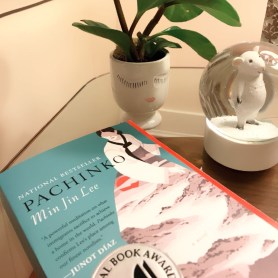
Pachinko


Rating: ⭐⭐⭐⭐
Author: Min Jin Lee
Genres: Historical Fiction
Read: Jan. 2018

It feels like I’ve been working on Pachinko for ages, but I finally finished it. I flew through several books at the beginning of the year, but it was nice to settle down with this one, which is definitely an epic and had a lot of depth.

If you’ve been following along, I decided to read 3 books about immigration for my January Challenge and Pachinko was my second selection. I read Girl in Translation earlier this month and loved it. I picked Pachinko because it’s been getting rave reviews and it’s one of the few books I found about immigration that wasn’t a story about immigrating to America.

Pachinko begins in Korea in 1910 and takes us on a journey with 4 generations of the same family as they are forced to leave their ancestral home and build a life for themselves in Japan. This was a great history lesson and I learned a lot about both Korea and Japan and the touchy relationship between the two. Korea was colonized by Japan between 1910 and 1945 and split into North and South Korea after the second world war.

The story starts with Sunja and her parents, Hoonie and Yangjin, who run a boarding house in the small town of Yeoungdo in southern Korea. Sunja falls for a wealthy Korean visiting from Japan and becomes pregnant. Fortunately, one of their boarders, a young christian minister Isak, feels led to marry Sunja to save her from the shame of bearing a child out of wedlock and so that her child might take his name. Isak had been on his way to Japan for an appointment with a church when he stopped at the boarding house and they marry and Sunja accompanies him to Japan.

Relations between Japanese and Koreans were not good at this time and there is a lot of racism against the Koreans. The Japanese believe themselves to be the ruling class and think of Koreans as dirty and stupid. Sunja faces a lot of challenges living in Japan and the novel takes us though 80 years of history through Sunja’s children and grandchildren.

This is definitely not a fast read, but it is very impressive in it’s scope. I haven’t read a lot of historical epics (Ken Follett’s Fall of Giants trilogy is the only other one that comes to mind) and at times Pachinko felt very slow moving, while at other times I was really into it and wanted to know what would happen next. With 4 generations, we inevitably experience many deaths in this book and some of them were actually quite shocking and emotional!

There are so many great themes in this book. I loved Sunja and Kyunghee’s characters and their experiences as women and with motherhood. Lee continuously explores women’s roles throughout the novel and the expectation that a woman’s lot in life is to suffer. Their husbands and family were everything to Sunja and Kyunghee and it never occurred to them to seek happiness for themselves outside of their family. They both had dreams for their lives, yet they were always secondary to the dreams of the men. With each new generation it was interesting to see how women’s roles would change and I enjoyed when Sunja starts to question what her life might have been or could be now if she had made other choices.

The familial relationships in the story are heartbreaking. There’s so many different relationships presented in this book and they were all very beautifully written (although sometimes tragic). This family is tried again and again. They all suffered an enormous amount as Koreans, but their tenacity was inspiring in what they were able to accomplish. I really liked Kyunghee and Kim and I was really intrigued about what happened to the Koreans who returned to North Korea after the war. Lee leaves us with quite a lot of unanswered questions, but I think this is very much indicative of the relationship between Japan and Korea. North Korea was very much a big black box and you never knew what happened there. Many Koreans had to live their entire lives without ever finding out what had become of their friends and family.

I liked Mozasu’s story with the Pachinko parlours as well and I loved the themes Lee tied in with the parlours. So many Koreans were trapped in a cycle of poverty in Japan. They were 2nd or 3rd generation immigrants who had come to the land of their colonizers in search of prosperity and were then later emancipated from their homeland. It was so hard for Koreans to succeed in Japan and they were always looked down upon, yet there was nothing in Korea for them to go back to.  Pachinko parlours are gambling dens where you can play these pinball-like machines in hopes of winning. Because of the gambling, parlour owners were often mixed up in dark criminal underworld and linked with the Yakuza, the Korean gangsters. I liked that despite being rough around the edges growing up, Mozasu was able to discover who he really was in the Pachinko parlours and become an honest man, despite how easy it would have been to become corrupted.

“Every morning, Mozasu and his men tinkered with the machines to fix the outcomes – there could only be a few winners and a lot of losers. And yet we played on, because we had hope that we might be the lucky ones. How could you get angry at the ones who wanted to be in the game? Etsuko had failed in this important way – she had not taught her children to hope, to believe in the perhaps absurd possibility that they might win. Pachinko was a foolish game, but life was not.”

As a book about immigration, Pachinko was fantastic. There are so many thoughtful nuggets of information and shared experiences about immigration in this book. I was particularly moved when Mozasu had to take Solomon on his 14th birthday to get his fingerprints taken and get his documentation card so that he could remain in Japan. Even though he and his son had both been born in Japan, they were forced to renew their identity cards every 3 years and could potentially be deported to South Korea – a country neither of them had ever known. This is so relevant to what’s happening all over the world with white people spewing hate at immigrants that have been living and contributing to their countries and economies for years.

I’ll finish with a quote from Solomon towards the end of the novel which I loved for it’s hopefulness despite the decades of discrimination his family had experienced. I appreciated the relationships Lee built between the Koreans and the Japanese, to remind her readers that we are all just people. There are good actions and their are bad actions, but we are each our own and we can each actively make the decision to accept and support each other, rather than hate.

“Kazu was a shit, but so what? He was one bad guy, and he was Japanese… Even if there were a hundred bad Japanese, if there was one good one, he refused to make a blanket statement. Etsuko was like a mother to him; his first love was Hana; and Totoyama was like an uncle, too. They were Japanese, and they were very good.”

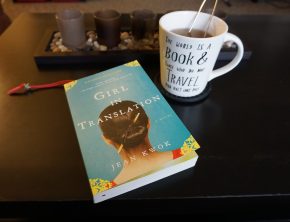
Girl in Translation


Rating: ⭐.5
Author: Jean Kwok
Genres: Fiction, Young Adult
Read: Jan. 2018

YES! Finally, a good read in 2018! I was off to a rough start before this gem!

Girl in Translation has been on my TBR forever and I finally decided to give it a read as part of my January Reading Challenge to read 3 books about immigration. This is a beautiful, beautiful book and I’m so glad I finally took the time to read it.

Girl in Translation tells the semi-autobiographical story of Kimberly Chang and her mother as they try to survive in New York City as new immigrants from Hong Kong. I’m not entirely sure when this book is set, but from a few of the pop culture references it seems to take place in the 1980’s. Kim and her Ma are sponsored into America by her Aunt Paula, who puts them up in an apartment in Brooklyn and gives Ma a job at her husband’s clothing factory. Kim and Ma are dismayed at the state of the apartment, which has broken windows, no heat, and a lot of roaches and rats.

Back in Hong Kong, Kimberly was always top of her class, and knowing hardly any english, she struggles at school. Ma is working as a finisher at the clothing factory along with many other Chinese-Americans. The factory is actually a sweat shop that illegally pays its workers by the garment (as opposed to an hourly wage) and Kim must help Ma every day after school until late in the night to get the clothes ready for each shipment. When Kimberly is teased at school and harassed by her teacher, she wants to skip school, but quickly realizes that she is her and Ma’s only chance at ever getting out of poverty. She’s throws herself wholeheartedly into learning English and works hard to get back to the top of the class again.

This is such a heartbreaking and inspiring story and I really like Kwok’s writing. It reminded me of A Tree Grows in Brooklyn, which is a huge compliment because it is one of my all time favourite books. It’s not a plot driven book, it’s simply the story of a young girl growing up in very tough circumstances and working incredibly hard to better herself and her family. I loved that Kimberly was tenacious and ambitious, but that she was also very real and had flaws. She takes the weight of the world upon her shoulders and she refuses to ever ask for help. She struggles to make friends, but she is so lucky to have Annette and I wish she’d confided in her and shared herself with Annette. Kim always declined help and was reluctant to let anyone into her life. I feel like may be a symptom of her Chinese culture as Ma was always reluctant to build any relationship that couldn’t be reciprocated and reverently believed in the idea that a debt must always be repaid. Sadly they both seemed to confuse kindness as a debt sometimes.

The ending is pretty abrupt, which caught me off guard. I actually think this story could have used another 50 pages to do the ending justice, but I still really liked it. It’s a heartbreaking ending, but I really appreciated it because it was real. When I saw where things were going at the end, I immediately knew how Kim was going to react because Kwok has breathed such life into this character that she took on a life of her own and acting any other way would have been contrary to her character. Kwok is very perceptive and I loved all of her characters because they were so real and so flawed. I was worried she might take the easy way out to create a happier ending, but I’m glad she stayed true to her characters and gave us this very bittersweet ending.