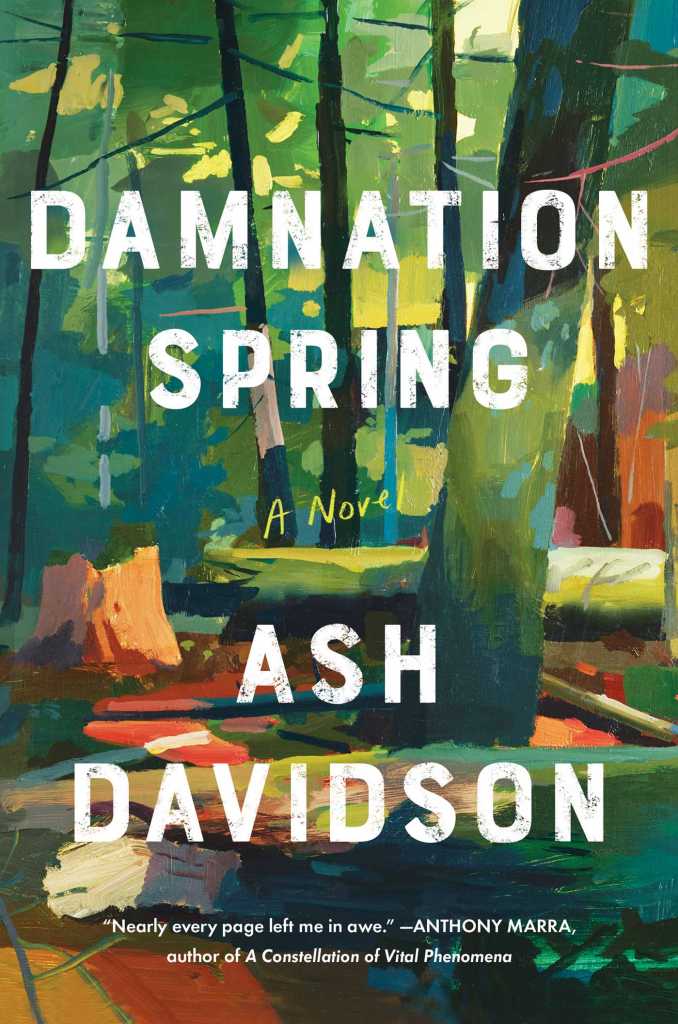
Damnation Spring

Rating: ⭐⭐⭐
Author: Ash Davidson
Genres: Historical Fiction
Pub. Date: Aug. 2021 (read Sep. 2021 on Audible)

The logging of old growth forests is a hot topic in BC these days and with all the big news stories about corporations polluting water supplies, the synopsis of this book really piqued my interest. It had two good narrators, so I decided to pick it up on Audible.

Damnation Spring combines the two issues I’ve summarized above into one big scandal. It’s the 1970’s and Rich and Colleen have lived in Damnation Grove for their entire lives, where Rich works as a tree-topper with a logging company and Colleen as a midwife. They have one son and have desperately been trying for a second, but poor Colleen keeps suffering miscarriages.

Through her work as a midwife, Colleen starts to remark that there have been a lot more complicated births, as well as infant deaths. Word starts to spread that other women have also been having miscarriages and rumours start to circulate that the pesticides the logging company sprays on the forest is potentially getting into the water supply and causing birth defects.

As an employee of the logging company and new owner of a swath of old growth forest that he’s dreamed of logging, Rich stands on one side of the scandal, while Colleen stands on the other. On top of everything, environmentalists and indigenous groups have been flooding the town arguing for the protection of the trees and threatening the way of life of this long time logging town.

To say this book tries to tackle a lot of issues would be an understatement. The problem was that I don’t think the author really did justice to any of them. This was actually the perfect setting for a story of such depth because so many of these issues are often related. I did really like the inclusion of the local First Nations band, who argued for the protection of the trees and waterways despite the terrible racism and abuse they suffered. I thought the idea of blending all of these issues into one was really smart and multi-faceted, it just wasn’t executed quite as well as I would have liked.

My primary criticism would actually be that this book was too long, although that’s not quite right, it’s not so much that it’s too long, but that the author didn’t really focus on the right aspects of the story. Now this is just my opinion, but the author spent a lot of time talking about logging that I just didn’t care to read. There is so much time dedicated to the logging company, the company drama, and waxing on and off about logging techniques. I just didn’t really care about any of it. I totally got and appreciated that this was a logging town and that it was the community members entire livelihood. Despite popular opinion that we shouldn’t be logging old growth forests (agree), I could still empathize with the community. I 100% bought into Rich’s dream of wanting to log the 24/7 tree, I understood why and yes, I felt bad for him. But this was the smaller part of why I wanted to read this book.

Sadly I felt Davidson just didn’t spend enough time on the whole ‘poisoning-the-water-supply’ angle. I felt like most of the book was an expose about uncovering the water pollution, versus a fight to stop it. This is covered to a certain degree, those who stood up against the spraying were definitely ostracized, but generally I found the conclusion of this plot point to be unsatisfying. It almost felt like the resolution of the two issues were tangential to one another. By which I mean, the pesticides issue was only solved because of the duplicity of the logging company selling out to the Park, negating the need for spraying. It made me question what was even the point of me reading this entire story when at the end of the day, it was still the logging company ultimately calling the shots. . It just made me feel like this was a book about logging, with all the other conflicts thrown in just for the drama of it, rather than the reverse. Likewise, I thought it should have ended earlier and felt there was some unnecessary drama thrown in at the end that didn’t really add to the story.

I did still enjoy the book, but honestly, I think I’d rather just go read some non-fiction about it instead, because we know there’s enough drama surrounding these topics that there’s no need to have to make it up.

Malibu Rising

Rating: ⭐⭐⭐
Author: Taylor Jenkins Reid
Genres: Historical Fiction
Pub. Date: June 2021 (read Aug. 2021 on Audible)

Malibu Rising was one of my most anticipated reads of the year, but sadly it was a major letdown. Taylor Jenkins Reid had such success with Evelyn Hugo and Daisy Jones (both of which I loved), so I had very high expectations for this book and sadly it didn’t live up to them. Reid reminds me a bit of Kristin Hannah in that she published a ton of mediocre books before her big break (Evelyn Hugo for Reid, Nightingale for Hannah), followed it up with another smash hit (Daisy Jones and Great Alone), only to regress on the next book (Malibu Rising and Four Winds). Both are accomplished writers, I just think the question becomes whether you’re creative enough to find something else meaningful to write about. Evelyn Hugo had so much great social commentary and Daisy Jones’ format was incredibly unique, but sadly, Malibu Rising had all the trappings of a story that just didn’t need to be told.

Malibu Rising is about the Riva family. Mick Riva rises to fame as a rock artist after marrying June and fathering 4 children. The novel covers their family history before delving into the lives of each of the 4 Riva children, bringing all their family drama to a head at the annual all-night Riva party in Malibu. This had similar vibes to Daisy Jones with the whole rock n roll scene, and the structure and focus on a fire reminded me of Little Fires Everywhere. It’s an all encompassing family drama with a large cast of narrators.

So here’s the thing. This wasn’t a bad book – it did remind me a little bit more of Reid’s earlier work, but it’s still fairly well written. It has a bit of a slow start, but the pace does pick up as the novel progresses and I was honestly just as invested in the past as the present day narrative. So what was the problem with this book? My main issue was that I just didn’t care. I didn’t feel connected to any of the characters and I struggled to understand why I should give a sh*t about any of them. Reid explores several different themes here, but I can’t say I found any of them particularly compelling.

I feel like she was going after something similar to Daisy Jones with the intrigue of the rich and famous (a theme in all her recent bestsellers), but it really didn’t work for me in this book. Like I mentioned, Evelyn Hugo had a lot to say about Hollywood, race, and sexuality, while Daisy Jones had a unique format and a lot to say about gender politics and privilege. But with Malibu Rising I was left scratching my head about why I should really care about this privileged white family? Sure it’s a character study (of many different characters), but a weak one. I didn’t think there was anything really special about these characters and I struggled to relate with them.

I do think one of the problems is that Reid introduces just a few too many characters. I could handle the 4 Riva siblings and June (honestly would have liked Mick to feature more), but for some reason Reid keeps introducing more character perspectives for very limited periods of time. Like, how many random characters did she start adding during the party? I couldn’t keep track of them and they played such small and insignificant roles in the plot that I questioned why bother including them at all? It’s fine to have a large cast of characters, but I don’t need to read from their perspective. It made me question if she was just trying to reach a page count and threw all these other characters in just to add some length.

The same went for Casey and the fire at the end of the book. The fire is alluded to from the beginning of the book, but we don’t actually get into it until the final hour. Very similar to Little Fires Everywhere, but at least in Little Fires Everywhere I felt like it added something to the story, whereas in Malibu Rising I felt that it added nothing to the actual plot and was just used as lazy device for symbolism. Likewise, I thought Casey’s storyline ultimately didn’t really add anything to the plot.

So overall, a very disappointing read for me. I’m between 2 and 3 stars, 2 because it was not a very compelling book, but 3 because it’s still pretty well written. So I guess I’ll end at 2.5 stars. Not a great read, but I still wouldn’t be deterred from reading her next book.

Luster

Rating: ⭐⭐
Author: Raven Leilani
Genres: Fiction
Pub. Date: Aug. 2020 (read May 2021 on Audible)

It’s been too long since I read this for me to write a proper review for it, but I do want to write a short one to capture my thoughts.

I saw lots of buzz about Luster and read that it was a bit of a polarizing book. It was compared to Queenie, which is also somewhat of a polarizing book, but I read it several years ago and loved it, so I thought I might enjoy Luster as well. Sadly, I did not. I can see why this is compared to Queenie, but in my opinion it had none of the charm of Queenie.

Both books feature black women trying to find their way in the world while simultaneously combatting racism and micro-aggressions at every turn. Both women pursue (often abusive) sexual relations to avoid their personal trauma, but that is pretty much where the comparisons end. Despite Queenie raging against herself and looking for love in all the wrong places, she still had so much charm and spunk. A lot of people didn’t like the comparison of Queenie to Bridget Jones, but I actually thought it was pretty apt. Queenie struggled with her mental health, but she very much used that wry British humour as a coping mechanism.

Luster is a different beast than Queenie entirely. Queenie was trying to mend her broken heart with bad sex, whereas Edie pursues an entirely inappropriate relationship with an older white married man. Eric has a somewhat open marriage and when things fall apart for Edie, she finds herself living in Eric’s house with his wife and discovering they have an adopted black daughter.

While I did find the exploration of Akila’s character (the daughter) really interesting, a black girl fighting the same racism Edie is used to, but without the acknowledgement or understanding of her parents, this novel made me entirely too uncomfortable. I get that that’s kind of the point of the book, but the casual violence in Edie and Eric’s relationship, and the bizarre relationship with his wife, were just too much for me to handle. I desperately wanted to like it because I generally love books with unlikeable characters, but I had to acknowledge this book wasn’t for me.

I didn’t enjoy the writing and despite some good themes, I wasn’t quite sure what Leilani was trying to say with this book. I acknowledge this book wasn’t written for me though, and that’s okay. But given the choice between the two, read Queenie instead.

Of Women and Salt

Rating: ⭐⭐⭐⭐
Author: Gabriela Garcia
Genres: Fiction, Historical Fiction
Pub. Date: Mar. 2021 (read May 2021)

I have read some really good books this month and Of Women and Salt is definitely one of them. I’ve been seeing a lot of buzz about it over the past few months but I couldn’t quite pin down what the plot was. I gathered it was a multi-generational immigrant story and honestly, I didn’t need to hear any more, I was sold. 

We put this on our book club voting list and it lost to The Lost Apothecary, which is really too bad because I think my book club would have enjoyed this a lot more than they enjoyed The Lost Apothecary. This book is centered around women, primarily the relationships between mothers and daughters. It’s another story that is told non-linearly (seriously, I’ve read so many of these this year), but this is one of the books where I didn’t mind the non-linear telling. Overall the plot is pretty simple, so I didn’t find it difficult to jump around as the novel focuses more on the character relationships than anything else. 

The novel kicks off in 19th century Cuba and then jumps around from there. Though someone from almost every generation of this Cuban immigrant family are featured throughout the novel, most of our time is spent close to present day with the youngest woman in the family, Jeanette. When she witnesses her neighbour being taken away by ICE in the middle of the night, she inadvertently becomes guardian to her neighbour’s daughter for a short period of time. Though they only know each other for a few days, the experience has a profound impact on both Jeanette and the young girl, Ana. 

I’m glad the novel focused on these two individuals because I did find their stories to be some of the most memorable and meaningful of the book. Though I did love the development of both Jeanette’s relationship with her mom (Carmen), and her Mom’s relationship with Jeanette’s grandmother (Delores). Beyond Delores, I don’t think going further back in the family tree really added that much to the story. The inclusion of the family tree at the start was definitely a good idea, I could see this being really confusing otherwise.

Some might question how much Ana and her mother’s story really belonged in this book, but I loved the comparison of two different immigration stories and though they are only loosely linked to one another, I thought the inclusion of both really made this a more well rounded story. 

Honestly, my only complaint about this book is that it could have been longer. It’s only about 200 pages and I really would have loved to spend more time with each of the women in this family, particularly Carmen. I felt like I had good insight into Dolores’ perspective, but I would have loved to hear more about Carmen’s experience immigrating to America and what it was like growing up under the shadow of her childhood trauma. Abuse was passed down from generation to generation in this family and I think that Garcia could have really developed this theme more to make her narrative even more impactful. I just wanted a little bit more from each of the characters, but the writing was so beautiful I’m definitely excited to see what the author will write next. An excellent debut!

Detransition, Baby

Rating: ⭐⭐⭐⭐
Author: Torrey Peters
Genres: Fiction
Pub. Date: Jan. 2021 (read May 2021)

This is going to be a hard review to write. It took me a long time to read Detransition, Baby; not because it’s a bad book, but because it’s a heavy book in scope. As a character study, this book is incredible. Peters really gets into the psyche of her main characters and I was frankly astonished at the emotional depth to which she takes Reese and Ames. These are not hastily created characters, they are well developed individuals and Peters brings to life every aspect of their character, from their most trivial thoughts, to their deepest secrets. Don’t come to this book if you are looking for a fast-paced plot, but rather if you want to get down into the nitty gritty of what it means to be trans and the exploration of both womanhood and motherhood as a trans-woman, this is the book for you.

It’s what made it so hard to read. The plot is not told linearly and the book is chaotic in its exploration of the themes and who these people are. Peters goes to some dark places and this is not a lightweight book. For those not aware of the plot, Detransition, Baby is primarily about two characters, Ames and Reese, though Katrina also plays a central role in the story. Reese and Ames were in a relationship for many years, but Ames eventually decides to detransition back to male and accidentally impregnates his boss, Katrina. The novel explores the idea of these 3 individuals raising the baby together because Ames fears that Katrina will not understand why the idea of ‘fatherhood’ is so scary to him and because Reese is a trans-woman that has always wanted a baby.

It’s a messy book and I can see it being very polarizing. But the fact that it’s been creating so much buzz and making bestseller lists from its release is in itself an achievement. The danger I think may be that this is held up as the only example of what it means to be trans, so I hope to see many more books like this get published to both broaden the narrative, and of course, for representation. Although shoutout to the YA genre which I think has been ahead of literary fiction genre on this topic. 

There are so many ideas presented in this book that I did find myself finishing it and not knowing quite what to think. I’m still not sure if I loved it, but I can’t deny its power because I really can’t stop thinking about it and I appreciate Peters’ unapologetic telling of these individuals. This is ultimately a book about womanhood and motherhood and what it means to navigate those worlds as a trans-woman. Peters explores so much within a limited number of pages and I definitely commend her on her honesty.

My only complaint is that I wish this story had been told linearly. I’ve read a lot of non-linear stories lately and for the most part, it doesn’t bother me – but I’m not sure what this style achieved in this book. The chapters are very long and every time I finished one, I knew I would be jumping to an entirely different part of the story, so it made it hard to pick the book up again every time I put it down. I felt like I had to get re-invested in the story after every chapter because the storytelling itself was quite chaotic. 

But one thing is for sure – whether you loved it or hated it, Torrey Peters is definitely one to watch!