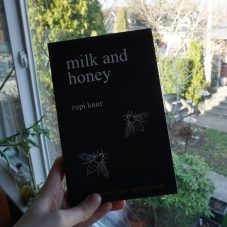
Milk and Honey


Rating: ⭐⭐⭐
Author: Rupi Kaur
Genres: Poetry
Pub Date: Nov. 2014 (Read Mar. 2018)

I read Rupi Kaur’s second book, The Sun and Her Flowers, last year and really liked it, so I decided to pick up her first book as well. These are both poetry anthologies with feminist themes that tell short stories of heartbreak and healing, explore love and sexuality, and promote self-love. The books are also illustrated with sketches, which makes for a nice reading experience.

This is a very fast read, I read the entire book in under an hour in one sitting. Milk and Honey is Kaur’s debut novel – I definitely liked it, but I think I liked her second book a little bit more than this one and it had stronger themes.

Milk and Honey is broken into 4 parts, the Hurting, the Loving, the Breaking, and the Healing. Kaur addresses a lot of themes in this short book, looking at love and sexuality and the the heartbreak that can accompany it. I thought it had a strong start with the chapter on the Hurting, which is a devastating look at abuse, and I really liked the last chapter, the Healing, which is cathartic and empowering.

I didn’t love the middle section, especially the Loving, which I personally found a little over the top. Kaur is very descriptive of her feelings on love and relationships in both her books and love for her seems to be an all-consuming feeling which I personally find a little intense. For me love is about the little moments. Those small, every day gestures in which your partner demonstrates their love for you and the closeness you build with that one person. Kaur is very intense in her love (and her break-ups) and I just couldn’t relate because I have always felt very grounded in who I am, whereas Kaur felt a little defined by her relationships. That said, I’ve been in the same relationship for the last 7 years, so I definitely can’t relate to that feeling of “new” love anymore, which is totally fine.

However, Kaur is also very much about self-empowerment and self-love, which I enjoyed. I thought these themes, and the feminist undertones, were stronger in The Sun and Her Flowers, which is probably why I enjoyed that anthology more. Milk and Honey is still a good, quick read though and there were several beautiful passages, here’s one of my favs:

i want to apologize to all the women
i have called pretty
before i’ve called them intelligent or brave
i am sorry i made it sound as though
something as simple as what you’re born with
is the most you have to be proud of when your
spirit has crushed mountains
from now on i will say things like
you are resilient or you are extraordinary
not because i don’t think you’re pretty
but because you are so much more than that

The Power


Rating: ⭐.5
Author: Naomi Alderman
Genres: Science Fiction, Dystopian, Feminist
Read: Feb. 2018

Execution is the key word for The Power. I’ve been dying to read this book since it first came out, but I’ve been seeing it get some mixed reviews and now I can understand why. This book had such a great premise, but I think it was a bit of a miss on the execution, which is so disappointing.

The Power is a dystopian, science fiction novel in which women have developed the power to basically electrocute people and things using their hands. They can take down electrical grids, burn trees and structures, and kill people using the power. The book is told from the point of view of a male historian recounting the events of when women first gained the power. Girls start developing the power at 15 and can awaken it in other women. Their power comes from a skein in their collarbones that all women have, but has never been awakened until now.

As you can imagine, women suddenly developing this power totally flips gender dynamics and this book focuses on the perspectives of 3 women and 1 man from different parts of the world. There’s Margot, an American mayor; Allie, a teenage runaway; Roxy, daughter of a British drug dealer; and Tunde, a Nigerian boy turned reporter. The book definitely had a strong start and I was super into it at the beginning, but I got a bit frustrated as things progressed because I felt like the author lacked an obvious theme or direction. I feel like she had a lot of different ideas and themes and sadly, I thought they were poorly executed and took away from the story. I think she needed a more focused direction.

My biggest struggle is that I just don’t know what the central theme is. Is it that this reversal in gender dynamics just ends up with a reversal of male/female roles? Or that even if women developed the ability to electrocute men, it would still be a huge struggle for them to gain power and men would be just as destructive towards women as they’ve always been? Is the author’s point that power can turn anyone into a monster? That women are just as vicious and oppressive as men have been and don’t deserve power? Or is she just trying to help men better understand the ways they currently harm and hurt women and how obvious these inequalities become through a simple reversal of gender roles?

Maybe I’m too dense to figure it out, but I feel like Naomi Alderman was trying to make all these points, which is why the book fell flat. There are definitely authors out there who can address this many ideas in a novel, but I feel like you need some kind of central theme and that the writing got overwhelmed by the ideas in this book and they just all lacked development. I don’t think the author needed to connect the multiple viewpoints the way that she did in this book. The characters seem to just randomly come across each other and help out each other’s storylines, but I felt that instead it made each individual storyline more disjointed and less impactful.

Disclaimer, the rest of this review contains spoilers. Usually I try and avoid spoilers, but I feel like I need to include them in order to properly discuss this book, so don’t read any further if you’re planning to read this book.

First off, let’s look at some of the things that I liked. I liked the scenes about the Men’s Rights movements and the internet trolls and bombings. They felt very real to me and I had no trouble believing we’d see this kind of backlash if women gained this power. I kind of expected the development of the power to switch gender roles a lot faster than it did, but I felt Alderman’s portrayal of this slow cling to power by men to be very believable. It’s got to be devastating to go from holding all the power to suddenly losing it and becoming oppressed and I have no doubt men would fight back and fight back violently (especially since women were also using violence).

I also liked the uprisings by women and the seedy underside of how some women choose to use their power. I really liked Margot’s story at the beginning, but then I was disappointed to see her basically left out of the second half of the novel. In contrast, I wasn’t really into Tunde’s story at the start, but ending up thinking he had one of the most meaningful storylines by the end of the book.

On the other side, I did not like Allie’s story at all and I only liked a few select parts of Roxy’s story. Allie’s story just felt like a total tangent with the whole religious revolution. I absolutely believe something like this could happen, but I just didn’t think this storyline fit in with the rest of the novel. It reminded me a little bit of the religious zealots in Station Eleven, which is a post-apocalyptic book in which 90% of the world population is killed by one virus. But I think this whole storyline just watered down the themes of the rest of the book and I hated that Roxy got involved because then I just had to read twice as much about it.

I thought Roxy’s story had such a strong start. It was so dark and I couldn’t wait to see where the author would take it, but I really didn’t dig the whole soldier aspect and based on what happened later, didn’t see that point of including it at all. The only other part of Roxy’s story I really liked was the skein removal scene, which was super horrific for an imaginary medical procedure. I felt so bad for Roxy, but it was such a powerful commentary on the lengths men were willing to go to maintain their power

The scenario that plays out in this book could obviously develop in so many different ways and I did like some of the contrasting events that Alderman explores. I thought it was really cool that it was the developing countries where women rose up first to fight back against their oppressors, whereas in America and Great Britain, men did whatever they could to retain power and women did less to fight back and in Margot’s case, actually hid her power. I also liked the contrast between the scene where Darrell first uses Roxy’s power and the other girls rise up against him to protect Jocelyn, whereas in the Romanian jungle, the women were actively hunting down any man, woman, or child who stood in their way and seemed to have no sense of compassion or bond with other women.

I loved Tunde’s story because of that feeling of total powerlessness at the end of the novel. He’s always had an exit plan and then the total despair of being betrayed by those closest to you and watching your life work stolen from you is just devastating. And to then be trapped in the middle of a female revolution with no way to fight back? That had to be so terrifying and I just wanted men to read that to try and understand the oppression and fear so many women feel at the hands of men.

I can see this book being both powerful and dangerous. Powerful because it makes a statement about the inequalities women face and reversing them to affect men can be powerful in helping men to empathize with women. There were so many small but meaningful nuggets at the beginning, like where mothers were talking about how they wouldn’t let their sons out alone on the streets because of the danger of being attacked by women. My disappointment again was that I felt this theme could have been so much more powerful, but I felt like it kind of got lost throughout the novel. On the other side, I can see these ideas being dangerous in that I could see actual MRA’s taking it and saying, “see, look what could happen if we let women have power.”

I struggled with the format of the supposed historian telling this story. I didn’t buy it and I could have done without the whole thing. Why would a historian tell a story like this? I don’t think they would. I thought the letters at the end of the book between the historian and Naomi were fantastic, but again, just so confusing for the execution of this book!

I thought the main theme was going to be that with power, and given a long enough time, women essentially just become men. But in my opinion the actual novel didn’t really support this theme and I was super frustrated that the whole novel covers 10 years of history and then at the end we discover the story is actually being told 5000 years after the fact! The letters at the end totally support the theme that the power just eventually resulted in a total role reversal, but it felt so disjointed because this is not the theme I felt the rest of the novel was promoting.

I wonder if I’m maybe holding this book to a bit of a higher standard because of its relevance to modern day feminism, but I just feel it had so much more potential. In summary, I would give this 3.5 stars because it definitely makes you think a lot, but with more focus and better execution, I really think this could have been a 5 star read, which is why it felt so disappointing.

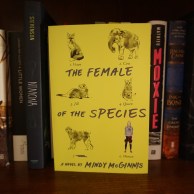
The Female of the Species


Rating: 
Author: Mindy McGinnis
Genres: Young Adult, Fiction
Read: Dec. 2017


This was so DARK.

I cannot figure out my feelings about this book. I pretty much read it in 2 sittings, so it’s a pretty quick read, but it packs a punch.

The Female of the Species is told from 3 points of view: Peekay, the preachers kid who has just broken up with her boyfriend; Jack, the popular guy trying to get a full ride to college; and Alex, whose sister Anna was raped and murdered several years prior. Alex is a loner and mostly people don’t think about her, but what they don’t know is the dark feelings Alex struggles to hide inside her.

From the synopsis you think this is going to be a revenge novel, but it’s mostly focused on relationships. I knew it was going to be dark, but I was surprised by how sweet some parts of the novel were. Peekay and Alex work together at an animal shelter and start an unlikely friendship in their senior year. Peekay is still reeling over her boyfriend breaking up with her to hook up with the most popular girl in school, Branley, and Branley is secretly hooking up with all-star Jack. Until Jack meets Alex and can’t shake her from his mind.

There’s a lot of cheating and hook-ups in this book and Branley plays the role of the villain trying to steal everyone’s man, but I liked how honestly McGinnis tried to portray her. Yes Peekay hates Branley for stealing her boyfriend, but the author still wrote a really interesting relationship between them, which gave Branley a lot more depth. She also highlights the culture of slut shaming and I liked when Alex defended Branley’s right to have lots of sex and enjoy it, without being cast in the role of slut.

Ultimately this book is about rape culture. After Anna’s death, Alex struggles with all the casual rape jokes and with anyone even touching her or her friends without consent. When creepy guys threaten her friends, she lashes out at them and hurts them in the same way they intended to hurt women, but the hurts she causes are perceived as so much worse than the potential hurts an assault would cause the victim. There’s a minor scene in gym class where she watches her classmates and teacher ignore one of the guys pretending to simulate sex with his basketball and comments that if she were to act the same way as a girl, people would lose their damn minds.

I liked Alex but she still scared the life out of me. I liked that she erased graffiti against other girls in the washroom, that she always looked out for Peekay, and that she was totally comfortable in her sexual experience (“it’s okay if we wait to have sex”, “I know” lol). I don’t really know what to comment about Alex’s violence. Obviously you can’t just go around killing people no matter how bad they hurt you, but portraying her character this way was an effective way to get your reader thinking about rape culture and all the ways it impacts and hurts people.

What Happened


Rating:
 ⭐⭐⭐⭐⭐
Author: Hillary Clinton
Genres: Memoir, Non-Fiction, Feminist
Read: Sept. 2017 on audiobook


Last year I attended a panel discussion featuring female leaders in STEM and one of the women said something which has been particularly memorable for me. She spoke about how being the first woman to do something means nothing if you don’t pave the way for those behind you.

Hillary talks a lot in this book about being the first female presidential nominee. After a while I kind of just wanted to roll my eyes, but you know what, women are never allowed to celebrate their accomplishments. We’re told to be humble, not to brag, and we’re perceived as vain if we talk too much about ourselves. Hillary has had many, many accomplishments and she should be able to talk about and celebrate those successes, especially in the aftermath of such a devastating loss.

Hillary was the first. But please God don’t let her be the last. I’m not even American and I was totally devastated when she lost. It was heartbreaking to watch America tear down the first candidate to ever look like me. It was terrifying that nearly half of Americans (Hillary still won the popular vote, yo) would rather have a man who incites violence and hatred as their president than a *gasp* woman!

“But her emails” – I can’t even really talk about the emails because they really are just a stupid excuse for people to hide their misogyny behind and Hillary is right when she talks about how her emails were given way too much media attention in the election. If you think her emails are worse than any of the million offensive things Trump said and did, then you need to check your privilege and priorities.

So yes, Hillary was first, and as upsetting as it was to see her lose, I do think she has tried to pave the way for those behind her. She went into more detail than I cared to know on parts of her journey and parts of the book got repetitive towards the end, but I really enjoyed hearing about all the people she met throughout her campaign and how she worked with those people to draft her policies. I was particularly moved by the group of mothers that she met with to draft her policies on gun violence. She met with the mothers of black men, women, and children that have been killed by law enforcement, such as Tamir Rice and Trayvon Martin. These women formed their own coalition and campaigned with her on the road as she took on the NRA.

I was so inspired by some of the people Hillary met and worked with and I just kept thinking how awesome women are and I appreciated Hillary for shining a light on all these amazing individuals. I love that woman are taking all the insults Trump throws at them and using them as tools for empowerment. Call Hillary a nasty woman? Fine, we’ll turn it into a meaningful awareness campaign. Enact a gag order on organizations that provide abortions and try to take away our reproductive freedoms? We’ll march in the damn street.

I loved the parts of this book that Hillary devoted to talking about what it means to be a woman in politics. How she struggled to communicate in a way that wasn’t considered “offensive” for a woman. I struggle with this myself. I am passionate about equality and a lot of things make me frustrated and angry. It’s hard not to talk about them without becoming animated. When women get impassioned about things society calls them “angry” or “shrill” – whereas men are “passionate” or “charismatic”. I knew that Hillary had to act a certain way in front of the cameras. It’s so obvious at the debates that she’s putting in an effort to always be smiling and keep her voice even and soft. But it’s so damn frustrating that women can’t speak out in the way that they want because they run the risk of being labelled an “angry woman” and therefore someone who can be dismissed.

I was fascinated when she talked about her rallies and how high the energy of her crowds would be. She wanted to go out there and match the energy of the crowd, to be loud and passionate, as any man would be (seriously, think of any moving speech given by a man, they’re always loud and expressive). But she couldn’t because that’s not what people expect from a woman. Women should be able to express their passion in the same way that men do. Women should be able to show outrage without being labelled “angry”. Hillary had to work so much harder than any male nominee because she had to be so critical of every tiny thing she did and said lest she be perceived as too masculine or too feminine.

I’ve read a lot of criticism that Hillary blames Bernie for her losses in this book, but I did not find this to be the case. She mentions Bernie a few times and there is 1 or 2 (of 97!) chapters that focus on her experience running against Bernie. Of course she’s going to talk about Bernie, he was a huge part of her experience and of course she’s going to have some criticism, they ran against each other and on different platforms. Of course she feels differently than Bernie. But I don’t think it’s fair to say she blamed Bernie. She is very critical of herself in parts of this book and repeatedly blames herself for her loss and for the all the women she feels she let down as a result. She talks about the mistakes she made and the things she wishes she’d done differently.

I also loved that she talked about her policies. She is right when she talks about how little media attention her political agenda actually got during the election. Everything was focused on her emails or whatever new offensive thing Donald Trump had done most recently. I liked when she talked about fairness in reporting. In journalism you often want to remain unbiased and present both sides of the story, but this does not work when one of your candidates makes a mistake about how she sends and stores her emails and the other candidate is a sexist, racist, xenophobic menace who can’t complete a single sentence without insulting at least 3 minorities (or who honestly just can’t complete a sentence, period).

You can’t talk about Hillary’s emails in every single newscast and treat them like they have the same gravity as all of Trumps transgressions just to keep things equal. It is unfair and irresponsible. It was like Trump could do no wrong because no matter how many insulting things he said and lies he made up, the media always compared it to one of Hillary’s mistakes (ie, emails emails emails). And the media let Trump dominate the news – no matter how much he shocked you, he was bound to surprise you again. The candidates platforms were rarely covered, which is a real shame because Hillary spent an incredible amount of time hosting round tables and listening to people in order to develop her policies. I loved that this book actually gave the chance to hear Hillary talk about her policies, even if we won’t see them come to fruition. It’s too bad they got overshadowed by the rat race of the election.

So what next? Hillary was first, but I do think she has tried to pave the way for those behind her. It was a brutal and devastating defeat, but she is still optimistic about the future, so I will try to be too. It would appear that this book can only be rated 1 or 5 stars on goodreads, so 5 stars from me because Hillary Clinton is a boss lady and she still inspires me.

“never doubt that you are valuable and powerful and deserving of every chance and opportunity in the world to pursue and achieve your own dreams.”