January Summary

I can’t believe January is over already! Seriously, where did the time go?!

It was a bit of a mixed bag for books this month. I got off to a bit of a rough start to the year with several book duds, but things definitely picked up later in the month and I loved all three of the books that I read for my January reading challenge. Here’s my summary:

Books read: 10
Pages read: 3,797
Main genres: Young adult, historical fiction, fantasy
Favourite (new) book: Girl in Translation
Favourite re-read: On the Jellicoe Road

I started off the month with Thunderhead, the sequel to Neal Shusterman’s new series Scythe. I did like this one, but overall I don’t think Shusterman is quite my cup of tea and I found it a bit boring. He explores a lot of really interesting concepts in Scythe and in comparison, Thunderhead seemed a bit lacking.

Things only got worse though because I followed up Thunderhead with The Life She Was Given and The Star-Touched Queen, both of which I did not like at all. The Life She was Given was my book club read of the month and it ended up being our lowest rated book to date, and we’ve read over 50 books! I found the book totally lacking in depth, development, and meaning. Likewise, I thought the writing in the Star-Touched Queen was so over-the-top flowery that it completely took away from the story. I can see why some people might be into this type of writing, but it really did nothing for me and I didn’t find the story meaningful.

Things picked up after that with the first book in my January Challenge to read 3 books about immigration – Girl in Translation. This is a fantastic book about a Chinese mother and daughter who immigrate to America and the terrible conditions they put up with just to survive. It was so well written; I loved the main character Kim and her aspirations to get the very best education so that her and her mother could rise above their circumstances. it was a very moving story.

Next I read Looking for Alibrandi, which is one of the few Melina Marchetta books I hadn’t already read. It was a solid 3-star read and I thought the main character Josie had a lot of spunk, but I didn’t think it was anything that special. However, it inspired me to give On the Jellicoe Road a re-read, which is one of my favourite books of all time and still moves me to tears, even after several re-reads over the last few years. These are both relatively older YA contemporary books, but I honestly think On the Jellicoe Road is timeless and that everyone should read it!

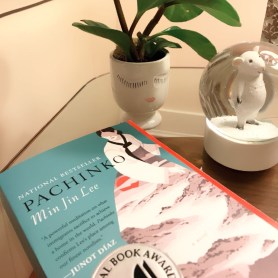
My second January Challenge read was Pachinko, which is a slow-moving historical epic that spans 80 years of history about a Korean family that immigrates to Japan during its colonial rule over Korea and struggle to build a life for themselves and escape the stigma of being Korean. It examines the challenges of being emancipated from your homeland and finding where you fit in in a new culture. Also a wonderful read, although quite long.

I needed something light and fast-paced before I tackled my last Challenge book, so I read The Cruel Prince which has been getting an insane amount of good reviews. I liked it, but was definitely disappointed with it because I think it’s gotten a little over-hyped and the book wasn’t able to deliver on my expectations. That said, I still gave it 3 stars and I will definitely be continuing on with this series. I’m hopeful about the next book!

My last book on immigration was American Street, which was refreshing in that it was totally unlike the first two books I read. American Street focuses on 16-year old Fabiola, whose mother is detained when they try to enter America from Haiti. She is forced to go on to Detroit without her mother and struggles to navigate her new life with her 3 larger than life cousins and her sick aunt. This was my least favourite of the 3, but I still really enjoyed it and gave it 4 stars.

I thought American Street would be the last book of the month, but I managed to fit in one more with Ruined. Based on other reviews I figured I would either love or hate Ruined and I’m pleased to say I LOVED IT! It’s a fast-paced YA fantasy novel that has a lot of action and a fair bit of romance. Sometimes I dislike too much romance in my fantasy novels, but I loved it in this one. Can’t wait to get my hands on a copy of the sequel!
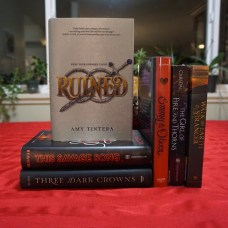
Ruined


Rating: ⭐⭐⭐⭐
Author: Amy Tintera
Genres: Fantasy, Young Adult
Read: Jan. 2018

Omg, I LOVED THIS!

Everyone seems to have really mixed feelings on Ruined – the reviews are all either “1 star I hated it” or “5 stars I am obsessed”. But I definitely fall into the latter category. I guess I could maybe see why some people might not love this and think it has a recycled plot, but it was such a fast-paced emotional, fantasy, thriller that I just didn’t even care.

I actually wasn’t that intrigued by the plot, but EpicReads seems obsessed with this one and I was in the mood for some action, so I decided to give it a try. The idea is that there are 4 different kingdoms and they’re all at war with each other in some way or another, with everyone trying to seize the most power. Our main character, Emelina Flores is from Ruina, a kingdom of magic wielders who are slowly being exterminated by the Kingdoms of Lera and Vallos because of their fear of the Ruined’s magic. Even though Emelina is a princess of Ruina, she didn’t inherit the Ruined’s powers. Her parents were murdered by Vallos and her sister taken prisoner by Lera. She is determined to get her sister back and take her revenge on everyone who opposes her.

Mary, Princess of Vallos, has been betrothed to Casimir, Prince of Lera. Emelina hatches a plan to kill Mary on her way to Lera, impersonate her, and infiltrate the castle to find out the location of her sister, Olivia. She’ll have to marry Prince Casimir, but it’s just another unfortunate event on her way to revenge. It’s fair that it’s pretty easy to guess the direction of the plot from there, but there were still so many surprises in this novel. It’s incredibly fast-paced, surprisingly humorous and a lot of fun!

Sometimes I really don’t like romance in my fantasy novels, but I loved it in this one. I can definitely be a sucker for a good romantic side story and I loved the slow build romance in Ruined. I loved the characters and their development throughout the novel and I loved that Amy Tintera basically wrote this story in the morally grey areas. There’s no obvious good guy. Lera and Vallos have done some shitty things, but so have the Ruined. Nobody really knows where to point the finger of blame of who started the whole thing and I really enjoyed watching the main characters trying to navigate these ambiguous ethical areas.

In a way Emelina is your classic female heroine; she’s incredibly skilled in swordplay and she is bloodthirsty and unforgiving. But she’s also a 16-year old girl being married off to the son of the man who destroyed her family. She was very vulnerable. I can’t imagine any 16 year being so ruthless and still being emotionally stable. I liked that she was able to be powerful, but still show emotions and vulnerability. Same with Cas. He was never emasculated by Em, but I liked Tintera’s portrayal of him as a boy who has had power and responsibility thrust upon him and how overwhelming that feels.

I pretty much inhaled this book and I can’t wait to get my hands on a copy of the next one. Ruined has the perfect cliffhanger in that it answers all your questions, but still leaves your mouth hanging out wondering what kind of crazy shit is going to go down in the next book. I need it ASAP!

Side note, I love that Amy Tintera actually says the word “sex” in this book. YA fantasy authors tend to sidestep their way around explicitly talking about sex and use all these really weird innuendos and double entendres to describe their sex scenes (looking at you Sarah J Maas), it was refreshing to see a YA author just call it what it is. Let’s all be grown-ups about it so actual teenagers can be too.

American Street


Rating: ⭐⭐⭐⭐
Author: Ibi Zoboi
Genres: Young Adult, Magical Realism
Read: Jan. 2018

Ibi Zoboi! Way to rip my heart out and stomp on it! What even? I was not expecting this.

This was the last book in my January Challenge to read 3 books about immigration. I read Girl in Translation and Pachinko earlier this month and loved both of them. American Street was a whole different kind of story, quite unlike either of the others. It was probably my least favourite of the 3 books, but still really good.

Fabiola Toussaint was born in America, but raised in Haiti because her mother didn’t have citizenship. Her Aunt Jo and her 3 cousins, Chantal, Pri, and Donna all live in Detroit and regularly send money back to Haiti to help out Fabiola and her mother. When Fab is entering her junior year of high school, they send enough money for her and her mother to finally move to America for good. Fab has American citizenship, but her mother has to get all the necessary visas to “visit” America. Unfortunately, when they enter America, Fab’s mother is detained at the border and she is forced to go on to Detroit without her.

Her aunt and cousins live at the corner of American Street and Joy Road. Fab has been desperate to come to America to live in the land of the free, but she doesn’t feel very free with her mother detained in an immigration prison in New Jersey and navigating her cousins’ world is scary and overwhelming. Her cousins are notorious at school and a little rough around the edges. Fabiola is pulled into their world and discovers the dark underside of what it costs to chase after the american dream.

Like I said, this was really different from any of the other immigration books I’ve read this year. I think Zoboi really captures Fab’s Haitian spirit and what it’s like growing up black in Detroit. She intertwines some cultural elements, like Haitian vodou, which is very much a spiritual thing for Fab, but is usually interpreted more like witchcraft in modern society. She weaves in some magical realism which surprised me and first, but I thought really worked with the story.

Voice was key for me in this novel. I’m a privileged white girl who grew up in a predominantly white town, so I definitely can’t relate to Fabiola or her cousins, yet their voices rang so true. I had no trouble believing in Zoboi’s characters. Fab’s uneasiness when she first arrives at her aunt’s house; Chantal’s desire to chase education but her reluctance to leave her family; Donna’s inability to say ‘enough is enough’; and Pri’s fierce and protective love for her sisters. My only complaint would be that Zoboi didn’t actually go deep enough into each of these characters. She formulated some really excellent characters, I just wanted more of them.

I really wasn’t anticipating where the plot of this story went. I thought it was mostly going to be about Fab trying to re-unite with her mom. While this was definitely an underlying conflict throughout the entire novel, Zoboi tackled a lot of other issues in this story. Although I would have liked to have heard her mother’s story as well and learn about what it’s actually like to be detained. I never really knew where the story was going and felt quite out of my depth with some of the content, much as I imagine Fabiola must have felt arriving in Detroit and trying to fit in with girls attacking each other over boyfriends and drugs passing hands on the sly. But Zoboi was quite unflinching in her delivery. I really did not see the end coming in this book and parts of it and brutal.

So like I said, probably my least favourite of the 3 books that I read, but actually very complimentary because this offered a totally different perspective than the other two. The characters in Girl in Translation and Pachinko are very meek and I loved Fabiola’s strength in this novel. She makes some pretty big mistakes, but she’s not afraid to chase after what she wants and she is very brave and courageous. Her culture shock was quite different and I liked getting another perspective. She could have let herself be pushed around, but she wouldn’t stand for it and decided to make her own place. Family is a central theme to this novel and I enjoyed the messiness that was the Francois sisters and Fabiola’s relationships with them.

Way to go Zoboi, this is a great debut novel!

The Cruel Prince


Rating: ⭐⭐⭐
Author: Holly Black
Genres: Fantasy, Young Adult
Read: Jan. 2018

First off, I definitely liked this. It was an intriguing story with some pretty interesting characters. But I didn’t love it quite as much as I was hoping. This may be a good example of a book where the hype gave me unrealistic expectations. The Cruel Prince only came out the first week of January, but I’ve been seeing so much buzz about it everywhere and pretty much everyone seems to have totally loved it. Like I said, I did actually quite enjoy this book and I will definitely be reading the next one, but it’s one of those 3 stars reads that I liked not loved.

This was my first Holly Black book. I know she’s written a ton of stuff and that she’s quite popular, which surprised me because I didn’t love her writing style. Her writing is very simple and I honestly had to go back to goodreads to check what genres this was listed under because, with the exception of the opening scene (which is gruesome), I felt like I was reading a middle grade novel for the first half of this book. Between Jude’s bullying at school, her boy woes, and the simple writing, I didn’t feel like I was reading a YA fantasy novel.

Anyways, to give you a quick summary, The Cruel Prince is set in the world of the high fae, which is closely linked with the mortal world. The first chapter is stellar and starts off with a brutal double murder and the faerie general, Madoc, dragging Jude and her two sisters back to Faerie to be their surrogate father. Jude and her sister Taryn are both humans and suffer a lot at the hands of the fae. Humans are often enchanted and used as servants by the fae and it’s only Madoc’s status as the general that protects them. They are bullied at school, but Faerie is really all they’ve ever known and they are both desperate to fit in.

Jude wants to prove herself by besting the fae and becoming a knight to the royal family. But she is at odds with the young prince Cardan, who’s in her class at school and it unbelievably cruel. When rumours fly that the high king is going to be abdicating his position to one of his 6 children, Jude gets caught up in the drama and the secret scheming for the crown.

Okay, what did I like about this book? I liked Jude as the narrator. She had spunk and she was quite stubborn, but also ballsy. I also liked Cardan – the book is called ‘the cruel prince’ so you know there’s going to be more to Cardan than meets the eye and I was really intrigued as to what his deal is. I also thought Madoc was a fascinating character, even though I HATED him. I liked Vivi too, so I guess the strongest part of this novel for me was the characters, which is a pretty good because in my opinion, characterization is key.

Things I didn’t like – apparently there’s a few of them. Firstly, I did not like the pacing, which I thought was all over the place. The novel starts off strong with the double murder and then gets ridiculously boring for the first third. Things get super intense again two thirds in with the coronation scene, but then they inexplicably slow down during the last third when the novel should be at its climax! I like a good planner, but I didn’t really like having to read about all the planning in lieu of just reading about the action.

I also thought this book was king of predictable. There was a side mystery going on throughout the course of the book, but I didn’t find it particularly compelling and I found it kind of hard to follow, so I was never really that intrigued in trying to solve the mystery because I never felt like I even really knew what the point was. There were definitely some surprising scenes in the book, but overall I could kind of guess where things were going and I was never really surprised by betrayals because I never trusted any of the characters to begin with.

I can’t decide if I liked the relationship between Jude and Taryn or not. They were really all each other had in the world and I found it hard to believe they would be so at odds with one another.

I’ll give Black props though, this book had a lot of characters and I never had any trouble following along with them all (with the exception of the side mystery element). I love when minor characters matter and I love when they have depth, and Holly Black had both in this novel. The Cruel Prince has the perfect kind of cliffhanger. Black has closed off all her loose ends, but she’s still left a wide up open space for the story to move into. I am genuinely excited to see what’s going to happen with Jude and Cardan in the next book and I really like the dynamic between the two of them. The most disappointing part is that I’m going to have to wait a whole year for the next installment!

Pachinko


Rating: ⭐⭐⭐⭐
Author: Min Jin Lee
Genres: Historical Fiction
Read: Jan. 2018

It feels like I’ve been working on Pachinko for ages, but I finally finished it. I flew through several books at the beginning of the year, but it was nice to settle down with this one, which is definitely an epic and had a lot of depth.

If you’ve been following along, I decided to read 3 books about immigration for my January Challenge and Pachinko was my second selection. I read Girl in Translation earlier this month and loved it. I picked Pachinko because it’s been getting rave reviews and it’s one of the few books I found about immigration that wasn’t a story about immigrating to America.

Pachinko begins in Korea in 1910 and takes us on a journey with 4 generations of the same family as they are forced to leave their ancestral home and build a life for themselves in Japan. This was a great history lesson and I learned a lot about both Korea and Japan and the touchy relationship between the two. Korea was colonized by Japan between 1910 and 1945 and split into North and South Korea after the second world war.

The story starts with Sunja and her parents, Hoonie and Yangjin, who run a boarding house in the small town of Yeoungdo in southern Korea. Sunja falls for a wealthy Korean visiting from Japan and becomes pregnant. Fortunately, one of their boarders, a young christian minister Isak, feels led to marry Sunja to save her from the shame of bearing a child out of wedlock and so that her child might take his name. Isak had been on his way to Japan for an appointment with a church when he stopped at the boarding house and they marry and Sunja accompanies him to Japan.

Relations between Japanese and Koreans were not good at this time and there is a lot of racism against the Koreans. The Japanese believe themselves to be the ruling class and think of Koreans as dirty and stupid. Sunja faces a lot of challenges living in Japan and the novel takes us though 80 years of history through Sunja’s children and grandchildren.

This is definitely not a fast read, but it is very impressive in it’s scope. I haven’t read a lot of historical epics (Ken Follett’s Fall of Giants trilogy is the only other one that comes to mind) and at times Pachinko felt very slow moving, while at other times I was really into it and wanted to know what would happen next. With 4 generations, we inevitably experience many deaths in this book and some of them were actually quite shocking and emotional!

There are so many great themes in this book. I loved Sunja and Kyunghee’s characters and their experiences as women and with motherhood. Lee continuously explores women’s roles throughout the novel and the expectation that a woman’s lot in life is to suffer. Their husbands and family were everything to Sunja and Kyunghee and it never occurred to them to seek happiness for themselves outside of their family. They both had dreams for their lives, yet they were always secondary to the dreams of the men. With each new generation it was interesting to see how women’s roles would change and I enjoyed when Sunja starts to question what her life might have been or could be now if she had made other choices.

The familial relationships in the story are heartbreaking. There’s so many different relationships presented in this book and they were all very beautifully written (although sometimes tragic). This family is tried again and again. They all suffered an enormous amount as Koreans, but their tenacity was inspiring in what they were able to accomplish. I really liked Kyunghee and Kim and I was really intrigued about what happened to the Koreans who returned to North Korea after the war. Lee leaves us with quite a lot of unanswered questions, but I think this is very much indicative of the relationship between Japan and Korea. North Korea was very much a big black box and you never knew what happened there. Many Koreans had to live their entire lives without ever finding out what had become of their friends and family.

I liked Mozasu’s story with the Pachinko parlours as well and I loved the themes Lee tied in with the parlours. So many Koreans were trapped in a cycle of poverty in Japan. They were 2nd or 3rd generation immigrants who had come to the land of their colonizers in search of prosperity and were then later emancipated from their homeland. It was so hard for Koreans to succeed in Japan and they were always looked down upon, yet there was nothing in Korea for them to go back to.  Pachinko parlours are gambling dens where you can play these pinball-like machines in hopes of winning. Because of the gambling, parlour owners were often mixed up in dark criminal underworld and linked with the Yakuza, the Korean gangsters. I liked that despite being rough around the edges growing up, Mozasu was able to discover who he really was in the Pachinko parlours and become an honest man, despite how easy it would have been to become corrupted.

“Every morning, Mozasu and his men tinkered with the machines to fix the outcomes – there could only be a few winners and a lot of losers. And yet we played on, because we had hope that we might be the lucky ones. How could you get angry at the ones who wanted to be in the game? Etsuko had failed in this important way – she had not taught her children to hope, to believe in the perhaps absurd possibility that they might win. Pachinko was a foolish game, but life was not.”

As a book about immigration, Pachinko was fantastic. There are so many thoughtful nuggets of information and shared experiences about immigration in this book. I was particularly moved when Mozasu had to take Solomon on his 14th birthday to get his fingerprints taken and get his documentation card so that he could remain in Japan. Even though he and his son had both been born in Japan, they were forced to renew their identity cards every 3 years and could potentially be deported to South Korea – a country neither of them had ever known. This is so relevant to what’s happening all over the world with white people spewing hate at immigrants that have been living and contributing to their countries and economies for years.

I’ll finish with a quote from Solomon towards the end of the novel which I loved for it’s hopefulness despite the decades of discrimination his family had experienced. I appreciated the relationships Lee built between the Koreans and the Japanese, to remind her readers that we are all just people. There are good actions and their are bad actions, but we are each our own and we can each actively make the decision to accept and support each other, rather than hate.

“Kazu was a shit, but so what? He was one bad guy, and he was Japanese… Even if there were a hundred bad Japanese, if there was one good one, he refused to make a blanket statement. Etsuko was like a mother to him; his first love was Hana; and Totoyama was like an uncle, too. They were Japanese, and they were very good.”