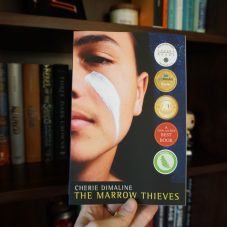
The Marrow Thieves


Rating:  ⭐⭐⭐⭐
Author: Cherie Dimaline
Genres: Science Fiction, Young Adult
Pub Date: Apr. 2017 (Read Mar. 2017)

“Sometimes you risk everything for a life worth living, even if you’re not the one that’ll be alive to see it.”

This was a beautiful book! I’m so glad it’s in the Canada Reads shortlist this year because I think it’s unlikely I would have discovered it otherwise and that would have been a shame because the writing is so gorgeous!

The Marrow Thieves is a short novel by Métis author Cherie Dimaline about a dystopian Canada that has been ravaged by climate change and disease and a large portion of the population has been wiped out. In the aftermath, everyone but indigenous peoples have lost the ability to dream. In an attempt to discover why the government starts constructing new schools (that mirror the old residential schools) to study indigenous peoples. It turns out that the ability to dream comes from your bone marrow and the government starts rounding up and experimenting on indigenous peoples to harvest their bone marrow.

Frenchie has slowly lost everyone in his family and finds himself alone in the woods. He follows his family’s plan to head North and eventually runs into other bands of ‘Indians’ who are slowly treking their way North as well and he is adopted into a new family and they travel together. Their group consists of an elder, Minerva; their leader, Miig; and several other young people who have lost their families. Miig tries to preserve the old ways through story-telling and everyone has the opportunity to tell their own ‘coming-to’ story.

I loved the writing in this book and learning everyone’s story – hearing about their struggles and how they came to end up part of this little adoptive family. They all come from different backgrounds and families, but they have retained their ability to dream and their desire to survive in the angry world around them. Miig teaches them how to hunt, cook, fight, and survive in the wild and how to connect back to their original roots.

I really liked this because I thought by telling this horrifying, dystopian story, Dimaline was able to convey some of the horrors that have been committed against indigenous peoples in the past in a way that enabled you to empathize emotionally with them and better understand how they felt. On paper, everyone knows about the residential school systems and the struggles of indigenous peoples to retain their culture, but that part of history feels a degree removed and it’s shameful so I think people generally avoid thinking about it.

It reminded me a little of Tim O’Brien’s book, The Things They Carried, in it’s ability to use exaggeration to convey emotion. The Things They Carried is a book about O’Brien’s experience in the Vietnam War that is written to read like a memoir, but is actually partially fabricated. O’Brien’s essay about being drafted and his internal debate about whether he would defect to Canada to avoid going to war is one of the best essays I’ve ever read. It reads like non-fiction and is an exaggerated account of O’Brien’s experience, but it is so effective because the exaggeration is what enables to you really feel his despair, frustration, and hopelessness. Dimaline’s horrifying account of the marrow thieves is what enables you to relate and empathize with the persecution of indigenous peoples throughout Canada’s history. I mean, I obviously empathized with them before and thought the residential schools were horrifying, but this book uses science fiction and exaggeration to evoke a much stronger emotional reaction.

Indigenous peoples are obviously incredibly tenacious and this book re-iterated that. It is really a pretty simple story about family, love, and the bonds we build with those around us. Who are we when everything else is stripped away from us? What can we become when faced with adversity, antipathy, and violence? Is family blood or the bonds we build we those we love? I thought this was a thoughtful, well written novel and I would definitely recommend to all Canadians! I read both The Boat People and The Marrow Thieves and while I really liked them both, I think this was my favourite of the two.

I Am Not Your Perfect Mexican Daughter

Rating: ⭐⭐⭐⭐.5
Author: Erika L. Sánchez
Narrated by: Kyla Garcia
Genres: Young Adult, Fiction
Pub Date: Oct. 2017 (read Mar. 2018 as an Audiobook)

I listened to I Am Not Your Perfect Mexican Daughter on audiobook and it is definitely the fastest I’ve ever listened to an audiobook! I LOVED IT!

I’ve written a few times about how I don’t love fiction audiobooks because I think they can be very unforgiving of an author’s writing and for some reason hearing fiction read out loud always seems to make the writing sound cheesy or lame. I think non-fiction translates better to audiobooks overall, but this is hand-downs my favourite fiction audiobook that I’ve listened to and I think the narrator, Kyla Garcia is TOPS!

I Am Not Your Perfect Mexican Daughter was a National Book Award finalist in the young readers category and tells the story of Julia, a teenage daughter of undocumented Mexican immigrants. Julia’s older sister Olga has just died tragically in a road accident and her whole family is reeling from the loss. Julia’s mother always viewed Olga as the perfect daughter and Julia’s sharp contrast from Olga creates a lot of tension with her mother, who doesn’t understand why Julia is so difficult.

Julia is 15/16 years old (can’t remember) and she is extremely brash and confrontational. She’s constantly picking fights with those around her, she lies to her parents, she can be vulgar, and she is of course, grieving. In the wake of Olga’s death, Julia starts to discover some of her sister’s secrets and finds that her sister may not have been as perfect as she led everyone to believe. She struggles to justify this new Olga with the sister she knew and in her grief, she acts out against her friends and family.

A lot of the reviews for this book are pretty critical of Julia and I can understand why a lot of readers didn’t like her. She’s not a particularly likable character, but like Scarlett O’Hara, her flaws were what I loved about her, and I definitely loved this character. I have to give some of the credit to the narrator because I thought she captured Julia’s voice and the tone of this novel perfectly. Her Mexican accent was fantastic and she absolutely read this like an angst-y, grief-ridden teenager.

Julia had a lot of spunk and while I couldn’t believe some of the things she was gutsy enough to say to people, I thought she was incredibly relatable as a teenage daughter of immigrants. She’s grown up in completely different circumstances than her parents and they struggle to relate to each other. She’s lived her whole life in the shadow of her perfect older sister and even though Julia is really smart and accomplished herself, she’s always been overshadowed by her sister in her parents eyes. She is critical of Olga’s desk job and can’t imagine settling for a job like that when she wants to be a writer, but her parents are critical of her dreams because they don’t believe a writer is a real job and as people who have done labour their entire lives, they can’t imagine anything better than Olga’s desk job.

Following the death of her sister, her mother suddenly wants to try and give Julia everything she was never able to give Olga. She fears for Julia’s safety and is extremely protective of her, forbidding her to go to parties or spend time with boys. But Julia just wants to live her life and the wedge between her and her mother only grows bigger. Julia becomes depressed and overwhelmed by the constant pressure to be more like Olga and how critical her mother is of everything she does and wants.

While I thought Julia sometimes took things too far, I was incredibly sympathetic for her. She is grieving and her world is crumbling and she has little support to navigate the scary new world around her. I thought this book was so well written and that Sanchez captured what its like to be a teenager so well.

The only reason I rated this 4.5 stars instead of 5 stars is because I didn’t love the last third of the book as much. Julia eventually goes off to Mexico for a period of time and I didn’t think this added a whole lot to the story overall. She does learn more about her family there and starts to better understand her mother, but I felt these epiphanies still could have happened in America and that removing her from America made us have to press pause on the rest of the drama in the story, which made it feel a little bit disjointed. There’s a lot of plot points that surface in the last few chapters of the story and they felt a little out of place because her trip to Mexico disrupted the flow of the story.

But overall, I absolutely loved this and I would highly recommend the audiobook. I’m not convinced I would have liked this quite as much if I’d read it because I thought the narrator did such a good job as Julia!

The Child Finder


Rating: ⭐⭐⭐.5
Author: Rene Denfeld
Genres: Mystery
Pub Date: Sept. 2017 (read Mar. 2018)

I tore through this short mystery novel in 2 days. The Child Finder tells the story of Naomi, a private investigator who specializes in lost children and has gained a reputation as the ‘Child Finder’. She’s been hired by a couple in Oregon whose daughter disappeared 3 years ago into a snowy forest and was never found. Naomi grew up in Oregon and the return to the woods reminds her of her own upbringing with her foster mom and foster brother, as well as the dark past she has blocked from her memory. As she searches for Madison and her foster mom’s health declines, she must face her own past and relationships in order to ever be whole.

Setting and atmosphere are key in this novel and I loved them both. The story takes place deep in Oregon’s wilderness and in a land of perpetual winter. Denfeld integrates fairy tales into the story and I thought they worked so well against the backdrop of the snowy forest. Everything is so secluded within the park that you feel transported back in time to when trappers still ran the land and lived in their log cabins in the woods, living off the land. Naomi is very much an island herself and the setting mirrored her struggle to build relationships and set down roots. She is always on the move from one missing child case to the next, always running from her past.

I liked this as both a mystery novel and a character study. I really liked Naomi and I’d be interested in reading a sequel to see her deal with her own ghosts and guilt. She was complex, yet simple. I was impressed with how well the author crafted her character in such a short book. I love when characters are so well crafted that they take on a life of their own and you can almost anticipate how they will react because you feel you’ve come to know them so well. I felt this way about Naomi and as much as I wanted her to settle down, I understood why she always had to keep moving.

I don’t have a whole lot to say about the plot. It’s a pretty simple story overall and it felt more about Naomi’s growth than the actual mystery. I liked that the author included two missing children cases, as well as snippets of Naomi’s back story, because it added a bit more intrigue to the book. I quite liked the writing. It was simple but it also had this dreamy quality to it which I thought flowed well throughout the story and is what really helped to create the atmosphere.

Disclaimer, this book does have some disturbing content, but I thought it was actually handled really well by the author. Some books are needlessly gratuitous about physical and sexual violence, and while this book has both, I thought it was well written. It offers some interesting insight into the cycle of abuse and how isolation and never knowing love can impact children and the people they grow up to be.

Before We Were Yours


Rating: ⭐⭐⭐⭐
Author: Lisa Wingate
Narrated By: Emily Rankin
Genres: Historical Fiction
Pub Date: June 2017 (read Mar. 2018 as an Audiobook)

I listened to Before We Were Yours as an audiobook. It reminded me a lot of The Alice Network, which I also listened to as an audiobook and had a similar format, alternating back and forth between a present day and historical perspective based on true events. I thought The Alice Network told a fascinating story about a real-life individual, Louise de Bettignies, who ran a spy network in World War I, but I found the second narrative boring, poorly written, and unnecessary to the story. Fortunately I felt differently about Before We Were Yours and while I still thought the writing was a little cliche in places, I thought this story was better done overall.

The whole present day narrator investigating the past is such a common troupe in historical fiction and a lot of the time it’s just not well done (also thinking of The Life She Was Given) but I didn’t mind it too much in this book. In my opinion, this troupe doesn’t always add something meaningful to the story, but I do think this element worked in this book because of the way that families were torn apart and how it took many families generations to reunite, if at all. Audiobooks also tend to make the writing seem a little cheesy and there were definitely parts where I rolled my eyes, but overall this translated well in audiobook and I thought the narrator was fantastic.

Let’s get into the plot. Before We Were Yours focuses on a little known piece of American history that is both fascinating and horrifying. The story starts in Tennessee in 1939 and looks at real-life individual Georgia Tann and her work with the Tennessee Children’s Home. Rill Foss and her 4 siblings have grown up as river gypsies, living in a house boat, running their way up and down the Mississippi River. At the beginning of the novel, their mother is about to give birth with the help of a midwife, but things become complicated when they discover she’s actually pregnant with twins and the midwife forces her to go to a hospital to deliver the babies. The rest of the children spend the night on the river boat with Rill in charge.

However, the following day the police show up and basically kidnap them before dropping them off at the Tennessee Children’s Home. Rill has no idea what happened to her parents or why they’ve been forced to stay at the Children’s Home, but does her best to keep her siblings together, despite the horrors they start to experience.

At the same time, we’re learning about Avery Stafford. A wealthy young lawyer who has returned to her childhood home in South Carolina to be groomed to take over her father’s role as a senator. On a political visit to a senior’s home, she bumps into a old woman named May who seems to know her grandmother and is drawn into a decades old mystery of how these women are connected and what threat this mystery might pose to Avery and the Stafford family in her bid for senator.

Georgia Tann is a real life woman who is often known as the “mother of modern adoption”. She ran the Tennessee Children’s Home, which took care of orphans and children whose parents were too poor to properly take care of them or who turned them over to the state for care. Tann oversaw the care of the children and worked to find them all loving homes (for a price). But what was not known until later is the horrifying conditions the children were forced to live in, the ways they were abused, how they were exploited for financial gain, and the horrifying circumstances through which many of the children were obtained.

While Tann did undoubtedly (indirectly) rescue many children from poor conditions and abusive families and place them in loving wealthy families, she also obtained a lot of the children through shocking means. Some children were kidnapped out of their family homes or off the street, like Rill and her siblings, while others were obtained by tricking the birth mother or parents who were often poor or illiterate. Tann had workers in hospitals who would tell mothers that their newborns had died or trick them into signing papers giving up their children to the state, while Tann would take the children and sell them to wealthy buyers. The extent of the network that Tann had set up is actually shocking and it’s hard to believe that so many people were able to turn a blind eye to the suffering of the children and the birth parents.

Many victims on Tann’s schemes were abused or died while in her care. She did everything to ensure that the children’s families would never be able to find or reunite with their children and separated many siblings, destroying any paper trail that might enable to birth parents to try and get their children back. Equally shocking was that she would sometimes later even harrass the adoptive parents to get further payments from them under the guise of lawyer fees.

Unfortunately Tann was never prosecuted for her crimes as she was very old and sick before they were ever discovered and people generally were of the opinion that the wealthy adoptive families were more fit to raise the children than the poor families would have been anyways. I thought this was a fascinating opinion, although Wingate didn’t explore it very extensively in the novel. I think it’s a question that is still relevant today. Do poor parents not deserve the right to raise their own children just because someone else could better financially provide for their children? Is money all that matters when it comes to raising a child? What is the long term impact on a child who has been stolen away from their biological parents, whether they can remember it or not?

It was a really interesting story and I did find myself engrossed in both May’s story and Avery’s story. Audiobooks aren’t my favourite way to read because I find they are very exposing of an author’s writing, which can sometimes detract from the story. Like I said, this still had some cliche writing, but overall, I did like this book and was fascinated by the piece of history that it exposed.

The Thief


Rating: ⭐⭐⭐⭐
Author: Megan Whalen Turner
Genres: Fantasy
Read: Mar. 2018

The Thief was the first book in my March Challenge to read 3 fantasy novels. It’s been on my TBR since Thick as Thieves came out last year and I heard that the series has gotten really good reviews. I’ve heard that the second book, The Queen of Attolia, is really the star of the series, so I wasn’t sure if The Thief would be that great, but I still really enjoyed it!

It’s a short book and it has a fairly simple plot, but it was a lot of fun! Gen claims to be able to steal anything, but he finds himself trapped in the King’s prison at the start of this novel. He’s very weak from being confined to the prison, with painful wounds on his ankles and wrists from the chains. But he’s offered a chance to get out of the prison when the King’s Magus appears to take him on a quest to steal an item for the King of Sounis. If Gen is successful, he’ll be granted immunity and allowed to walk free, the only catch is that he’s not told where they’re going or what they’re going to steal.

Gen sets off on a journey with the Magus, his 2 apprentices, and a solider, Pol, to steal an item of great value to the 3 kingdoms: Sounis, Eddis, and Attolia. This item will give Sounis a political advantage against their enemies. Gen isn’t interested in the journey or the task at hand, but he does want freedom, so he agrees to aid the Magus in his task.

I thought Gen was a fantastic character. He’s a bit full of himself and a bit dim-witted – he got thrown into prison because he spent too much time bragging in a wineshop about what a good thief he is. He’s got a dry sense of humour and his only real joys seem to come from eating and sleeping. He may be along for the journey, but he’s not going to make it easy on his captors. He knows that he has no real power, but he also knows that they need him, so he takes the opportunity to mess with them a little bit since they don’t want to see him harmed before he can steal for them.

It is a bit of a slow moving plot – there’s a lot of journeying and not a whole lot of action until the second half of the book, but I enjoyed the writing and the characterization. But the ending is what really made this a great book. The plot seems simple, but it’s the first of 5 books, so you know this book has to be setting up the rest of the story, and it is, but Turner puts in a great twist at the end to really give this book a meaningful start to the story.

It reminded me a little of Howl’s Moving Castle, one of my favourite middle grade books, in that a lot of seemingly random, unimportant stuff happens and it’s not until the end that you realize that all those incidents and conversations actually do mean something and that this book was actually a lot more complex and clever than you realized. You have a great epiphany at the end and everything comes together so well that you can’t help but be impressed with the structure and writing!

So definitely a great start to a new series, I’m just lamenting that I can’t jump right into the next book!