Lord of the Butterflies

Rating: ⭐
Author: Andrea Gibson
Genres: Poetry
Pub. date: Nov. 2018 (read Nov. 2019)

Poetry can be a bit tricky to review sometimes, so more often than not I don’t write a full review for it. But I was so impressed with Andrea Gibson’s anthology, Lord of the Butterflies, that I have to make an attempt at a review.

Poetry is definitely not for everyone and it’s something I’ve only recently started reading. I’d read the occasional novel written in prose and started easing into poetry a few years ago with Rupi Kaur’s anthologies, which are pretty easy reading if you’re new to poetry (which I am). Then I discovered Robert Service when I read The Great Alone last year and I am totally obsessed with his style of poetry. I’m still working my way through a few of Service’s anthologies, but I haven’t been able to find any other works of similar style or subject, so if anyone knows of any poetry that centres around a love and reverence for the outdoors, please let me know!

Anyways, Gibson’s poetry is a whole different kind of beast than Robert Service of course, but equally as enjoyable (for me) in a whole different way. I dabbled in some other poetry this year, reading Danez Smith’s, Don’t Call us Dead, and Ocean Vuong’s, On Earth We’re Briefly Gorgeous, but to be honest, both were a bit over my head. I really liked Gibson’s poetry because it had an incredible amount of depth, but wasn’t filled with so many metaphors that it was a slog to wade through.

Gibson’s poems focus on our sorts of topics, from gender and sexuality, to mental health and depression, to politics and reform. They’re not afraid to be honest and vulnerable and even though me and Andrea are so different, their poetry was so relatable. Apparently Gibson is a pretty well known poet in the LGBTQIA+ community and beyond and they won the very first World Slam Poetry competition in 2008. They have published 4 anthologies as well as a ton of spoken word albums, all of which I am definitely planning to check out. I went through a brief obsession with slam poetry last year after I heard Zariya Allen’s “Somewhere in America” poem, but I didn’t really know where to look for more slam poetry, so I’m thrilled to have discovered Gibson.

It’s hard to pinpoint specific poems that stood out from this anthology because they are all fantastic, but a few memorable ones for me were Orlando, which is about the club shooting in Florida, Black and White Angel, which is about Gibson’s sister awaiting trial in jail for petty crimes she committed while suffering from substance addiction, and America Reloading, which is about America’s lack of gun control and its impact. But what’s make’s all of these poems so powerful is Gibson’s vulnerability and their courage in holding nothing back. They’re not afraid to go to some very dark places, but are so perceptive of how closely entwined everything is in our society and how the system continues to oppress and work against those who do not fit the status quo.

If you’re looking to dabble in poetry and are at all interested in gender politics, I would definitely recommend this anthology!

Ember and the Ice Dragons

Rating: ⭐⭐⭐⭐
Author: Heather Fawcett
Genres: Fantasy, Middle Grade
Pub. date: Oct. 1, 2019 (read Oct. 2019)

I wish I didn’t wait so long to write my review for this book because I really loved it! Heather Fawcett is killing it with her books and I’m really drawn to the settings she creates. I loved her Himalaya inspired fantasy world in Even the Darkest Stars and loved the blend of fantasy she created in Ember and the Ice Dragons.

Ember and the Ice Dragons is a middle grade fantasy series set in our world, but with magic. Ember’s adoptive father is a magician that chases storms because they are where he gets his magic from. On one adventure he discovers a baby dragon, Ember, and turns her into a human to save her life and hide her, because unfortunately the fire dragons have since been hunted to extinction.

As you might expect, Ember struggles in England because she has a tendency to randomly burst into flames and as such, is afraid to make friends. Eventually she convinces her father to ship her off to Antarctica to live with her Aunt because she is much less likely to catch fire in the cold climate. Once in Antarctica, Ember is surprised when two other children, Nisha and Moss, attempt to befriend her. She’s also enraged to discover that the ice dragons of Antarctica are also being hunted and targeted, same as the fire dragons were in England. She teams up with Nisha and Moss to take down the hunt and save the ice dragons.

Like I said, I loved the setting. Most of the book is set in Antarctica and loved reading about it. Fawcett likes to set her stories in the bitter cold outdoors and it just makes for such an enjoyable reading experience in the fall and winter. Ember is the perfect heroine – with just the right amount of spunk and vulnerability. I liked watching her come of age and finally starting to make friends and build relationships with those around her instead of constantly being afraid of being discovered. Fawcett is also good at writing perfect villains and anti-heros and I like that some of her characters are flawed, yet still good.

This read like a standalone, so I’m not sure if Fawcett is planning on expanding the world or not. I kind of hope not because I think this works well as a standalone and I want to see what other types of worlds she will dream up!

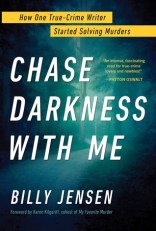
Chase Darkness With Me

Rating:
Author: Billy Jensen
Genres: Non-fiction, True Crime
Pub. date: Aug. 2019 (read Sep. 2019 on Audible)
Narrated by: Billy Jensen

Chase Darkness was a bit of an impulse buy. It came up in my search of “best audiobooks of 2019” (or something along those lines) and as usual, I bought it because I thought the narrator sounded good.

I recently listened to Michelle McNamara’s audiobook, I’ll be Gone in the Dark, which I really liked, so I figured I give this one a try too. The non-fiction nature of true crime translates pretty well to audio format and I was not disappointed. What I did not realize until listening to this book though, is that the author, Billy Jensen, is actually the author that finished Michelle’s book after her death. So it made for a really interesting read because he references Michelle’s book throughout and spends a chapter discussing the capture of the Golden State killer, which had not occurred at the time of publication of I’ll be Gone in the Dark.

So I do feel a bit like I stumbled upon this whole fan base of true crime and citizen solved crimes. Billy Jensen is a journalist. Unlike Michelle, he wasn’t totally focused on solving one single case, although there were crimes that have stuck with him over the years that he would really love to see solved. But Jensen’s real focus was on solving crimes through crowd sourcing on social media. He was haunted by several criminals who have never been ID’d, despite the police having decent photos or videos of them. Billy wondered if any of these crimes could be solved using social media. He experimented a bit with crowd sourcing and suddenly he was actually helping solve crimes!

That does make it sound a little bit easier than it actually was. In many cases Jensen was not able to get an ID on the criminals or killers, but in other cases, sharing crime videos and photos on platforms like facebook, and targeting the audience to a radius around where the crime was committed, did actually result in positive ID’s of the criminal!

I found this book interesting because it does look at a variety of cases instead of just one, and there is the immediate satisfaction of finding the answer to crimes that are many years old. Plus it was interesting to learn about the frustrations Jensen faced when he either couldn’t get an ID, or worse, did get an ID, but never a conviction or even an investigation because the police just couldn’t build up enough evidence. It was interesting that some of the criminals were ID’d based not on facial recognition, but recognition of their size, voice, gait, or general demeanor.

I’m not going to discuss any of the cases in my review, there wasn’t any particular case that stuck out to me. Mostly it was just interesting learning about citizen investigations. I find true crime fascinating enough, but I’m definitely not an aficionado, though it was interesting learning about people that are. There’s definitely a huge portion of people out there that are obsessed with true crime and solving decades-old crimes. Jensen is one of them and did let his obsession take over his life, especially once he actually starting solving crimes and had the police and victim’s families actively approaching him for help.

The book did end a little earlier than I was anticipating, because the last part is dedicated to citizen solves and is basically Jensen advising people who want to get involved in citizen investigations. That’s personally not me, so I skipped the last bit, but still enjoyed the book overall. It’s narrated by the author and I thought he did a good job.

I do think it enhanced the experience that I had already read Michelle McNamara’s book, so I’d maybe recommend reading hers first, though definitely not necessary. Both books had similar topics, but offer different listening experiences.

Things You Save in a Fire

Rating: ⭐⭐⭐
Author: Katherine Center
Genres: Fiction, Romance
Pub. date: Aug. 2019 (read Sep. 2019)

Things You Save in a Fire is a book I was wildly excited for, but somehow got missed in my reviews. It’s now been about a month and a half since I read it, but I still really want to review it, so I’m going to do my best, but must admit that some of the details are a little fuzzy.

Things You Save in a Fire is about firefighter Cassie Hanwell. Cassie graduated top of her class and has spent the last few years building up a good reputation for herself at a progressive firehouse in Texas. She’s well respected by the rest of the male firefighters and has the pleasure of working for another female fire chief. But then at the peak of her career, her estranged mother asks her to move to Boston for a year to help her recover her health after a recent surgery. Cassie is reluctant to return, but due to other circumstances, it ends up not being a bad time for her to try something new.

The thing is, her firehouse in Texas was pretty progressive and well funded, but her new firehouse in Boston is not. The firehouse has fallen into disrepair is not well equipped in terms of what Cassie would consider important safety equipment. But the biggest difference is that Cassie is the first female to ever be hired at the firehouse and the male firefighters are not pleased about it. They’re used to things running a certain way and having the freedoms to act and speak as they choose, and despite Cassie’s protests that they can do and say all the same things around her, they choose to believe that they can’t.

As a female, Cassie has obviously had to work twice as hard to gain the respect of her peers, but she’s never worked in an old-school-boys-club firehouse like this one and she is really challenged. Cassie is used to training hard and knows how to fit in, when to speak up, and when to stay quiet, but she really struggles to be taken seriously and the other firefighters continue to be threatened by her female presence in their traditionally male place of work.

On paper, this story has everything I usually look for in a book. Although it is a romance, which is not something I’m usually drawn to, it is a book about powerful women subverting the status quo. There were parts of this book that I really liked – it draws attention to the challenges women face in male fields – how they have to work so much harder to be taken seriously and that everything that is expected of them is contradictory. You have to be as good as your male counterparts, but you can’t be better than them lest they feel emasculated by you. You can’t be girly, but you’ll never be one of the boys. And you can’t expect to be treated differently, even though everyone adamantly treats you differently. On top of the challenges at work, Cassie struggles with an incident that happened to her in her past. An incident that has made her keep her distance from dating for many years and is triggering when she finally develops a crush on one of the other firefighters.

Like I said, there’s a lot to like. Cassie is powerful, but also immensely vulnerable. She has built up a wall around her in order to keep herself safe, but you want nothing more than for her to finally tear that wall down so that she can really experience and interact with the world. So overall I quite liked the story. The romance was a little embarrassing at times, but overall I bought into it. While I generally liked the book though, there were definitely some parts where I couldn’t help rolling my eyes and wished the author had maybe taken a slightly different approach.

This is namely when Cassie repeatedly shows up the guys in her firehouse. I understand that Cassie has to work really hard to be taken seriously, but I was frustrated by how much she relied on physical strength to show up her colleagues or try and gain their respect. It just felt like she was good at everything and I didn’t buy that she would continuously beat everyone in every challenge. It had nothing to do with her being a woman, just that no one is that good at everything. I think its still okay to let female characters be vulnerable and not the best at things. It’s unrealistic to think that to be a successful female firefighter, you have to epically better than your male peers at everything. That is never going to happen and it’s discouraging to portray this as the only way to be successful in this field.

Cassie was just good at everything, even non physical feats, like applying for funding. Now don’t get me wrong because I thought this was actually a brilliant example of where a woman would bring valuable skills to a firehouse and a great example of how you don’t need to best everyone physically to be an asset. Though Cassie was vulnerable emotionally, I just would have liked to see a little more vulnerability at work.

Overall, I did like the book, but I didn’t love it and this was what made it a run of the mill 3 star read for me instead of a 4. A good read, but not a great one.

Special thanks to Netgalley and St. Martin’s Press, who provided me with a free e-copy of the book in exchange for an honest review.

The Amber Spyglass

Rating:
Author: Philip Pullman
Genres: Fantasy, Middle Grade
Pub. date: 2000 (read on Audible in Oct. 2019)

I read the first two books in this trilogy about 8 years ago, but never got around to finishing the series. I’ve been wanting to read the Amber Spyglass ever since, but felt I needed to re-read the first two books again since it’s been so long. I don’t regret re-reading the first two, because I enjoyed them a lot more the second time around, particularly The Golden Compass, and I think the full cast audiobooks are wonderful. But after waiting 8 years to read The Amber Spyglass, it was a huge disappointment.

There’s a lot going on in this book. It is significantly longer than its predecessors (at least it’s a lot longer in audio form) and I felt like the plot had no clear direction. The Golden Compass is really an excellent book, with just the right amount of mystery, metaphors about the catholic church, and a feisty main character. The Subtle Knife was not quite as strong, but was still a great exercise in world building. I thought both books were super creative and that the fantastical elements, though seemingly a bit random (talking polar bears, witches, etc), all worked well together.

But wow, The Amber Spyglass just really didn’t work for me. First of all, I feel like it was almost several books in one. When I think back now to the start of the book, I can’t believe that Lyra was unconscious for the entire first section and that those parts were still part of the same book. Pullman goes heavy on the religious symbolism in this book, but somehow it became less obvious to me what his point actually is. He lost the subtlety and I think the story suffered for it. The Golden Compass really made me think critically about the church and it’s roll in government, whereas in this book, there were so many religious references that the themes became confused.

I felt Pullman tried to accomplish a little too much. There’s an entire side story with Mary Malone that I think offers absolutely nothing to the series, as well as side stories with Mrs. Coulter and Lord Asriel, that while more interesting, still felt a little tangential. We also meet the Galevespians in this book, which again, while interesting, still didn’t really add anything to the story. There are a lot of different mystical beings in this series and instead of introducing more, I would have preferred to spend time learning more about the polar bears or the witches, who aren’t really relevant after the first book. It’s not that I necessarily had a problem with any of these elements, I just felt like they made the story unnecessarily long.

Mostly I just wasn’t sure where Pullman was going with this book. At first I thought we were working towards an epic battle between Lord Asriel and his allies against the angels and the “authority”, but the battle with Metatron ended up feeling more like a bit of a side note than a climax. It felt more tangential than central to the story and made me wonder what the whole point of Lord Asriel even was. On a separate note, I found Mrs. Coulter fascinating and really liked how she had a change of heart in this book, but I found her ending to be anti-climatic and would have preferred to see a reunion between her and Lyra. I thought it would be really interesting to explore whether or not Lyra would be capable of forgiveness and whether Mrs. Coulter was even worthy of it after having committed so many atrocities.

Lyra’s plotline with the World of the Dead was a lot easier to follow along with, but it just dragged on forever with a ton of heavy metaphors that were honestly over my head. I’m pretty well versed in Christian doctrine and scripture and I still wasn’t sure what Pullman was getting at or what his ultimate theme was.

I thought the World of the Dead was going to be a side plot that impacted the eventual main plot, but apparently the World of the Dead was really the whole point of the book. Lyra was meant to open up a permanent way out of the land of the dead to free all the trapped ghosts, but I’m not sure what the land of the dead represented – was it hell? purgatory? – I don’t really know. Pullman had obvious beef with the ‘Authority’, but by the end of the book I wasn’t even really sure who I was supposed to be mad at. Was the ‘Authority’ to blame for trapping all the ghosts in the World of the Dead? Because that doesn’t seem very in line with the Christian doctrine of heaven and hell, so I had a hard time buying into it and I wasn’t really sure what the point was. If anyone has a little more insight, I’d love to know.

In turn, I thought the whole ‘Lyra as Eve’ theme was a little overdone and that the ending with Lyra and Will was the stupidest thing ever. Like, they are 12 years old and suddenly they are passionately in love and kissing constantly, envisioning their life together forever? Give me a break. They are 12! It just felt so cheap to suddenly have these two main character mature so quickly. The reader knows that Lyra and Will are both right on the cusp of puberty and that Dust will soon start to collect around them, but like, please ease us into it a little more.

Then there was the whole thing with the witches and closing all the doors between worlds. It just seemed like too neat and upsetting an ending. Again, I’m not sure what message Pullman was trying to leave me with here, but I didn’t like the way he suddenly just tried to tie up all these loose ends after I invested so much time into reading all the stupid and indulgent drama between the other characters.

Anyways, I could continue griping, but at the end of the day this was just a huge disappointment for me. I feel like Pullman went too big with the last book and was too self-indulgent. He lost his subtlety. I enjoyed thinking critically about his themes in the first book, but here I just felt like he was trying to beat me over the head with every problem he’s ever had with Christianity and it just didn’t make sense. But I’ll end it here because I know this is a beloved series to many and I know the series has a lot of merit beyond my criticisms. I’m probably just not advanced enough to really understand what Pullman was going for with book, so any fans are welcome to take a stab at trying to explain it to me, because I really would like to understand.