Such a Fun Age

Rating: ⭐⭐⭐
Author: Kiley Reid
Genres: Fiction
Pub. date: Dec. 2019 (read May 2020 on Audible)

Such a Fun Age was totally not what I was expecting, but it was so good! A great look at race, the white saviour narrative, and that no matter how “woke” you are, you still can’t speak for someone else.

Such a Fun Age is about Emira Tucker, a black 25 year old who recently completed her university degree, but has been struggling to find a job in her field. To make ends meet, she takes a part time job as a babysitter for the wealthy Chamberlain family. She develops a great relationship with the child she babysits, Briar, but then one night when she’s at the grocery store, another customer and security guard accuse her of having kidnapped Briar and wont let her leave the store.

Though it was embarrassing, Emira would prefer to move on from the incident without making waves. Here we’re introduced to two other characters, Alix Chamberlain, Emira’s wealthy boss who has made her career as a lifestyle blogger who promotes “letting women speak”, and Kelly Copeland, a guy who witnesses what happens to Emira in the grocery store and speaks up for her – they eventually start dating.

I thought the dynamics of this book were fascinating. Alix is a well meaning white woman who does her best to be an ally to all women and applauds herself on her openness and acceptance, but has a lot of blind spots when it comes to class, race, and privilege. She has a tendency to play the victim and is more than happy to write whatever narrative best suits her purposes. She’s controlling and entitled and fails to see how her money and upbringing have blinded her to others experiences.

Similarly, Kelly also believes himself to be a great ally to black people. She sticks up for Emira when she’s accused in the grocery store and is kind and charming to her. He’s more familiar with the stereotypes and injustices that Black people have to fight against every day, but also has a blind spot in how he might appropriate black culture and fetishize black people. He acts like he knows what Emira is going through and how she should respond, but gets so caught up in “justice” that he loses sight of what’s actually in Emira’s best interest.

As the book goes on we learn more and more about Emira, and more and more about the history of these two white people who have taken over a large part of her life. Alix and Kelly are both extremely critical of the other – seeing only each other’s flaws, without being able to recognize that they are both painted from the same brush. Their perspectives are different, but they both have the same confused notions about race. What I loved is that as the story is revealed to you, you go back and forth questioning both Alix and Kelly – who is right and who is wrong. But there’s no easy answer. In some ways they are both allies, while in other ways they are both trying to be saviours to someone who doesn’t need saving – at least not in the way they think.

I love books that are not clear cut. So many narratives are dichotomic, you can’t help but side with one of the characters, but I was both intrigued and disgusted by both of these characters. There were times when I understood where Alix was coming from and thought she was unfairly judged by Kelly, but she was also so manipulative and used any situation to try and make herself look good. Then there were times when I thought Kelly was a stand up guy, but got frustrated with how little he really tried to understand Emira. They were both so caught up in trying to be allies, that they completely missed the point that black people don’t need white people to speak for them.

I’m sure there’s a lot of context in this book that I missed as a white person, but I really enjoyed coming along for the ride. It’s an interesting kind of story because I couldn’t tell whether it was the plot or the characters that carried the book. The character development was as much about the ways in which the characters grew as it was about the ways that they didn’t. In many ways, Emira doesn’t grow that much throughout the story, but she becomes okay with that. The acknowledgement that life is hard and sometimes just surviving is enough.

Then there’s Alix and Kelly. You would think that they would both come out of the experience having learned something, but neither really did. They both maintained their messed up views about race without stopping to think for one minute that maybe there was something they were missing. Both saw themselves as heroes and failed to recognized the same flaw in themselves that they condemned in each other.

Anyways, I feel like I’m getting a bit repetitive. There’s a lot more social commentary to unpack from this book and I liked how organic the writing was. I felt like I was living Emira’s life with her. There’s a lot of avenues that went unexplored throughout the novel, but that’s okay because its too exhausting for one person to address every single injustice in their life. A subtle, but powerful story and an impressive debut.

Anxious People

Rating: ⭐⭐⭐
Author: Fredrik Backman
Genres: Fiction
Pub. date: Sep. 2020 (read Jun. 2020)

Fredrik Backman writes some of the most random and interesting stories. I’ll admit I didn’t really know what to expect going into this book, but I definitely was not expecting what I did get. Anxious People is about a bank robbery that accidentally turns into a hostage situation where the bank robber somehow goes missing at the end. We’re introduced to a huge cast of characters as the police interview all of the hostages to try and determine what happened to the bank robber.

After Beartown, I can confidently say that Backman is great at large cast stories. His packs a lot of heart and character development into a 300 page book and his characters never become confused with one another. His writing style is very different, but in some ways he reminds me of Melina Marchetta in his style of relationship development. His characters and their relationships to one another always grow in ways you don’t expect.

Beartown is one of my favourite books of all time, Anxious People definitely isn’t a contender to unseat it, but I still really enjoyed this book. It’s about a serious topic without ever feeling serious, something I wouldn’t say about Beartown. Backman’s writing style continues in this book with the same level of gravitas and though given to each sentence, but the humour here is a lot more reminiscent of his earlier books. The story has a nice mystery component without every feeling like a heavy mystery novel.

Backman is just so wonderful at crafting his characters. This book has some flawed characters, yet you grow to feel an attachment to each and every one of them. I love that he can take something like a bank robbery gone hostage situation and somehow make you feel empathy for the bank robber. He explores our traditional notions of good and bad, black and white, and the very real grey area in between. I don’t think this book has quite the same depth as some of his other novels, but it was a fun and thoughtful read.

And of course I have to say special thanks to Atria Books for sending this over to me. I vaguely remember getting an email about this book, but I had no idea they were sending me over a copy and it was an awesome surprise. Backman is a wonderful writer and I’m always thrilled to see what he decides to write about next!

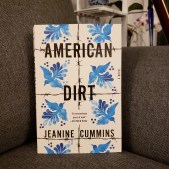
American Dirt

Rating: ⭐⭐⭐
Author: Jeanine Cummins
Genres: Fiction
Pub. date: Jan. 2020 (read Apr. 2020)

So I know this book has had its fair share of good and bad reviews. We threw this one on our book club list right after it came out because the synopsis sounded so compelling and it wasn’t until later that I heard about some of the criticisms surrounding the book. Between then and now I forgot completely everything I’d read about the book and ended up going into it completely blind. For some reason I thought this was a book about adjusting to life in America after immigration – that is clearly not the case.

American Dirt tells the story of mother and son, Lydia and Luca, as they are forced to flee across their home country of Mexico to escape the violence of the big drug cartel in Acapulco, Los Jardinos. They end up joining the many migrants who make the epic journey across Central America in the hopes of finding sanctuary on the other side of the American border.

I can see why the book is popular – it’s been compared to a modern day Grapes of Wrath and deals with a topic close to the heart of all Americans – not just those in the United States who’ve taken ownership over the term. The catch is that the book is written by a white American woman with no first hand experience of what it means to be a migrant.

Honestly, I think that even 5 years ago few people would have raised a flag about the author. Unfortunately most mass consumed literature is written by white people, but I think there has been a real shift in recent years to highlight other authors and other stories – that representation matters and that’s there’s so much value to be gained from Own Voices writers. Obviously there’s a whole genre of historical fiction where this is largely impossible and I don’t think that we shouldn’t write about that which interests and inspires us. But it’s definitely a sensitive topic and I understand why the book has been criticized for this fact.

I’d like to try and explore both sides of this issue in my review. I cannot deny that I loved this book. I am the exact intended audience. A white woman that cares about social justice but is woefully ill-informed about the migration crises south of the American border. Whether the author correctly captured the migrant experience or not, I found this book incredibly eye-opening and though it describes something I knew was happening, it really drove home the plight of migrants. I think it will likely draw attention to this injustice and hopefully inspire people to become better informed and take action on it.

That said, as a reader, I still have a responsibility to acknowledge where this account may have its shortcomings. For this I look largely to the internet, from people who have had first hand experience of migrating to America. American Dirt has a very dark plot and I found the characters had almost no positive experiences. I’m sure this is largely the case for a lot of migrants, but I also wonder if in an effort to shock and engage – Cummins took every traumatic experience she’d ever heard of and combined it all in to one book. I did worry that she was stealing from the migrant experience to create an edge of your seat social justice thriller. While this trauma is likely all based in reality, its not meant for entertainment. I thought Cummins did maintain a good hold on this balance for most of the novel, but veered a bit to the extreme towards the end. Lydia’s interaction with Javier at the end of the book and what happened to Beto really pushed it over the edge for me into the use of someone else’s trauma for the sake of a dramatic climax.

The other area where I questioned Cummins authenticity on the subject was in her portrayal of America. I read in other reviews that her rudimentary use of Spanish in the novel is belittling and that she was ignorant to large parts of Mexican culture. I’ve seen it criticized that Lydia seemed way too shocked about the things that happened in her own country, things that any other Mexican would not find shocking but be well aware of. What I did note was the consistent portrayal of America as the ultimate salvation. It took on a bit of a mythos among the characters, though I think we all know America is still hugely flawed. Cummins did capture this somewhat better towards the end with the introduction of Marisol and other deportees. but I think there needs to be some sense of reality that even people fleeing to America recognize its shortcomings.

So the book is not without flaws. To further educate myself, I did some research on other existing literature about the experiences presented in this book that are actually based on first hand knowledge. I decided to add the following books to my TBR to hopefully get a broader and more accurate perspective of the issue: The Distance Between Us by Reyna Grande, Enrique’s Journey by Sonia Nazario, Lost Children Archive by Valeria Luiselli, and the Book of Unknown Americans by Christina Henriquez, which was actually already on my TBR.

Moving on to what I liked about the book. I can’t deny I liked the writing. I connected with these characters. Not because I pitied them, but because they had such rich and emotive back stories. I liked the depth that Cummins brought to Lydia’s character and her relationship with Javier, Rebeca’s depiction of her mystical village in the cloud forest, Soledad’s quiet and reverent love for her sister and father, and the relationship that developed between Lydia and Luca, born of the grief they shared. I liked the exploration of how the immediate need to survive can overpower trauma and the fear that arises out of having no one you can trust – when anyone could be a potential informant. How violence can make you doubt even the authenticity of a 10 year old boy and how even in periods of extreme stress, people are still willing to sacrifice anything to help someone else in need.

Once I started this book, I struggled to put it down. I was on edge the entire time I was reading it and even though this will never make the reader understand how it feels to be in the characters situation first hand, I really felt the sense of urgency, the fear, and the unknown plaguing these characters throughout the course of the book. I don’t regret reading it, in fact I am definitely glad that I did. I lament that Latinx writers are not getting the same exposure as Cummins did, but I am glad to have been exposed to this story. I will try and do my best to pick up some other books on the subject with authors more closely connected to their subject matter. Looking forward to discussing this one at book club!

Greenwood

Rating: ⭐⭐⭐
Author: Michael Christie
Genres: Fiction
Pub. date: Sep. 2019 (read Mar. 2020 on Audible)

It’s been just over a month since I finished Greenwood, so I’ll do my best to review. Like a lot of my audiobooks, I didn’t really have any intention of reading this book, but I stumbled across it, liked the sound of the narrator, and thought it seemed interesting enough. The story did get bogged down in places, but overall, I really liked it.

Greenwood tells the story of the Greenwood family over 4 generations and is a mixture of literary fiction, mystery, and dystopia all rolled into one compelling book. The highlight of the storytelling for me was in the structure. The novel starts on Vancouver Island in 2034. In recent years a tree virus has felled the majority of the world’s trees, but there’s still a pristine old growth forest that remains on a small island near Pacific Rim and it’s here that ecologist Jake Greenwood works, taking wealthy vacationers walking along the last remaining giants.

From here, each part of the story takes us back in time, to Liam Greenwood in 2008, a carpenter who renovates homes using reclaimed wood. Then to Willow Greenwood in 1974, a hippy and environmentalist who protests her father’s rich timber company. Then back to Everett Greenwood in 1934, a poor hermit who lives in the woods farming maple syrup, and then finally to 1908 and the events that started everything for the Greenwood Family. Once we reach 1908, the story reverses again as we slowly start to make our way back to 2034. It’s a fascinating structure. I loved going back in time to learn more about the events that preceded each storyline, only to learn new mysteries that I won’t find the answers to until the story reverses itself again.

The majority of the story takes place in 1934 and the actions Everett takes have a lasting impact on the Greenwood Family for generations to come. It’s interesting to see how secrets are hidden and how easily history can be lost over multiple generations. How quickly the cycle of poverty can reverse itself. My favourite timelines were 1934 and 2034, but I think they all offered something unique to the story. I did think the author dragged out the 1934 storyline a little bit too much – it is the critical part of the book, but I don’t really think this book needed all it’s 500+ pages and easily could have been more in the 400-450 range.

I did love how this book takes us all over Canada and parts of America and how it incorporates trees as its central theme. Even though some of the family members use the trees as a resource for profit and others seek to protect the trees, they all make their living from the trees and are impacted by them. It’s interested to see something inanimate like a tree take on such a central role in the novel. As someone who lives in Western Canada and loves the landscape here, I really enjoyed the exploration of the value of trees and was moved by the imagination of a world without them. Our old growth forests are incredibly valuable and I can’t imagine the loss of them, much less the majority of trees on the planet. How they scape our cities, towns, and parks and the number of resources that we pull from them.

So overall I did find the story slowed down in places, but overall I really enjoyed and would recommend to lovers of Canadian lit!

The Tattooist of Auschwitz

Rating: ⭐⭐.5
Author: Heather Morris
Genres: Historical Fiction
Pub. date: Sep. 2018 (read Apr. 2020 on Audible)

This was supposed to be my book club pick for March, but then of course our meeting was cancelled and I couldn’t bring myself to pick up a holocaust book during a global pandemic. We’ve rescheduled our book club meeting so I decided to give the audiobook a go since I’ve been struggling with paperbacks recently, but have been doing a lot of jigsaws. This was definitely the way to go and a flew through this short book and my latest jigsaw in a single weekend.

Aside from the whole pandemic thing, I still wasn’t really looking forward to reading this because I’ve read a lot of holocaust books over the years and though there’s many great and emotional books on the topic, after reading so many books about the camps I find not a lot of new content offered anymore, so it’s just easier not to read such upsetting works.

The Tattooist of Auschwitz does offer a point of view I haven’t seen before, that of a Jewish prisoner conscripted to work as the tatowierer who inks all of the prisoners with their number when they enter the camps. It was an interesting story in that is was told from the point of view of someone who received preferential treatment in the camps. Lale was spared from physical labour and given his own room in one of the camp blocks. He didn’t have to report for roll calls and so was able to move about the camp a lot easier than many other prisoners would have been able to. He uses this privilege to build up a bit of an underground trade. The girls who go through the prisoners clothing provide him with jewels, which he trades for extra food. Building up a stockpile which he shares with other prisoners and uses to cash in on favours.

Unfortunately this book made me really uncomfortable, but not in the way you might expect a holocaust story to make one feel uncomfortable. I feel like I might be a bit callous in critiquing a story such as this one, but there were 3 issues I had with the story.

First of all, on Lale’s first night in the camp, he is stunned to see two men shot and killed for sport by the Nazis while using the bathroom. Upon witnessing this act, he vows that he will do whatever it takes to survive the camp. That’s all good and I admire his tenacity, but Morris revisits this theme several times throughout the novel and I felt like I was supposed to believe that Lale survived Auschwitz out of sheer force of character. This was not the case – he relies heavily on the kindness of others, which he takes advantage of to improve his own situation and that of those he cares about. But on more than one occasion his life is saved by other individuals. This in itself isn’t a big deal, but pushing the narrative that Lale’s grit is what enabled his survival is belittling to all the people that didn’t make it out of the camps. Grit and determination have literally nothing to do with surviving the atrocities of a concentration camp. Lale traded on the kindness of others and was incredibly lucky. I don’t find any fault in Lale’s actions, but let’s just call it what it is.

The second issue that bothered me, and what made this an uncomfortable read for me, was the love story between Lale and Gita. I can’t say I’ve ever read a love story set in a holocaust camp. I’ve read so many beautiful holocaust stories in which love is the central theme, but definitely not a ‘meet and fall in love in a camp’ story. Again, the idea of a couple falling in love in a concentration is not that unbelievable – this is based on the true story of real life couple Lale and Gita, so it obviously happened, but the writing about the love story just made me soooo uncomfortable.

Like I said, I believe two individuals could fall in love in a camp. Under unthinkable emotional trauma, it would be natural to seek comfort and reassurance from those around you. To be brought together by your shared experience and build a deep and lasting bond of trust and understanding. I didn’t struggle to believe that Gita would fall in love with Lale, he looked after her most basic needs, found her better work, food, and medication, and provided emotional support through a traumatic experience. But please don’t try and portray this relationship as sexy. Lale and Gita were both victims of their situation and I really think the author grossly romanticized their relationship. I know this is based on a true story, but it’s also based on one man’s 70 year old memories. Maybe this is the way Lale remembered his experience, but this is still “fiction” and the author has a duty to question how those memories may have been manipulated an warped over the years to block out a traumatic experience.

I find it hard to believe that after living several years in a concentration camp, being beaten and starved, that anyone would use a chocolate bar to try and seduce someone. In general I just couldn’t help but cringe at all of the romance scenes. Especially how Lale talked about women – how “all women are beautiful” and you have to take care of women, and what a womanizer he was. It was so eye-rolling, but again, obvious that it was probably lifted straight from her interview with Lale. Of course an old man who grew up in the 1930’s would talk like that, but nothing about it felt genuine or reflective of how Lale actually might have felt in 1942.

But this is just one example of the ways in which I struggled to buy into the story and felt Morris’ should have taken more artistic license in how she told it. Everything about Lale’s experience seemed to be romanticized. How easy it was for him to trade in diamonds and food, how he was able to manipulate almost everyone around him to get what he wanted, how no part of the camp was closed off to him and he could pretty much just do and go where ever he wanted, how easy it was for him to survive an interrogation without breaking down, and then just pick up the pieces of his fabricated life in the camp once he was released again. I don’t disbelieve that this was the account Morris’ received from Lale, but again, it’s where your duty to history and the reader comes in to question the authenticity of those experiences and how your portrayal of a concentration camp might read to those who have lived through similar, though very different experiences. I felt the author failed to portray the horror of the concentration camps, which should really be the easiest part of the story.

The Tattooist of Auschwitz reminded me a lot of another WWII book I read a few years ago, Beneath a Scarlet Sky. Both are fascinating stories in themselves, but both books were inspired by late-in-life interviews with their subjects. In both books I think the authors rely too heavily on the source material from their interviewees and somehow fail to connect to their characters on an emotional level.

Which brings me to my final point. This book was poorly written. This is more a flawed chronological account of Lale’s 3 years in the camps than a meaningful piece of historical fiction. Morris relies heavily on dialogue and plot to carry her story, but misses out on any kind of characterization. Somehow an emotional story of 3 terrible years in concentration camps lacks in any real emotional connection. Now obviously this is a personal opinion. I know a lot of people really loved this and connected with Lale, so it makes me feel like a bit of troll saying that I didn’t feel anything from a holocaust story, but I just felt that Morris didn’t give these characters the humanity they deserved. Her writing style is very detached and as such, I always felt detached as well. The story just seemed to be “and then he did this and then he said this and then she did that”. It was just kind of boring.

It was a story with a lot of promise, and like I said, it does show a different experience of life at Auschwitz, but I just wanted more from it. Lale is a flawed individual and I would have loved to see more exploration of how his morality was impacted by his time in the camp. He alludes a few times that he was worried he might be considered a collaborator and I would have liked to see more of that internal struggle. He was a generally selfless person and i felt he likely would also have struggled with the fact that he couldn’t help everyone and the impact having to decide who he would help might also have on him. At 250 pages, there was certainly room to better develop this story, so I was disappointed that the author decided to just retell an interview rather than do the hard emotional reflection on how this experience would impact Lale and those around him.

I think I’ll end it there. I could probably say more, but this is getting long enough. I see there’s a sequel. I am intrigued that it’s about Cilka, she is one of the characters that I probably empathized with the most and it was really upsetting to learn she was convicted as a collaborator. I’m curious if her sequel is fabricated or actually based on a real person. Anyone know? I won’t be reading it either way, but I am intrigued.