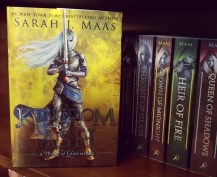
 Rating: ⭐⭐⭐⭐
Author: Sarah J. Maas
Genres: Fantasy
Pub date: Oct. 23, 2018 (read Oct. 2018)
Series: Throne of Glass Book #7
This is going to be a beast of a review for a 1,000 page beast of book. Kingdom of Ash has totally taken over my life this past week and I have so many thoughts on the conclusion to this epic series.
As usual, I’m a little torn on how to rate this. Did I enjoy reading it? Absolutely. Was it intense? Undoubtedly. Am I satisfied with the ending? Mostly. Did it still have problematic elements? Sadly, yes.
This series has had a lot of ups and downs over the years. Upon re-reading the series, I’ve come to the conclusion that Crown of Midnight and Empire of Storms were my favourite books in the series, and Tower of Dawn was my least favourite. KoA kept me on the edge of my seat for the full 1,000 pages, but it could definitely have been shorter and I don’t think it will top my list for favourite book in the series.
Disclaimer, I won’t be able to keep this review spoiler free, so if you haven’t read the book yet, I would hold off on reading this review.
First off, the beginning of this book is really dark. I mean, I was expecting it to be dark based on how Empire of Storms ended, but I was not anticipating just how far into the depths this would go. We know at the end of EoS that Aelin is trapped by Maeve and likely to be tortured, but it was so much darker and worse than I expected. In fact, my spirits were so low in the first 300 pages of this book that I almost had to put it aside for a while and I was unsure whether Maas would be able to redeem the story after bringing it to such a low point. However, though I could have done without some of the descriptions and inference of how Aelin was tortured (I really hate any depictions of torture), I appreciate that Maas didn’t shy away from the impact it had on Aelin. Aelin is a mess after escaping from Maeve and she doesn’t bounce back. Every day is a struggle and she tries to put on a brave face for the people around her, but we know she has been broken. She is so tired of the war and the sacrifices demanded of her and she repeatedly says she just wants it to be over. Her feelings rang so true for me and I was really glad Maas wrote Aelin this way and didn’t shy away from the impact it would have on her. As a side note, I also loved the inclusion of Rowan asking Aelin for consent before touching or kissing her again after she escapes Maeve. So overall, I thought Rowan and Aelin were really well done in this book. There were still a lot of sex scenes (overall, not just Aelin and Rowan), but they were definitely more low key and background to the plot.
My second favourite part of the story was by far Dorian. I thought Dorian kicked some ass in this book. He was really more of a tag along character in EoS. He was recovering from his ordeal with the valg prince and didn’t contribute a lot to the story. But Dorian is a king in his own right and I wanted to see him play a larger role in the story. Maas definitely delivered in KoA. He takes control of his own power, makes his own decisions based on the needs of his kingdom over his personal (or anyone else’s) wishes. He is not afraid and takes on the enormous burden of finding the third wyrdkey. My favourite moment in his story arc was when he tricks Maeve. I figured he had some other plan up his sleeve, but I ultimately expected him to be overcome by Maeve and I loved when he destroyed Morath all on his own. The only thing I wasn’t into was Dorian and Manon’s relationship. There’s not really any chemistry between them and I found it hard to believe someone as badass as Manon would be into someone like Dorian. I didn’t like when he basically made her ask him to stay, but I did like that they both understood that she would ultimately never be happy with Dorian, and that while she liked him, her Queendom meant way more to her. She wanted to win back and live in the Wastes and Dorian wanted to rebuild his kingdom.
Finally, I was pretty into Elide in this book. In my review of Empire of Storms, I talked about how important of a character Elide is because she’s essentially the only one without any physical strengths, but she gets by just fine on her wits. I was thrilled to see her play spy in Doranelle at the beginning of the book and to see her repeatedly save her friends throughout the story. She plays a huge role in winning the war and I was shocked at how important her and Yrene were to the conclusion of the story. I just expected Maas to give the glory to one of the other characters, and I actually thought it was great that she wrote Yrene and Elide as two of the heroes of the story. The only thing I didn’t like was how mean Elide was to Lorcan at the beginning. I thought it was justified at the end of EoS, and I could see her just ignoring him through this book, but she was actively mean to him, which I didn’t like.
That said, I did really like Lorcan in this book and I LOVED Fenrys. Fenrys was kind of irrelevant in EoS, but his story in this book is devastating, yet beautiful. He and Aelin suffered so much and I really liked the relationship Maas developed between them. How two people who had suffered so much, could understand each other so well and be a comfort to one another while they both tried to heal themselves. Plus I thought their storyline was clever and I loved their secret code. As for Lorcan, he’s a character who has developed so much since the start of EoS, when he was basically just a mindless killing machine, to finally finding some humanity and reason for living. He ended up being a very sensitive character and proves that even after 500 years, people are still capable of change.
While we’re talking about the cadre, I will say that I’ve never really cared for Gavriel. He was arguably the nicest of the cadre at the beginning, but he kind of just felt irrelevant. I didn’t care at all about him being Aedion’s dad and thought it was totally unnecessary filler. Plus I thought his reunion with Aedion was actually the worst thing ever. I was not impressed that Maas brought them together for like a minute, only to tear them apart again. I feel like she was trying to make this into a great sacrifice, but like, I never really cared about Gavriel and I think she only wrote this scene to get out of having to harm any of her other more important characters. It just felt kind of cheap.
Which is really one of the biggest complaints I have about this book. If you’re still reading this review and haven’t read the book, I’m about the get into major spoilers now. My complaint is that it felt unrealistic that nobody from Aelin’s court died at the end. I was gearing myself up for Dorian potentially sacrificing himself, which would have broke my heart, but been meaningful. I never really believed that Maas would see through the “queen who was promised” scenario because I just didn’t think she would separate her star crossed lovers, Aelin and Rowan. But really, no one died (I’ll get to the Thirteen). Aedion and Lysandra were fighting that tedious battle in Terrasen for the entirety of the novel, I found it very improbable that one of them wouldn’t die.
Aedion and Lysandra’s story was easily my least favourite sub-plot in this book. It was boring and so repetitive. Plus, the timeline made no sense. They fought essentially the same battle for the entire time that it took Aelin to escape, travel to Erilea over the span of weeks, take back Anielle, and then travel to Terrasen (again, over multiple weeks). I felt like it was supposed to create this huge sense of urgency, which it did, but it just wasn’t believable. Plus it was really boring! Also, side note, are we seriously supposed to believe this entire SERIES took place in just over a year? Girl please. There is no way Aelin escaped Endovier; dated Dorian and Chaol; saw her friend murdered; spent MONTHS in Wendlyn; met, fought, fell in love with, and MARRIED Rowan; came to terms with her heritage as queen; killed the king and brought down the glass castle; amassed Arobynn’s fortune and multiple armies; was captured for MONTHS and escaped; all in the span of ONE YEAR. Just no, not possible. She cannot possibly still be only 19 years old.
One of the main things I didn’t like about A Court of Wings and Ruin was that it was all about war and strategy and tactics. Maas lost a lot of the character development that made ACoMaF so great by making ACoTaR a more plot driven novel versus character driven (like ACoMaF was). I think she did a better job here, it was definitely still a character driven novel, but after a while battles just get boring and don’t necessarily drive your plot forward. Aedion and Lysandra’s plotline really needed more substance to it, it was just not enough to carry throughout the entire book. Plus, I really hate Aedion. Like a lot – especially at the beginning of this book. He is actually so mean to Lysandra. I said I didn’t like how Elide was mean to Lorcan, but I felt she was at least a little justified, whereas all Lysandra ever does is try to do what her Queen has asked of her and Aedion treats her like shit for it. I’ve never liked Aedion because he is so arrogant and borderline abusive, but he went to full abusive in this book and after he threw Lysandra out in the snow, I finally parted ways with him forever. In my eyes, he lost any chance of redemption and I really hoped Maas wouldn’t pair him and Lysandra together at the end. He was too mean to her and actually abusive. Super pissed about their storyline. In my opinion, Aedion would have been the perfect character to kill off. Someone needed to die, he’s still beloved, but like, we don’t need him.
Have I got through all the characters yet? There’s so freaking many! I don’t have much more to say about Chaol and Yrene or Nesryn. Honestly, did Tower of Dawn really even matter that much? When I read it I was like, oh this is actually really important to the storyline, but Aelin figured out Maeve was valg on her own anyways, so the only thing Tower of Dawn really added to this book was a huge army and a healer. We really didn’t need a 700 page book for that and I just thought all the characters from Tower of Dawn felt really two dimensional in this book. Everyone from EoS had this real depth to their characters, but Nesryn, Sartaq, Borte, and Falkan all felt like fillers. Yrene ended up being important, but for someone who was one of the core characters of the original series, I felt Chaol didn’t add that much to this story. I was glad to see him using his chair, cane, and horse, without complaining about it, and that he let Yrene live her life and wasn’t overprotective of her. I also loved seeing him and Dorian reunited, but overall Chaol just felt a little secondary.
And finally, Manon. I cried real tears for Asterin and the Thirteen! I loved how they died in that I thought it was a really powerful scene, but again, I kind of think Maas set them up to be the sacrifice over other characters. I loved watching them interact with the Crochans and how the Thirteen have always inspired Manon to be a better person. I was disappointed that Manon’s storyline seemed to focus more on Dorian than the Thirteen though. I don’t resent Maas for their sacrifice, because I did think it was really beautiful and well done, but I wish it had maybe been a little later in the plot? I don’t see how Manon could have ever come back from that. It really would have destroyed her. But I did love the scenes with the Bluebloods and that it was Petrah who took down Iskra.
I read an observation recently about how Manon should have been gay in this series and now I can’t stop thinking about it now. Maas has gotten push back about her books for not being diverse and being super straight. She tried to address this in ACoWaR by having Mor come out as gay, and the more I think it about it, it would have been so easy for Manon to have been gay. The witches totally don’t care about men at all, there are no male witches (well some in the Crochans I guess), and Manon is all about the sisterhood. Like, Manon and Asterin would have made the best couple ever. They definitely had more chemistry than Manon and Dorian.
Anyways, it brings me to another complaint about Maas’ books in general. I don’t get what the weird obsession is with mates and how the mating bond is like the strongest thing in existence. There’s definitely some abusive mates out there who probably trap each other in crappy relationships. In ACoMaF, Rhys even talks about how his parents were mates but weren’t actually that great together and that mates don’t always love each other, so it just seems like a really crappy system for finding your life partner. And I don’t get why is Maas so obsessed with pairing off every single one of her characters. Are there any single characters in this series? Because I can’t think of any? Fenrys and Gavriel are the only ones that come to mind, but not even Gavriel really because he’s supposedly still in love with Aedion’s mother who died. It just gets a little tedious and repetitive when every single main character turns out to be mates with another main character. Even Aedion and Lysandra? Like I knew they were going to end up together, but I didn’t think Maas was going to push the mate thing on them too. (and even the wvyerns have mates, lol, although kind of cute because Abraxos is adorable)
So I obviously have complaints about this book/series. I thought the whole Aelin escaping death thing was too convenient. It kind of cheapened the whole “queen who was promised” storyline and the fact that the Gods didn’t even take Erawan with them? What the hell?! Why did we just waste 3 books searching for wrydkeys, who even cares if it doesn’t get rid of Erawan?
Maas had the perfect setup to save both Aelin and Dorian, I don’t know why she didn’t use it? It made sense that Aelin would want to take the burden upon herself, and her asking Dorian to share the burden would be a great lesson in relying on your friends. You don’t have to do everything yourself, take everything on yourself – arguably one of Aelin’s biggest flaws. The idea that the two of them could each give half of their power was such a brilliant plot element in my opinion and would have been a really nice and sentimental moment about friendship. But no, Aelin had to take it all on herself and then have Maas make up some stupid way for her to escape it all. Did anyone else pick up on that Rhysand cameo by the way? I thought that was the freaking weirdest thing ever. I also missed the part in the plot where the keys were about sending the gods away… I thought it was just about sealing the gate Erawan was using and sending him back. I didn’t realize we were going to banish the gods as well. Ballsy move Maas, but it just didn’t really seem to fit the rest of the story.
However, I did like that Aelin actually lost her powers (though this still could have been accomplished with each her and Dorian each giving half their power). But I didn’t like that she had to lose her humanity. Also just felt very cheap. But I liked that she ultimately learns to rely on her friends by letting Elide, Yrene, and Dorian take care of Erawan, and that she took on Maeve without her powers. It said more about the character of the cast that they weren’t afraid to take on these two demons, even with reduced powers. So I actually did really like the conclusion of the book, with the exception of the random wolf tribe faes coming in at the end. They are literally never mentioned anywhere in the book, so it felt really anti-climatic and cheap. Plus, I need someone to explain to me how Aelin opened up all the portals, because that felt like a huge plot hole to me.
Mostly the battle scenes just felt really repetitive. I was nervous that this would happen after how ACoWaR ended. There were a lot of battles going on in this book, and they were constantly saved by a new ally showing up in the nick of time, only to have Erawan again send more forces that again warranted the arrival of yet another ally to save them. But the wolf tribe was by far the weirdest, because it didn’t even seem like it was really necessary. The Khagan’s forces seemed to mostly have everything under control, and if you’re just going to have all the armies collapse when Erawan dies, than you didn’t really need an extra army anyways.
I think that’s most of what I wanted to say. I do have one last comment about how Maas seems to have lifted a few plot points and phrases out of the Lord of the Rings movies/books. I picked up a few of them myself and was kind of like, “I think that’s from LoTR”, but didn’t think that much of it, but then I read this review about it and realized just how many times some things seems to be lifted from LoTR, so I think it’s worth mentioning.
I have ended up voicing a lot of complaints here, so despite how it might seem, I did actually really enjoy this book. I don’t think I’ll be in a hurry to re-read it and there were definitely problematic elements, but there was also a lot that I really liked about it. Like I said, I actually really liked the conclusion and I will be sad to part ways with this series. It’s definitely been a journey and it’s great to see epic fantasy series like this coming from female authors. Writers are definitely held to a higher standard these days, but it’s not an excuse to not have diversity in your books. Sarah started writing this series like 15 years ago, so it may be interesting to see what she comes up with after finally parting ways with something she’s been working on for half her life. This series was incredibly impressive in scope and I think I’ll always have fond feelings for it. But now I am feeling thoroughly wiped out and I need to go read anything that is not fantasy while I decompress.
Much love!
 Rating: ⭐⭐⭐
 Rating: ⭐⭐⭐⭐
 Rating: ⭐⭐⭐.5
 Rating: ⭐⭐⭐⭐
 The Paperback Princess