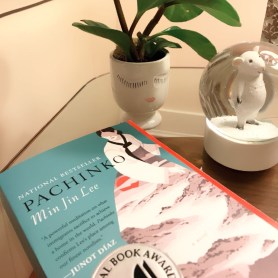
Pachinko


Rating: ⭐⭐⭐⭐
Author: Min Jin Lee
Genres: Historical Fiction
Read: Jan. 2018

It feels like I’ve been working on Pachinko for ages, but I finally finished it. I flew through several books at the beginning of the year, but it was nice to settle down with this one, which is definitely an epic and had a lot of depth.

If you’ve been following along, I decided to read 3 books about immigration for my January Challenge and Pachinko was my second selection. I read Girl in Translation earlier this month and loved it. I picked Pachinko because it’s been getting rave reviews and it’s one of the few books I found about immigration that wasn’t a story about immigrating to America.

Pachinko begins in Korea in 1910 and takes us on a journey with 4 generations of the same family as they are forced to leave their ancestral home and build a life for themselves in Japan. This was a great history lesson and I learned a lot about both Korea and Japan and the touchy relationship between the two. Korea was colonized by Japan between 1910 and 1945 and split into North and South Korea after the second world war.

The story starts with Sunja and her parents, Hoonie and Yangjin, who run a boarding house in the small town of Yeoungdo in southern Korea. Sunja falls for a wealthy Korean visiting from Japan and becomes pregnant. Fortunately, one of their boarders, a young christian minister Isak, feels led to marry Sunja to save her from the shame of bearing a child out of wedlock and so that her child might take his name. Isak had been on his way to Japan for an appointment with a church when he stopped at the boarding house and they marry and Sunja accompanies him to Japan.

Relations between Japanese and Koreans were not good at this time and there is a lot of racism against the Koreans. The Japanese believe themselves to be the ruling class and think of Koreans as dirty and stupid. Sunja faces a lot of challenges living in Japan and the novel takes us though 80 years of history through Sunja’s children and grandchildren.

This is definitely not a fast read, but it is very impressive in it’s scope. I haven’t read a lot of historical epics (Ken Follett’s Fall of Giants trilogy is the only other one that comes to mind) and at times Pachinko felt very slow moving, while at other times I was really into it and wanted to know what would happen next. With 4 generations, we inevitably experience many deaths in this book and some of them were actually quite shocking and emotional!

There are so many great themes in this book. I loved Sunja and Kyunghee’s characters and their experiences as women and with motherhood. Lee continuously explores women’s roles throughout the novel and the expectation that a woman’s lot in life is to suffer. Their husbands and family were everything to Sunja and Kyunghee and it never occurred to them to seek happiness for themselves outside of their family. They both had dreams for their lives, yet they were always secondary to the dreams of the men. With each new generation it was interesting to see how women’s roles would change and I enjoyed when Sunja starts to question what her life might have been or could be now if she had made other choices.

The familial relationships in the story are heartbreaking. There’s so many different relationships presented in this book and they were all very beautifully written (although sometimes tragic). This family is tried again and again. They all suffered an enormous amount as Koreans, but their tenacity was inspiring in what they were able to accomplish. I really liked Kyunghee and Kim and I was really intrigued about what happened to the Koreans who returned to North Korea after the war. Lee leaves us with quite a lot of unanswered questions, but I think this is very much indicative of the relationship between Japan and Korea. North Korea was very much a big black box and you never knew what happened there. Many Koreans had to live their entire lives without ever finding out what had become of their friends and family.

I liked Mozasu’s story with the Pachinko parlours as well and I loved the themes Lee tied in with the parlours. So many Koreans were trapped in a cycle of poverty in Japan. They were 2nd or 3rd generation immigrants who had come to the land of their colonizers in search of prosperity and were then later emancipated from their homeland. It was so hard for Koreans to succeed in Japan and they were always looked down upon, yet there was nothing in Korea for them to go back to.  Pachinko parlours are gambling dens where you can play these pinball-like machines in hopes of winning. Because of the gambling, parlour owners were often mixed up in dark criminal underworld and linked with the Yakuza, the Korean gangsters. I liked that despite being rough around the edges growing up, Mozasu was able to discover who he really was in the Pachinko parlours and become an honest man, despite how easy it would have been to become corrupted.

“Every morning, Mozasu and his men tinkered with the machines to fix the outcomes – there could only be a few winners and a lot of losers. And yet we played on, because we had hope that we might be the lucky ones. How could you get angry at the ones who wanted to be in the game? Etsuko had failed in this important way – she had not taught her children to hope, to believe in the perhaps absurd possibility that they might win. Pachinko was a foolish game, but life was not.”

As a book about immigration, Pachinko was fantastic. There are so many thoughtful nuggets of information and shared experiences about immigration in this book. I was particularly moved when Mozasu had to take Solomon on his 14th birthday to get his fingerprints taken and get his documentation card so that he could remain in Japan. Even though he and his son had both been born in Japan, they were forced to renew their identity cards every 3 years and could potentially be deported to South Korea – a country neither of them had ever known. This is so relevant to what’s happening all over the world with white people spewing hate at immigrants that have been living and contributing to their countries and economies for years.

I’ll finish with a quote from Solomon towards the end of the novel which I loved for it’s hopefulness despite the decades of discrimination his family had experienced. I appreciated the relationships Lee built between the Koreans and the Japanese, to remind her readers that we are all just people. There are good actions and their are bad actions, but we are each our own and we can each actively make the decision to accept and support each other, rather than hate.

“Kazu was a shit, but so what? He was one bad guy, and he was Japanese… Even if there were a hundred bad Japanese, if there was one good one, he refused to make a blanket statement. Etsuko was like a mother to him; his first love was Hana; and Totoyama was like an uncle, too. They were Japanese, and they were very good.”

The Life She Was Given


Rating: 
Author: Ellen Marie Wiseman
Genres: Historical Fiction
Read: Jan. 2018


Oh my goodness, how much suffering can one person take?

The Life She Was Given follows the stories of two women and switches back and forth between their perspectives every other chapter. Lilly’s story takes place in the 1930’s and begins when she is 10 years old. For the first 10 years of her life, Lilly has only known the attic of her parents manor. She is an albino and is shunned by her religious mother who views her as an abomination. However, one night she sees the red and white stripes of the big top being set up in the farmland near their estate and her mother hurries her out of the house for the first time in her life. Lilly is overwhelmed and shocked to discover that her mother has conspired to sell Lilly to the circus and abandons her with a controlling and terrifying man named Merrick who runs the circus sideshow, also known as the freak show.

As Lilly adjusts to circus life, we follow the story of another young woman, Julia. It’s the 1950’s and Julia is 18 and has run away from home, leaving behind her controlling religious mother and their huge manor. When she hears her mother has passed and the estate has been left to her, she reluctantly returns home and begins exploring the manor, discovering several photos of a young circus performer and realizing that her parents may have been hiding some dark secrets in the manor.

This book is a hard read. It is dark and disturbing and filled with an intense amount of suffering. I’m not opposed to reading dark books and I actually really like gritty books that make you feel, but there was very little that I enjoyed about this book.

First of all, Julia’s story was sooo boring. Barely anything happens to her and I found her whole side story with the horses pretty pointless. I can see why Wiseman decided to include it since it goes with her whole anti-animal cruelty theme, but honestly, I thought Julia’s arc with the horses really added nothing of value to the book overall. The whole premise of Julia’s story is that she finds stuff in the house that leads her to investigate what her parents were hiding, but it took forever for her to make any significant discoveries and I was just super bored. Julia was also totally unbelievable to me as an 18 year old runaway. Once she returned to the manor and took up all the responsibilities of running the farm, she seemed more like a 30 year old woman to me than an 18 year old who’d been living on her own with an abusive boyfriend for the last 3 years. She also didn’t read like someone who grew up in the 1950’s and I would have had no trouble believing her story took place in modern day. Overall I thought her characterization and development was very poor.

Lilly definitely had the more interesting story of the two women, but I didn’t love her story either. She was super mistreated, which I can understand because it was the 1930’s and people were afraid of things that were different or that they didn’t understand, but her story was just so dark! I found the whole animal whisperer thing to be a stretch and I didn’t really buy into it. I’m glad I read this book for my book club so that I can talk to some other people about it because I honestly have no idea what the theme of this book was supposed to be. Sure, this educated me a little bit on circus life, but really, what was the point of Lilly’s whole story? She just suffered and suffered without really seeming to grow as a character. I know she was mistreated her whole life, so it is understandable that she would be withdrawn, but she never actively did anything for herself. Things just kept happening to her and she only eventually escapes Merrick and finds any happiness because of Cole.

The ending of the book was just blah. I won’t spoil it, but everything about Lilly and Julia’s stories at the end just felt dramatic and overdone. There was no closure for me with this story and the ending felt very forced and not at all organic. I found this book to have a lot of clichés and insufficient justification for why some of the characters acted the way they did. For example, the whole thing with the zealous, religious mother and why she mistreated Lilly. This woman had zero compassion and felt like a caricature. She just was not believable to me as a human being and the “insight” into her character that Wiseman provides at the end was totally insufficient in helping me understand her. Honestly, Merrick was the only character I really thought was believable because I had absolutely no trouble imagining an overbearing, entitled man being a shit to woman to exert his control over them.

The whole animal cruelty storyline felt really cliché and basic too. I was eye-rolling hard at Julia every time she was opposed to something Claude wanted to do with the horses. Yes it is really sad about the nurse mares, but you are running a business and you can’t just adopt every foal put up for auction. But apparently Julia lives in a fantasy world where you can just abandon all manners of money making, become a philanthropist, and still maintain your wealth. For someone who basically lived on the street for 3 years, I found it really hard to believe she wouldn’t care about protecting her income.

Overall, this was an unsatisfying book and I’m glad it’s over.

Now I Rise

Rating: ⭐
Author: Kiersten White
Genres: Young Adult, Historical Fiction, Re-imagined History
Read: July 2017
Series: The Conqueror’s Saga (Book 2)


I couldn’t quite decide how I felt about this series when I read And I Darken, but after reading Now I Rise I am totally on the bandwagon!

This series is quite unlike anything else I’ve ever read. I love historical fiction and I love fantasy – The Conqueror’s Saga is a perfect mix of both genres! I would call this re-imagined history, focused on Kiersten White’s re-imagining of history if Vlad the Impaler had been a woman and in love with Mehmed the Conqueror.

The series takes place in the Ottoman Empire in the mid-1400’s when Lada and her younger brother Radu, heirs of Wallachia (part of Romania), are abandoned in the Ottoman courts and strike up a friendship with a young Mehmed. I won’t go into detail on the plot of And I Darken because it was a while since I read it, but Now I Rise follows Lada’s quest to take back the throne of Wallachia and Radu’s uncover spy mission into Constantinople during Mehmed’s attempt to take the city as one of his first accomplishments as the new sultan of the Ottoman empire.

I didn’t know much about the Ottoman Empire, so I found the historical aspects of this series fascinating. History remembers Vlad the Impaler as a villain, but to many Wallachian’s, he was a hero. Lada is completely ruthless and unforgiving, but you can’t help but love her as she does whatever it takes to restore Wallachia. She recognizes that she will always have to fight for power as a woman, but also acknowledges that the hardships she’s faced and the fact that she has to fight twice as hard as a woman is what gives her so much strength.

I liked how the series explores the different ways in which women could have power in the 1400’s and that power gained through marriage or children or even prostitution is still power and no less than that which is gained by traditional feats of strength or dominance. I love the scene where Lada is alone by the river, dealing with having her period, and is set upon by 3 men. She uses her femininity to her advantage and ultimately saves the lives of many of her men by doing so.

This series is dark and there is so much tension between the characters as they fight to gain power. The plot is strong, but the characters are really what really made this story wonderful. They are all so gritty and real. They do horrible things and make terrible choices and yet you understand their motivation and drive. I love the complicated relationship between Lada and Radu and felt such sympathy for Radu as he struggled with his feelings both for Lada and Mehmed. The secondary characters were all so wonderfully realized as well. Nazira is my hero and I loved Cyprian, Nicolae, and Hunyadi. I also enjoyed the exploration of religion in this book and Radu’s relationship with Islam.

Well done Kiersten White, can’t wait to read more!!

Scythe


Rating: ⭐⭐⭐.5
Author: Neal Shusterman
Genres: Science Fiction, Young Adult
Read: Dec. 2017


Scythe is another one of those 3-star books that is just so hard to rate. It raises a lot of really interesting questions and the second half of the book is pretty great, but the first half is such a snooze-fest!

I didn’t plan to read this series because it sounded pretty dark, but then I got a galley of the second book in the series, Thunderhead, so I decided to give it a go. Scythe is a utopian novel set in a version of the world where we’ve have basically perfected technology and solved all the problems of the world. Humans have reached the pinnacle of medical discovery and figured out how to make themselves immortal, as well as the pinnacle of technological advancements and have created a perfect artificial intelligence called the Thunderhead that now governs the planet. There’s no more sickness, no more poverty, and no more crime.

The only thing that remains outside of the jurisdiction of the Thunderhead is the Scythedom. Once humans obtained immortality, they had to find some way to manage population control, so they selected and trained an elite group of scythes to “glean” (kill) humans in order to maintain the earth’s population relative to the amount of available resources to continue living a comfortable existence. No one but a Scythe can permanently kill a human (if they die any other way they are just revived, Scythes carry out a permanent death). The Scythes are supposed to be live a humble existence separate from the rest of humanity and demonstrate compassion and justice in their gleanings. But over the hundreds of years of the Scythedom, some of them have started developing alternative opinions on the role of Scythes.

This story is about 2 teenagers, Rowan and Citra, who have been selected to apprentice to become Scythes. What I really liked about this book was how much it made me think. It raises some really great themes about living. In a world where we have made ourselves immortal and eliminated all forms of oppression, what really makes life worth living? We can’t really feel pain anymore and all of our accomplishments are meaningless because there’s nothing else left to be discovered or improved. In a world without suffering, can we really understand emotions like happiness and joy? Are these things humans can even experience anymore?

Then there’s the question of who deserves life and death? The Scythes all have their own strategies for “gleaning” and we are slowly introduced to several of them over the course of the novel. Should Scythes try and emulate the kinds of deaths that occurred in the age of mortality and target the same demographics? Should they look for people to “glean” who seem ready to move on or seem to have become stagnant in this life? Or just say ‘to hell with it’ and glean whoever they want? It’s up to Rowan and Citra to determine what kind of Scythes they want to be.

What I didn’t like about this book is that it took so freaking long to get going! I was really intrigued with the concepts, but Rowan and Citra are asked to basically give up their entire lives and to KILL people and it felt like it wasn’t even that big a deal. Where was the emotion? the drama? the angst?! They are 16 years old afterall and they just felt way too mature. I guess that is kind of the point though. They are selected for their maturity and empathy and in this new age where your emotions are constantly monitored and tweaked by “nanites” in your bloodstream, it’s almost impossible to emote in the same way that humans do now.

I get the whole exploration of how to be a Scythe, but I also felt like the whole thing was stupid and should have just been left to the Thunderhead to glean an appropriate percentage of old people every year. Why emulate deaths of the past when you don’t have to anymore? Why have to live in a world where children and young people die? In this world though, you have the option of “turning the corner” and returning your body to any age you want over the age of about 25, so there’s not really old people anymore and even though people are old in mind, they’re still able to have kids whenever they want. So theoretically, you’d still always be gleaning someone’s mother or grandmother, even if you didn’t glean children.

But I’m getting too far into the details. The second half of the book was happening! It has way more action and I found it hard to put down once I got past the halfway point. The plot reminded me a little bit of Hunger Games though. I feel like I’m going to be thinking about this book for awhile, so it’s definitely got that going for it, it was just a more detached kind of writing style. I tend to gravitate towards books that really emote and make me FEEL all the things. This book definitely made me think, but I always felt a degree removed from the characters and it made it a little harder to empathize with them.

Anyways, this is a much longer review than I thought I would write, but it did help me figure out some of my feelings on this book. So let’s call it a 3.5 stars. On to Thunderhead!

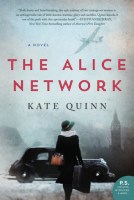
The Alice Network


Rating: ⭐⭐⭐ 
Author: Kate Quinn
Genres: Historical Fiction
Read: Oct. 2017 on audiobook


I listened to The Alice Network on audiobook, so I’ve slowly been making my way through this one for ages. It’s a historical tale set in France in both 1916 and 1947 and tells two stories simultaneously. In 1916, Evelyn Gardner was a British spy who operated in the french town of Lille, posing as a waitress and collecting information the German officers would spill over their meal. In 1947, Charlie St. Clair is searching for her cousin Rose who disappeared during the war. It turns out that Rose and Eve had a shared connection in that they both spied and worked under the same man in 2 different wars and Charlie pairs up with Eve to try and find her cousin.

I really liked Eve’s story. She was a part of the Alice Network, which was a real network of female spies in WWI, lead by Louise de Bettignies, alias Alice Dubois, or as she’s known to Eve, Lily. Louise was a real person and I found Eve’s story of spying on the German officers and how she would pass information fascinating. I don’t know how much of Lily’s character was fabricated, but hopefully not very much because she was an inspiring woman with her eternal optimism, humour, and spirit.

I didn’t love Charlie’s story. She was pretty annoying at the beginning of the novel (although I did feel for her and her predicament) and I found her story much slower moving. It only got interesting during the end and while I understand why Quinn decided to run their stories parallel, I felt that Charlie added very little to the story for most of the novel. I was disappointed at the end of each of Eve’s chapters when I knew I had to read a whole chapter about Charlie and I felt that little happened in her chapters to advance the plot. They went from town to town aimlessly and her story didn’t become engaging until the point when Eve started telling Charlie her story and they starting syncing up as Eve revealed more and more information to Charlie about her experience during WWI.

Definitely an interesting read though. I’ve read a lot of WWII books set in France so sometimes I get a bit fatigued with the “next big WWII book”, but I’ve read substantially less on WWI, which was another reason why I liked Eve’s story. That said, this was a well written book and I did enjoy it!