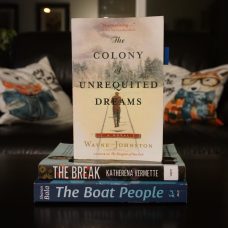
The Colony of Unrequited Dreams


Rating: 
Author: Wayne Johnston
Genres: Historical Fiction
Read: Feb. 2018

Where to start? This was a very long book that took a lot of motivation to pick up off my shelf, but that I ended up having a lot of opinions about. I was worried that it was going to be really dense, but fortunately, it turned out to be a very well written and engaging book about Newfoundland.

The Colony of Unrequited Dreams is historical fiction about Joey Smallwood, Newfoundland’s first premier who helped to usher Newfoundland into confederation with Canada. He is both a well liked and disliked premier, depending on who you talk to. Johnston definitely takes a lot of liberties with Smallwood’s character in this novel, but the story is still pretty accurately based on his life in terms of what he accomplished.

The story starts with Smallwood as a child in the early 1900’s. His family were shoe salesmen in St. John’s and he lived up on the Brow looking over the Harbour until his uncle decided to pay to send him to Bishop Feild, the prestigious boy’s boarding school of the day. At Bishop Feild, he meets Prowse, grandson of a noted historian, and Fielding, a girl who attends the nearby sister school, Bishop Spencer.

Fielding is the other main character in this story and unlike Smallwood, her character is completely fabricated. Fielding has a cane, walks with a limp, has a wry sense of humour, with sarcasm and irony being her preferred mediums. She’s a bit of an outcast who goes on to work as a reporter for The Telegram, publishing critical articles about all branches and parties of the government. Fielding marches to the beat of her own drum and I really liked her. I loved that she wasn’t afraid to speak her mind and I loved her sense of humour.

This book actually had a lot more humour in it than I was expecting and it had me laughing out loud early in the novel. Below is one of my favourite quotes from the book, which is an argument Smallwood has with his mother, and had me laughing because I also grew up in St. John’s while my parents grew up in rural outport communities. This is pretty much the exact same thing my parents would say to me growing up and the biggest way you could offend my parents would be to call them townies.

“I’m a Newfoundlander, but not St. John’s born, no, not St. John’s born,” he said.
“You’re a bayman and you always will be,” my mother said.

I’ve been living on the West Coast for the last 4 years, so this was super nostalgic for me. Wayne Johnston is not even describing my St. John’s in this novel because it’s set between 1900 and 1950, but there’s something really special about still being able to vividly picture the setting of a story, especially when it’s a place like Newfoundland, which I hold so special in my heart.

I didn’t love Joe Smallwood’s character, but I did like the writing. This was one of my monthly challenge books and I’m glad I challenged myself to read it because I probably never would have gotten around to it otherwise. Johnston does a really great job with the setting. I don’t know how non-Newfoundlanders might feel about this book, but I loved the setting and the atmosphere Johnston created. Especially towards the end when we finally get to the whole business of confederation and the end of independence. I felt like Johnston did a good job of not taking a side and presenting both sides of the story. It really makes you reflect on what Newfoundland gained, what it lost, and what may or may not have been.

I read Greg Malone’s Don’t Tell the Newfoundlanders several years ago and I felt that this book was a good contrast to that. Greg Malone is very clearly anti-confederation, as well as a bit of a conspiracy theorist. While I really liked Don’t Tell the Newfoundlanders, because it has some great history in it and I learned a lot, it is very speculative and I liked that Wayne Johnston presented a more balanced version of history and I feel he left his personal feelings out of it.

For those of you not well versed in Newfoundland’s history, we we’re an independent country up until 1933 when we had a commission of government forced on us by the British as a result of our war debt (even though A LOT of Newfoundlanders lost their lives fighting for Great Britain in WWI – I am a little bitter, yes). I’ve written an entire blog post about Don’t Tell the Newfoundlanders if you’re interested in our fascinating history (to me anyways), but basically we were supposed to get back our independence when we became self-sustaining once more, which we did after WWII. However, instead of just turning governance back over to Newfoundland, it was decided to hold a referendum to let the people choose if they wanted to join Canada instead.

Joe Smallwood wanted nothing more than to do something for which he would be remembered. He dropped out of Bishop Feild and failed at making a life for himself in New York, so he was desperate to have an influence in Newfoundland’s future. He was an avid socialist in his youth, but upon realizing that Newfoundlanders were never going to buy into socialism, he turned his talents to the Liberal government. He helped former Prime Minister Sir Richard Squires with his re-election campaign in hopes of winning the nomination to run himself, but he is jilted by Squires again and again and struggles to get into politics.

In this novel, he is a huge supporter of unions, walking across the entire provincial railroad line to start a rail-workers union, and he later travels all around Newfoundland’s most remote islands, trying to start a fisherman’s union. This really gave me an appreciation for how Smallwood became so popular and influential and why he supported Confederation. He really cared about Newfoundlanders and he spent an inordinate amount of time speaking with the poor throughout his life. He was also the host of a popular radio show that focused on sharing stories of Newfoundland and about Newfoundlanders.

The fisherman were not nationalists of any sort…They would vote for Confederation to get the mother’s allowance and would live by Confederation exactly as they had before…They had starved through a depression that had ended when the war began. Now, they were terrified that another decade like the thirties was on its way.

The crowd from St. John’s, the merchants and the wealthy, were all big supporters of independence. But Smallwood understood from his travels around Newfoundland that the majority of Newfoundlanders were poor fisherman, struggling to keep food on the table. They didn’t care about the government of the day and it rarely affected them. Confederation wouldn’t really change anything for them, except they’d be able to profit from access to Canada’s established public services.

The anti-confederates must have wondered how they lost…They had been to London and they had been to New York, but they had never been to Bonavista or La Poile, and that was why they lost.

Don’t Tell the Newfoundlanders leaves you feeling angry and riled up, but The Colony of Unrequited Dreams gave me an appreciation of what it was really like for Newfoundlanders. Forget the politics and the conspiracies, rural fishermen just wanted to catch a break and this was something I never really understood before. Yet Johnston still presents the other side of the story and makes you feel very nostalgic for what might have been. Personally, I wish we could have seen what might have been had we re-gained our independence, but I do also think it’s likely that we might have ended up joining Canada anyways and I’m proud to be both a Newfoundlander and a Canadian. I think this must be one of the reasons why Newfoundlanders always retain such a keen sense of home no matter where they go. There is something unique about Newfoundland culture that does not come from Canada because we have not always been Canadian.

The ending of this book was heartbreaking for me though. I was a little bit disappointed that Johnston chose to end this book about Fielding. I really liked her, but as a fictional character, I don’t think her story was quite as powerful and it felt very anti-climatic to suddenly jump back into Fielding’s past.

“You all but gave away Churchill Falls, which you had hoped would crown your career as Confederation had crowned Mackenzie King’s”

Johnston touches very briefly on Churchill Falls and I wish he’d explored it more. If this book had been written 10 years later, I’m sure he would have because the Lower Churchill is such a hot topic in Newfoundland right now. But I found this so heartbreaking because Churchill Falls was meant to be Smallwood’s swan song – his legacy – and instead it turned out to be one of the worst deals every made and a real sore spot for Newfoundlanders. Smallwood did not have a successful start as Premier and Johnston portrays him running out of time in office and chasing after Churchill Falls as his last chance to see Newfoundland transformed.

That said, my favourite part of this book is easily the way Johnston writes about Newfoundland. You can tell he has a great love and reverence for the island. I’m sure any Newfoundlander can relate as there’s just something that makes Newfoundlanders have this deep attachment to their homeland. She’s a rocky isle in the ocean, and she’s pounded by winds from the sea, but you just can’t help but love her ruggedness and her people. Smallwood was relentless and he really did want to do something good for Newfoundland. His whole life was dedicated to making Newfoundlander better and I do really think he cared about the poor Newfoundlanders and that they are what ultimately motivated him to chase after confederation.

I have often thought of that train hurtling down the Bonavista like the victory express. And all around it the northern night, the barrens, the bogs, the rocks and ponds and hills of Newfoundland. The Straits of Belle Isle, from the island side of which I have seen the coast of Labrador.
These things, finally, primarily, are Newfoundland.
From a mind divesting itself of images, those of the land would be the last to go.
We are a people on whose mind these images have been imprinted.
We are a people in whose bodies old sea-seeking rivers roar with blood.
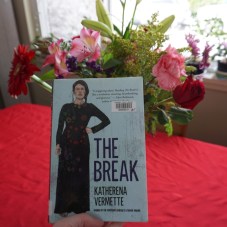
The Break


Rating: ⭐
Author: Katherena Vermette
Genres: Fiction
Read: Feb. 2018

I flew through The Break, which was the second book in my February Reading Challenge.

The Break is written by Métis author Katherena Vermette and tells the story of a Métis family and the struggles and challenges they’ve experienced, both together and apart. The novel opens with young mother Stella witnessing a crime on the break of land outside her house. She is paralyzed with fear and calls the police, but both the victim and the perpetrators have disappeared and law enforcement is not convinced of her story.

I don’t want to run the book by getting to into the plot, but it’s told from a lot of different viewpoints. There are 4 living generations in Stella’s family and they all have a voice in this story. As the police investigate the incident and the family is shook by violence, Vermette examines all the relationships and history that exist in this family. There are some narrators outside of the immediate family, such as the young Métis officer who investigates the incident, but this is really a story about family, the bonds that tie us together and the conflict that can threaten to tear us apart.

First off, the writing in The Break is fantastic. As soon as I started reading it I knew I was going to like it because it is just so beautifully written and the characters emotions are so tangibly felt. This was an insightful look inside the lives of a Métis family and it was very obvious the love this family had for one another, even through all the challenges they’ve had to overcome, the mistakes they’ve made, and the violence they’ve witnessed.

The tone of this story is very sad. Vermette made it easy to empathize with her characters and their pain felt very real. The story is heartbreaking and it was upsetting for me how frequently the women either experienced or witnessed sexual and domestic violence. But the women are what made this story so beautiful. It’s a very fractured family unit in that very few of the men in the family have stuck around or remained present in their families lives, but in the absence of reliable men, the women (sisters, cousins, aunts, grandmothers) have constructed their own family unit that is incredibly close.

The synopsis reads like this is a mystery novel, which it is in some ways, but it’s mostly a slow-burn family drama, which is one of my favourite types of stories. So I really liked this one and I am in love with Katherena Vermette’s writing. A fantastic read!

The Boat People


Rating: 
Author: Sharon Bala
Genres: Fiction, Historical Fiction
Read: Feb. 2018

Oh my goodness, I feel like this book took forever to finish! Between going on a ski trip last weekend and the Olympics stealing all of my attention, it took me a bit longer than anticipated to get through The Boat People. But I finally finished!

This was the first book of my February Reading Challenge and I am a little concerned I might not fit them all in this month because I am just completely obsessed with the Olympics! This month I challenged myself to read 3 books about Canada and this was my pick from the Canada Reads 2018 shortlist.

The Boat People is written by Sharon Bala, who fascinatingly was born in Dubai, raised in Ontario, and currently lives in Newfoundland, and it’s about a ship full of refugees from Sri Lanka who landed on Vancouver’s shores in 2010. It was a bit of a thrill to read a book about the place where I currently live, as I don’t read that much Canadian literature, and this was a fascinating bit of history about an event I knew shockingly nothing about.

Sri Lanka has been torn apart by war for decades, driving many people to desperation to escape the violence in any way they can. These 492 Sri Lankan’s board a cargo ship bound for Canada in an effort to seek out a better life. Fortunately everyone survives the journey and they are thrilled when they first see the coast of Vancouver Island, but the welcome party is cut short when they are promptly separated and detained in two prisons while the government fumbles to try and decide what to do about them.

I knew very little about the process for migrants who show up un-announced at the border and this was very eye-opening. Refugees must first seek permission to request asylum and then go through admissibility hearings for their request to be granted. In this case, the government was worried about terrorists being on board and wanted to delay the process as much as possible to assuage the public’s fears. The adjudicators had very little information to go on outside of the refugee’s testimony and because the government wanted to delay the process to dissuade copycat voyages, the refugees were forced to remain in these detainment prisons for months while their hearings were repeatedly denied and postponed.

I did struggle a bit with this book as there’s a lot of legalese in it, a lot of (slightly confusing) Sri Lankan history, and a lot of character names and stories that I struggled to keep straight, but I really liked how Bala wrote this book and she was not shy in tackling a lot of different issues.

The story is told from 3 perspectives: Mahindan, a single father who made the journey from Sri Lanka with his 6-year old son Sellian; Priya, an articling student (of Sri Lankan heritage) who’s firm takes on 5 refugee cases pro bono and has her help out on the cases; and Grace, an adjudicator (of japanese heritage) who is assigned by the xenophobic Minister of Immigration to adjudicate the detainment hearings.

This is a morally-gray book and I appreciated Bala for not making this a straight-forward morality tale. She tackles so many issues in this book; the xenophobia of the Canadian public, the refugee diaspora, the immigration process, Canada’s past failings, the importance of history and remembrance, reconciliation, culture shock, and the list goes on.

The novel first presents us with the refugees, ecstatic to arrive on Canada’s shores, and the brutality of their arrival and immediate imprisonment. In my opinion, you can’t help but empathize with them and think the government harsh. But then Bala gets into the morally gray areas of war and how good and innocent people can be forced and coerced into participating in what western countries view as terrorist organizations.

Are we right to studiously evaluate every refugee who comes into Canada for terrorist affiliation? I think yes, but do we need to steal their humanity from them in the process? No. Do we have the right to deport people when deportation will mean certain torture and death? People may be split on that opinion, but it’s a question that requires empathy and understanding that we will never have by “othering” people and fearing them.

Innocent people are forced to do bad things in wartime, but how to we evaluate those acts and decide if the intent was forced or malicious? What’s direct involvement in acts of “terrorism” and what’s proximate? These are impossible questions to answer and as much as I often disliked Grace’s line of thinking, I could appreciate the pressure that was put on her in these quasi-legal proceedings. All she has to go on is the migrant’s story and how is she to know what is truth? That said, she was an adjudicator appointed by the government in power, which begs the question if she should have the power to make those decisions at all.

However, I liked the contrast of Grace’s story and how Bala demonstrates how cyclical history can be. Grace is the grand-daughter of Japanese immigrants and takes a hard line on border safety and who should be permitted to enter Canada. She is determined to safeguard her daughters freedom to move around without fear, while at the same time struggling with her mother’s declining health. Her mother, Kumi, has Alzheimer’s and is slowly regressing into the past. Her parents had been interned during WWII and lost everything. They never spoke up about the injustice and kept their heads down to give their children a chance to become “true” Canadians. However, now she worries that the apathy of her parents has been passed down to her daughter and grandchildren and that Grace has forgotten the injustices of the past, perpetuating the cycle of oppression.

I thought it was an interesting theme on how people who were once oppressed and othered can learn to be oppressors themselves. And on how important reconciliation is, not just for righting our wrongs, but for protecting against repeating them, to keep fresh an empathy for others.

So while I did feel like it took me forever to get through this book, it was worth it. The Boat People made me think a lot and while it definitely was more ‘liberal-leaning’, it wasn’t a straight forward good vs evil narrative. It’s complex, gritty, and heartbreaking. A fabulous and meaningful debut for a Canadian author.

February Reading Challenge

January’s reading challenge was a roaring success, so I’m excited to set a new challenge for February. I loved all 3 of the books I read in January and hopefully I can replicate it again this month. You can see my January Summary here.

I was really torn between two challenge ideas for February. I have a pile of fantasy novels piling up on my shelf, so I was tempted to read 3 of them for February, but I decided to actually challenge myself and get a little bit more specific with some books I’ll be less likely to read anyways. That said, I may set a genre challenge every third month or so to help work my way through my TBR and try and keep my challenges from being too heavy or onerous.

So without further ado, my reading challenge for February is:

Read 3 books about Canada

It’s pretty embarrassing how few Canadian novels I’ve actually read and with CBC posting the 2018 shortlist for Canada Reads, I was inspired to try and knock back a few of my Canadian authors! My 3 picks for February are:

  1. The Boat People by Sharon Bala
  2. The Break by Katherena Vermette
  3. The Colony of Unrequited Dreams by Wayne Johnston

I’ve been anxiously waiting for CBC to drop the 2018 shortlist for Canada Reads and I decided to pick one of the 5 contenders for my reading challenge. The Boat People is based on the true story of a cargo ship of refugees from Sri Lanka that landed on Canada’s shores in 2010. However, instead of finding sanctuary all 500 of the refugees were thrown into a detention centre. The story is told through several different perspectives of both the refugees and people involved in the case. That’s all I really know about it and I’ve decided to read the book before I do any further research. So I guess I’m not done with immigration stories yet, but I didn’t read any books about refugees last month, so it’ll be interesting to get this perspective.

I’m trying to get a diverse selection of books, so I like that The Boat People is written by a woman of colour and that it features Vancouver a little bit (my current home). However, I literally just looked up the author to learn a little bit more about her and I was actually ecstatic to discover that while she was born in Dubai and grew up in Ontario, she currently calls St. John’s home (my hometown!!).

My second pick, The Break, was recommended to me by a co-worker and then I started seeing it everywhere and have only heard good things about it. It’s about a Métis woman in Manitoba who potentially witnesses a crime on the break outside her house. I don’t know a whole lot about the plot, but the book synopsis informs me that it’s a inter-generational saga that features the narratives of all the people who get tied up in the case. I’ve been loving family dramas lately, so I’m excited to dive into this one. The Break is also written by a woman of Métis decent, so I was inspired to give this in a read in order to support more first nations writers. Side note: The Marrow Thieves has also made the 2018 shortlist and sounds fascinating, so I’m hoping to find time to read this one in the near future as well.

Finally, I wanted to read something about Newfoundland since it is my homeland and I have a deep love for the island, even though I’ve been loving living in Vancouver for the last 4 years. There is a surprisingly amount of literature about Newfoundland, but it was hard to find one that was super appealing. I decided on A Colony of Unrequited Dreams, which is historical fiction about Joey Smallwood, Newfoundland’s first premier when we joined confederation in 1949.

I read Greg Malone’s Don’t Tell the Newfoundlanders a few years ago, which is an exposé about how Newfoundland came to join Canada. I found it fascinating and wrote a whole blog post on it here, so I’ve decided to expand my knowledge and give this book a try. I’m a little nervous about it though because my copy is 600 pages of tiny font. Usually book length doesn’t bother me, but I’m worried this one won’t be an easy read, so we’ll see how I do.

Anyways, wish me luck and I’ll check back in in a month!

January Summary

I can’t believe January is over already! Seriously, where did the time go?!

It was a bit of a mixed bag for books this month. I got off to a bit of a rough start to the year with several book duds, but things definitely picked up later in the month and I loved all three of the books that I read for my January reading challenge. Here’s my summary:

Books read: 10
Pages read: 3,797
Main genres: Young adult, historical fiction, fantasy
Favourite (new) book: Girl in Translation
Favourite re-read: On the Jellicoe Road

I started off the month with Thunderhead, the sequel to Neal Shusterman’s new series Scythe. I did like this one, but overall I don’t think Shusterman is quite my cup of tea and I found it a bit boring. He explores a lot of really interesting concepts in Scythe and in comparison, Thunderhead seemed a bit lacking.

Things only got worse though because I followed up Thunderhead with The Life She Was Given and The Star-Touched Queen, both of which I did not like at all. The Life She was Given was my book club read of the month and it ended up being our lowest rated book to date, and we’ve read over 50 books! I found the book totally lacking in depth, development, and meaning. Likewise, I thought the writing in the Star-Touched Queen was so over-the-top flowery that it completely took away from the story. I can see why some people might be into this type of writing, but it really did nothing for me and I didn’t find the story meaningful.

Things picked up after that with the first book in my January Challenge to read 3 books about immigration – Girl in Translation. This is a fantastic book about a Chinese mother and daughter who immigrate to America and the terrible conditions they put up with just to survive. It was so well written; I loved the main character Kim and her aspirations to get the very best education so that her and her mother could rise above their circumstances. it was a very moving story.

Next I read Looking for Alibrandi, which is one of the few Melina Marchetta books I hadn’t already read. It was a solid 3-star read and I thought the main character Josie had a lot of spunk, but I didn’t think it was anything that special. However, it inspired me to give On the Jellicoe Road a re-read, which is one of my favourite books of all time and still moves me to tears, even after several re-reads over the last few years. These are both relatively older YA contemporary books, but I honestly think On the Jellicoe Road is timeless and that everyone should read it!

My second January Challenge read was Pachinko, which is a slow-moving historical epic that spans 80 years of history about a Korean family that immigrates to Japan during its colonial rule over Korea and struggle to build a life for themselves and escape the stigma of being Korean. It examines the challenges of being emancipated from your homeland and finding where you fit in in a new culture. Also a wonderful read, although quite long.

I needed something light and fast-paced before I tackled my last Challenge book, so I read The Cruel Prince which has been getting an insane amount of good reviews. I liked it, but was definitely disappointed with it because I think it’s gotten a little over-hyped and the book wasn’t able to deliver on my expectations. That said, I still gave it 3 stars and I will definitely be continuing on with this series. I’m hopeful about the next book!

My last book on immigration was American Street, which was refreshing in that it was totally unlike the first two books I read. American Street focuses on 16-year old Fabiola, whose mother is detained when they try to enter America from Haiti. She is forced to go on to Detroit without her mother and struggles to navigate her new life with her 3 larger than life cousins and her sick aunt. This was my least favourite of the 3, but I still really enjoyed it and gave it 4 stars.

I thought American Street would be the last book of the month, but I managed to fit in one more with Ruined. Based on other reviews I figured I would either love or hate Ruined and I’m pleased to say I LOVED IT! It’s a fast-paced YA fantasy novel that has a lot of action and a fair bit of romance. Sometimes I dislike too much romance in my fantasy novels, but I loved it in this one. Can’t wait to get my hands on a copy of the sequel!