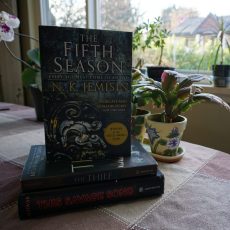
The Fifth Season


Rating: ⭐⭐
Author: NK Jemisin
Genres: Fantasy
Pub Date: Aug. 2015 (read Mar. 2018)

I’ve only heard good things about this series and I’ve been dying to read it for ages, but this was quite different than all the other fantasy I read and I really struggled to get into it.

I definitely liked the story, but it took me a while to get into it and it wasn’t until the first “twist” of the story that I started to understand how clever this was. I’ll be honest, I mostly read YA fantasy, which is why I think I initially struggled with this.

The Fifth Season supposedly tells the story of how the world ends for the last time. This world has been through many seasons that have threatened the existence of humans, but they have always managed to survive. The book starts off with a huge earthquake that destroys the major city of the continent, Yumenes, and with a mother fleeing her community after the death of her son. We follow the perspectives of 3 women as we learn about the intricacies of this world.

The continent is largely dictated by earthquakes. There are many fault lines and the ground is never stable. The communities are used to frequent shaking of the earth and many communities struggle to survive beyond a few seasons in this hostile world. There is one thing that can stabilize the earth and prevent earthquakes, the Orogenes, who can communicate with the earthquake and quell and create shakes. They can be extremely dangerous if not trained, so there is another group called Guardians, who seek out orogenes and bring them to the Fulcrum in Yumenes to be trained. Our three main characters are all orogenes. Essun has just lost her son after the great shake in Yumenes, Syenite is completing a mission on behalf of the Fulcrum, and Damaya has just been discovered in her community by a Guardian.

It’s a hard book to get into because there’s a lot to learn about this new world and it’s hard to keep up with the constantly changing perspectives. I also found the timeline a little confusing and had a hard time with Essun’s perspective because it’s written in 2nd person POV. But I did start to get into it after about the half way mark and I think the next two novels will be easier now that I understand the baseline of the story. Like I said, this book is quite clever and the writing is good.

I’m not sure when I’ll get to the next book, but I probably will try to do it soon because I’m worried about forgetting what happened in this book and I don’t want a steep learning curve again! Hoping the next one will be a 4 star read for me.

The Authentics

Rating: ⭐⭐
Author: Abdi Nazemian
Narrator: Kyla Garcia
Genres: Young Adult, Fiction
Pub Date: Aug. 2017 (Read Mar. 2018 as an Audiobook)

I am tearing it up with audiobooks this month! Granted this one was half the length of the audiobooks I usually listen to, but still.

I admit, after listening to I Am Not Your Perfect Mexican Daughter, I totally did a search on the narrator Kyla Garcia and found that she’d narrated another book on my TBR, which is the main reason why I decided to read The Authentics. Garcia did a fantastic job narrating this book as well, but sadly this was not on the same level as I Am Not Your Perfect Mexican Daughter.

This is young adult literature that definitely reads like young adult. I usually don’t have any trouble reading YA because there are some really great YA authors out there who tells stories that have a lot of depth and themes that are applicable to everyone, not just teenagers. This book definitely still had themes that anyone could enjoy, but the story felt pretty juvenille. It actually has a pretty surprising twist early in the novel that I would have been completely pissed about if I was Daria, but in my opinion this book was missing the emotion. It lacked tension and grit and I feel like the author was afraid to go there and instead wrote more of a “feel-good” family novel. There’s nothing wrong with “feel-good”, but I thought this story had a lot of potential and it just lacked impact and execution.

Daria is a 15 year old Iranian-American teenager. She was born in America and has never been to Iran, but she is very proud of her culture and her and her friends, who come from very diverse backgrounds, do their best to always “be authentic”. This all changes when their English teacher challenges them to do a presentation about their heritage and Daria learns something shocking about her family’s past. Daria begins to question everything she thought she knew about herself and her parents and finds it increasingly difficult to be authentic.

I don’t want to give anything more away about the story. There’s several different plots throughout the novel between Daria’s feud with her former best friend, her conflict with her family, and a new love interest, but I thought they were all mediocre and pretty surface level. Maybe I’m out of touch, but I like to give teenagers a bit more credit than I think the author does in this book. Everything about Daria’s fight with Heidi felt childish and the romantic relationship made me cringe. Teenagers have more depth than this and the whole thing just felt lacking.

That said, I really did enjoy the opportunity to read about Iranian culture and I do believe that diverse stories like this need to be told and are incredibly important. I just really wanted more from this. It may be unfair to keep comparing it to I Am Not Your Perfect Mexican Daughter, but it’s hard not to when they deal with a lot of similar themes (the daughter that can’t live up to their immigrant mother’s expectations) and the latter was so much better written and had so much more depth.

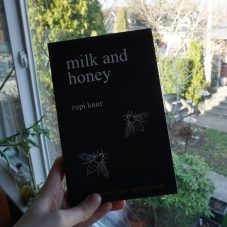
Milk and Honey


Rating: ⭐⭐⭐
Author: Rupi Kaur
Genres: Poetry
Pub Date: Nov. 2014 (Read Mar. 2018)

I read Rupi Kaur’s second book, The Sun and Her Flowers, last year and really liked it, so I decided to pick up her first book as well. These are both poetry anthologies with feminist themes that tell short stories of heartbreak and healing, explore love and sexuality, and promote self-love. The books are also illustrated with sketches, which makes for a nice reading experience.

This is a very fast read, I read the entire book in under an hour in one sitting. Milk and Honey is Kaur’s debut novel – I definitely liked it, but I think I liked her second book a little bit more than this one and it had stronger themes.

Milk and Honey is broken into 4 parts, the Hurting, the Loving, the Breaking, and the Healing. Kaur addresses a lot of themes in this short book, looking at love and sexuality and the the heartbreak that can accompany it. I thought it had a strong start with the chapter on the Hurting, which is a devastating look at abuse, and I really liked the last chapter, the Healing, which is cathartic and empowering.

I didn’t love the middle section, especially the Loving, which I personally found a little over the top. Kaur is very descriptive of her feelings on love and relationships in both her books and love for her seems to be an all-consuming feeling which I personally find a little intense. For me love is about the little moments. Those small, every day gestures in which your partner demonstrates their love for you and the closeness you build with that one person. Kaur is very intense in her love (and her break-ups) and I just couldn’t relate because I have always felt very grounded in who I am, whereas Kaur felt a little defined by her relationships. That said, I’ve been in the same relationship for the last 7 years, so I definitely can’t relate to that feeling of “new” love anymore, which is totally fine.

However, Kaur is also very much about self-empowerment and self-love, which I enjoyed. I thought these themes, and the feminist undertones, were stronger in The Sun and Her Flowers, which is probably why I enjoyed that anthology more. Milk and Honey is still a good, quick read though and there were several beautiful passages, here’s one of my favs:

i want to apologize to all the women
i have called pretty
before i’ve called them intelligent or brave
i am sorry i made it sound as though
something as simple as what you’re born with
is the most you have to be proud of when your
spirit has crushed mountains
from now on i will say things like
you are resilient or you are extraordinary
not because i don’t think you’re pretty
but because you are so much more than that

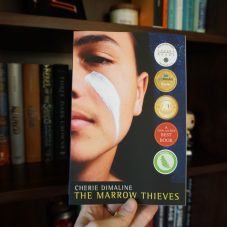
The Marrow Thieves


Rating:  ⭐⭐⭐⭐
Author: Cherie Dimaline
Genres: Science Fiction, Young Adult
Pub Date: Apr. 2017 (Read Mar. 2017)

“Sometimes you risk everything for a life worth living, even if you’re not the one that’ll be alive to see it.”

This was a beautiful book! I’m so glad it’s in the Canada Reads shortlist this year because I think it’s unlikely I would have discovered it otherwise and that would have been a shame because the writing is so gorgeous!

The Marrow Thieves is a short novel by Métis author Cherie Dimaline about a dystopian Canada that has been ravaged by climate change and disease and a large portion of the population has been wiped out. In the aftermath, everyone but indigenous peoples have lost the ability to dream. In an attempt to discover why the government starts constructing new schools (that mirror the old residential schools) to study indigenous peoples. It turns out that the ability to dream comes from your bone marrow and the government starts rounding up and experimenting on indigenous peoples to harvest their bone marrow.

Frenchie has slowly lost everyone in his family and finds himself alone in the woods. He follows his family’s plan to head North and eventually runs into other bands of ‘Indians’ who are slowly treking their way North as well and he is adopted into a new family and they travel together. Their group consists of an elder, Minerva; their leader, Miig; and several other young people who have lost their families. Miig tries to preserve the old ways through story-telling and everyone has the opportunity to tell their own ‘coming-to’ story.

I loved the writing in this book and learning everyone’s story – hearing about their struggles and how they came to end up part of this little adoptive family. They all come from different backgrounds and families, but they have retained their ability to dream and their desire to survive in the angry world around them. Miig teaches them how to hunt, cook, fight, and survive in the wild and how to connect back to their original roots.

I really liked this because I thought by telling this horrifying, dystopian story, Dimaline was able to convey some of the horrors that have been committed against indigenous peoples in the past in a way that enabled you to empathize emotionally with them and better understand how they felt. On paper, everyone knows about the residential school systems and the struggles of indigenous peoples to retain their culture, but that part of history feels a degree removed and it’s shameful so I think people generally avoid thinking about it.

It reminded me a little of Tim O’Brien’s book, The Things They Carried, in it’s ability to use exaggeration to convey emotion. The Things They Carried is a book about O’Brien’s experience in the Vietnam War that is written to read like a memoir, but is actually partially fabricated. O’Brien’s essay about being drafted and his internal debate about whether he would defect to Canada to avoid going to war is one of the best essays I’ve ever read. It reads like non-fiction and is an exaggerated account of O’Brien’s experience, but it is so effective because the exaggeration is what enables to you really feel his despair, frustration, and hopelessness. Dimaline’s horrifying account of the marrow thieves is what enables you to relate and empathize with the persecution of indigenous peoples throughout Canada’s history. I mean, I obviously empathized with them before and thought the residential schools were horrifying, but this book uses science fiction and exaggeration to evoke a much stronger emotional reaction.

Indigenous peoples are obviously incredibly tenacious and this book re-iterated that. It is really a pretty simple story about family, love, and the bonds we build with those around us. Who are we when everything else is stripped away from us? What can we become when faced with adversity, antipathy, and violence? Is family blood or the bonds we build we those we love? I thought this was a thoughtful, well written novel and I would definitely recommend to all Canadians! I read both The Boat People and The Marrow Thieves and while I really liked them both, I think this was my favourite of the two.

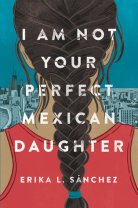
I Am Not Your Perfect Mexican Daughter

Rating: ⭐⭐⭐⭐.5
Author: Erika L. Sánchez
Narrated by: Kyla Garcia
Genres: Young Adult, Fiction
Pub Date: Oct. 2017 (read Mar. 2018 as an Audiobook)

I listened to I Am Not Your Perfect Mexican Daughter on audiobook and it is definitely the fastest I’ve ever listened to an audiobook! I LOVED IT!

I’ve written a few times about how I don’t love fiction audiobooks because I think they can be very unforgiving of an author’s writing and for some reason hearing fiction read out loud always seems to make the writing sound cheesy or lame. I think non-fiction translates better to audiobooks overall, but this is hand-downs my favourite fiction audiobook that I’ve listened to and I think the narrator, Kyla Garcia is TOPS!

I Am Not Your Perfect Mexican Daughter was a National Book Award finalist in the young readers category and tells the story of Julia, a teenage daughter of undocumented Mexican immigrants. Julia’s older sister Olga has just died tragically in a road accident and her whole family is reeling from the loss. Julia’s mother always viewed Olga as the perfect daughter and Julia’s sharp contrast from Olga creates a lot of tension with her mother, who doesn’t understand why Julia is so difficult.

Julia is 15/16 years old (can’t remember) and she is extremely brash and confrontational. She’s constantly picking fights with those around her, she lies to her parents, she can be vulgar, and she is of course, grieving. In the wake of Olga’s death, Julia starts to discover some of her sister’s secrets and finds that her sister may not have been as perfect as she led everyone to believe. She struggles to justify this new Olga with the sister she knew and in her grief, she acts out against her friends and family.

A lot of the reviews for this book are pretty critical of Julia and I can understand why a lot of readers didn’t like her. She’s not a particularly likable character, but like Scarlett O’Hara, her flaws were what I loved about her, and I definitely loved this character. I have to give some of the credit to the narrator because I thought she captured Julia’s voice and the tone of this novel perfectly. Her Mexican accent was fantastic and she absolutely read this like an angst-y, grief-ridden teenager.

Julia had a lot of spunk and while I couldn’t believe some of the things she was gutsy enough to say to people, I thought she was incredibly relatable as a teenage daughter of immigrants. She’s grown up in completely different circumstances than her parents and they struggle to relate to each other. She’s lived her whole life in the shadow of her perfect older sister and even though Julia is really smart and accomplished herself, she’s always been overshadowed by her sister in her parents eyes. She is critical of Olga’s desk job and can’t imagine settling for a job like that when she wants to be a writer, but her parents are critical of her dreams because they don’t believe a writer is a real job and as people who have done labour their entire lives, they can’t imagine anything better than Olga’s desk job.

Following the death of her sister, her mother suddenly wants to try and give Julia everything she was never able to give Olga. She fears for Julia’s safety and is extremely protective of her, forbidding her to go to parties or spend time with boys. But Julia just wants to live her life and the wedge between her and her mother only grows bigger. Julia becomes depressed and overwhelmed by the constant pressure to be more like Olga and how critical her mother is of everything she does and wants.

While I thought Julia sometimes took things too far, I was incredibly sympathetic for her. She is grieving and her world is crumbling and she has little support to navigate the scary new world around her. I thought this book was so well written and that Sanchez captured what its like to be a teenager so well.

The only reason I rated this 4.5 stars instead of 5 stars is because I didn’t love the last third of the book as much. Julia eventually goes off to Mexico for a period of time and I didn’t think this added a whole lot to the story overall. She does learn more about her family there and starts to better understand her mother, but I felt these epiphanies still could have happened in America and that removing her from America made us have to press pause on the rest of the drama in the story, which made it feel a little bit disjointed. There’s a lot of plot points that surface in the last few chapters of the story and they felt a little out of place because her trip to Mexico disrupted the flow of the story.

But overall, I absolutely loved this and I would highly recommend the audiobook. I’m not convinced I would have liked this quite as much if I’d read it because I thought the narrator did such a good job as Julia!