Rating: ⭐⭐⭐⭐.5 Author: Emily Henry Genres: Fiction, Romance Pub. Date: May 2022 (read May 2022)
It’s been almost 2 months now since I read this and I’m really regretting not writing a review about it then…
Emily Henry is quickly becoming an auto-buy author for me! I read People We Meet on Vacation and Beach Read earlier this year and am even debating reading some of her YA backlist. Of the 3 books I’ve read, I think Book Lovers might be my favourite! Beach Read had some definite flaws, but I really liked the friends to lovers aspect of People We Meet on Vacation. The plot of Book Lovers sounded a bit cheesy to me, but the story is so well crafted that I ended up loving it!
Nora Stephens is a literary agent for authors and has a tenuous relationship with Charlie Lastra, an editor who once passed on one of her biggest client’s bestselling book. Nora’s sister Libby convinces Nora to join her on a getaway to the small town in which her bestselling book is set, where they continually run into Charlie and learn the real reason why he passed on editing the book. But what Nora’s more curious about it why her sister really wanted them to take this trip and has a sneaking suspicion she won’t be very pleased when she uncovers the truth.
So the book has a pretty standard romance setting and plot, but what makes it stand out is the dialogue and characterization. First off, this is really a story about sisterhood, which is one of my all time favourite themes, and the romance that blooms during the sister trip is super organic and fun. Nora and Charlie have chemistry and I was really impressed with all of their banter. Emily Henry is quick witted and her dialogue is sharp. There’s no awkwardness and it’s a lot of fun to read. Like most enemies to lovers stories, Nora and Charlie are barely enemies, but I liked how quickly they become friends. There was an authenticity in easily sorting out your differences and acknowledging that your first impressions were misplaced.
I’ve said this of Henry’s other books, and it holds true in Book Lovers, that she is really great at bringing a strong dose of realism and depth to her romances. There’s always something going on in the story beyond just the romance and her characters are always realistically flawed, but in a way that is believable. Too many romances feature unrealistic men and while it’s nice to dream such a “perfect” man might exist, I like my love interests a little more nuanced.
What I liked about this one was that Nora and Charlie were very much the anti-heroes. Nora believes that she’s the high-powered, but lonely woman that always gets left behind in the city for the easy-going country girl, whereas Charlie’s the guy who always puts other people’s needs and happiness before his own. I loved that this book was basically in defense of all those women who like city life and pursue their careers over love. It’s about knowing who you are and what you’re willing to compromise.
As a side note, I’d also like to say that I loved that Nora was tall! I feel like almost all romances these days feature giant men and tiny women and I loved Henry’s exploration of height in a relationship and how little Charlie cared about it. The whole line about “there’s no such thing as a ‘too tall’ woman, only men who are too insecure to date them” had me swooning over Charlie! So I appreciate the realism since the average height for men and women is 5’9″ and 5’4″.
Then there’s a whole other element of this story that looks at Nora’s internalized guilt and responsibility. She’s taken on a lot of ownership over her sister’s happiness and this is very much about learning to let the people you love go. Letting them be responsible for their own success and happiness and being okay when your dreams don’t necessarily align with one another.
To conclude, I really liked it and read the entire thing over the span of 2 days. If you’re looking for a fun summer read, definitely pick up Book Lovers!
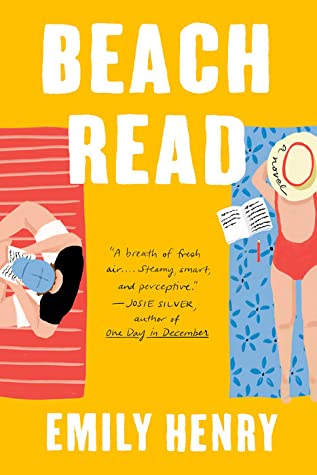
Rating: ⭐⭐⭐⭐ Author: Emily Henry Genres: Fiction, Romance Pub. Date: May 2020 (read Apr. 2022)
I read and loved People We Meet on Vacation earlier this year, so I was excited to pick up Beach Read this month. The two books together have firmly cemented Emily Henry as a “auto buy” author and I’m looking forward to her 2022 release, Book Lovers, coming out next month.
The two books are rated almost the exact same on Goodreads, but most people I know that have read both preferred Beach Read. I kind of wonder if it matters which one you read first (everyone seems to love their first pick), because as much as I liked this one, I did still like People We Meet on Vacation better. I feel like friends to lovers is an underdone trope (enemies to lovers seems very on trend these days, at least according to Booktok), so that’s why I liked People We Meet on Vacation so much.
I must conclude though that Emily Henry (or her publisher?) is not very good at naming her books. Beach Read and People We Meet on Vacation are both kind of misnomers to me, what are we actually going to get in Book Lovers? A book bonfire? But I guess I can overlook it because I love her approach to romance writing. Both are very much romance books, but they have a lot going on for them beyond just the romance. Plus the smut is limited, which some people will like and others won’t, but for me it just helps to present the book as more than simply a romance.
Anyways, let’s talk about Beach Read. It was quite emotional for what I thought was going to be a light read. Our protagonist, a novelist by the name of January, is reeling after the death of her father and the realization that he was living a double life. She decides to spend the summer in his secret beach house to write her next book while cleaning it out to sell. The problem is that she is a romance writer and with the disintegration of her relationship, along with the death of her father, she’s feeling a little low on inspiration.
Along comes Gus, another writer trying to pen the next great literary novel. The two decide to trade genres and Gus attempts romance while January makes a run at literary fiction. Of course drama ensues as the two get to know each other better and address the pre-conceived notions they had about one another.
I liked it – it’s fun and thoughtful, though ultimately a bit forgettable. I would love to know what kind of literary fiction these two are reading though (or Emily Henry is reading), because I read A LOT of lit fic, and nothing either of these two characters proposed sounded anything like lit fic to me. Gus’ cult family drama sounded more like mystery or horror, while January’s circus saga belonged somewhere in the historical fiction genre. But I guess they’re both literary in their own way, I just gravitate to contemporary lit fic I suppose.
On another note, it just about killed me when these two went off into the wilderness in street clothes. Thank goodness Gus knew what he was doing and brought a tent, but as an avid backpacker, it was high-key unbelievable to me that these two wouldn’t have spent a freezing, soaking wet night in the tent with only one blanket. Trust me, in reality it’s not quite the romantic scenario you’re envisioning. But I guess I live in a much colder climate, so what do I know?
Anyways, I’m going off on a lot of tangents because I don’t really have a lot to say about the book overall. It’s fun and sexy, it has emotional depth, but it didn’t sing to me the same way People We Meet on Vacation did. January and Gus are two complex individuals, but they did both have a lot of shit to work out, although I did like that it wasn’t a “ride off into the sunset” type of ending. I feel that Emily Henry’s romances have a strong dose of realism in them and I think that while this wasn’t quite as strong a novel for me, it’s what will keep me coming back to her books. 4 stars – a solid read, despite there being no actual beach reading to speak of in this book.
Rating: ⭐⭐⭐.5 Author: Lizzie Damilola Blackburn Genres: Fiction Pub. Date: Jan. 2022 (read Mar. 2022 on Audible)
So far 2022 is turning out to be the most off brand reading year for me. I feel like I’m reading a lot of different type books than I normally do and I am loving it! Whatever the opposite of a book slump is, that has been my 2022 so far!
Yinka, Where is Your Huzband? is maybe a little less off brand than some of my other reads and I was drawn to it because it sounded a lot like Queenie. It’s definitely a different book than Queenie, but like Queenie, it has been compared to Bridget Jones, and also like Queenie, people are pissed about the comparison. Honestly, it seems like everything is compared to Bridget Jones these days, but I disagreed with the haters about Queenie and I disagree with the haters about this one too. In my opinion, Yinka has the most similar voice to Bridget Jones, while solidly still being her own original character. Yinka has the self deprecating humour or Bridget, without being quite as self sabotaging as Queenie.
Yinka, Where is your Huzband? is set in London and features a British-Nigerian family. Yinka grew up in Peckham, is Oxford educated, and has a great job in investment banking. Unfortunately, despite her career success, she’s still seen as the black sheep of her family because she is in her 30’s and still not married. While her sister, cousins, and friends are getting married and having kids, Yinka hits a tough spot at work and struggles to get over her last relationship. For the most part, she is content with who she is, but the repeated pressure and embarrassment from her family to settle down spurs her to make a plan to do whatever it takes to get a date to her cousin’s upcoming wedding.
I read this as an audiobook and it did take me a little while to get into it. Things aren’t too bad for Yinka at the start of the novel, but they slowly start to fall about and the more she tries to fix things, the worse it seems to get. There are a lot of cultural expectations placed on her and it’s sad that while her family is very proud of her achievements, she is still seen as a failure for being unmarried and childless. Her mother’s greatest fear for her is that she will be an old maid who never gets married, as if marriage is the pinnacle of achievement. I thought it was a great look into the Nigerian diaspora in Britain and I both loved and was extremely frustrated by Yinka’s family, especially her cousin. Yinka gets shit on a lot, and while she had some growing to do, I do think her outbursts and anger were entirely justified.
Like I said, this is a more subtle book than Queenie. Whereas Queenie drowned her pain and depression in abusive sexual relationships, Yinka is still looking for her Prince Charming and tries to change her looks and personality to be more attractive to the men in her life. She has a deep rooted insecurity about being dark skinned and equates her self worth and beauty with not having lighter skin. She disappears into trying to be who she thinks other people want her to be, yet I admired that there were still some things she wasn’t willing to compromise on. Faith is a key part of this novel and Yinka isn’t willing to compromise her decision to remain chaste until marriage. Sometimes it felt a bit preachy, but I feel we don’t often see characters like this in mainstream literature, so I liked that it was different. Plus Yinka was never pushy about her faith.
I wish this book wasn’t being marketed as a romance though. I kind of knew going in that it wasn’t a romance and I liked that instead it’s a book about learning to love and take care of yourself. But if you’re going into this looking for romance, you will likely be disappointed. That said, I had whiplash from how many romantic interests are presented throughout the story. I kept trying to guess who Yinka was actually going to end up with, but in the end it didn’t really matter because it’s not really what the book is about.
As with any kind of book like this, I think some people will struggle with Yinka’s character. I really liked her and found her struggles to be very relatable. I understood the complicated relationships she had with a lot of her friends and family, but loved that she also had some solid relationships in her life too, namely Nana and Auntie Blessing. Her relationship with her cousin (I can’t remember her name now… Oola? Oona?) was really frustrating, but I liked the exploration of how friendships can turn toxic and how family dynamics can create unhealthy and competitive environments with the people we should love. Her cousin is looked down on by her mother for not having an education, while Yinka is looked down on by her mother for not having a husband. It’s hard for anyone to feel good about themselves and it really pitted the two cousins against one another.
So there was a lot I liked about the book, but there were also some things I didn’t like, the first of which was Yinka’s career trajectory. It was tiring how everyone kept pushing Yinka to switch careers – on the one hand, it’s great to have friends that encourage you to pursue something you’re passionate about, but I didn’t really get the vibe that Yinka was passionate about helping the homeless. It just read more to me that the author thought there is something inherently wrong with being an investment banker and that Yinka should so something more “meaningful” (as is constantly preached to us through characters like Dominic). I don’t like attaching this kind of social or moral value to jobs because most people aren’t privileged enough to have the luxury to choose since, like Yinka, their number one priority is paying the bills. Working for a homeless charity is great if that’s what you really want to do, but it doesn’t necessarily make you make you a better or more virtuous person.
In addition, I feel like Yinka was chastised a little too much for changing and experimenting with herself. Like I get the whole “be true to yourself” thing, but I don’t think there’s anything fundamentally wrong with trying new things. Like, if Yinka wants to try having a weave or learn to make Nigerian food, is that really so bad? She shouldn’t suppress and lie about who she is, but I felt she was unfairly criticized for trying something new. The poor woman just lost her job, let’s cut her a bit of slack.
Likewise I didn’t blame her at all when she freaked out at her cousin and I was a bit annoyed at Nana for her whole “you’re better than this” speech. I think that kind of attitude likely goes back to the whole Christianity aspect, that you should always self-sacrifice and take the high ground, but Yinka’s cousin was a bit of a bitch and honestly I was glad to see Yinka stand up for herself. I just feel like everyone held Yinka to an unreasonably high standard and she was always in the wrong in every interaction.
For example, you’re not a bad person for having a few drinks because you’re sad and then showing up drunk at your sister’s house. If anything I was pissed that her sister was only concerned about Yinka exposing her apologetically drunk self to her newborn baby and then putting her in a cab home. How about instead, she have an honest conversation with Yinka about what’s going on in her life and how she is coping with being jobless and husband-less in such a toxic and challenging family environment. Only one of the two sisters was being a jerk in that interaction and it wasn’t Yinka. So give me a break, Yinka was only in the wrong half the times she was made out to be. So overall, I found it to be a bit too preachy and felt the rest of Yinka’s family could also do with a bit of personal growth.
But it did feel real. The author accurately captures the unfair pressures we put on women and how we de-value each other based on social achievements and milestones. Single women can be just as fulfilled as married women, as can childless women be just as fulfilled as mothers. It was a good exploration of the pressures women face and how sometimes the easiest way to achieve happiness is through self reflection and acceptance. Overall, the novel had some flaws, but I still enjoyed reading it and admired Yinka for her perseverance and personal growth. 3.5 stars.
Rating: ⭐⭐.5 Author: Rebecca Serle Genres: Fiction, Romance Pub. Date: Mar. 2022 (read Mar. 2022)
This book was a bit of a bummer for me. I’ve seen some really excellent (and some not so excellent) reviews, so I was a bit on the fence, but impulsively decided to give it a go. The book did improve throughout, but I knew almost as soon as I started reading it that I wasn’t going to love it.
One Italian Summer tells the story of 30 year old Katy Silver, who has just lost her mother to cancer and has in turn, lost a piece of herself. Her Mom was her best friend and she doesn’t know how to move on without her. The two women were supposed to take a trip to Positano, Italy together, a place that was special to her mother Carol, but unfortunately she passes away before the trip and Katy decides to go to Italy alone to try and heal her broken heart. However, while in Positano, something magical happens and the 30 year old version of Carol stumbles into Katy’s holiday, bringing truths to light that Katy never realized about her mother.
It’s a book about love and grief, so I was ready for an emotional and moving read, but sadly, the writing style just didn’t work for me. I don’t want to totally slam on the book because I can see how some people might love this, Serle definitely crafts a very vivid portrayal of Italy in her writing, but the style was so straight forward and matter of fact that I was left feeling like I was reading a dull travel diary rather than the emotional, grief-stricken self discovery story that I was hoping for.
To put it simply, the writing is boring. Everything about this was a classic example of telling instead of showing. It’s overwritten and I thought we got so many details that were just unnecessary. If you’re looking for a good detailed itinerary of what to do in Positano, this is great, but I wanted to go on an emotional journey with Katy and that just wasn’t happening. I found it extremely hard to relate with Katy and the whole narrative was a bit insufferable. Everything about Positano is incredibly beautiful, from the scenery, to the sunsets, to the food, to the luxury hotels – so it’s hard to empathize with a bunch of faux-sad white people living a dream holiday. We’re told about Katy’s grief, but we don’t really experience it.
It also comes down to Katy being a pretty unlikeable character. There’s nothing wrong with a good unlikeable character, but Katy is not intentionally unlikeable. I believe we’re supposed to like and empathize with her, but it’s very hard because she seems totally unaware of her privilege and it’s hard to buy that a 30-year old woman would be this out of touch with reality. One of the key themes is centered around how Katy and Carol are best friends and Katy’s discovery that, surprise, her mother actually had a life before and outside of her. She’s shocked by this 30 year old version of her mother and spends so much time in awe of the ways in which her mother is both the same and different. I’m sorry, but what 30 year old woman is unable to imagine that their mother might have had a vibrant life before them? Plus I thought the whole my-mom-is-my-best-friend thing was a little tired.
A lot of women love their moms and would consider them a best friend. But come on, mother-daughter friendships are still going to be based on a totally different foundation than peer-to-peer friendships and I would it extremely unrelatable that Katy didn’t have ANY friends outside of her Mom and husband. She mentions one girlfriend in passing, but as far as I can tell, she has no other friends, so that’s probably why she’s so shocked to find out that her mother actually had a life before her. So mostly Katy just read as juvenile and bit dense to me.
The one thing I did like about this book though was the exploration of the erasure of women through motherhood. It’s something I’ve been thinking about a lot as more and more of my girlfriends have children. I’ve been noticing that some of my friends almost seem to disappear into motherhood. They’re still them, but all of their passions and interests have become secondary to that of being a mother. Their children become their number one priority and personality. I’m not saying it’s necessarily a bad thing, I just personally find it very scary because I have a lot of things that I’m passionate about and the idea of losing or having to give up those things in motherhood is one of the primary reasons I delay it. Some people are able to find a good balance between being a mom and being a woman with your own dreams, but it seems it’s easy for who are before being a mother to get lost in the chaos of parenthood.
What Katy is grappling with more than anything is the loss of who she thought she was and the fear of having to suddenly be her own person. Her mom was a comfort to her because then she never had to think too hard and her suddenly realizing that her mother had her own hopes and dreams is scary for her. The realization that our parents can want things for themselves beyond the hopes and dreams they have for us. I don’t fault children for this, but it’s hard to watch a grown woman suddenly figuring this out.
The other issue I had with this book was with the romance. I won’t get into it to avoid spoilers, but I thought it was an interesting choice to give a married woman a love interest. We’re told Katy and her mother are best friends, but we’re not shown it. Likewise, we’re told at the beginning of the novel that things aren’t really working out between Katy and her husband, but we’re not told why and we’re definitely not shown it either. We’re just told that she’s so depressed over the loss of her mother that she has no interest in any of her other relationships, which is really only her marriage because she has no other friends.
Anyways, the only other thing I’ll say is that the book has a bit of a twist, which I thought was well done. I really should have seen it coming, but I didn’t. Unfortunately, none of the positives were really enough to outweigh the negatives and I wouldn’t recommend this book. But if you like it and Rebecca Serle’s writing, then all the more power to you! It did have some very evocative descriptions of Italy, but the writing style along with Katy’s immaturity make it a pass from me.
Rating: ⭐⭐⭐⭐ Author: Emily Henry Genres: Fiction, Romance Pub. Date: May 2021 (read Mar. 2022)
So many people told me to read Beach Read, but I just had a feeling this was the one for me. I’m still planning to read Beach Read, but after a slew of enemies to lovers books recently, I really wanted to read one about friends to lovers because I had a sneaking suspicion I would really like it. And I did!
This book is a lot more subtle than some of the other romances I’ve read, but it’s the one that felt the most real to me. Poppy was a more relatable character – as sexy as the enemies to lovers trope was in books like The Love Hypothesis and The Spanish Love Deception (and as compelling as those plots were) – I do really think this is the better book. Every person I’ve ever loved has been my friend first and there’s something so lovely reading about two people that genuinely like each other.
People We Meet on Vacation is about two friends, Alex and Poppy, and their relationship over the past 12 years. They’ve been friends for a long time and even though they live in different cities, they’ve always taken the time to travel together once a year… until something happens on their most recent trip and they don’t talk for 2 years. Poppy realizes she misses Alex and invites him to take one more trip with her, to which he agrees.
This book is subtle and I liked that about it. It’s not as quick paced as some of the other romance books I’ve read because the present day storyline is constantly interrupted to return to one of their past trips. This slowed the pacing down initially, but as you progress further into the book, you realize this friendship is not quite the relationship you thought it was. There is just as much romance in the development of their friendship, because it never really is just a friendship. Just-friends don’t bring this kind of complicated conflict into your other relationships and you can’t help but root for these two people to be together.
I say this is a subtle book because it is also very much about loneliness and allowing people the space to say and be who they really are. Poppy and Alex recognize that love isn’t always the most important part in a relationship. Relationships are also about making the space for your partner to communicate their needs and being willing to compromise on your life together. That two individuals still need to take the time to work on their own shit before they can be what the other person needs. I felt like this had a lot more maturity and that they had the kind of solid foundation that a successful relationship would be built on.
I also liked that both characters were well developed and flawed. I really think Alex is one of the strongest love interests. To talk about romance we must acknowledge that they are primarily written by women, for women, and so the men are often a bit more fantasy than most of the men I’ve met in real life. We read romance for the escapism of it – because we are human and we want to read emotional stories about people falling in love. But so many of the men are almost so perfect in their love for the protagonist they become caricatures. Alex felt very real, like someone I could honestly fall in love with myself. He’s quiet and a bit weird. He has anxieties and he’s afraid to put himself out there. He knows what he wants, but isn’t quite sure he deserves it and recognizes the ways in which he’s not willing to compromise.
Likewise, Poppy is chasing after something she thinks she wants without realizing that it’s really that she’s running away from something instead. We’re sold this ideal and she thinks filling her life with travel and new people will make her happy – that it will compensate for the inadequacies she felt when she was younger. We all like to think our bullies go on to make nothing of themselves, but they are just flawed people too and we are only holding ourselves back by trying to prove ourselves to them later. If you make decisions based on the way you are perceived by someone else, you are still not living for yourself. Was it unrealistic that two friends could be so blind for so long? Maybe, but these two people wanted such drastically different things that I could believe it.
It’s also a subtly sad book that made me reflect a lot. I really wasn’t sure if we were going to get a happy ending or not. I wish the author had dedicated a bit more time to the ending because she introduced several new themes in the last 50 pages about self care and compromise, that I really would have loved to see explored further. So overall I really liked this book, perhaps even more than The Love Hypothesis. I did rate that one higher because it was so compelling and I couldn’t put it down, but I do think this is the better story. The other books I read were that fun, all-consuming love, this was gentler, but it also felt a lot more real. It’s nice to get swept up in a love story, but it’s also nice to sink into one, and that’s what I feel like I did with this one.



 The Paperback Princess