People Person

Rating: ⭐⭐⭐
Author: Candice Carty-Williams
Genres: Fiction, Mystery
Pub. Date: Sep. 2022

People Person has been on my TBR pretty much since it was announced. I loved Queenie, so I was really excited to read this one, but it’s been getting mixed reviews and I was afraid to pick it up. Eventually the audiobook became available at my library, so I finally read it.

A lot of reviewers are saying not to compare this to Queenie and I definitely agree with that assessment. It’s an entirely different book and if you loved Queenie, it’s best not to equate the two. People Person is about 5 half siblings that are linked by a shared (absent) father, Cyril Pennington, but it primarily focuses on one of the siblings, Dimple.

The siblings are first introduced when Dimple is a teenager and Cyril randomly picks them all up for ice cream. Dimple is caught completely off guard by the existence of these people and resolves to never contact them again. That is until she finds herself in need of help in a very awkward situation. She reaches out for help and suddenly they all find themselves entwined in each other’s lives in both good and bad ways. 

The beginning of this book caught me completely off guard. It’s literary fiction, but it almost reads like a mystery/thriller at the start and it was so unexpected, but in a good way. I thought the premise was entirely batshit crazy, but I couldn’t deny I was intrigued. But after the initial action, the plot settles down and it becomes much more of an examination of characters and relationships. It had a really great premise and I loved that these characters are all flawed, but I wish it had been executed a little differently. 

What I liked is that none of these characters are entirely likeable. I sympathized with Dimple, but overall found her to be incredibly annoying despite being the main character. I say this with the utmost respect though because she is unlikable in an entirely believable way. Nikeesha, Danny, and Prince (sorry if I got any spelling wrong, I did audiobook) grow up poor, while Dimple and Lizzy are afforded more opportunities. Dimple is annoying because despite that fact that she is indeed a victim, it’s hard to view her as such because of her commitment to playing the victim in every possible scenario. She’s a pitiful character and I wanted to shake her and tell her to pull herself together and start making smart and proactive choices about her life.

I really liked the examination of each of the characters as they get to know one another. A lot of them were victims of circumstance and bad decisions, but I felt they were all searching for something and that these new siblings might have the ability to fill that void. They were all complex and each had a unique background and story. They really had no business developing relationships with one another, so it was interesting to see how they were pulled together by this one common thread between them.

That said, there were things I didn’t like about the book. My primary complaint is that I didn’t believe anyone would be willing to take such risks for someone they barely new, half sibling or not. Most of the characters had a weird loyalty to one another that I just didn’t believe would exist. Yes, such a shocking event might serve to develop a strong sense of loyalty, but there’s no reason for it to be there initially. None of them knew Dimple and I struggled to believe their willingness to expose themselves for her. A joint fear of the police didn’t seem like a good enough reason to me.

Honestly, I felt like this book barely even need Kiran. After the initial surprise at the beginning, the book was primarily a character driven novel, which I loved, but I didn’t think it needed such a high stakes plot to grow those relationships. Instead of focusing solely on Dimple, I would have loved to get perspective from each of the 5 siblings; to learn their stories and grow with each of them individually and as a family. But that would be a pretty different stylistic choice, so I’ve been trying to appreciate what the author does with Dimple’s character instead. I did think Dimple experiences some growth, but not necessarily as much as I expected and I wanted to see more from the other siblings too.

So overall not a bad book, but not a favourite either. Though it’s a lot different than Queenie, given the choice between the two, I would definitely recommend Queenie over this one, but I’ll be back for more from Candice Carty-Williams!
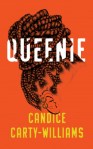
Queenie

Rating:
Author: Candice Carty-Williams
Genres: Fiction
Pub. date: Mar. 2019 (read Apr. 2019 on Audible)
Narrator: Shvorne Marks

I completely sped through this audiobook! Queenie wasn’t really on my radar at all and then suddenly, it was everywhere! It’s been compared to Bridget Jones and it featured a Jamaican-British, 25 year old, so I was definitely intrigued. Plus the audiobook narrator sounded great in the sample and had me laughing out loud in her 5 minute clip.

The reviews are a bit mixed on the book though and after reading it, I can definitely understand why. Queenie works for a newspaper and has just split up with her boyfriend of 3 years, Tom. They’ve been struggling as a couple, so they decide to go on a break for 3 months. but Queenie really struggles with the separation and turns to casual sex to fill the void in her life. She’s lonely and her break with Tom is really the start of a pretty brutal downward spiral and a ongoing fight with anxiety and depression.

The reason I say I can understand why some people would dislike this book is because Queenie is often a frustrating and sometimes unlikable character. She has very little self esteem or self respect and she struggles to stay motivated at work, making a lot of bad choices, both in her personal and professional life. She’s also black and struggles with institutionalized racism at work, casual racism in her relationship with Tom, and fetishism in her romantic life.

The book is hard to read at times because Queenie is so rough on herself and you just want her to come to terms with reality and start to make her life better. But I loved it because she felt like such a real character. Despite her bad choices, I really empathized with her and her friends. She knows she’s not okay and she just keeps pushing ahead toward the end of her “break” with Tom with the idea that if she can just return to her relationship, everything else will sort itself out. But she eventually has to come to terms with the fact that she is the only person who can sort out her problems and that getting back with Tom won’t fix the other things she’s struggling with.

This is ultimately a book about mental health and the additional struggles that black people and immigrants face in achieving success and finding support. Queenie is up against additional hurdles because she is black and even though her family loves her very much, there’s a real cultural disconnect in the way that they think about mental illness. Her family has suffered so much physical and emotional trauma in immigrating, that they are very dismissive of mental health and the value of therapy. I loved when Queenie was finally able to recognize that counselling might actually be able to help her and that she pursued it despite what her family thought. She is adverse to medicating for her panic attacks though, which I thought was a too bad because it probably would have helped her a lot.

Because of the depth of Queenie’s struggles, I’ve read a lot of reviews that the comparison to Bridget Jones isn’t accurate. I knew that going into the book and I was fine with it because I always prefer a little more depth to my characters, but I would actually agree with the assessment that this is like Bridget Jones. It’s definitely darker and not a fun rom-com like Bridget Jones, but I did notice a lot of parallels, which I thought made the book even more enjoyable.

Queenie has a similar sense of humour to Bridget, which I equate with British humour. She’s self deprecating and unflinchingly honest – to the point of oversharing. Like Bridget, she’s someone who is ready to settle down with a man, but continually finds herself making poor decisions. She works in publishing, makes the mistake of acting on an ill-informed work romance, and has a small group of friends that she turns to for support. Her group of friends consists of Darcy, Cassandra, and Cheska (sorry, I listened to audio so I genuinely have NO idea how to spell her name, so I’m going with the phonetic spelling). I loved that she called her friends “the corgis” and I loved all the interactions she had with them. I thought each of these women were fully realized as secondary characters and I found them all extremely relatable. Everyone has women like this in their lives, even snooty, annoying friends like Cassandra. Cheska was my favourite because her and Queenie understood each other better, both being black, but I also really liked Darcy, who supported Queenie in her own way as well.

Even though I couldn’t personally relate with most of Queenie’s problems, overall I still thought she was so relatable! Her character was so honest and I thought the author did a wonderful job in taking us on Queenie’s journey to self discovery. The book explores how everyone has baggage and that everyone deals with those issues in different ways. You don’t need to apologize for falling apart, and you don’t have to put yourself back together alone. I thought this book also did a great job at shining a light on all of the little microaggressions that black people have to put up with day after day and how people repeatedly dismiss their existence and see them as less than human in some circumstances. Men fetishized Queenie’s black skin and curves and they treated her with less respect than I think they would a white woman. In most cases, Queenie deserved the criticisms she received, but there were definitely other cases where she was discriminated against and treated unfairly as a black woman.

I also liked that this was ultimately a story about self-discovery and self-love and that Queenie never solved her problems by finding romantic love. Stories like this often follow the troupe where the woman has no luck with love but then eventually finds it in the least likely place and everything ends happily ever after. Queenie tries to fill the void in her life with sex, but ultimately realizes that her happiness in not contingent on a man and that her familial and friend relationships are ultimately the most important relationships in her life.

I also liked that when Queenie started looking after her mental health, she found more clarity in where she was at fault in her relationships and where other people were at fault. It’s clear from the beginning that Tom and Queenie had relationship issues. She initially blames Tom for all their issues, and while he is definitely still at fault for a lot of their problems (namely not sticking up for her against his family’s casual racism), Queenie realizes that she is also at fault for some of their problems. She is better able to recognize her own harmful habits and identify the habits others have that are harmful to her, but that she has let slide in the past.

There are some relationships where it is worth forgiving the person who has hurt you. It’s evident from the beginning that Queenie has a bad relationship with her mom, although it’s a while before we learn the extent of why. Her mother undeniably hurt her and some of the decisions she made were terrible, but sometimes it is worth acknowledging a person’s shortcomings, but still deciding to forgive them in the interest of safeguarding that relationship. Then there are other relationships where you really don’t owe the person who has hurt you anything. Just because they want your forgiveness, it doesn’t mean you have to grant it, and there are times when it is better to cut that harmful person out of your life, regardless of how they say they’ve been transformed.

Overall, a great read. Maybe not for everyone, especially if you struggle with frustrating or unlikable characters. Personally, I never disliked Queenie, I just lamented her bad choices. My favourite parts were the frank discussions around mental health and the examples of microaggressions that Black people face on a daily basis. I will miss reading about this character!