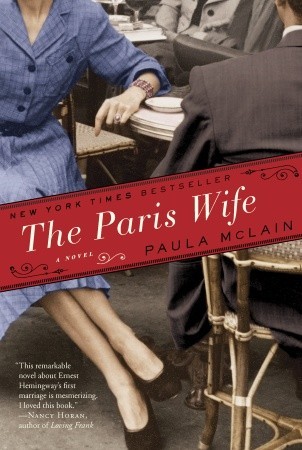
The Paris Wife

Rating: ⭐⭐
Author: Paula McLain
Genres: Historical Fiction
Pub. Date: Feb. 2011 (read Jun. 2022)

This was pretty much the most disappointing read of the decade. My book club selected it for our June meeting, which just so happened to be our 100th book and 10th anniversary as a club. We were really hoping for a winner and this absolutely did not deliver. 

The Paris Wife is set in the 1920’s and features the relationship between Ernest Hemingway and his first wife, Hadley Richardson. They meet in Chicago and quickly fall in love and marry before moving to Paris together for Ernest to pursue writing. I admit, I didn’t know very much about the lost generation and I did find it intriguing to learn that so many classic authors were acquainted with one another. At first it seems surprising, but after thinking about it a bit, I guess it kind of makes sense that affluence would produce so many classic writers. I don’t want to be salty, but it gives me the impression that the writers who received acclaim at the time are more a product of the society they kept rather than that they were actually challenging the field. I’m sure there were lots of non-white authors writing a lot more groundbreaking material at the time that went unrecognized.

Maybe that’s unfair because I haven’t actually read anything by Ernest Hemingway. The book may have briefly inspired some interest in picking up a Hemingway, but this was so flipping boring that I can’t stand to read another page about bull fighting and shit men, so it dashed any interest I might have held. 

I had a mild interest for some of the content, but I’m honestly questioning who the intended audience of this book is? Is it for Hemingway fans? Because I can’t see how anyone who likes Hemingway would finish the book feeling the same way, and anyone who was indifferent about Hemingway sure as hell won’t be anymore. Even though Hadley is at the centre of the story, it’s still not compelling. The synopsis paints the picture of an incredible bond and the ultimate betrayal, but the bond looked more like subservience to me and you could predict the betrayal a mile away. There are no likeable characters in the book, which isn’t always a problem for me, but I felt like we were supposed to like some of the characters, which is what made it more problematic.

I found nothing about their portrayal intriguing. Hemingway paints himself as a poor, struggling artist, but none of these people are poor, as evidenced by their frequent trips across the Atlantic and all around Europe. This was a boring account of a bunch of privileged, pretentious, white people. I honestly didn’t see the point. What was the theme of the book? Why did we all waste our time on this? If it’s not going to challenge my thinking in some way, it should at least be entertaining right?

To finish, the last thing I’m going to say is that the idea of my husband’s mistress climbing into bed with me and my husband and then f**king each other next to me is pretty much the most traumatizing, messed-up thing I’ve ever heard. I obviously didn’t like it and it’s probably mean to keep bulldozing it. I feel like I’m actually being harsher than I was at my book club, so I will say that the writing is good. Honestly, I feel like this could have worked really well as a biography or piece of non-fiction writing. I can see the interest in learning more about Hemingway and the lost generation, but as fiction it’s not compelling. It was too factual, with not enough emotion or liberty taken for fiction. I’d like to think that maybe the author was trying to evoke Hemingway’s sparse type of writing style, but it was my second book by her and the first one was boring too. So it’s time to move on – if you like semi-biographical fiction – this may be for you.

The Great Believers

Rating: .5
Author: Rebecca Makkai
Genres: Historical Fiction, Fiction
Pub. date: Jun. 2018 (read May 2019 on Audible)

I listened to The Great Believers as an audiobook and I feel like I’ve been working on it for a long time. It took me a while to get into it, but once I did, there were parts of the book that I really liked, and other parts that I found kind of boring.

First of all, I will say that the scope of this novel is impressive. Makkai tackles a lot in this book. The main plot of the story (for me anyways), centers on Yale Tishman, who is a gay man living in Chicago in the 1980’s and coming to grips with the HIV/aids crisis completely decimating his entire community. The novel opens with the death of Yale’s friend Nico, which in a round-about way initiates a conversation between Yale and Nico’s great Aunt, Nora, who would like to donate her personal art collection to the university art gallery that Yale works for, which would be a huge acquisition for Yale and the gallery.

At the same time, a second storyline is set in Paris in 2015 as Nico’s sister, Fiona, searches for her adult daughter who she hasn’t seen in 5 years since she disappeared into a cult in America called the Savannah Collective. I would never have thought to pair any of these plotlines together, so I was impressed with Makkai for her creativeness and scope of the book.

That said, I didn’t love all of the plots in this book. I thought some parts were a lot stronger than others and it’s what really drove the rating down for me. I’ve described 3 major things: the HIV/aids crisis in the 1980’s, an art acquisition, and a missing daughter. Yale’s storyline about the HIV/aids crisis was by far my favourite. I’ve been privileged to have not had to give this period in history a whole lot a thought, so it was both sobering and fascinating to read about.

I really liked Yale. I thought he was super relatable and I loved reading about his relationships with all his friends and his perspective on the HIV/aids crisis. I thought his story had a really good balance of history, politics, and emotion. I connected with him a lot and it was devastating to watch his friends die one by one and the government do nothing. Makkai weaves in a lot of social commentary without overpowering her novel with it. This was still very much a novel about characters and relationships, with just the right amount of history and politics.

I thought the art acquisition storyline was mildly interesting. I liked the parallels that Nora drew between the artists she knew in WWI and the war that Yale and his friends were fighting in Chicago. I have never really read anything about the art world, except maybe like, the Da Vinci Code or something (lol), so this was a whole new world for me that was intriguing to learn about.

But Fiona’s story set in 2015 didn’t do much for me and is what really dragged down my rating and enjoyment. I found myself tuning out for entire sections of Fiona’s story and I felt like very little happened in her timeline. It took forever for the story to advance and when I finally realized what the “so what” was of Fiona’s story at the end of the novel, it felt a little anti-climactic. Fiona had a tumultuous relationship with her daughter that was an indirect result of the trauma of losing all her friends in the 1980’s. She talks about how you can’t really describe what it feels like to survive a war that none of your friends make it out of and how that impacts the rest of your life without you even noticing. I thought this was a fascinating topic and I was eager to explore it, but I thought Fiona’s relationship with her daughter was a laboured way of doing it. I liked Fiona, but I just thought the modern day part dragged the book down. I also felt like I didn’t get enough context of Fiona’s relationship with Claire as a young girl and so I didn’t understand why Claire hated Fiona so much

Overall though, I did like the book and I would definitely place it firmly in the category of literary fiction. Makkai writes with depth and I loved the characterization of Yale and all the secondary characters in his timeline. It wasn’t as stand out a book as I was hoping, but I’m definitely glad I read it.