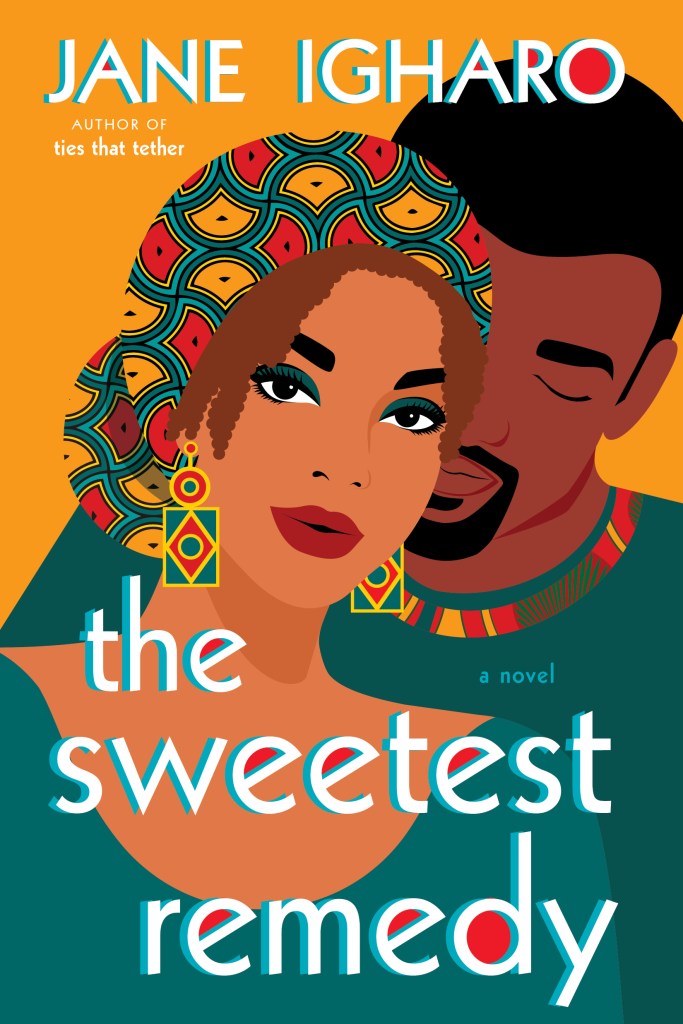
The Sweetest Remedy

Rating: ⭐⭐.5
Author: Jane Igharo
Genres: Fiction, Romance
Pub. Date: Sep. 2021

I picked this up right away after really enjoying Ties That Tether, but unfortunately, it didn’t have any of the same charm. Both books are a bit overwritten and don’t do a very good job at “show don’t tell”. But the characters in Ties That Tether had a lot of chemistry, which I felt was really lacking from this story. The romance was very instalove and it didn’t feel organic to the rest of the story.

The central story is really about Hannah meeting her estranged family for the first time and discovering her Nigerian heritage. Hannah grows up bi-racial, living with her white mother and never knowing her Nigerian father. When he passes away suddenly, she is invited to attend his funeral and get to know the rest of her family, meeting an interesting family friend, Lawrence, along the way, to whom she is attracted.

Overall, I thought the story had a very strong central idea, with lots of really great themes to explore around identity, class, family, heritage, and racism. Even though this is labeled as a romance, I actually found the romance detracted from the rest of the story. While it had a great premise, it was lacking in depth.

All of the characters felt really one dimensional and there wasn’t real tension between any of them, despite the author continuously setting up barriers between each of the characters. In my opinion, none of the conflicts had any real emotional depth, and the characters were basically wealthy Nigerian royalty, so it was really hard to relate to them or feel any empathy for them. I empathized with Hannah, but I don’t think the author committed to the entire spectrum of grief that Hannah likely would have experienced. Where was the rage at her father and his family for casting her out? Where was the deep sadness about never having the opportunity to know her father? Even the children who did know him hardly seemed to be mourning him, so the entire thing just read like a fantasy.

Which is really the problem I had with this book. I felt like the author had lived Ties That Tether. She understood Azere’s interpersonal conflict and feelings. Even though Azere and I have almost nothing in common, her emotions and longing were still incredibly relatable. I’m not convinced the author really understood the content of what she was trying to say in this book. Everything about this story read like a self-insert fantasy to me. If you grew up disconnected from your heritage, I could see the longing of gaining a family and a culture and finally feeling seen. But how easily the siblings accepted Hannah, and how they were so rich, and how she immediately meets a sensitive and nice Nigerian man to instruct her in the ways of Nigerian culture, seemed so transparently a fantasy to me. Like the author was dreaming about being adopted into a rich and affluent family.

There was no tension between Hannah and Lawrence, and there was no tension between the siblings – except for Tiya. Everyone was too easily accepted and forgiven. Sure, everyone wants a happy ending, but this was too convenient. Give me some grit! It’s a fluffy read, but neither of Igharo’s books are really fluffy stories. Ties That Tether had a good balance, but it was lost in The Sweetest Remedy and the plotline felt detached from reality.

Anyways, I like it less now that I’ve written the review. It was a disappointment. Read Ties That Tether and skip this one. 2.5 stars.

Ties That Tether

Rating: ⭐⭐⭐⭐
Author: Jane Igharo
Genres: Fiction, Romance
Pub. Date: Sep. 2020

I picked this book up a few years ago at Powell’s Bookstore as an impulse buy, but I’ve never felt much draw to actually read it. The only reason I think I finally picked it up was because I found the audiobook at my library and the narrator sounded really good, so I listened to it over Christmas while on my jigsaw puzzle kick.

I’m so glad I finally did read it, because it was a lot different and better than I was anticipating. Azere is Nigerian-Canadian. She grew up in Toronto and has been heavily influenced by Canadian culture, but her parents still cling to their Nigerian roots and raise her in fear that she will lose her connection to Nigeria. Her father passes when she is 12 and his dying wish is for her to marry a Nigerian man – a promise that holds Azere hostage for her entire adult life.

Her mother is particularly threatened by the potential loss of culture in her children and is a domineering presence in Azere’s life. Despite working for a successful marketing firm, Azere is characterized as a failure by her mother for not being married or having children. Her mother routinely tries to set her up with Nigerian men and doesn’t seem to care whether those men are actually well suited to her daughter or not. So one night Azere acts out after a bad date and has a one-night stand with a white man, who later resurfaces at her marketing firm as her new co-worker.

This is marketed as a romance, and it definitely has a romantic plot, but I would shelve it more as general fiction. I know this culture conflict is a common refrain for many immigrants, including many of my friends, so I think it makes for a compelling and nuanced story. The characters are frustrating, but you also know they’re coming from a place of love, so it’s hard to either accept or condemn their actions. That said, Azere’s mom definitely had some things to apologize for, but it was nice to see Azere finally take control over her own life and say, “enough is enough”.

My main criticism would be that I thought Rafael had some glaring flaws that I didn’t really like in a male love interest. He hid his past from Azere, and while I understood it was because of the trauma associated with what happened, I didn’t think it was very fair of him to rake her over the coals for not accepting him when we wasn’t willing to share his whole self with her. He also had temper issues that I didn’t have any tolerance for.

But overall, I was pleasantly surprised by this book and quickly rushed out to pick up a copy of her second book, The Sweetest Remedy. I’d definitely recommend the audio version, but I did switch back and forth between audio and paperback and enjoyed both!

My Sister, the Serial Killer

Rating:
Author: Oyinkan Braithwaite
Genres: Fiction
Pub. date: Nov. 2018 (read Aug. 2019 on Audible)

Woo, this was a fun little novella! It was a mistake to buy this on Audible because I listened to it way too fast! Seriously, I flew through it in like 3 days. Great narrator though!

I’ve seen this book popping up in a few places, but I wasn’t sure if the premise was exactly as the name suggestions… it is. My Sister, the Serial Killer is set in Nigeria and is told from the point of view of Korede, a young nurse whose sister has a suspicious tendency to be forced to kill her boyfriends. Ayoola always has a reason, either he attacked her, or tried to rape her, or he just happened to be poisoned while they were out to dinner together. But she consistently looks to her straight laced sister to help her clean up the mess.

Korede is torn between her obligations and loyalty to her family, and her fear for the men of Lagos. Either way, she decides to keep quiet. But when Ayoola starts getting close with one of the doctor’s at her hospital, she can’t deny she is torn about what to do.

Despite the gruesome nature of the plotline, this was a fun little book. Honestly, I found Korede’s dilemma highly entertaining. The author infuses a lot of humour into the story and the juxtaposition of the humour against the dark storyline really compliment each other wonderfully. This is the kind of extremism that really highlights human nature. On one hand, Ayoola is clearly crazy and should be locked up, but on the other hand, you can’t help admire her guts. Korede totally enables her, but what other choice does she have unless she decides to turn her sister in. After the first time, she’s an accessory in the murders, so to turn on her sister would also be the end of her life too.

it’s a short book, but I liked it that way. It was tightly plotted and you have to admire an author who says what they need to say and then moves on. No superfluous writing in this one!

Buried Beneath the Baobab Tree

Rating: ⭐⭐⭐⭐
Author: Adaobi Tricia Nwaubani
Genres: Young Adult, Historical Fiction
Pub date: Sep. 4, 2018 (read Oct. 2018)

The most overwhelming feeling I have upon finishing this book is that I’m just so glad it exists. Buried Beneath the Baobab Tree is about Boko Haram and the many girls and children they have abducted to their cause since 2009. You may recall in 2014 when Boko Haram kidnapped 276 female students from their dormitory in Chibok, Nigeria. Because of the large number of girls that were kidnapped, the crisis finally garnered international attention and forced the Nigerian Government to take real action in rescuing the stolen girls.

Unfortunately, this wasn’t a one off event. Boko Harem has been pillaging and killing in the North of Nigeria since 2009 and while many of the Chibok girls have escaped, been released, or been rescued since then, many have not. Boko Haram is a radical Islamic group that believe in Sharia law and absolute Islamic government. They kill men and kidnap girls, women, and children, forcing them to convert to islam and act as slaves in their outposts hidden deep in the Sambisa Forest. The boys are radicalized and the girls either act as slaves or are married off to Boko Haram fighters called the Rijale.

Buried Beneath the Baobab Tree is a short book told from the point of view of a kidnapped young girl. She is not one of the Chibok girls, but she was stolen from her village along with several of her friends. She dreams of winning a scholarship to attend university and become educated, but instead she is forced to convert to Islam, change her name, and marry one of the Rijale and attend to his home. Her dreams sustain her through the ordeal and remind her of who she is and that Boko Harem does not adequately represent Islam. But it kills her to watch her best friend lose her grip on reality, fall for her new husband, and begins touting the benefits of Boko Harem and Sharia Law.

There’s nothing I would change about this book. I thought it struck a wonderful balance between introducing us to Nigerian village life and the hopes and dreams of these young girls to the devastating contrast of life under Boko Haram. It’s easy for Westerners to become desensitized to these stories, and I loved that Nwaubani spent the first half of the book developing characters before focusing on the girls kidnapping. It’s an upsetting read, to be sure, but an important one to remind us of the atrocities that Boko Harem has committed, and that are still ongoing.

Thanks to HarperCollins Canada and HCC Frenzy for providing me with a free review copy of this book in exchange for an honest review. Buried Beneath the Baobab Tree is currently available in stores.