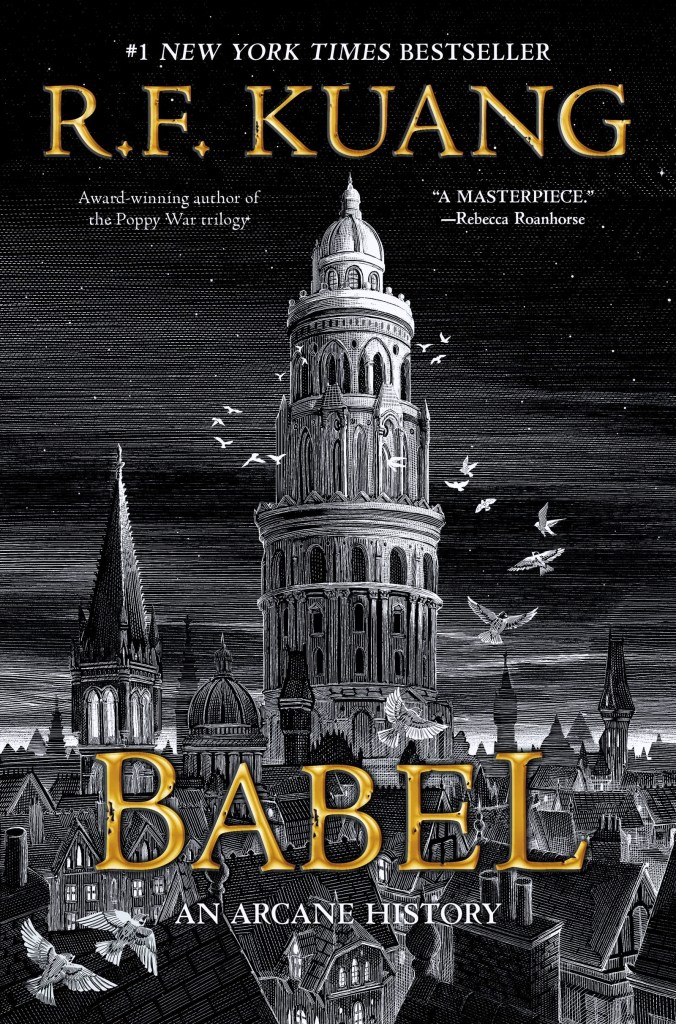
I spent months trying to read this book and it’s time to move on. I’ve been sitting on it since February and as much as I’d like to finish it, I can’t stand to read another 250 pages. I’m still rating it because I made it past 50%. There is honestly a lot to like about this book, it’s smartly written and includes a lot of interesting social commentary about language and colonialism.
The reason I’m moving on? It’s incredibly dull. No shade if you loved it – but even after 300 pages I found it slow moving and it didn’t capture my attention. While the ideas presented are great, they are repetitive. It’s a brilliant concept, but I wanted to see Kuang push the boundaries with it instead of just beating us over the head about the injustice of England growing rich and strong by stealing from other countries. It’s accurate, but not that insightful beyond its initial premise.
I liked her newest book, Yellowface, but it suffers from some of the same shortfalls in that it says the same thing in many different ways. The difference is that Yellowface is short and doesn’t take itself too seriously, making for a fast and engaging read. I do admire Kuang for what she does in this book, but the plot could definitely be tightened up to make this a shorter and easier read. It doesn’t turn me off her writing though. I would definitely recommend Yellowface and I also liked her debut, The Poppy War.
On a side note, I hated the footnotes. First of all, the little asterisk in the text was so small I literally always missed it, but it didn’t matter because the footnotes were boring as hell anyways.
People Person has been on my TBR pretty much since it was announced. I loved Queenie, so I was really excited to read this one, but it’s been getting mixed reviews and I was afraid to pick it up. Eventually the audiobook became available at my library, so I finally read it.
A lot of reviewers are saying not to compare this to Queenie and I definitely agree with that assessment. It’s an entirely different book and if you loved Queenie, it’s best not to equate the two. People Person is about 5 half siblings that are linked by a shared (absent) father, Cyril Pennington, but it primarily focuses on one of the siblings, Dimple.
The siblings are first introduced when Dimple is a teenager and Cyril randomly picks them all up for ice cream. Dimple is caught completely off guard by the existence of these people and resolves to never contact them again. That is until she finds herself in need of help in a very awkward situation. She reaches out for help and suddenly they all find themselves entwined in each other’s lives in both good and bad ways.
The beginning of this book caught me completely off guard. It’s literary fiction, but it almost reads like a mystery/thriller at the start and it was so unexpected, but in a good way. I thought the premise was entirely batshit crazy, but I couldn’t deny I was intrigued. But after the initial action, the plot settles down and it becomes much more of an examination of characters and relationships. It had a really great premise and I loved that these characters are all flawed, but I wish it had been executed a little differently.
What I liked is that none of these characters are entirely likeable. I sympathized with Dimple, but overall found her to be incredibly annoying despite being the main character. I say this with the utmost respect though because she is unlikable in an entirely believable way. Nikeesha, Danny, and Prince (sorry if I got any spelling wrong, I did audiobook) grow up poor, while Dimple and Lizzy are afforded more opportunities. Dimple is annoying because despite that fact that she is indeed a victim, it’s hard to view her as such because of her commitment to playing the victim in every possible scenario. She’s a pitiful character and I wanted to shake her and tell her to pull herself together and start making smart and proactive choices about her life.
I really liked the examination of each of the characters as they get to know one another. A lot of them were victims of circumstance and bad decisions, but I felt they were all searching for something and that these new siblings might have the ability to fill that void. They were all complex and each had a unique background and story. They really had no business developing relationships with one another, so it was interesting to see how they were pulled together by this one common thread between them.
That said, there were things I didn’t like about the book. My primary complaint is that I didn’t believe anyone would be willing to take such risks for someone they barely new, half sibling or not. Most of the characters had a weird loyalty to one another that I just didn’t believe would exist. Yes, such a shocking event might serve to develop a strong sense of loyalty, but there’s no reason for it to be there initially. None of them knew Dimple and I struggled to believe their willingness to expose themselves for her. A joint fear of the police didn’t seem like a good enough reason to me.
Honestly, I felt like this book barely even need Kiran. After the initial surprise at the beginning, the book was primarily a character driven novel, which I loved, but I didn’t think it needed such a high stakes plot to grow those relationships. Instead of focusing solely on Dimple, I would have loved to get perspective from each of the 5 siblings; to learn their stories and grow with each of them individually and as a family. But that would be a pretty different stylistic choice, so I’ve been trying to appreciate what the author does with Dimple’s character instead. I did think Dimple experiences some growth, but not necessarily as much as I expected and I wanted to see more from the other siblings too.
So overall not a bad book, but not a favourite either. Though it’s a lot different than Queenie, given the choice between the two, I would definitely recommend Queenie over this one, but I’ll be back for more from Candice Carty-Williams!
Rating: ⭐⭐⭐⭐ Author: Elizabeth Lim Genres: Fantasy, Young Adult Pub. Date: July 2021
After I read and loved The Girl Who Fell Beneath the Sea, I found Six Crimson Cranes suggested as a similar read and quickly purchased a copy of the beautiful UK edition. Six Crimson Cranes is about 17 year old Princess Shiori and her 6 brothers, who are cursed by their step mother. Her brothers are turned into cranes and Shiori is forced into silence, her identity hidden by a bowl covering her face. She is abandoned far from the castle where she grew up and forced to try and break the curse and save the kingdom.
I did enjoy this. It wasn’t my favourite, but it wasn’t hard to read and was a compelling story. There are lots of really likable characters, it has a creative and intriguing world, and Shiori has a lot of characterization. There’s a lot going on and it made for a compelling start to the novel. Between the dragon and the curse, there’s a lot of action to take in. Although I did think the book struggles with some pacing issues. It starts off quick and it has an explosive ending, but it gets a bit lost in the middle of the book and I found the story dragged once Shiori is cursed. She spends a lot of time at Castle Bushian, and while this is a very important part of the story for character development and relationship building, I really think it could have been trimmed down. At 450 pages, I think this book could easily have been 50-75 pages shorter.
That said, it has a very smart plot, but maybe a little bit too smart. In some ways it’s predictable (I had no trouble guessing who was behind the shenanigans at Bushian Castle), but in other ways it’s convoluted. There’s a lot going on in the kingdom, but limited information is revealed to the reader before the end of the book, which I found confusing and overwhelming after such a slow middle. I will be returning for book 2 once the paperback releases, but I kind of wish this had been a standalone instead. That said, there is definitely some unfinished business, so I’m excited to see where things go in the next book!
I’ve been a fan of Heather Fawcett for years (BC based author!) and I’m so glad to see so much buzz about Emily Wilde this year! If you liked this one, definitely go check out her YA series, Even the Darkest Stars, which I also love. Besides that she has a few middle grade books that are still a lot of fun. I’ve seen Emily described as “cozy fantasy” and I would describe all her books that way.
Because her last few books have all been middle grade, I assumed Emily Wilde was also middle grade. I was delighted to learn that it’s actually her first adult fantasy! It reads a bit more like YA, but there’s definitely some violence in here. It’s very infrequent and not gratuitous, but who knew such handsome faeries could be so casually violent when they get angry.
Anyways, let’s get into it – Emily Wilde’s Encyclopaedia of Faeries is set in the fictional country of Ljosland (although Google informed me this is also a small village in Norway). It’s appropriate because Ljosland is a cold, northern country that made me think of Finland or Iceland (or Norway). Emily is a young professor who has been working for many years writing an encyclopaedia of faeries and this is her last field trip to research “the hidden ones”.
Initially she finds it hard to fit in in cold Ljosland and is not sure why the villagers have rejected her. Things get even more challenging when her enigmatic colleague Wendell Bambleby arrives at her cottage and she fears he has come to piggyback off her research and success. However, the two soon discover that there is something nefarious going on between the hidden ones and the villagers and Emily must apply all her research of faeries to help protect the villagers.
This is quite different from most other fantasy novels I’ve read and even though I found it a bit slow moving, I really enjoyed it. I’ve always said that Heather Fawcett is great at creating setting and atmosphere and this novel was no exception. She really excels at writing these desolate, cold landscapes and despite the chill, I love to escape into them. What I liked about this book is that Fawcett trusts her reader to be able to infer information and context without spelling it out for them. This world is very similar to our own world (though set in 1909), with only subtle changes in terms of geography and the existence of faeries. Her world building is strong and I felt like I walked straight into this slightly kooky world that was fully realized without a lot of tedious info dumping. In short – she’s good at showing, not telling. A skill many fantasy authors have not been able to hone.
Emily is a great character. She’s relatable, yet flawed. She’s intelligent, capable, and quick-witted, yet she recognizes when she should ask for help. She makes lots of smart decisions and plays hero to several of the villagers, yet she also makes mistakes and requires a rescue of her own. Despite being set in a fantastical world of faeries, she’s incredibly genuine and believable, which I think will appeal to a lot of readers.
Like any good fantasy, this story also has a side-romance. It’s definitely subtle, but this is one of my favourite types of romances. It doesn’t dominate the storyline, rather Fawcett focuses on relationship building, while weaving a simple element of romance between the characters. Their love is tangential to the story, but makes it so much more meaningful because of it. Any good series author will also weave ongoing plotlines throughout multiple novels, which Fawcett has done, so I can’t wait to see where this relationship goes in the next book.
So overall, there was a lot to like about this book, but I do have some criticisms as well, mostly with the ending. The book moves along at a pretty slow pace – I didn’t mind it, but overall I thought it had some pacing issues. What I didn’t like was how quickly everything wrapped up at the end of the book. I felt like the story ended too quickly and was not resolved. There’s no real conclusion to the conflict the village was having with the faeries and it seemed to me like Emily and Wendell were just disappearing off into the night without accomplishing their objectives. Otherwise, it was a really fun book. I’ll definitely be picking up book 2 when it releases and may now have to get to a few of her backlist books that I haven’t read yet!
.
Spoilers Below
.
.
.
What was the most frustrating to me was how Emily stopped the poisoning plot because “it didn’t feel right”, basically because it wasn’t in line with the faeries stories and she didn’t want to see things ended that way. So instead they run away and leave things even more unresolved in my opinion. As a reader, it just didn’t feel very satisfying. I was hoping to see some resolution in Emily and Wendell’s relationship as well, but that one I could accept because it will be continued in book 2. It doesn’t sound like we’ll be returning to Ljosland, so the poor village is going to be more or less left on their own. Overall, I just felt like I had whiplash from how quickly the story ended and it left me feeling a bit unsettled and incomplete. I would have liked to see a bit more closure to the main plot points. It just felt a bit sloppy.
I started listening to this as an audiobook a full month ago and it took me a long time to get into the story. It’s really slow at first and I found it to be pretty confusing. I felt like the author didn’t give quite enough context or background for the story and I was left scratching my head about what was happening and who all the characters were.
Once things get going, I liked it a lot more. The Bandit Queens is named after real life Indian activist, Phoolan Devi. Phoolan was imprisoned for murdering the men who raped her and eventually went on to be a politician and activist once getting out of prison. Phoolan herself doesn’t feature in the story, but she’s a source of inspiration for the poor Indian village women in a microloan group, who dream of lives without their abusive husbands.
Our main protagonist, Geeta, was abandoned by her husband 5 years earlier and since no one knows what happened to him, many of the women assume Geeta killed him. Some of the women want to be rid of their own husbands and approach Geeta as a sort of hired killer to help murder them. It sounds dramatic, but the author infuses a lot of humour into the story, which changes the tone and makes it read more like Finlay Donovan than How to Get Away with Murder.
Once the plot picks up, I was pretty into it. I love how easy it is for the women to kill because everyone constantly underestimates them and no one expects a few poor little village women to actually be murderers. Either because they think women are incapable of killing, or just too stupid to pull it off. The author tackles a lot of heavy social issues, primarily around how women are still viewed as the property of their husbands in India and that domestic abuse is widespread and marital rape not recognized. There’s also a lot about caste politics in here, but it was a little bit over my head and I’ve read some reviews that it wasn’t that well done.
So I was actually pretty impressed with the second half of the novel until the big climactic scene at the end. I thought the juxtaposition of the author’s humour against social injustice was an effective way to make this book more readable. I know some readers prefer for these kinds of topics to be given the gravitas they deserve, but I don’t think the humour takes away from the impact of the domestic violence they experienced, if anything, centering your story around a cadre of murdering housewives only serves to highlight the ridiculousness of such a patriarchal system.
However, in the last 10% I think the author takes it too far. The climax of the novel veered into unbelievability for me and I felt it was sensationalized for the sake of drama. I hate when authors do this, but I do think it’s an easy mistake for a debut author to make. I think she took the outrageousness too far and it detracted from her initial premise. I believed the women as they stumbled along, trying to figure out how to be rid of their husbands, to protect themselves and their children. But they start to become villainous in their plotting and I couldn’t suspend my disbelief in the final confrontation. Plus, the author gets too heavy-handed with her social agenda around caste and I felt she was telling me about equality and representation rather than showing me. I know a lot of her readers won’t be Indian and that this system may not be familiar to us, but trust us to be able to figure out basic inequality.
Overall I thought the book had an excellent premise, but that the author tries to do a bit too much with it. In some ways it sinks under the weight of its aspirations and the author would have done better to focus her ideas. But overall, not bad, not great. solid 3 stars.


 The Paperback Princess