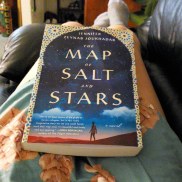
The Map of Salt and Stars

Rating: ⭐⭐.5
Author: Jennifer Zeynab Joukhadar
Genres: Historical Fiction
Pub date: May 2018 (read July 2018)

The Map of Salt and Stars is another one of those books that I wanted to love, but I just didn’t. Books like this are super important, so it’s hard to give them a bad review because I’m really glad that someone has written a split modern day/historical story about Syria. But unfortunately this novel just didn’t work for me at all.

The Map of Salt and Stars tells two stories simultaneously. The first is about Nour, an eleven year old Syrian-American who grew up in America, but whose family has just returned to Syria only to be bombed out of their house and forced to flee the country. The second story is set 800 years in the past and features a young girl Rawiya, who seeks her fortune as a map maker with the famous (and real-life person) Al-Idrisi.

Everything about this synopsis seems like a story that I would absolutely love, but the writing and characters both fell flat to me. I thought the relationships between Nour and her mother and sisters were underdeveloped and the story of Rawiya and Al-Idrisi was not engaging. I was a little more interested when I realized that Al-Idrisi was a real person, but even though Rawiya’s part of the story includes fantastical elements, it was really boring to read and I was disappointed every time the chapters switched because I didn’t want to go back to reading about her.

Likewise, Nour’s story had the potential to be super interesting, but I thought there were a lot of really weak and clumsy metaphors interspersed throughout the story and I wanted more developed relationships between all of the characters. Both stories are progressing on a road trip of sorts that align with one another, but I was never really sure what the point of pairing these two stories together was. I thought the whole secret map metaphor between Nour and her mother was laboured and ineffective. I feel like either of these stories could have been a standalone, but together neither was developed enough to really work.

I do applaud the author for what she tried to accomplish in this book and I think she has some great ideas, she just needs to keep writing and developing them into something stronger than what this book had to offer.

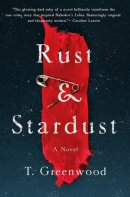
Rust & Stardust

Rating: ⭐⭐⭐⭐
Author:
T. Greenwood
Genres: Historical Fiction, True Crime
Pub Date: Aug. 7th, 2018 (read July 2018)

Thank you to NetGalley and St. Martin’s Press for providing me with a free electronic copy of this book in exchange for an honest review.

I got an ARC of Rust & Stardust a while ago, but I was never really in the mood to read it, so I kept postponing. But I finally started it last week and totally powered through it in 3 days.

As is my style, I knew very little about this book going in, except that it was about the true crime that inspired Nabokov’s classic, Lolita. Disclaimer: I haven’t read Lolita, so I’m not really sure what intrigued me so much about this one, but I’m glad I requested it because it was a really interesting fictional account, based on the true kidnapping of 11 year old Sally Horner.

Rust & Stardust features a series of narrators from Sally’s family and from individuals that crossed paths with Sally during her kidnapping, but it is predominantly narrated by Sally herself. I don’t often like child narrators that much, but I thought Sally’s voice in this book, and Greenwood’s style of writing, we’re perfect for this time setting and plot. Sally reads a copy of A Tree Grows in Brooklyn throughout this story (one of my personal favourite books), and I thought that the writing and narration style were very similar to Betty Smith’s classic and I thought it was such a fitting comparison to have Sally relate to Francie’s experience.

For some context, this story starts when Sally gets caught trying to shoplift a notebook by Mr. Warner, a customer in the store. However, he convinces Sally that he actually works for the FBI and that she is in big trouble for trying to steal. He essentially blackmails her into coming to Atlantic City with him so that she can clear her name before a judge and convinces her she needs to keep this shame secret from her mother and sister.

What follows is 2 years of captivity for Sally at the hands of the perverted Mr. Warner (Frank La Salle in real life). While her family is desperate to find her and slowly starts to fall apart in her absence, Sally is coming of age in extremely horrifying and abusive circumstances. Her kidnapping is pretty horrifying, but I appreciated the author for not being overly graphic in her descriptions. I thought the author totally nailed Sally’s voice. As the reader, you just want to rage at Mr. Warner, but you can also understand Sally’s confusion at the turn of events, her inner guilt and shame at what she’s done and what’s been done to her, and how her thoughts get so turned around by Mr. Warner’s constant gaslighting.

In reality, almost all of this story is fabricated, but the bones of the novel are based on true events. It is mostly unknown what actually happened between Sally and Frank La Salle during the 2 years of her captivity, but Greenwood has appropriately conveyed how evil Frank La Salle is (even if some of the events are fabricated). He was a character that made me so mad, mostly because of how he mentally abuses and gaslights Sally throughout the entirety of the book. He is so manipulative and aside from physically abusing her, he really gets inside her head and makes her question everything about her family and the world. It was so heartbreaking to watch a young girl have to come of age (something that can be traumatizing enough for an 11 year old) without her mother and sister for support.

There’s also a whole side story going on with Sally’s mother, Ella, and her sister and husband, Susan and Al. I didn’t find the side plot as compelling as Sally’s story, but it did add an interesting dimension to the story.

Mostly I just liked that I learned something new from this book, and my enjoyment was greatly aided by Sally’s voice in this novel. I thought the writing fit the time period perfectly. I felt like I had been transported to 1950 and even though I thought the writing was told in a slightly detached kind of way, it conveyed so well Sally’s horror and confusion and how a single event can compound and become unimaginably bad and seemingly insurmountable without proper emotional support.

A good (but upsetting) read, I liked this a lot more than anticipated.

Not That Bad

Rating: 
Author: Edited by Roxane Gay
Genres: Essays, Non-fiction
Pub date: May 2018 (read as audiobook Jul. 2018)

I listened to Not That Bad as an audiobook on audible and thank goodness I’ve finally found a new book that translates well to audiobook! I really should just stick to non-fiction when it comes to audiobooks because they translate so much better when read aloud than fiction (from my experience anyways). I read Bad Feminist, a series of essays by Roxane Gay, as well as her memoir, Hunger, and loved them both. This collection is edited by Roxane Gay; she’s not featured in any of the essays, but it was wonderful!

Not That Bad represents a diverse collection of stories about rape culture and how women condition themselves to hide their experiences or tell themselves their experiences aren’t valid because they “weren’t that bad” in comparison to other stories they’ve heard. How women brush off street harrassment because it’s not as bad as getting raped, how we’re taught to always be nice at the expense of our own comfort and safety, how a certain level of harrassment should be expected because of what we wore or how we acted, how we should be flattered instead of offended if we’re still getting catcalls when we’re older.

I’ll admit, because I listened to this as an audiobook over several weeks, I’m already struggling to recall a lot of the essays, but there are two that stick out for me.

The first was an essay about a girl in college who was pressured into attending a party (on a boat/island) with a guy who she obviously didn’t like and was afraid of – and how she spent the whole night hiding from him because she knew he expected sex and she didn’t want it. She watched him from a far as he angrily stormed around the island looking for her, asking “where’s that f***ing b***h”, and how she waited until she felt it was late enough to safely go back to their room, only to be woken from sleep to him raping her. “They will wake you up to rape you.”

It’s enraging that women can never win and can never really be safe. That many men feel they can expect sex for taking a woman out or buying her something, or in this case, taking her to a boat party. That they feel entitled to call women horrible, derogatory things if they aren’t interested in having sex and that they feel in any way entitled to a women’s body without her consent. In this case, the author later sees her rapist and he makes jokes about her rape and legitimately doesn’t think that he raped her. I’m not sure why this story stood out to me more than any of the others. This to me is very obviously “that bad”, just as all of the other stories are, but women still condition themselves to keep quiet about these horrible, invasive things that happen to them and are even forced to interact with their rapists after the fact. Some of these stories are about rape, some are about harrassment, some are about rape culture, but they are all “that bad”.

The second story that stands out to me is that of another woman who was raped and when she tells other people about it, she is routinely told, “you’re lucky he didn’t kill you”. I can’t even imagine having this response to a rape victim, but I can imagine it in a million other scenarios. He catcalled you? You’re lucky he didn’t touch you. He touched you? You’re lucky he didn’t rape you. It goes so well with this idea that as women we are responsible for the things that happen to us and not the people who actually perpetrate them. If you go drinking wearing a short skirt, you’re lucky if no one touches you. If you walk home alone a night, you’re lucky if no one bothers you. If you stay with a person who hits you, you’re lucky he doesn’t kill you.

This logic is so obviously flawed and yet it’s so pervasive in our society. This is a hard collection to read, but so important. I especially loved that many of these essays were narrated by the writers. I love when audiobooks are narrated by the writers because no one can convey tone better than the author. I only talked about two of the essays, but they are all meaningful and important in their own ways. A great collection!

I Was Anastasia

Rating: 
Author: Ariel Lawhorn
Genres: Historical Fiction
Pub Date: Mar. 2018 (read June 2018)

I had pretty high expectations of this book and unfortunately it just did not live up to them. Anastasia was pretty much my favourite animated film growing up (even though it is not at all historically accurate) and I was super excited to read a whole book about the lost princess. Plus this book had the added intrigue of being written from two contrasting timelines.

I was Anastasia tells the story of the Romanov’s from two points of view. The first is from the POV of the Grand Duchess Anastasia, commencing at the Russian Revolution and leading towards the execution of the entire Romanov family. The second point of view is from a woman going under the name of Anna Anderson who claims to be the princess Anastasia. Anna’s story is told backwards, starting near the end of her life and chronicling her lifelong struggle to be formally recognized as the Grand Duchess.

I was super excited about the structure of this book, but it ended up not working for me at all. It’s a really interesting concept to tell a story backwards and I was definitely intrigued, but I felt it was very poorly executed. There were way too many names and dates and the timeline was constantly changing, so it was extremely difficult to keep track of what was happening and I eventually gave up. Plus the author would constantly end chapters on cliffhangers, but because the story was being told backwards, you would never re-visit that part of the story and it made everything feel very disjointed and de-valued the story because you were constantly meeting characters that only mattered for a chapter or two. It made character development very difficult and Anna Anderson a pretty unlikable character. Because I found her story difficult to follow, I was really only interested in Anastasia’s timeline and would dread every time I had to switch back to Anna (although to be honest, Anastasia’s story started dragging a little bit towards the end as well.)

There were still parts of this story I found interesting though. I’m going to talk about them below, but if you’re still interested in reading the book, than I would suggest not reading any further and not doing any prior research on the Romanov’s – just read the book. This has the potential to be an interesting read if you go into blind because of the way the author has written the story. So be aware that there are spoilers below and you shouldn’t read any further if you’re still planning to read this book.

So what I did like about this book is that I didn’t know Anna Anderson was actually a real person and this is where I think most of the enjoyment of this novel came from. I thought Anna was an entirely made up character and that the author was telling a fictional story to let us decide whether or not we thought Anna Anderson was actually Anastasia. I think this is the greatest strength of the book and I appreciated the authors note because she tells a story that makes you want to believe that Anna is actually Anastasia.

What I didn’t realize is that Anna Anderson is actually a real person and most of what is written in this novel about her is based on true events. Because there was so much secrecy surrounding the deaths of the Romanov’s, there was a great myth that maybe the youngest daughter had survived. There were many Anastasia impostors over the years, especially when it became known about the great wealth the Romanov’s had stored in the Bank of England. However, Anna Anderson is the most famous Anastasia impostor and she does deserve credit for keeping Anastasia and the Romanov’s legacy alive for many many years. She claimed to be Anastasia for over 50 years and had many supporters, many of who actually knew Anastasia, yet she was never able to successfully prove her claim.

I liked that, while the author did take some liberties, this was a historically accurate book. Both stories told in this book are based in fact and as horrific as they both are, they were very interesting to learn about. I can’t love this book because I did have a lot of problems with the timeline and I honestly just didn’t find the writing or the storytelling that compelling. But I learned a lot and I still appreciate what Lawhorn was trying to do with this book. Not a favourite for me, but an interesting read if you’d like to learn a bit more about Anna Anderson and the Grand Duchess Anastasia in her final year and a half of life.

The Great Alone


Rating: 
Author: Kristin Hannah
Genres: Historical Fiction
Pub Date: Feb. 2018 (read Jun. 2018)

The Great Alone has been haunting my shelf since it first came out and I finally found time to read it as part of my June Challenge to read 3 historical novels. I read The Nightingale in 2015 and while I did like it a lot, I’ve read a lot of WWII historical fiction and had a bit of fatigue reading that genre. The Great Alone has the most gorgeous cover though (don’t pretend it doesn’t matter) and I was intrigued by a story about Alaska and a POW.

I’m so glad I finally read this because it was seriously a pleasure to read from start to finish, even though it broke my heart and tossed me into the pits of despair. The Great Alone has some of the most gorgeous writing and Kristin Hannah breathed so much life into her setting and her characters. Setting is key for this story and the author did a magnificent job a creating a sense of place. Sometimes too much descriptive imagery can bog a story down, but Hannah’s writing made me fall totally in love with a place I’ve never even been.

Alaska in the 1970’s is the last frontier of America. A place where no one really cares who you are or where you came from. A place where everyone is running to something or from something. A place where 5 of every 1,000 people goes missing and is never found. Where you’re only allowed to make one mistake, because the second one will kill you.

Ernt Albright returns from the Vietnam War a broken man. His plane crashed and he was captured early into his tour and spent years being tortured in a POW camp. When he finally returns to his family, he is broken and disillusioned with America. He was in love with his country when he signed up to go to Vietnam, but now all he can see is an America that no longer represents him – corrupt politicians and blind citizens. Between the Watergate scandal and the young girls going missing in Washington, Ernt Albright feels the whole world is just going to shit.

In his frustration, Ernt becomes an angry and volatile man, moving his family all over America before inheriting a cabin in Alaska from his late friend from Vietnam. In a last bid to find peace, he packs up his life and moves his wife, Cora, and their 13 year old daughter, Leni, to Kaneq Town in Alaska.

They arrive in Alaska in the Spring and are enchanted by the landscape. The days are long and Ernt finally has a purpose – repairing the decrepit old cottage and learning how to survive. Leni has never really had a place that she could call home, but something about Alaska calls to her. This is the great alone, where you can be whoever you want to be. There’s a real sense of community – trade is a currency and in a place where survival is all that matters, the neighbours band together to look after each other.

I’ve been living in BC for the last 5 years, and while I know it’s a lot a different than Alaska, I have become totally enamoured with the landscape here, the mountains and lakes. I spend most of my free time in the summer hiking and camping in the mountains. I also grew up in Newfoundland, which again, has little in common with Alaska, but is more remote and you spend a lot of your year suffering through a dark winter. I know the Alaskans wouldn’t be impressed with my measly camping skills when living off the land is their life, but I did feel like I could totally relate with their love of place, even though 8 months of the year that place is trying to kill you.

The author does a fantastic job with the imagery and making you fall in love with Alaska when the Allbright’s first arrive. The days are long and the flowers are in bloom, what’s not to love about Alaska. For the first time in her life, Leni sees a place where they might actually be able to be a happy family. The sun drives away Ernt’s nightmares and being responsible for your own subsistence gives them all a purpose. Plus, Leni makes her first real friend. There’s only 6 students in the tiny school in Kaneq, but Matthew Walker is 13 too and for the first time, they both have a real friend to spend time with. Matthew is the third generation of the Walker family to grow up in Alaska and he shares his love of the land with Leni and they become very close.

However, at the same time that Hannah’s writing has you falling in love with Alaska, there’s this feeling of darker things lurking on the horizon. The townspeople seem to be obsessed with winter. After school lets out, the entire summer is devoted to preparing for a long a dark winter and Leni and her family work from dawn til dusk every day doing their best to prepare. They must til the land, grow a garden, smoke and can salmon, and most important, bag a moose to see them through the long winter. And as the days start to get shorter, the long nights bring the return of Ernt’s nightmares. His temper gets shorter and Leni begins to realize that what can kill her outside the house may be second to what lurks inside their own home.

I think I could talk forever about this book. I thought it was a little slow moving at the beginning, but it didn’t hurt my enjoyment. I learned a lot about Alaska and survival, which I found just as enthralling as the character development and conflict that came later. There’s a lot going on in this book and Kristin Hannah created some truly wonderful characters. It’s hard to read about Ernt and Cora and their volatile love, as well as the heartbreak that befalls the Walker family early in the novel. But I loved watching the relationships grow. The relationships between Leni and her mother and Leni and Matthew are beautiful, as well as the relationships that develop between Leni and her mother with secondary characters like Large Marge and Tom Walker (I love both of these characters!)

This is a coming of age story for Leni and it is wrought with secrets and heartbreak. Leni loves both her parents, but she also knows they are bad for one another and she struggles to understand their love or to follow her mother’s policy of silence. Tom Walker has money and wants to invest it in the community, to promote tourism in their little piece of the world. But Ernt is opposed to change in any form and the two men find themselves at odds with one another and Ernt’s opinions threaten to tear the community apart. Leni’s friendship with Matthew and her fear of her father cause her to get caught in the middle. What matters more, her family or her future.

Like I said, this book tore my heart right out of my chest and stomped all other it. It is deeply sad, but it also makes you feel so much. It’s about the strength of women and the power of community. How some loves are good and important, but others are toxic and dangerous. There doesn’t have to be shame in our deepest, darkest secrets and that sometimes sharing them with someone else can be incredibly powerful. We don’t always have to carry our burdens alone.

This book also shines a light on some of the inequities of the past and how they still exist today. The law is not very accommodating of battered women. This hasn’t really changed. Leaving bad relationships can be the hardest thing and can sometimes even be more dangerous than staying in a bad relationship. Without help for women, sometimes there is no escape. This book will break your heart, but it will also give you that righteous anger about the way women are treated and tricked within the legal system. How in the 70’s women couldn’t even get their own credit card without a male signatory, so how are they supposed to make it on their own? But the Great Alone has some powerful characters and I loved watching Leni grow and find herself. She was forced into some tough decisions, but Alaska taught her to survive against things tougher than just nature.

I can see how this book might not be for everyone, but I absolutely loved it and now I’m dying to go visit Alaska. Recommend to everyone!