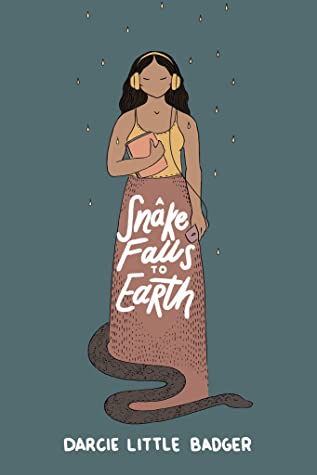
A Snake Falls to Earth

Rating: ⭐⭐⭐⭐
Author: Darcie Little Badger
Genres: Fiction, Young Adult
Pub. Date: Nov. 2021 (read Jan. 2022)

A Snake Falls to Earth was one of my most anticipated books for 2021 – I wasn’t able to get my hands on a copy in 2021, so I read it early in 2022 and really enjoyed it! It’s the second book from Darcie Little Badger, whose debut novel was Elatsoe. I really loved Elatsoe, which is why I was so excited for this one.

Overall, I don’t think I liked A Snake Falls to Earth quite as much as Elatsoe, but it’s also hard to compare because they are very different books. A Snake Falls to Earth delves into Lipan Apache history and legend about the joined Era, when spirits and monsters walked the Earth. The spirit world has since become separated from Earth, but our protagonist, Nina, a Lipan Apache girl, believes animal people may still occasionally visit earth. We follow two parallel stories, that of Nina, and of Oli, a cottonmouth from the spirit world. Until one day a snake falls to earth and the two meet. 

Little Badger still captures a lot of the magic of what made Elatsoe so great in this book. I adore her writing style, which I think reads like middle grade rather than young adult, but both her stories are strongly centered around family and place. She writes very thoughtful teenagers – whether or not it’s an accurate portrayal of teens, I’m not sure, but it’s very refreshing to read. She also blends Lipan Apache storytelling and cultural elements seamlessly into the narrative. I loved learning all about the joined era and animal people and the interesting quirks and abilities of each of her family members. 

Oli’s story is much more whimsical and I didn’t find it quite as compelling early in the novel. Again, I love the characters (Oli, Reign, Risk, Ari, Brightest, and the bear, and the mockingbird), but I didn’t find myself really engaged in the story until they started their journey to earth and their adventures blended with Nina’s. Plus I found the spirit world to be somewhat lacking in tension. Oli has the run in with the Alligator and the Fish (I’m sorry I can’t remember what specific animal it was), but I’m not sure that it added a lot to the story and felt more like the kind of faux drama you’d find in a children’s book. Whereas Paul and the hurricane were more believable threats. It’s a great feel-good book, but I think it could benefit from just a little bit more conflict and tension.

I loved Grandma! I thought her connection to the land and the fact that she couldn’t leave it was fascinating. Plus I appreciated the inclusion of oral storytelling and respect for elders. I only wished that Nina had more friends. She grows throughout the course of the novel and essentially has no friends throughout. I thought that would likely have a big impact on her character over time and was sad to see that she remains a loner the entire book. I know she eventually befriends the animal people, but given that they can only visit earth occasionally, I don’t think this would really benefit her in the long term. 

Anyways, I still really liked it. The structure is interesting and falls a really different narrative than Elatsoe, but both offer something really special and different from what we see in most literature these days. Just another reason why it’s important to amplify all voices! Will definitely read whatever this author decides to write next!

The Rose Code

Rating: ⭐⭐⭐⭐
Author: Kate Quinn
Genres: Historical Fiction
Pub. Date: Mar. 2021 (read Jan. 2022)

The Rose Code was my book club pick for January. I read The Alice Network a few years ago and only half liked it, so I wasn’t super excited to pick this one up, especially given it was 650 pages, but I ended up quite liking it, despite some flaws.

One of the key things I didn’t like about The Alice Network was the modern day storyline – there is no modern day story in The Rose Code and I think this helped with my enjoyment of it. So many historical fiction novels seem to follow the formulaic approach of splitting the story between two timelines and while The Rose code does this to an extent, there’s no present day narrative, which I rarely find adds much to the novel. Instead, The Rose Code focuses most of the narrative during the war, while occasionally jumping forward a few years.

The narrative focuses on 3 female codebreakers working at Bletchley Park. The setting was somewhat familiar to me having watched The Imitation Game, but I felt this provided a much more nuanced approach. Osla and Mab are mysteriously called to Bletchley Park for a job interview and meet on the train. They billet together in the local village where they meet their landlady’s daughter, Beth. It’s never explicitly stated, but the reader can assume Beth lies somewhere on the spectrum and while she doesn’t pick up on a lot of social cues, she is great with puzzles and ends up working at Bletchley Park as well.

This book covers a lot of history. Bletchley Park is credited as being extremely important to the war effort, with hundreds of individuals spread across the campus working on different parts of codebreaking and translation. This is done for the sake of privacy so that no single individual comes to possess too much information. Osla is a wealthy socialite who speaks 3 languages and is in a secret relationship with Prince Philip, who she meets at the start of the war. Mab doesn’t run in the same circles as Osla, but is trying to elevate her position by searching for a wealthy husband. And Beth is just trying to get out from under the shadow of her abusive, god-fearing mother.

Without getting into spoilers, I found the author’s note to be very illuminating. Osla Kendall is based on a real person, Osla Benning (with obvious liberties taken), who was actually Prince Philip’s wartime girlfriend. Mab is completely fictionalized and Beth is an amalgamation of two real female codebreakers. But upon reading the author’s note, I would say that the majority of Quinn’s characters are the amalgamation of a subset of real people. She does a great job at taking as many real aspects from history as she can and incorporating them into her fictional story. I especially liked her inclusion of the mental hospital in this book and think she could have written an entire book just on this topic.

Last year I read Kate Moore’s book, The Woman They Could Not Silence, which is about how many women would often be locked up in mental institutions, not because they were mentally ill, but as a way to oppress or silence them, often at the hands of their husbands, brothers, or fathers. It’s a fascinating subject in itself – had I not read Kate Moore’s book, I might have thought Quinn was including the hospital for dramatic effect, but actually I had no trouble believing this frustrating narrative and I think she did a really good job a capturing the sexism and injustice of it all.

I liked that each of the characters came from a different socio-economic backgrounds – it really gave a good scope of the war and struggles faced. I really liked Mab and thought the inclusion of her love story really well done. Each of the women had their own struggles and challenges, but they were all fully realized characters with a lot of character development.

So what didn’t I like about this book? There were really just 2 things. The first is that the book is far too long. Quinn goes REALLY in depth about codebreaking, and while it is interesting, I didn’t have a lot of context for it and I don’t think she really explained rodding and the bombe machines in a way that I could meaningfully understand how they worked. I found the narrative got a bit repetitive over time and I’m not exaggerating when I say I think she could have cut out at least 200 pages. It felt like there was a lot more filler than there needed to be.

The second thing I didn’t really like was the inclusion of Prince Philip’s relationship with Osla. This is set as the foundation of the entire story, with Quinn counting down the days to the royal wedding while we get flashbacks to the war. I think a lot of people are fascinated to learn that Philip has a wartime girlfriend, but I felt more along the lines of, why wouldn’t he? At the end of the day, the royal wedding and Osla’s relationship don’t actually have that much bearing on the story and I thought it was odd to center the entire narrative around it. For me, the codebreakers were the focal point of the story and I found the royal wedding to be distracting and tangential. I felt like Quinn discovered all these historical figures and just tried to cram as many as she could into one story without thinking critically about whether they belonged there. Or maybe she just thought a story with a byline about Prince Philip would sell, in which case, she’s not wrong because people lap up stories about the royal family.

Overall I just found the story took awhile to get going. I was glued to the page for the entire last third of the book, but it’s a bit of work to get there and I felt weary about it given the length of the book. Shorten this baby a bit and I think it would be even more inviting and accessible to readers. I do appreciate what Quinn has done in telling this story about Bletchley Park though. For a long time Bletchley Park was a hidden part of England’s history, and it’s exciting that the general public now gets the chance to learn about it. So 4 stars from me, which is still a great rating, despite its shortcomings.

Talking to Canadians

Rating: ⭐⭐⭐⭐
Author: Rick Mercer
Genres: Memoir, Non-Fiction, Humour
Pub. Date: Nov. 2021 (read Nov. 2021 on Audible)

Last year I read Rick’s book Final Report and was a bit disappointed when I discovered it was just a collection of rants from throughout the years. Somehow it’s just not as interesting to listen to Rick rant about Stephen Harper 10 years later. But I was interested in Talking to Canadians when I learned it would be a proper memoir and decided to read on Audible.

Talking to Canadians definitely has a niche market, but I found it to be an interesting read. Rick goes pretty in depth about how he got his start in comedy and it covers everything up until he started doing the Mercer Report. There’s a lot about how he found comedy and acting in high school and his years on 22 minutes, which I did find pretty fascinating.

Of course, Rick makes for a great audiobook narrator and I would highly recommend doing the audio if you’re reading this book. I read it back to back with Mark Critch’s new book, which I also did with both comedians last year. Between Final Report and Son of a Critch, I’d give the edge to Critch, but overall I preferred Talking to Canadians to An Embarrassment of Critch’s, though they’re both great books. They actually make surprisingly complementary reads as well since both men have 22 minutes to thank for jumpstarting their careers. I read Critch’s book first, but if you’re going to read both, start with Talking to Canadians, it makes a bit more sense chronologically.

Overall a fun read if you like memoirs and funny Canadians!

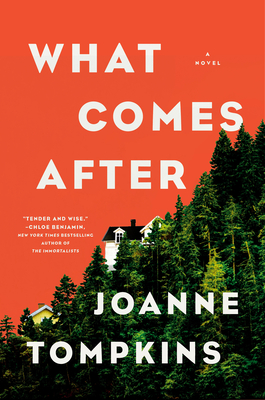
What Comes After

Rating: ⭐⭐⭐
Author: JoAnne Tompkins
Genres: Fiction
Pub. Date: Apr. 2021 (read Oct. 2021 on Audible)

It’s been awhile since I read this one, but I wanted to review it anyways because it’s one of the stranger books I read in 2021. I’d seen it floating around on Goodreads and it was a bit of an impulsive buy as an audiobook.

What Comes After is set in the pacific northwest and is about what life is like after you experience a major tragedy. In this case, it’s about a teenage boy who goes missing, and then his best friend confesses to having killed him before taking his own life. Understandably, both boys families, who are next door neighbours, are traumatized by the loss of their sons, as is young Evangeline, who is a runaway girl that was connected to both boys.

Evangeline ends up forging relationships with both boys families and we get multiple perspectives from Evangeline and the parents. I wasn’t really sure what to make of this one. It was an interesting concept and the writing is fine, but everything about the book made me so uncomfortable that it was hard to really like it. I feel like being uncomfortable is kind of the point with a book like this, but I struggled to connect with some of the characters. I liked Laurie, who was the mother of the boy who killed himself and struggles with feelings of both grief and guilt, but I didn’t really like Isaac, the father of the boy who was murdered. Isaac is a mormon and while there’s nothing wrong with this, I didn’t find him a particularly relatable character. Nor did I really connect with Evangeline, which I wish I had because she’s one of the most interesting characters in the book and a real victim of circumstance. She’s a liar and reluctant to open up, neither of which I faulted her for, but it did make me feel detached from her character.

I liked some of the themes that the author explored around abuse and survivorship and I think it makes for a really interesting debut, but I had to admit that I just couldn’t really relate with the characters. The circumstance is so dark and while murder and intrigue make for a great mystery novel, as literary fiction it was just something that I had no reference point for. I couldn’t really move past my discomfort with the storyline and while it wasn’t a bad novel by any means, I just don’t think I’d want to return for more.

So overall, a solid 3 star read, not bad, not great, just not really a book that I enjoyed either.

Where Hope Comes From

Rating: ⭐⭐⭐⭐⭐
Author: Nikita Gill
Genres: Poetry
Pub. Date: Feb. 2021 (read Oct. 2021)

I don’t often review poetry because I’m not always sure what to say about it after the fact, but I wanted to write a short review for this one since I enjoyed it so much. I read one of Gill’s other anthologies, Wild Embers, a few years ago, as well as the collection she edited called SLAM. Those were both great, but this was definitely my favourite.

Where Hope Comes From is a collection of poems about life during the pandemic. I knew the pandemic was soon going to start showing up in a lot of books and to be honest, I wasn’t really looking forward to it. We’ve all lived through it for almost 2 years now and in some ways I want the escapism of simpler times. I stumbled across this one in Chapters and bought it because I thought it might be nominated in the Goodreads Choice Awards.

I’m so glad I did buy it because I ended up enjoying it so much more than I thought I would! I feel like we’ve consumed so much media about the pandemic in the past 2 years, but until I picked this up I had no idea how much I needed to read thoughtful and reflective writing about the pandemic. Granted, this is mostly about the early pandemic and I would argue the second and third waves were emotionally much more challenging than the first one, but I feel like Gill does such a great job of evoking all the feelings I felt at that time and giving voice to the pain and sadness that we’ve all felt over the past 2 years.

Poetry is a medium unlike any other and it was such a good reminder of collectively what we’ve all been through. The poems are simple and I think that’s what makes them so powerful. They are very accessible to a wide audience. I oscillate with poetry because I really like it, but a lot of the time I feel like it’s just a bit over my head. Nikita Gill’s poetry is relatable and it’s just what I needed in a time when I think we’re all ready to move on, but burnt out over what we’ve collectively experienced. Definitely recommend if you’re feeling reflective.