The Women

Rating: ⭐⭐⭐⭐.5
Author: Kristin Hannan
Genres: Historical Fiction
Pub. Date: Feb. 2024

4.5 stars, rounded up. I absolutely flew through this book! I was really excited to read it, but for some reason I was expecting it to be a slow read. I enjoyed The Nightingale, absolutely loved The Great Alone, and didn’t really care for The Four Winds. But Kristin Hannah is back on her game with The Women.

She said in the author’s note that this is a story she’s been wanting to write for a long time, but didn’t want to write it until she was a more mature author. I think now was the right time and that writing about Vietnam captures her at her best. While The Great Alone isn’t really about Vietnam, the fact that Ernt Albright is a POW from Vietnam is really critical to the story. I feel like the Vietnam War is something close to Hannah’s heart, and it shows in her writing.

I think “The Women” is a very uninspired title, but it does fit this book. Hannah explores a lot of themes, but above all, she asks the question, “what about the women?” Frankie McGrath is 21 years old and has just obtained her nursing license in California. Her family has a proud history of military service and her brother, Finlay, is quick to enlist to serve in Vietnam. At that time, America was portrayed as winning the war and the extent of casualties were either limited, or not communicated to the public. 

Frankie misses her brother and is frustrated by the limitations of being a junior nurse. In an effort to get on her Dad’s “hero wall”, which memorializes their family’s service, she decides to enlist as an Army Nurse. Shortly after, the family learns that Finlay’s helicopter has been shot down and he has been killed. But it’s too late for Frankie to back out and she proceeds to basic training and ships out to Saigon.

Once in Vietnam, Frankie quickly has to adapt to the chaotic nature of war. After her initial shock, she becomes a very adept surgical nurse and develops close friendships with the other women. But over time, Frankie becomes disillusioned with the American government and their portrayal of the war and its success. Her mother keeps her updated on the protests at home, but when she returns to America, she is surprised at the level of antipathy the public has towards veterans. As Frankie struggles with PTSD, she realizes that no one even considers nurses to be veterans, and she is refused the few scarce benefits and supports that are offered to the men who served. (it’s not stated, but I’m curious if the male doctors were able to access veteran benefits?)

I love the way this book is written. We spend the first half of the book in Vietnam, where Frankie is exposed to unfathomable terrors, which includes a steady stream of maimed, wounded, and dying soldiers, as well as severely burned Vietnamese civilians who are the accidental (I hope) target of America’s extensive use of Napalm. Frankie rises to the occasion, becoming steady, reliable, and knowledgeable as a combat nurse.

As the reader, you go through this journey with Frankie. Even though I was aware of many of these atrocities, Hannah does an excellent job of conveying the chaos and heartbreak of war through Frankie’s eyes. It’s a brilliant set-up for the rest of her book because she is showing the reader exactly why so many people suffered PTSD from the War. It’s hard to empathize with characters like Ernt Albright in The Great Alone, because I didn’t really know what he went through. But we go through the war with Frankie, so it’s so much easier to understand her struggles.

The entire novel is compelling, but the first half definitely sucks you in. It’s a high stress setting and I could not put the book down. The second half of the book is slightly more understated, but the aftermath of Frankie’s time in Vietnam is the real reason why Hannah is telling this story. To shine a light on the injustices faced after the war by the women who served their country, and in my opinion, this second half is still gripping.

When Frankie returns to America, the culture shock is immense. She is literally spit upon at the airport and her 2 years of service are dismissed by her parents. She has nightmares and trauma responses to stimuli around her. She initially lashes out (justifiably) at both her parents and friends, but she does try to seek help from a veteran’s clinic and is turned away. She’s repeatedly told that “there were no women in Vietnam”, that “she didn’t see combat”, and so as a result “she doesn’t understand what it’s really like”. Her only coping mechanism is to remain silent and try and forget about the war. I’m sure it was still very challenging for the male veterans, who were also experiencing PTSD and public opposition to their service, but I can’t imagine having to also deal with the mass societal gaslighting of being told your experience didn’t even happen.

There’s so much to unpack in this book. At its core, it is a book about women’s history. The late 60’s and early 70’s were a time of change in America, the era of free love. White women were gaining more rights, but women overall still faced a lot of injustice and erasure. The book focuses heavily on Frankie’s PTSD, as well some issues of equal and civil rights. Frankie becomes very close with Ethel and Barb, who were nurses with her in Vietnam, and she relies heavily on these women throughout the novel.

Barb is a black woman, and even though she’s only one character, I’m glad Hannah opted to include her perspective. This is still primarily a white woman’s book, but there is recognition that there were a lot of black men who served their country in Vietnam and that their grassroots organization in the civil rights movement was also largely applied in protesting the war in Vietnam. I don’t think we really get a deep look at how Barb would have been marginalized in the Army and as an activist, or how she might have struggled being friends with two privileged white women, but I was glad to see the inclusion of a strong black woman in the story.

Frankie is a mess in the second half of the book and despite some of her gains, her life continually goes from bad to worse. I could see how her trauma could get repetitive to some readers, but I’m glad that Hannah wrote it this way because PTSD is repetitive. At this time period, PTSD still wasn’t very well understood, especially in women. It is shocking to hear about the high rates of alcohol, drug abuse, and suicide among Vietnam veterans, which is further exacerbated when you learn that many of them also developed cancer or had miscarriages or birth defects as a result of the chemicals the American’s were spraying all over the countryside.

The Vietnam War was really unlike any other war the Americans had participated in at the time. First of all, they lost it, but second of all, because of the opinion of the public, there was no glory in it. The soldiers weren’t coming home to parades like WWI and WWII. I think my problem now is that I don’t really know who is to blame, although this may be a byproduct of a lack of knowledge on my part. America was committing atrocities in Vietnam. The book doesn’t outright address incidents like the My Lai massacre, but it is demonstrated through the number of Vietnamese civilians that Frankie treats in her OR and what she witnesses at the mobile clinics. The question this book doesn’t answer is, who is accountable? 

How aware was the average soldier about the injustices the US committed against Vietnamese citizens? Can you separate the war from the soldiers? Frankie asks the question, can’t the American public support the troops and protest the government? These men and women are still serving their country, the same as in WWI and WWII, but what if your government or your superiors are acting in bad faith? I honestly don’t know the answer. Many people who are tried for war crimes throughout history use the excuse that they were just following orders, at what point are you serving your country and at what point do you become the villain? 

As a set-up to examine the impacts of war and the struggles of a country divided, I think this book is brilliant. I think Hannah asks all the right questions and focuses on the right themes. Her execution is excellent. What you’ll notice I haven’t mentioned yet is any of the personal drama in the novel, of which there is no shortage. Frankie has varying relationships with 3 men throughout the book and while this narrative is compelling, it’s secondary. I liked Frankie’s interactions with Jamie and Rye and Henry. I think they all add something different to the story and are good tools for engaging the reader. Jamie and Rye are used to explore Frankie’s personal moral code and demonstrate the heartbreak of war, while Henry is a good man and friend who helps Frankie along her healing journey. What I didn’t think was needed was the soap opera plot.

This is probably my one criticism of the book. This is my 4th Kristin Hannah book, so I knew the final act soapbox was coming, but it disappoints me every time. Hannah always adds a surprising (or not so surprising) twist to her books and it irks me because I think it’s both unnecessary and manipulative. Some readers love it because it really reinforces the heartbreak and tragedy of the story, but while still compelling, I think that Frankie’s romantic relationships are the least interesting thing about her.

Yes, Frankie did need to hit rock bottom to finally seek the help she needed. Overall, I did like how her healing journey was handled, but I feel that certain elements of the story are included only to shock and manipulate the reader emotionally. You don’t need the intense personal drama Kristin! I adore Frankie of her own merits. I had the same criticism about The Great Alone and felt the dramatic ending marred an otherwise perfect story.

But I can get over it. These dramatic elements are a way to further engage your reader. It does make for compelling storytelling and I know a lot of readers love it. I just don’t want Frankie’s personal relationships to detract from the much more important themes of this book. I’d still highly highly recommend this book. It evoked so much critical thought for me and I’m holding it to such a high standard. I questioned whether I’d outgrown Kristin Hannah after I didn’t care for The Four Winds, but I will absolutely continue to read her books. A fantastic read!

The Women is my book club’s pick for May, so my rating may change after I meet with them next week, but for now, it’s 4.5 stars, rounded up.

The Four Winds


Rating:
⭐⭐⭐
Author: Kristin Hannah
Genres: Historical Fiction
Pub. Date: Feb. 2021 (read Feb. 2021)

I know Kristin Hannah has over 20 books, but she’s become really popular with her last few publications, and for good reason. My book club read and loved the Nightingale and then I became absolutely obsessed with her last book, The Great Alone. So I was very excited to read another historical novel, this time about the dust-bowl era and mass migration to California.

While I knew about the great depression, I’m a little embarrassed to say I knew very little about the dust-bowl era of the early 1930’s. As a Canadian I won’t be overly shamed about this, but one of my biggest takeaways is that I really should read the Grapes of Wrath, which sounds like it is more or less the same plot as The Four Winds. I don’t mean that as a slight, it just seems like most people cover this period of history in their learnings by reading John Steinbeck’s classic, so I’m definitely anxious to read that book as well now.

The Four Winds opens in Texas prior to the great depression. Our heroine Elsa has been cast out by her wealthy family and marries into an Italian farming family. Though she struggles to satisfy her husband, she finds great happiness on the farm and takes joy in a hard day’s work and in raising her two children, Loreda and Ant. However, when drought strikes Texas the family falls on tough times and Elsa must make the decision whether to head west with her family in search of work and better days.

The Dust-bowl era coincides with the Great Depression and is a period of history in which many southern states experienced severe drought and dust storms. Agriculture crashed and many developed dust pneumonia as a result of the storms. This resulted in mass migration to California where migrants faced even more hardship – cast out and vilified by the locals, aid was denied to many and the only work to be found was hard labour at a pitiful wage.

It is this hardship that Elsa and her children experience. I found the plot really interesting in that I knew very little about the dust-bowl era and didn’t realize there had been a mass migration in America in the 1930’s. What’s most striking is the way that history has a tendency to repeat itself and that no matter the individual, America does a great job at othering “outsiders” and vilifying the poor.

Before southerners migrated to California, Mexicans would cross the border to work in the cotton and fruit farms as pickers, earning minimal wages, then leaving at the end of each season to return to their families. Eventually the government cracked down on this immigration and suddenly the California growers found themselves with no cheap labour to pick their goods. Until farmers from the south started flooding across the border looking for any work to feed their families. The growers took advantage of this labour and the sheer number of people allowed them to pay even lower wages, maximizing their profit because there was always someone desperate enough to pick for any wage.

This echo’s the world we still live in. Capitalism is built on cheap labour and immigrants are often still forced to work for any wage to survive. I find it hard to understand how the American Dream is even still a thing because class difference in America is so divided and there are so many people living in poverty. People with privilege rise up on what they pretend are their own merits, while a multitude of people struggle to survive every single day – many of whom are taken advantage of by their employers. The only real difference in The Four Winds is that the workers are white American born citizens. While they are absolutely justified in wanting to be treated humanely and earn a living wage, I couldn’t help but notice their indignation at being treated, for lack of another word, like immigrants. They feel that as American citizens, Californians should empathize with their plight – but it just goes to show how ingrained feelings of nationalism and state pride go and how threatened people will always feel by “others”. Heaven forbid an “outsider” receive state aid or take advantage of state services paid for by “their” tax money.

In some ways though, the migrants were just as proud as many of the Californians in that they felt they should be able to provide for themselves and should not need to take relief or government assistance. They honestly just wanted to be paid a living wage so that they wouldn’t need the relief. I’m sure many would be happy to pay taxes and contribute to services, but their poverty and the lack of work made this impossible. It’s just scary that this is a mindset that still exists today. That somehow poor people aren’t worthy of basic access to services like welfare and healthcare. That giving someone a helping hand will make them reliant on support. No one wants to be on welfare. And the fact that we still have to debate, in a pandemic, that people deserve a living wage and that the government should step up and provide financial relief, is frankly embarrassing.

I’m sure it didn’t come as a surprise to those who are more well informed than me, but what I found most shocking about this book was the Welty Farm. The sheer brilliance and evil of allowing people to run themselves into debt on your farm, all to secure their labour throughout picking season. In some ways the families that found themselves with a cabin on Welty Farms were very lucky. It put an actual roof over their heads and allowed them some modicum of comfort over living in the shanties. But the model of forcing poor migrants to buy everything on credit from the company store at triple the price and never paying them in cash is really so evil. And not allowing them to seek work elsewhere in the off season to ensure that every cent they earn during cotton picking will go into paying off their debt, ensuring they’ll have to stay around another year and survive again on credit, is just plain evil. It’s hard to believe someone can look in the face of such poverty and deny someone a living wage. But this is the world we live in – where people like Jeff Bezos make billions in a pandemic yet refuse to pay their workers a living wage. Really, what has changed since 1930?

But I should probably spend less time ranting and actually talk about the book. You’re probably wondering why I gave this 3 stars when it sounds like I was really into it. As a history book, I did really like this. Hannah showcases every aspect of this era and I liked that we got to experience how awful the dust storms were, what it was like to migrate across the country, and how in many ways, California was worse than what they experienced in Texas. So I did really like the history covered in this book and felt it was fairly comprehensive. But as far as this goes as a novel, I did think it was a little lacking.

Hannah is definitely a good writer. I fell in love with her writing in The Great Alone and the way she wrote about Alaska and her characters. I felt they all had such heart despite the hardships they faced. I love that Hannah focuses on the mother-daughter relationship in her novels and it’s what compels me to pick up each of her books. But unlike The Great Alone, in The Four Winds the land and everything around it is dying. While Elsa is undeniably a strong and inspiring character, I couldn’t help but feel this book was lacking in heart.

First of all, I thought it was too long. A lot happens in this book, but we just got a bit too much of everything. I felt like we were suffering the same thing over and over again. I know this is the reality of this kind of a life, but oh my goodness, in the beginning the dust storms seem to go on and on! I don’t think the novel was exaggerated, but we easily could have dropped a hundred pages. I repeatedly got bored throughout this book and at times felt it hard to pick it up again because it was just more and more of the same.

But like I said, as much as I liked Elsa, I just didn’t connect with her in the same way that I have with some of Hannah’s other characters. I’ll admit Hannah is somewhat emotionally manipulative in all her books, including The Great Alone, as much as I love it. She creates these grand heartbreaking situations near the end of her books, but in this one, I felt like Hannah was smashing my face into the sidewalk trying to force me to feel something I didn’t. I loved the inclusion of the wage campaigners and “communists” and seeing the migrants stand up and fight for their rights, but I struggled to buy into the romance (didn’t see the draw of the characters or any chemistry between them). I didn’t see why Elsa’s story was any more inspiring than any other migrant. The climax just felt really forced to me and it took away from the story in my opinion.

From there I thought it just went downhill altogether. I don’t want to post any spoilers, but I didn’t like how easy everything became after the climax. This is a family that has struggled and will continue to struggle. Unfortunately there is never an easy way out of these kinds of struggles. Migrants will continue to be taken advantage of. When the drought ends, yes many will likely return to where they came from, but the sad reality is that this will not be an option for many of the migrants. One, because they will literally not gave the money to return, and second, because many of them have nothing to return to. The farms they abandoned were taken over by the bank, it’s not as simple as returning to your land because the rains have returned, in many cases families will have no land to return to. It’s a really sad way to end a book, but unfortunately sometimes the bad guys win.

I’ll have to do some research about what did happen at the end of the great depression and how people were able to raise themselves back up, but I didn’t like that it wasn’t covered in this book. I assume at some point things did improve, likely some of the migrants left, enabling those that stayed behind to demand better pay. Or that job access improved with the end of the depression, but we don’t really see any of that in this book. It’s just misery straight to the end. I read some reviews that complained that the book has very few high points and too much suffering. I see the point, but I actually disagree – a lot of times the there is truth in so much suffering, but I do still want there to be a purpose for me reading the book. Yes, I learned a lot about a historical period I knew little of, but otherwise I’m not sure what my takeaways were. Yes, I know that Elsa was good and strong and that she learned to be proud of herself, but what of her relationship with Loreda? In most cases their relationship felt forced to me and I felt it was resolved with “telling” rather than “showing”. I guess overall I felt the writing too manipulative towards the end and I struggled to enjoy it.

Anyways, this turned into a pretty lengthy review. The book definitely has its strong points, but other areas that could use some work. Don’t get me wrong, I did still like it, but not Hannah’s strongest work in my opinion. That said, I haven’t been able to stop thinking about this book since I finished and I am anxious to go out and read more material about this era, so I do thank Hannah for the intro. Still recommend her books and I know a lot of readers liked this more than I did, so don’t be deterred by my review!

Top 10 Books of 2018

I read over 100 books this year, so it is incredibly hard to narrow the list down to just 10 books! I really like reading new releases and this year almost half of all the books I read were published in 2018, so like last year, I’ve decided to publish two lists. This will be my top 10 favourite books that were published in 2018, and my second follow up post with be my top 5 favourite books that I read in 2018, but were published in other years. Without further ado, here’s my top 10 of 2018, in order this year!

10. Sadie by Courtney Summers

Sadie has been making waves this year and was my first Courtney Summers book. I started reading it on a 3 day kayak trip and was totally enthralled with it the entire weekend. It’s a powerful read, but one of the things I actually liked most about it was the format. Sadie tells the story of a young woman named Sadie – when her sister turns up dead, Sadie disappears from town and goes on a mission to track down her sister’s killer. What made the format so unique was that half of the book is told in the style of a podcast investigating what happened to Sadie, while the other half is told from Sadie’s point of view as she moves through rural America trying to track down the killer. The podcast reminded me a lot of Serial and I thought it made for a really interesting and dynamic read. Summers doesn’t hold back any punches in this story and it’s really a book about how girls and women disappear and are murdered far too often. I can’t take another dead girl.

9. The Astonishing Color of After by Emily X.R. Pan

The Astonishing Color of After was a bit of a slower read compared to some of the other books on this list, but is the writing and the story ever beautiful! It tells the story of Taiwanese-American teenager, Leigh, whose mother has committed suicide. In her grief, Leigh believes that her mother has come back as a bird and is trying to communicate with Leigh. In an effort to learn more about her mother, she decides to take a trip to Taiwan for the first time to meet her grandparents. The story is filled with magical realism and is a beautiful coming of age story about grief, mental health, the pains of growing up, and the importance of chasing after the things that you love. I really liked the portrayal of mental health and depression and how anyone can be impacted by them and how there’s often no rhyme or reason to why someone might suffer from depression. I loved the cultural aspects that were woven into this story as well as Leigh’s relationship with her friend Axel and how it evolves throughout the story. Mostly though, I just loved this for the beautiful writing and would definitely recommend to anyone!

8. An American Marriage by Tayari Jones

An American Marriage has been featured on pretty much every “must read books of 2018” list I’ve seen on the internet and was featured in Oprah’s book club, so I was intrigued to read it. It’s about a newly married couple, Celestial and Roy, who’s marriage is abruptly cut short when Roy is accused of a crime he didn’t commit and incarcerated for 12 years. They try to maintain their marriage, but 12 years is a long time and Celestial starts to drift away from Roy. However, when Roy gets a surprise early release after 5 years, everyone’s lives are thrown into turmoil. Celestial has moved on and is unsure what to do in the face of her husband’s release. Roy on the other hand, is still hugely invested in Celestial and wants to give their marriage another shot. It’s a thought provoking novel on the justice system and what it means to be black in America. I really liked it because there were no easy choices for the characters and it was a critical look at the impact prison can have on the individual and their greater family and community.

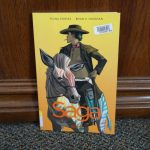
7. Saga, Volume 8 by Brian K. Vaughan, illustrated by Fiona Staples

I’ve been reading Saga for the last two years, but for some reason, Volume 8 hit me a lot harder than any of the other volumes. I also read Volume 9 this year, which I liked, but didn’t love, but something about Volume 8 struck me differently. Saga is a graphic novel series about an intergalactic romance between two soldiers on opposing sides, Alana and Marko. The series starts off with them giving birth to their daughter, Hazel, and the entire series is them gallivanting around the galaxy trying to avoid all the individuals that think their marriage and relationship is an abomination. Volume 8 deals with abortion and I think it’s one of the reason’s why I liked it so much. The whole series is incredibly diverse and examines a number of different relevant social issues, and this issue looks at some of the reasons why women and couples decide to have abortions and why all reasons are valid. Overall, I would highly recommend the series, I’ll just put a disclaimer that the series does include a lot of sex and nudity.

6. The Simple Wild by K.A. Tucker

To be honest, it’s a bit of a mystery to me why I liked this book as much as I did. Maybe I was just in the mood for a good romance, but I think it was because this was one of the rare New Adult books that I could actually relate to. I find there’s a huge gap in literature between stories about teenagers and stories about adults. There’s not a lot of great books about people in their mid-twenties and this book really that need. The Simple Wild is about 26 year old Calla. She grew up with her mom in Toronto, but she’s been estranged from her father, who is an Alaskan bush pilot, since she was 2. When she finds out her father has cancer, she decides to finally make the trip up to Alaska to meet him. She’s never understood her father’s life or why he would never leave his job to be with her and her mother. She finally has the opportunity to get to know him a little better, but fears it may be too late. At the same time, she meets her father’s best pilot, Jonah, and despite having almost nothing in common, they strike up a friendship that evolves mostly out of the two of them teasing one another. I’m not going to lie, I totally fell in love with Jonah, but this book has so much more going for it than just romance. I’m obsessed with any book set in Alaska and this was a great story about taking risks, getting out of your comfort zone, and walking a mile in someone else’s shoes.

5. Not That Bad edited by Roxane Gay

Not That Bad is a collection of stories about rape and rape culture that definitely needed to be told. I listened this anthology as an audiobook and I thought every single essay added something valuable to the collection and as a whole, the essays were extremely diverse. The premise of the book is that any story about rape, assault, or rape culture deserves a space and to be heard. People often refrain from sharing the things that have happened to them because they think they are not that bad compared to what has happened to other people they known. Gay wants to break down that idea that there is any kind of scale for breaking down the things that happen to us. Every story is that bad and every pain deserves to be acknowledged. It is only by sharing our stories that it becomes evident just how pervasive and widespread rape culture is. Your voice deserves to be heard – what happened to you is that bad – there is no hierarchy of pain and we acknowledge you.

4. Women Talking by Miriam Toews

This was my first Toews book, but I was totally blown away by it. It’s a short and simple book, but so startling in it’s honesty. Women Talking is based on a Mennonite community in rural Bolivia where the women were continuously subjected to sexual assault in secret by members of the community. They were not believed and were told that they were being punished for their sins. Eventually it came out that several men in the community had been knocking the women out with animal anesthetic and raping them in their sleep and they were arrested. This is the re-imagined conversation that took place between the women in deciding how to move forward from this ordeal. As they see it, they have three options: they can do nothing, stay and fight, or they can leave. It is extremely thoughtful and thought-provoking. Even though these characters are imagined, I was inspired by the women and their ability to forgive, love one another, and use humour to move on with their lives.

3. Wundersmith: The Calling of Morrigan Crow by Jessica Townsend

Okay, now we’re into the top 3! It’s hard to organize the lower end of this list because I liked all those books but they’re not the top books that stand out to me and it’s difficult to rank them. But the top of list is easier because they were my favourite books that I read this year, starting with Wundersmith, the sequel to Nevermoor. The Nevermoor series is a new middle grade fantasy series that I am obsessed with. I’ve compared it multiple times to Harry Potter, not because it’s like Harry Potter, but because it reminds me of all the things I loved about Harry Potter and in how it makes me feel. Morrigan Crow is a cursed child, destined to die on the eve of her 11th birthday. But instead, she is whisked away by enigmatic Jupiter North to the land of Nevermoor, which is filled with magic and flying umbrellas and gigantic talking cats. It is such a fun series filled with so much whimsy! The world building is incredible and the plot is clever and has a lot of depth. I am in love with the characters and the world Jessica Townsend has created and I cannot wait to see where she takes this series in the future!
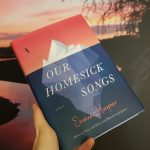
2. Our Homesick Songs by Emma Hooper

Our Homesick Songs took me totally by surprise. It’s historical fiction about Newfoundland’s cod fishery and the moratorium in 1992. It’s about family, community, loneliness, music, and love of place. The Connor family has always lived in the small rural, island town of Big Running and has  always survived off the cod fishery. When the fish disappear, many families are forced to make tough decisions about their future and leave their homes in search of work on the mainland. Aidan and Martha try and avoid that fate for their children, Cora and Finn, and instead decide to share a job at one of the camps in Northern Alberta. But as their community slowly disappears, Cora and Finn struggle with the changes to the life they’ve always known and the hole in their community. As a Newfoundlander, this book spoke to a part of my soul and I absolutely fell in love with Hooper’s writing style. I can see how it might not work for everyone, but her writing evoked such a feeling of homesickness that I felt I’d just moved right into the pages with Cora and Finn and Aidan and Martha. It’s a beautiful story about family and community and the links that tie us together. It’s a heartbreak story that was a reality for many Newfoundland families and I thought Hooper did a wonderful job of transporting her readers back to this time and place. I love the way she tied music into the story and I know this family will stick with me for a long time.

  1. The Great Alone by Kristin Hannah

And the number one spot goes to The Great Alone by Kristin Hannah. I read this book back in June and nothing has been able to top it since. It was an extremely emotional, but enjoyable, reading experience and even 6 months later, I still can’t stop thinking about it. Setting is everything for me in this novel. The Great Alone is set in Alaska in the 1970’s and focuses on the Albright family: Ernt, Cora, and their daughter Leni. Ernt is a POW from the Vietnam War and suffers from PTSD. He’s worried about the direction the government is going and in an effort to get back to the land, moves the family to the small town on Kaneq in Alaska. They move in the height of summer and Leni is totally enamoured with the landscape and their hand to mouth existence. It’s hard work to survive in Alaska and the sense of purpose and the long summer days keep Ernt’s PTSD at bay. However, when the long winter starts, Ernt’s demons start to get the better of him and Leni begins to wonder if she’s more at risk from the dangers lurking outside her door or from the dangers lurking within. It is a heartbreaking story, but Hannah creates such a sense of place and community that I just totally fell in love with. The writing is beautiful and every character is so well imagined and developed. A wonderful story about family and community, but also about the challenges women faced in the 1970’s and still face today.

Top Reads of Summer 2018

I read 29 books throughout the months of June, July, and August. It’s so hard to narrow it down to my favourites, but here’s a few of the books I loved this summer:

The Great Alone by Kristin Hannah
I am obsessed with this book. It may end up being my top read of 2018. It’s set in Alaska in the 1970’s and focuses on 13 year old Leni and her parents. Her dad was a POW in Vietnam and still struggles with PTSD, taking out his frustrations on Leni’s mother. The setting was the highlight of this book for me, followed closely by the writing. As someone who loves the mountains and the outdoors, I was totally sucked in my Kristin Hannah’s depictions of Alaska and the unforgiving nature of the great white north.

Nevermoor: The Trials of Morrigan Crow by Jessica Townsend
This is the follow up series to Harry Potter that I’ve been waiting for. A middle grade fantasy series about young Morrigan Crow, a “cursed” child who has been rejected by her family. To avoid her fate, she signs a contract with the mysterious Jupiter North and is whisked away to Nevermoor, where she competes in the trials to become a member of the prestigious Wunder Society. This is a clever and beautiful book about belonging and I can’t wait to see where Townsend takes this series.

Women Talking by Miriam Toews
One of my more recent reads, Women Talking is a sobering book about the injustices women face and the struggle of when to walk away and say enough is enough. This is a fictional recounting of true events that took place in a mennonite community in Bolivia. The women in this book are undervalued, despite the great contributions they make in running their community. Even though they’ve been violated by the men in their community, it’s still hard for them to walk away. They understand the community will fall apart in their absence, but they also understand that walking away will be more effective than trying to stay and fight and that only in their absence might things change.

Not That Bad by Various Authors, edited by Roxane Gay
This is a book of essays edited by Roxane Gay about rape culture and how women have been conditioned to stay silent, believing their experiences are not that bad. It features a wonderfully diverse series of authors and re-iterates that no matter what has happened to you in the past and how worse you think someone else’s experience was, your experiences are valid and they matter.

An American Marriage by Tayari Jones
This was an interesting novel about the American justice system and how it disproportionately targets and prosecutes black people. It had some great social commentary on what it means to be black in America, but I really liked the relationship dynamics between the 3 central characters and how it incorporated family into the story. Roy and Celestial had only been married for a year when Roy is incarcerated. Believing that Roy will be in prison for 20 years, she moves on to another relationship with her childhood friend, Andre. But when Roy is released early, Celestial must make a difficult choice about her relationships.

Sadie by Courtney Summers
This is the new YA book that everyone is talking about and it was extremely compelling. Sadie’s younger sister is murdered and in her anguish, Sadie disappears without a trace as she heads off in search of her sister’s murderer. What’s so interesting about this book is that it’s partly told in the format of a podcast about missing girls. It reminded me of Serial and features a journalist interviewing Sadie’s friends and family, trying to learn more about her disappearance and her sister’s murder. It’s a fast paced, but introspective read and I totally flew through it.

June Summary

I know, it’s halfway through July and I’m only now posting my June Summary, it’s shameful, but it’s also summer and I am having so much fun doing all the outdoor activities! For this reason, I haven’t been reading quite as much and I feel like I’ve been in a bit of a slump. I had a great start to June, but things kind of floundered a bit after that. I struggled to finish my book club selection and I really only managed to read so many books because 2 of them were audiobooks and 1 was a poetry anthology. But enough excuses, here’s my June Summary:

Books read: 8
Pages read: 2,589
Main genres: Historical Fiction
Favourite book: The Great Alone

I have to start with talking about The Great Alone because I am obsessed with this book! It’s been a month and a half since I read it and still cannot stop thinking about it! It definitely tops my list so far as best book of 2018 and I’m not sure anything will be able to top it because I loved everything about this book, even though it tore my heart to shreds. It’s set in Alaska in the 1970’s and it has made me totally obsessed with everything to do with Alaska and I am now dying to go there. I don’t want to get too much into the plot of the book, I wrote a lengthy review of it if you want to check it out, but honestly, just get yourself a box of tissues and go read it immediately!

My love of The Great Alone inspired me to pick up two other books about Alaska in June. I finally read my copy of The Smell of Other People’s Houses, which believe it or not is set in the exact same time period, but in Fairbanks Alaska. This is a short YA book with the most gorgeous cover and the most disappointing story. I did not like this one, the plot was too shallow and lacked any really emotion. Secondly, I read Robert W. Service’s most popular poetry anthology from the early 1900’s, Songs of a Sourdough, which is mostly about the Yukon and Alaska. It’s referenced several times in The Great Alone and I was already familiar with some of his poetry (the cremation of Sam McGee), but I’m thrilled I picked this one up because it has some great poems in it and I love the rhythm of his poetry and sense of place.

I read one mystery novel in June, The Dry by Jane Harper. I quite liked it as it had a good balance of mystery, investigation, and flashback to a previous mystery, which I always love in a good PI novel. This book now has a sequel called Force of Nature, which I am dying to get to because it sounds like it might have a bit of man vs. nature conflict going on, which is always interesting.

I listened to 2 audiobooks. I ran out of credits on Audible and my library’s collection of audiobooks is truly shameful, so I found a free version of Jane Austen’s Emma that I decided to listen to. It took me like 2 months to get through this one though, and while I thought the narrator did a great job, it was just so flipping boring that I couldn’t love it. I also listened to Girls Burn Brighter, which I did like, but which was just so depressing that I found it hard to listen to. It’s a sobering book about human trafficking, but it was also much heavier than I was ready for. I gave both audiobooks 3 stars, because I do appreciate what both authors were trying to do with these books, but I didn’t love either.

Finally, I read two other historical fiction novels for my monthly challenge (The Great Alone was the first one): I was Anastasia and Fruit of the Drunken Tree. I did like both of these books, but sadly neither blew me out of the water and they were both pretty standard 3 star books. I did learn some neat history from both of them though, so I commend them for that.

And that’s it for June, I will try and be more speedy in July I promise!