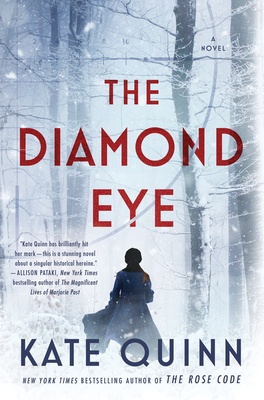
The Diamond Eye

Rating: ⭐⭐⭐
Author: Kate Quinn
Genres: Historical Fiction
Pub. Date: Mar. 2022

Now here’s a review I wish I’d written earlier. HarperCollins kindly sent me a copy of The Diamond Eye when it was released in exchange for an honest review, but I held off reading it because my book club really wanted to read it together. I wrote this review back in October (just before my book club meeting to collect my thoughts), but I never got around to posting it.

This was my third Kate Quinn novel as I’ve also read The Alice Network and The Rose Code. I read The Rose Code with book club last year and that one is still probably my favourite of the 3, but I can’t decide which I liked better of the other two. The Diamond Eye is set between Ukraine and America during the second world war. Mila Pavlichenko already has sharp-shooter training when war breaks out and immediately signs up for the war effort. Women weren’t precluded from fighting in the Soviet Union and when her skills are noticed, she quickly starts making a name for herself and winds up with her own team of snipers. Her continued success earns her the title of Lady Death and eventually she is sent to the US to rally Americans to the cause and develops an unlikely friendship with Eleanor Roosevelt.

The book starts out really strong. We learn of Mila’s history with her ex-husband and the child she’s been raising in his absence. It’s based on a true story and Mila herself is quite remarkable. That a single mother would have gotten her sharp-shooting certification at all is pretty intriguing, as is her success in the war. Women were so often relegated to the sidelines of the war effort – as nurses, or factory workers, or sometimes spies. But the Soviet Union allowed women on the front, which is quite unique on its own and presents a narrative I’ve not seen before in WWII fiction.

The first half of the book is really excellent. We accompany Mila as the Germans push the Soviets and the Soviets fight back. She develops both good and bad relationships with the men in her unit; succeeds despite the sexism of the senior male officials; and still has the odd verbal tussle with her frustrating ex, who is now a doctor in the war effort. The story is a little overly dramatized and I was annoyed that it followed a very similar sub-plot to The Rose Code, but otherwise, an excellent first half.

Unfortunately, the second half didn’t work as well for me. This book is too long. The entire second half of the book is set in America, but this plot wasn’t as engaging as the first half and was too dragged out. Had it been shorter, it might have been more effective, but I got bored around the 75% mark, which is a really bad part of the book to lose interest. Quinn takes a lot of liberty with the story in the second half and fabricates a lot of the central plot. Considering this book is centered around the real life of a real person, making up so much of the plot didn’t work for me. I felt that Quinn progressed the plot in intentionally dramatic ways and if those are not rooted in realism, it is a stain on the story. It makes the reader question what was based in fact and what was based in fiction. You have to commit one way or the other – either tell the truth, or create a fictional character with a different name. The Rose Code amalgamated several real people to form its fictional characters and I think that is a better approach if you want to deviate from real history. I don’t think you can have it both ways.

I think where this also lost me was the inclusion of another real life person, Eleanor Roosevelt, who is much more well known in real life than our protagonist. I didn’t know what to trust or where the line was for actual vs. fabricated history. The decision to include Eleanor’s “notes” and the POV of the gunmen were both interesting choices that definitely added to the drama of the story, but again, not the realism. Mila can anchor this story on her own. She is fascinating enough, Quinn didn’t need to bring Eleanor into the story in such a large way. I felt like it was a cheap way to build intrigue in the synopsis. I had similar thoughts about the inclusion of Prince Philip in The Rose Code, but I guess this is Quinn’s new thing and I’m sure it helps to sell books when you reference well-known historical figures like Eleanor Roosevelt and Prince Philip.

Anyways, overall it is a good book and an interesting story. I learned a lot and was engaged through most of the book. It wasn’t everything it could have been, but it was entertaining. Taking a peak at goodreads, my rating is on the lower side compared to the rest of my book club, who enjoyed it more than me. I’m sitting at a solid 3 star read – not bad, not great.

The Rose Code

Rating: ⭐⭐⭐⭐
Author: Kate Quinn
Genres: Historical Fiction
Pub. Date: Mar. 2021 (read Jan. 2022)

The Rose Code was my book club pick for January. I read The Alice Network a few years ago and only half liked it, so I wasn’t super excited to pick this one up, especially given it was 650 pages, but I ended up quite liking it, despite some flaws.

One of the key things I didn’t like about The Alice Network was the modern day storyline – there is no modern day story in The Rose Code and I think this helped with my enjoyment of it. So many historical fiction novels seem to follow the formulaic approach of splitting the story between two timelines and while The Rose code does this to an extent, there’s no present day narrative, which I rarely find adds much to the novel. Instead, The Rose Code focuses most of the narrative during the war, while occasionally jumping forward a few years.

The narrative focuses on 3 female codebreakers working at Bletchley Park. The setting was somewhat familiar to me having watched The Imitation Game, but I felt this provided a much more nuanced approach. Osla and Mab are mysteriously called to Bletchley Park for a job interview and meet on the train. They billet together in the local village where they meet their landlady’s daughter, Beth. It’s never explicitly stated, but the reader can assume Beth lies somewhere on the spectrum and while she doesn’t pick up on a lot of social cues, she is great with puzzles and ends up working at Bletchley Park as well.

This book covers a lot of history. Bletchley Park is credited as being extremely important to the war effort, with hundreds of individuals spread across the campus working on different parts of codebreaking and translation. This is done for the sake of privacy so that no single individual comes to possess too much information. Osla is a wealthy socialite who speaks 3 languages and is in a secret relationship with Prince Philip, who she meets at the start of the war. Mab doesn’t run in the same circles as Osla, but is trying to elevate her position by searching for a wealthy husband. And Beth is just trying to get out from under the shadow of her abusive, god-fearing mother.

Without getting into spoilers, I found the author’s note to be very illuminating. Osla Kendall is based on a real person, Osla Benning (with obvious liberties taken), who was actually Prince Philip’s wartime girlfriend. Mab is completely fictionalized and Beth is an amalgamation of two real female codebreakers. But upon reading the author’s note, I would say that the majority of Quinn’s characters are the amalgamation of a subset of real people. She does a great job at taking as many real aspects from history as she can and incorporating them into her fictional story. I especially liked her inclusion of the mental hospital in this book and think she could have written an entire book just on this topic.

Last year I read Kate Moore’s book, The Woman They Could Not Silence, which is about how many women would often be locked up in mental institutions, not because they were mentally ill, but as a way to oppress or silence them, often at the hands of their husbands, brothers, or fathers. It’s a fascinating subject in itself – had I not read Kate Moore’s book, I might have thought Quinn was including the hospital for dramatic effect, but actually I had no trouble believing this frustrating narrative and I think she did a really good job a capturing the sexism and injustice of it all.

I liked that each of the characters came from a different socio-economic backgrounds – it really gave a good scope of the war and struggles faced. I really liked Mab and thought the inclusion of her love story really well done. Each of the women had their own struggles and challenges, but they were all fully realized characters with a lot of character development.

So what didn’t I like about this book? There were really just 2 things. The first is that the book is far too long. Quinn goes REALLY in depth about codebreaking, and while it is interesting, I didn’t have a lot of context for it and I don’t think she really explained rodding and the bombe machines in a way that I could meaningfully understand how they worked. I found the narrative got a bit repetitive over time and I’m not exaggerating when I say I think she could have cut out at least 200 pages. It felt like there was a lot more filler than there needed to be.

The second thing I didn’t really like was the inclusion of Prince Philip’s relationship with Osla. This is set as the foundation of the entire story, with Quinn counting down the days to the royal wedding while we get flashbacks to the war. I think a lot of people are fascinated to learn that Philip has a wartime girlfriend, but I felt more along the lines of, why wouldn’t he? At the end of the day, the royal wedding and Osla’s relationship don’t actually have that much bearing on the story and I thought it was odd to center the entire narrative around it. For me, the codebreakers were the focal point of the story and I found the royal wedding to be distracting and tangential. I felt like Quinn discovered all these historical figures and just tried to cram as many as she could into one story without thinking critically about whether they belonged there. Or maybe she just thought a story with a byline about Prince Philip would sell, in which case, she’s not wrong because people lap up stories about the royal family.

Overall I just found the story took awhile to get going. I was glued to the page for the entire last third of the book, but it’s a bit of work to get there and I felt weary about it given the length of the book. Shorten this baby a bit and I think it would be even more inviting and accessible to readers. I do appreciate what Quinn has done in telling this story about Bletchley Park though. For a long time Bletchley Park was a hidden part of England’s history, and it’s exciting that the general public now gets the chance to learn about it. So 4 stars from me, which is still a great rating, despite its shortcomings.

The Alice Network


Rating: ⭐⭐⭐ 
Author: Kate Quinn
Genres: Historical Fiction
Read: Oct. 2017 on audiobook


I listened to The Alice Network on audiobook, so I’ve slowly been making my way through this one for ages. It’s a historical tale set in France in both 1916 and 1947 and tells two stories simultaneously. In 1916, Evelyn Gardner was a British spy who operated in the french town of Lille, posing as a waitress and collecting information the German officers would spill over their meal. In 1947, Charlie St. Clair is searching for her cousin Rose who disappeared during the war. It turns out that Rose and Eve had a shared connection in that they both spied and worked under the same man in 2 different wars and Charlie pairs up with Eve to try and find her cousin.

I really liked Eve’s story. She was a part of the Alice Network, which was a real network of female spies in WWI, lead by Louise de Bettignies, alias Alice Dubois, or as she’s known to Eve, Lily. Louise was a real person and I found Eve’s story of spying on the German officers and how she would pass information fascinating. I don’t know how much of Lily’s character was fabricated, but hopefully not very much because she was an inspiring woman with her eternal optimism, humour, and spirit.

I didn’t love Charlie’s story. She was pretty annoying at the beginning of the novel (although I did feel for her and her predicament) and I found her story much slower moving. It only got interesting during the end and while I understand why Quinn decided to run their stories parallel, I felt that Charlie added very little to the story for most of the novel. I was disappointed at the end of each of Eve’s chapters when I knew I had to read a whole chapter about Charlie and I felt that little happened in her chapters to advance the plot. They went from town to town aimlessly and her story didn’t become engaging until the point when Eve started telling Charlie her story and they starting syncing up as Eve revealed more and more information to Charlie about her experience during WWI.

Definitely an interesting read though. I’ve read a lot of WWII books set in France so sometimes I get a bit fatigued with the “next big WWII book”, but I’ve read substantially less on WWI, which was another reason why I liked Eve’s story. That said, this was a well written book and I did enjoy it!