I read over 100 books this year, so it is incredibly hard to narrow the list down to just 10 books! I really like reading new releases and this year almost half of all the books I read were published in 2018, so like last year, I’ve decided to publish two lists. This will be my top 10 favourite books that were published in 2018, and my second follow up post with be my top 5 favourite books that I read in 2018, but were published in other years. Without further ado, here’s my top 10 of 2018, in order this year!
10. Sadie by Courtney Summers
 Sadie has been making waves this year and was my first Courtney Summers book. I started reading it on a 3 day kayak trip and was totally enthralled with it the entire weekend. It’s a powerful read, but one of the things I actually liked most about it was the format. Sadie tells the story of a young woman named Sadie – when her sister turns up dead, Sadie disappears from town and goes on a mission to track down her sister’s killer. What made the format so unique was that half of the book is told in the style of a podcast investigating what happened to Sadie, while the other half is told from Sadie’s point of view as she moves through rural America trying to track down the killer. The podcast reminded me a lot of Serial and I thought it made for a really interesting and dynamic read. Summers doesn’t hold back any punches in this story and it’s really a book about how girls and women disappear and are murdered far too often. I can’t take another dead girl.
9. The Astonishing Color of After by Emily X.R. Pan
 The Astonishing Color of After was a bit of a slower read compared to some of the other books on this list, but is the writing and the story ever beautiful! It tells the story of Taiwanese-American teenager, Leigh, whose mother has committed suicide. In her grief, Leigh believes that her mother has come back as a bird and is trying to communicate with Leigh. In an effort to learn more about her mother, she decides to take a trip to Taiwan for the first time to meet her grandparents. The story is filled with magical realism and is a beautiful coming of age story about grief, mental health, the pains of growing up, and the importance of chasing after the things that you love. I really liked the portrayal of mental health and depression and how anyone can be impacted by them and how there’s often no rhyme or reason to why someone might suffer from depression. I loved the cultural aspects that were woven into this story as well as Leigh’s relationship with her friend Axel and how it evolves throughout the story. Mostly though, I just loved this for the beautiful writing and would definitely recommend to anyone!
8. An American Marriage by Tayari Jones
 An American Marriage has been featured on pretty much every “must read books of 2018” list I’ve seen on the internet and was featured in Oprah’s book club, so I was intrigued to read it. It’s about a newly married couple, Celestial and Roy, who’s marriage is abruptly cut short when Roy is accused of a crime he didn’t commit and incarcerated for 12 years. They try to maintain their marriage, but 12 years is a long time and Celestial starts to drift away from Roy. However, when Roy gets a surprise early release after 5 years, everyone’s lives are thrown into turmoil. Celestial has moved on and is unsure what to do in the face of her husband’s release. Roy on the other hand, is still hugely invested in Celestial and wants to give their marriage another shot. It’s a thought provoking novel on the justice system and what it means to be black in America. I really liked it because there were no easy choices for the characters and it was a critical look at the impact prison can have on the individual and their greater family and community.
7. Saga, Volume 8 by Brian K. Vaughan, illustrated by Fiona Staples
 I’ve been reading Saga for the last two years, but for some reason, Volume 8 hit me a lot harder than any of the other volumes. I also read Volume 9 this year, which I liked, but didn’t love, but something about Volume 8 struck me differently. Saga is a graphic novel series about an intergalactic romance between two soldiers on opposing sides, Alana and Marko. The series starts off with them giving birth to their daughter, Hazel, and the entire series is them gallivanting around the galaxy trying to avoid all the individuals that think their marriage and relationship is an abomination. Volume 8 deals with abortion and I think it’s one of the reason’s why I liked it so much. The whole series is incredibly diverse and examines a number of different relevant social issues, and this issue looks at some of the reasons why women and couples decide to have abortions and why all reasons are valid. Overall, I would highly recommend the series, I’ll just put a disclaimer that the series does include a lot of sex and nudity.
6. The Simple Wild by K.A. Tucker
 To be honest, it’s a bit of a mystery to me why I liked this book as much as I did. Maybe I was just in the mood for a good romance, but I think it was because this was one of the rare New Adult books that I could actually relate to. I find there’s a huge gap in literature between stories about teenagers and stories about adults. There’s not a lot of great books about people in their mid-twenties and this book really that need. The Simple Wild is about 26 year old Calla. She grew up with her mom in Toronto, but she’s been estranged from her father, who is an Alaskan bush pilot, since she was 2. When she finds out her father has cancer, she decides to finally make the trip up to Alaska to meet him. She’s never understood her father’s life or why he would never leave his job to be with her and her mother. She finally has the opportunity to get to know him a little better, but fears it may be too late. At the same time, she meets her father’s best pilot, Jonah, and despite having almost nothing in common, they strike up a friendship that evolves mostly out of the two of them teasing one another. I’m not going to lie, I totally fell in love with Jonah, but this book has so much more going for it than just romance. I’m obsessed with any book set in Alaska and this was a great story about taking risks, getting out of your comfort zone, and walking a mile in someone else’s shoes.
5. Not That Bad edited by Roxane Gay
 Not That Bad is a collection of stories about rape and rape culture that definitely needed to be told. I listened this anthology as an audiobook and I thought every single essay added something valuable to the collection and as a whole, the essays were extremely diverse. The premise of the book is that any story about rape, assault, or rape culture deserves a space and to be heard. People often refrain from sharing the things that have happened to them because they think they are not that bad compared to what has happened to other people they known. Gay wants to break down that idea that there is any kind of scale for breaking down the things that happen to us. Every story is that bad and every pain deserves to be acknowledged. It is only by sharing our stories that it becomes evident just how pervasive and widespread rape culture is. Your voice deserves to be heard – what happened to you is that bad – there is no hierarchy of pain and we acknowledge you.
4. Women Talking by Miriam Toews
 This was my first Toews book, but I was totally blown away by it. It’s a short and simple book, but so startling in it’s honesty. Women Talking is based on a Mennonite community in rural Bolivia where the women were continuously subjected to sexual assault in secret by members of the community. They were not believed and were told that they were being punished for their sins. Eventually it came out that several men in the community had been knocking the women out with animal anesthetic and raping them in their sleep and they were arrested. This is the re-imagined conversation that took place between the women in deciding how to move forward from this ordeal. As they see it, they have three options: they can do nothing, stay and fight, or they can leave. It is extremely thoughtful and thought-provoking. Even though these characters are imagined, I was inspired by the women and their ability to forgive, love one another, and use humour to move on with their lives.
3. Wundersmith: The Calling of Morrigan Crow by Jessica Townsend
 Okay, now we’re into the top 3! It’s hard to organize the lower end of this list because I liked all those books but they’re not the top books that stand out to me and it’s difficult to rank them. But the top of list is easier because they were my favourite books that I read this year, starting with Wundersmith, the sequel to Nevermoor. The Nevermoor series is a new middle grade fantasy series that I am obsessed with. I’ve compared it multiple times to Harry Potter, not because it’s like Harry Potter, but because it reminds me of all the things I loved about Harry Potter and in how it makes me feel. Morrigan Crow is a cursed child, destined to die on the eve of her 11th birthday. But instead, she is whisked away by enigmatic Jupiter North to the land of Nevermoor, which is filled with magic and flying umbrellas and gigantic talking cats. It is such a fun series filled with so much whimsy! The world building is incredible and the plot is clever and has a lot of depth. I am in love with the characters and the world Jessica Townsend has created and I cannot wait to see where she takes this series in the future!
2. Our Homesick Songs by Emma Hooper
 Our Homesick Songs took me totally by surprise. It’s historical fiction about Newfoundland’s cod fishery and the moratorium in 1992. It’s about family, community, loneliness, music, and love of place. The Connor family has always lived in the small rural, island town of Big Running and has always survived off the cod fishery. When the fish disappear, many families are forced to make tough decisions about their future and leave their homes in search of work on the mainland. Aidan and Martha try and avoid that fate for their children, Cora and Finn, and instead decide to share a job at one of the camps in Northern Alberta. But as their community slowly disappears, Cora and Finn struggle with the changes to the life they’ve always known and the hole in their community. As a Newfoundlander, this book spoke to a part of my soul and I absolutely fell in love with Hooper’s writing style. I can see how it might not work for everyone, but her writing evoked such a feeling of homesickness that I felt I’d just moved right into the pages with Cora and Finn and Aidan and Martha. It’s a beautiful story about family and community and the links that tie us together. It’s a heartbreak story that was a reality for many Newfoundland families and I thought Hooper did a wonderful job of transporting her readers back to this time and place. I love the way she tied music into the story and I know this family will stick with me for a long time.
- The Great Alone by Kristin Hannah
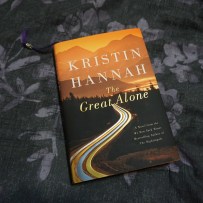 And the number one spot goes to The Great Alone by Kristin Hannah. I read this book back in June and nothing has been able to top it since. It was an extremely emotional, but enjoyable, reading experience and even 6 months later, I still can’t stop thinking about it. Setting is everything for me in this novel. The Great Alone is set in Alaska in the 1970’s and focuses on the Albright family: Ernt, Cora, and their daughter Leni. Ernt is a POW from the Vietnam War and suffers from PTSD. He’s worried about the direction the government is going and in an effort to get back to the land, moves the family to the small town on Kaneq in Alaska. They move in the height of summer and Leni is totally enamoured with the landscape and their hand to mouth existence. It’s hard work to survive in Alaska and the sense of purpose and the long summer days keep Ernt’s PTSD at bay. However, when the long winter starts, Ernt’s demons start to get the better of him and Leni begins to wonder if she’s more at risk from the dangers lurking outside her door or from the dangers lurking within. It is a heartbreaking story, but Hannah creates such a sense of place and community that I just totally fell in love with. The writing is beautiful and every character is so well imagined and developed. A wonderful story about family and community, but also about the challenges women faced in the 1970’s and still face today.


 Rating: ⭐⭐⭐
 Rating: ⭐⭐⭐⭐
 Rating: ⭐⭐⭐.5
 The Paperback Princess