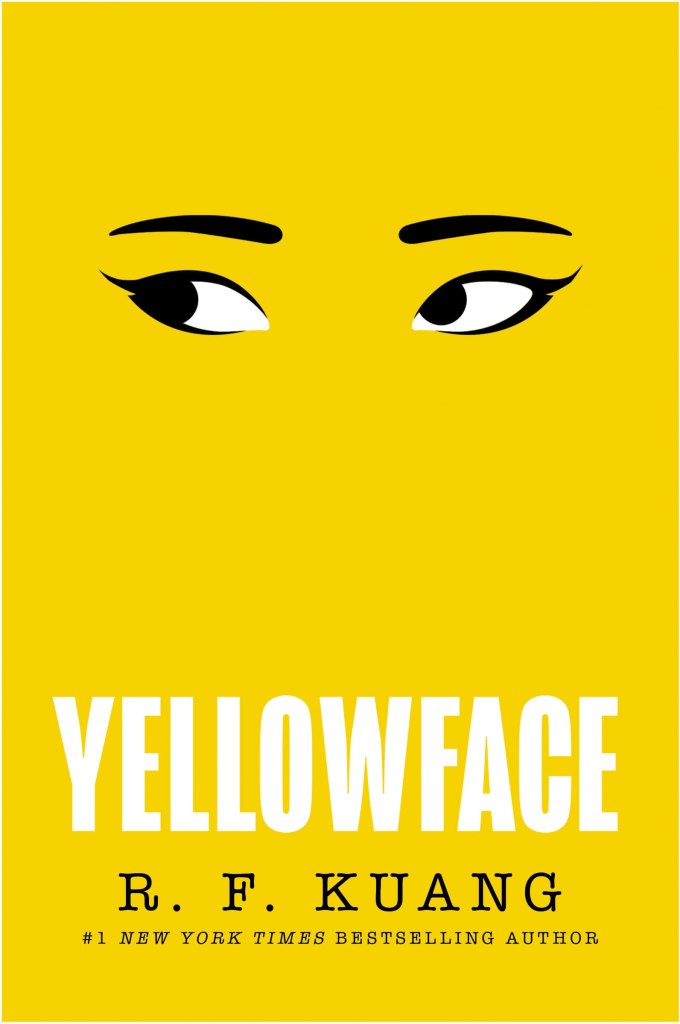
Rating: ⭐⭐⭐.5
Author: R.F. Kuang
Genres: Fiction
Pub. Date: May 2023
Yellowface was one of my most anticipated books of the year, so I was thrilled to receive an advance copy from Harper Collins in exchange for an honest review.
My anticipation of this book might come as a bit of a surprise seeing as I DNF’d Babel, but the synopsis of Yellowface was completely irresistible to me after I read and loved Disorientation by Elaine Hsieh Chou last year. The two books have a lot in common, but are both entirely different beasts. Of the two, I’d definitely recommend Disorientation first, but Yellowface is still an interesting read.
Yellowface is about two friends, Athena Liu and June Hayward. Athena is the bright, young author who receives critical acclaim for her debut novel and watches all her subsequent books become bestsellers and get optioned for TV. Though they went to the same university, June’s debut novel is a flop and she can’t help but be jealous of Athena’s success. They’re barely even friends really and June has never understood why Athena hangs out with her (me either to be honest) – to June, Athena has always been the kind of girl you love to hate.
Then June plays witness to Athena’s tragic death and in a moment of impulsive opportunity, steals Athena’s most recent manuscript, which hasn’t been seen by anyone. The manuscript is incredible, but still needs a lot of work and June figures that without her loving care, the novel would never become a true masterpiece, making the work as much hers as it was Athena’s. Suddenly June is catapulted into the career she always wanted and envied Athena for. But will she be found out for what she’s done? Someone seems to be hot on her tail and June becomes haunted by the ever watchful presence of Athena’s ghost. Can she reconcile her actions or will ghosts forever lurk around her.
The premise of this book is really smart. Underneath the obvious plot, this is a story about the pitfalls of the publishing industry. With only 5 major publishing houses, it’s a tight knit industry to break into and it examines the inherent racist and classist structures that exist in any long standing industry. Although even more interesting, it examines whether bestselling books are written or made.
What makes it intriguing is Kuang’s approach to the narrative. She doesn’t write this story from Athena’s point of view, but rather from June’s. As a young Asian American author, it would be so easy for her to write from Athena’s perspective about her experience in the publishing industry, but instead she decides to flip the narrative on its head by writing about it from the perspective of a white woman.
In some ways, writing speaks for itself – Athena became a bestseller on her own merits – and her work is equally undeniable in June’s hands. But what is interesting, is the way June is treated by her publishing team as a white woman. What I do think is missing from this book is the contrast to how Athena achieves her success. It’s alluded to that she had to fight against systemic injustice in getting her novels published, but it’s not explored in any depth. Rather we see how easy it is for June and how her publishing firm is willing to stand behind her no matter what allegations are made against her. It’s interesting to watch how they brand her, intentionally creating ambiguity in her identity to thwart future criticism about “own voices”. So I would have liked to see a little more contrast between the two experiences. It’s no real shock to me that the industry is white-washed, instead show me how this impacts young minority authors like Athena.
As the novel advances, June’s deceitfulness grows, as does her boldness. The plot becomes more and more chaotic, which was everything I wanted. Disorientation was a satirical novel that descended entirely into chaos. Yellowface is also satirical, though not quite as outlandish as Disorientation. If anything though, I wanted Yellowface to really go there. I’m sure some readers don’t like it when books veer into unbelievability, but for a book like this I feel the contrast only serves to highlight systemic injustice. Although as I alluded to above, I think the contrast is somewhat missing from this book. June is a brazen character, but without the contrast of what Athena experienced as a writer, it’s harder for the reader to understand exactly how privileged June’s experience is when we don’t know the realities of the publishing industry ourselves.
So despite this being a pretty scathing assessment of the publishing industry, my main comment is that I think Kuang could have actually done more. I said in my review of Babel that despite Kuang’s impressive understanding of language, her key themes are actually pretty basic. For such a long book, I found Babel to be very repetitive. Likewise in Yellowface, the premise is brilliant, but I thought her ideas were repetitive and a bit tired. This is basically one long look at white privilege and the ignorance of white people. I think it’s an entertaining book and an important message, but I feel like Elaine Hsieh Chou tackled SO much more in Disorientation and the discussion was a lot more nuanced, whereas Yellowface takes one central idea and exhausts it in the extreme.
Chou looks not only at systemic racism in academia, but explores in depth about identity and how her main character perceives the other white and asian people around her. Any discussion around identity is effectively silenced in Yellowface because the only Asian character chokes on a pancake. I wanted to see Kuang stretch her ideas a little more. Like I said, it’s still a great exploration of systemic racism, it just didn’t challenge my thinking in quite the same way.
But please don’t take this as too harsh of a criticism because it’s not for our limited Asian-American authors to carry this entire weight on their shoulders. As is evident, they face enough barriers and challenges in getting published at all. It actually says a lot about Kuang’s skill (and Chou’s) that their books inspire such analysis because that means their narratives are being published and promoted more. Despite me wanting more from the book, it still left me with this lengthy review and a lot to chew on. I would still recommend the book and I devoured it over the course of two days. Kuang is a great author and kudos to Harper Collins for their willingness to publish a book that looks so closely at the publishing industry.
 Rating: ⭐⭐⭐⭐
 The Paperback Princess