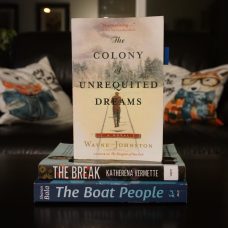
The Colony of Unrequited Dreams


Rating: 
Author: Wayne Johnston
Genres: Historical Fiction
Read: Feb. 2018

Where to start? This was a very long book that took a lot of motivation to pick up off my shelf, but that I ended up having a lot of opinions about. I was worried that it was going to be really dense, but fortunately, it turned out to be a very well written and engaging book about Newfoundland.

The Colony of Unrequited Dreams is historical fiction about Joey Smallwood, Newfoundland’s first premier who helped to usher Newfoundland into confederation with Canada. He is both a well liked and disliked premier, depending on who you talk to. Johnston definitely takes a lot of liberties with Smallwood’s character in this novel, but the story is still pretty accurately based on his life in terms of what he accomplished.

The story starts with Smallwood as a child in the early 1900’s. His family were shoe salesmen in St. John’s and he lived up on the Brow looking over the Harbour until his uncle decided to pay to send him to Bishop Feild, the prestigious boy’s boarding school of the day. At Bishop Feild, he meets Prowse, grandson of a noted historian, and Fielding, a girl who attends the nearby sister school, Bishop Spencer.

Fielding is the other main character in this story and unlike Smallwood, her character is completely fabricated. Fielding has a cane, walks with a limp, has a wry sense of humour, with sarcasm and irony being her preferred mediums. She’s a bit of an outcast who goes on to work as a reporter for The Telegram, publishing critical articles about all branches and parties of the government. Fielding marches to the beat of her own drum and I really liked her. I loved that she wasn’t afraid to speak her mind and I loved her sense of humour.

This book actually had a lot more humour in it than I was expecting and it had me laughing out loud early in the novel. Below is one of my favourite quotes from the book, which is an argument Smallwood has with his mother, and had me laughing because I also grew up in St. John’s while my parents grew up in rural outport communities. This is pretty much the exact same thing my parents would say to me growing up and the biggest way you could offend my parents would be to call them townies.

“I’m a Newfoundlander, but not St. John’s born, no, not St. John’s born,” he said.
“You’re a bayman and you always will be,” my mother said.

I’ve been living on the West Coast for the last 4 years, so this was super nostalgic for me. Wayne Johnston is not even describing my St. John’s in this novel because it’s set between 1900 and 1950, but there’s something really special about still being able to vividly picture the setting of a story, especially when it’s a place like Newfoundland, which I hold so special in my heart.

I didn’t love Joe Smallwood’s character, but I did like the writing. This was one of my monthly challenge books and I’m glad I challenged myself to read it because I probably never would have gotten around to it otherwise. Johnston does a really great job with the setting. I don’t know how non-Newfoundlanders might feel about this book, but I loved the setting and the atmosphere Johnston created. Especially towards the end when we finally get to the whole business of confederation and the end of independence. I felt like Johnston did a good job of not taking a side and presenting both sides of the story. It really makes you reflect on what Newfoundland gained, what it lost, and what may or may not have been.

I read Greg Malone’s Don’t Tell the Newfoundlanders several years ago and I felt that this book was a good contrast to that. Greg Malone is very clearly anti-confederation, as well as a bit of a conspiracy theorist. While I really liked Don’t Tell the Newfoundlanders, because it has some great history in it and I learned a lot, it is very speculative and I liked that Wayne Johnston presented a more balanced version of history and I feel he left his personal feelings out of it.

For those of you not well versed in Newfoundland’s history, we we’re an independent country up until 1933 when we had a commission of government forced on us by the British as a result of our war debt (even though A LOT of Newfoundlanders lost their lives fighting for Great Britain in WWI – I am a little bitter, yes). I’ve written an entire blog post about Don’t Tell the Newfoundlanders if you’re interested in our fascinating history (to me anyways), but basically we were supposed to get back our independence when we became self-sustaining once more, which we did after WWII. However, instead of just turning governance back over to Newfoundland, it was decided to hold a referendum to let the people choose if they wanted to join Canada instead.

Joe Smallwood wanted nothing more than to do something for which he would be remembered. He dropped out of Bishop Feild and failed at making a life for himself in New York, so he was desperate to have an influence in Newfoundland’s future. He was an avid socialist in his youth, but upon realizing that Newfoundlanders were never going to buy into socialism, he turned his talents to the Liberal government. He helped former Prime Minister Sir Richard Squires with his re-election campaign in hopes of winning the nomination to run himself, but he is jilted by Squires again and again and struggles to get into politics.

In this novel, he is a huge supporter of unions, walking across the entire provincial railroad line to start a rail-workers union, and he later travels all around Newfoundland’s most remote islands, trying to start a fisherman’s union. This really gave me an appreciation for how Smallwood became so popular and influential and why he supported Confederation. He really cared about Newfoundlanders and he spent an inordinate amount of time speaking with the poor throughout his life. He was also the host of a popular radio show that focused on sharing stories of Newfoundland and about Newfoundlanders.

The fisherman were not nationalists of any sort…They would vote for Confederation to get the mother’s allowance and would live by Confederation exactly as they had before…They had starved through a depression that had ended when the war began. Now, they were terrified that another decade like the thirties was on its way.

The crowd from St. John’s, the merchants and the wealthy, were all big supporters of independence. But Smallwood understood from his travels around Newfoundland that the majority of Newfoundlanders were poor fisherman, struggling to keep food on the table. They didn’t care about the government of the day and it rarely affected them. Confederation wouldn’t really change anything for them, except they’d be able to profit from access to Canada’s established public services.

The anti-confederates must have wondered how they lost…They had been to London and they had been to New York, but they had never been to Bonavista or La Poile, and that was why they lost.

Don’t Tell the Newfoundlanders leaves you feeling angry and riled up, but The Colony of Unrequited Dreams gave me an appreciation of what it was really like for Newfoundlanders. Forget the politics and the conspiracies, rural fishermen just wanted to catch a break and this was something I never really understood before. Yet Johnston still presents the other side of the story and makes you feel very nostalgic for what might have been. Personally, I wish we could have seen what might have been had we re-gained our independence, but I do also think it’s likely that we might have ended up joining Canada anyways and I’m proud to be both a Newfoundlander and a Canadian. I think this must be one of the reasons why Newfoundlanders always retain such a keen sense of home no matter where they go. There is something unique about Newfoundland culture that does not come from Canada because we have not always been Canadian.

The ending of this book was heartbreaking for me though. I was a little bit disappointed that Johnston chose to end this book about Fielding. I really liked her, but as a fictional character, I don’t think her story was quite as powerful and it felt very anti-climatic to suddenly jump back into Fielding’s past.

“You all but gave away Churchill Falls, which you had hoped would crown your career as Confederation had crowned Mackenzie King’s”

Johnston touches very briefly on Churchill Falls and I wish he’d explored it more. If this book had been written 10 years later, I’m sure he would have because the Lower Churchill is such a hot topic in Newfoundland right now. But I found this so heartbreaking because Churchill Falls was meant to be Smallwood’s swan song – his legacy – and instead it turned out to be one of the worst deals every made and a real sore spot for Newfoundlanders. Smallwood did not have a successful start as Premier and Johnston portrays him running out of time in office and chasing after Churchill Falls as his last chance to see Newfoundland transformed.

That said, my favourite part of this book is easily the way Johnston writes about Newfoundland. You can tell he has a great love and reverence for the island. I’m sure any Newfoundlander can relate as there’s just something that makes Newfoundlanders have this deep attachment to their homeland. She’s a rocky isle in the ocean, and she’s pounded by winds from the sea, but you just can’t help but love her ruggedness and her people. Smallwood was relentless and he really did want to do something good for Newfoundland. His whole life was dedicated to making Newfoundlander better and I do really think he cared about the poor Newfoundlanders and that they are what ultimately motivated him to chase after confederation.

I have often thought of that train hurtling down the Bonavista like the victory express. And all around it the northern night, the barrens, the bogs, the rocks and ponds and hills of Newfoundland. The Straits of Belle Isle, from the island side of which I have seen the coast of Labrador.
These things, finally, primarily, are Newfoundland.
From a mind divesting itself of images, those of the land would be the last to go.
We are a people on whose mind these images have been imprinted.
We are a people in whose bodies old sea-seeking rivers roar with blood.

The Boat People


Rating: 
Author: Sharon Bala
Genres: Fiction, Historical Fiction
Read: Feb. 2018

Oh my goodness, I feel like this book took forever to finish! Between going on a ski trip last weekend and the Olympics stealing all of my attention, it took me a bit longer than anticipated to get through The Boat People. But I finally finished!

This was the first book of my February Reading Challenge and I am a little concerned I might not fit them all in this month because I am just completely obsessed with the Olympics! This month I challenged myself to read 3 books about Canada and this was my pick from the Canada Reads 2018 shortlist.

The Boat People is written by Sharon Bala, who fascinatingly was born in Dubai, raised in Ontario, and currently lives in Newfoundland, and it’s about a ship full of refugees from Sri Lanka who landed on Vancouver’s shores in 2010. It was a bit of a thrill to read a book about the place where I currently live, as I don’t read that much Canadian literature, and this was a fascinating bit of history about an event I knew shockingly nothing about.

Sri Lanka has been torn apart by war for decades, driving many people to desperation to escape the violence in any way they can. These 492 Sri Lankan’s board a cargo ship bound for Canada in an effort to seek out a better life. Fortunately everyone survives the journey and they are thrilled when they first see the coast of Vancouver Island, but the welcome party is cut short when they are promptly separated and detained in two prisons while the government fumbles to try and decide what to do about them.

I knew very little about the process for migrants who show up un-announced at the border and this was very eye-opening. Refugees must first seek permission to request asylum and then go through admissibility hearings for their request to be granted. In this case, the government was worried about terrorists being on board and wanted to delay the process as much as possible to assuage the public’s fears. The adjudicators had very little information to go on outside of the refugee’s testimony and because the government wanted to delay the process to dissuade copycat voyages, the refugees were forced to remain in these detainment prisons for months while their hearings were repeatedly denied and postponed.

I did struggle a bit with this book as there’s a lot of legalese in it, a lot of (slightly confusing) Sri Lankan history, and a lot of character names and stories that I struggled to keep straight, but I really liked how Bala wrote this book and she was not shy in tackling a lot of different issues.

The story is told from 3 perspectives: Mahindan, a single father who made the journey from Sri Lanka with his 6-year old son Sellian; Priya, an articling student (of Sri Lankan heritage) who’s firm takes on 5 refugee cases pro bono and has her help out on the cases; and Grace, an adjudicator (of japanese heritage) who is assigned by the xenophobic Minister of Immigration to adjudicate the detainment hearings.

This is a morally-gray book and I appreciated Bala for not making this a straight-forward morality tale. She tackles so many issues in this book; the xenophobia of the Canadian public, the refugee diaspora, the immigration process, Canada’s past failings, the importance of history and remembrance, reconciliation, culture shock, and the list goes on.

The novel first presents us with the refugees, ecstatic to arrive on Canada’s shores, and the brutality of their arrival and immediate imprisonment. In my opinion, you can’t help but empathize with them and think the government harsh. But then Bala gets into the morally gray areas of war and how good and innocent people can be forced and coerced into participating in what western countries view as terrorist organizations.

Are we right to studiously evaluate every refugee who comes into Canada for terrorist affiliation? I think yes, but do we need to steal their humanity from them in the process? No. Do we have the right to deport people when deportation will mean certain torture and death? People may be split on that opinion, but it’s a question that requires empathy and understanding that we will never have by “othering” people and fearing them.

Innocent people are forced to do bad things in wartime, but how to we evaluate those acts and decide if the intent was forced or malicious? What’s direct involvement in acts of “terrorism” and what’s proximate? These are impossible questions to answer and as much as I often disliked Grace’s line of thinking, I could appreciate the pressure that was put on her in these quasi-legal proceedings. All she has to go on is the migrant’s story and how is she to know what is truth? That said, she was an adjudicator appointed by the government in power, which begs the question if she should have the power to make those decisions at all.

However, I liked the contrast of Grace’s story and how Bala demonstrates how cyclical history can be. Grace is the grand-daughter of Japanese immigrants and takes a hard line on border safety and who should be permitted to enter Canada. She is determined to safeguard her daughters freedom to move around without fear, while at the same time struggling with her mother’s declining health. Her mother, Kumi, has Alzheimer’s and is slowly regressing into the past. Her parents had been interned during WWII and lost everything. They never spoke up about the injustice and kept their heads down to give their children a chance to become “true” Canadians. However, now she worries that the apathy of her parents has been passed down to her daughter and grandchildren and that Grace has forgotten the injustices of the past, perpetuating the cycle of oppression.

I thought it was an interesting theme on how people who were once oppressed and othered can learn to be oppressors themselves. And on how important reconciliation is, not just for righting our wrongs, but for protecting against repeating them, to keep fresh an empathy for others.

So while I did feel like it took me forever to get through this book, it was worth it. The Boat People made me think a lot and while it definitely was more ‘liberal-leaning’, it wasn’t a straight forward good vs evil narrative. It’s complex, gritty, and heartbreaking. A fabulous and meaningful debut for a Canadian author.

Eleanor Oliphant is Completely Fine


Rating: ⭐⭐⭐.5
Author: Gail Honeyman
Genres: Fiction
Read: Feb. 2018

I think I have a bit of an unpopular opinion on this one. I appreciate what Gail Honeyman did with this book and I actually do think it’s a really good story, but I was just so bored for a lot of this book.

Eleanor Oliphant is Completely Fine reminded me in parts of The Rosie Project (but better) and A Man Called Ove (but not quite as good). Eleanor is seemingly fine; she gets up every day and goes to work, she talks to her mum every Wednesday, and every Friday she purchases a bottle of vodka and spends the weekend alone in her flat. She likes routine, she dislikes emotion, and she believes she is completely fine.

Her routine is disrupted when she meets Raymond, the IT guy from her office, and together they witness an old man, Sammy, have a heart attack in the middle of the street. They take care of him until EMS arrives and check in on him as he recovers in hospital. For the first time in her life, Eleanor finds herself enjoying time with other people – building relationships and miking plans outside of her normal routine.

This is definitely a good book. I don’t want to say any spoilers, so I’ll try and talk in general terms, but I really like Eleanor’s evolution throughout this novel. The changes in her do feel very natural and believable and I didn’t think any of the interactions were forced. The novel climaxes at a very odd spot, about the 70% mark, but I did like watching Eleanor grow and heal throughout the last 30%. I liked that it wasn’t rushed or that she’s not just suddenly better, because that is not believable.

I absolutely loved Raymond. He was so down to earth and accepting. The thing I didn’t like about The Rosie Project was that I didn’t ever really buy into Rose and Don’s relationship, but I had no problem believing Eleanor and Raymond’s. Eleanor is a bit of a social outcast, but she’s also pretty likable and funny and I liked that Raymond was able to laugh with her and accept her little quirks and idiosyncrasies.

Taking the time to write this review and reflect on the book is actually improving my opinion of it (and I still have a book club meeting coming up, which might lower or increase my rating). I do think this is a good story, hence why I’m still giving it 3.5 stars, and it did make me think a lot afterwards. But I just can’t ignore that I was bored for a lot of the reading of the novel.

I know this book is narrated the way Eleanor thinks, which is mostly without emotion, but I am a very emotional person, so I found it really hard to engage in the story and I never felt anything tugging at me to pick this book up again once I put it down. And that’s totally fine. These are still important stories that should be told, it’s just not necessarily for me. It still helped me appreciate the way that some other people experience and move about in the world and I don’t regret reading it. Just not going to be a favourite.

On the Jellicoe Road


Rating: ⭐⭐⭐⭐⭐
Author: Melina Marchetta
Genres: Young Adult, Fiction
Read: Jan. 2018

As usual, all the stars in the world for this book! Can’t re-call if this is my 4th or 5th time reading On the Jellicoe Road, but it is still just as beautiful and moving and leaves me tearing up on the couch, feeling so emotional!

I’m pretty sure I will never stop loving this book. It is just the most gorgeous writing and story! Melina Marchetta knows how to crack your heart open and writes the most moving characters!

On the Jellicoe Road is a bit of an older YA book now, published in 2006, and is set in rural Australia. It definitely has one of the more bizarre-sounding plots, and I will admit to being a little bit confused the first time I read it because there’s a lot of characters and I didn’t realize at first that the story was switching between two different points of view, so I’ll warn readers about that up front. The main story is told by Taylor Markham, but everything that’s italicized is a different point of view.

The novel is set at a boarding school called Jellicoe, which is located about 7 hours drive from Sydney, right next to Jellicoe Town. Every year from September to November, a group of cadets come to Jellicoe to practice their outdoor skills and set up camp in the woods for 6 weeks. There are three main factions: the kids boarding at the Jellicoe school, the Cadets, and the Townies, who live and go to school in Jellicoe Town. During the 6 weeks that the Cadets visit every year, the Townies, Cadets, and Jellicoe School have a secret war going on behind the teacher’s backs and duke it out to win territory from each other.

This year Taylor has been selected as the leader of the Jellicoe School. Taylor has an unfortunate history and was abandoned by her mother on the Jellicoe Road when she was just 11 years old. She was picked up by Hannah, who lives in a small house next to the school and spends the next 5 years attending the school. Taylor knows very little about her past and struggles with the pain she feels about being abandoned by her mother and hesitates to let anyone into her life. She is tested when at the beginning of term, Hannah, the only person who’s ever been there for her, disappears. Taylor wants more from the people in her life, but she’s afraid to love or let anyone in lest they abandon her too.

The only thing Hannah leaves behind for Taylor is an unfinished manuscript about 5 kids and a tragic accident that happened on the Jellicoe Road 22 years earlier. Taylor is confused by the story, but starts developing an attachment to Hannah’s characters, wondering if they might have more to do with her past than she realizes.

Every single thing about this story is beautiful. The best thing I’ve always loved about Marchetta’s writing is the bonds and relationships she creates between her characters. Marchetta really understands friendships and our need as humans to belong to something. Taylor is slowly falling apart in this novel and I love watching the relationships she builds with the other kids in the story and how they become friends and support each other. I love how each character has this incredible backstory that brings so much depth to the novel. I love that even Marchetta’s minor characters are fully realized individuals and that every character matters. There are never throw away characters in Melina’s novels.

This is ultimately a story about growing up and self discovery. As someone who has been shuffled around, Taylor craves history and I love the history Marchetta creates between each of the characters. Many of them are very broken people and I love watching them grow throughout the novel. Plus, the writing is so dreamy. I think the manuscript is really well written, but I also love Taylor’s inner monologue. There are so many great quotes in this book and it hits me right in the feels every time I read it.

You do not have to be a teenager to enjoy this book. It actually has some pretty dark and mature themes and I highly recommend it to anyone and everyone! Please read, it is by far one of my most favourite books of all time!

Looking for Alibrandi


Rating: ⭐
Author: Melina Marchetta
Genres: Young Adult, Fiction
Read: Jan. 2018

This is a tough one to review because I’m not quite sure how I felt about this book. Looking for Alibrandi was Melina Marchetta’s first book and it’s been on my TBR for a very long time. On the Jellicoe Road is the first Marchetta book I read and it still remains my favourite of her books (and one of my favourite books of all time). I keep hoping that one of her other books will be better than Jellicoe Road, but they never are.

This was a fun book. I really liked Josie. She was spunky and I laughed out loud at her more than once. I haven’t read a YA book like this one in a while and sinking into Marchetta’s writing is like sinking into a hot bath. It feels so nice and comforting. I didn’t love Looking for Alibrandi and I did take issue with the main romantic relationship in the novel, but I also appreciate what Melina did with this book.

Josephine Alibrandi is in her final year of high school and she’s determined to do well on her HSC exams so that she can become a barrister (it’s set in Australia). Josie has never quite taken herself seriously and sees herself as an outcast because of her heritage. Her grandparents moved to Australia from Italy in the 1940’s and she’s been raised heavily Italian. Her mom became pregnant with her at 17, alienating herself from her family, and raised Josie on her own, without any support from Josie’s father.

Josie struggles to belong because of her heritage and because she goes to a catholic high school, she is largely shamed because of her single mother. She’s had a crush on do-gooder John Barton for years, but she finds herself enamoured with the rough-around-the-edges Jacob Coote after she meets him at a regional school event. To top things off, when her father unexpectedly shows up in Sydney, she knows she’s in for a whirlwind senior year.

There were a lot of things I liked about this book, the biggest of which was the insight Marchetta provides into race relationships in Australia. Many of the Australians are actively racist against the families that immigrated from Italy and Greece in the 1940’s and 1950’s and there’s an interesting dynamic between Josie and some of her classmates. I enjoyed when Josie learned about her Italian heritage and how she learned to accept it and appreciate it.

I also liked the relationship she built with her father and the dynamic between her and the rest of her family. Her relationship with her mother and grandmother felt very real. At first you wonder if any of them actually like each other and they all seem a bit bipolar in how they treat one another, but when I think of my family and how we can one minute all be screaming at each other and the next minute happily sitting down for dinner, it rings true of that special bond that you can have with your family that I’ve never experienced in any other friendship.

The reason I liked Josie’s relationship with her Dad though is that it was so anti-dramatic. Children finding their birth parents always has a super dramatic and emotional narrative, but I loved that Josie was so secure in herself and her family relationships that meeting her father was just an event that happened to her. She never felt like she was lacking anything and when she finally did meet her father, it was just this interesting opportunity to get to know him. I never felt emotionally manipulated by the author in any of the relationships.

Now, to the part I didn’t like: Jacob Coote. Am I supposed to like this character? He reminded me a little of Rhett Bulter in Gone With the Wind in that he never conformed to what Josie wanted him to be and was the only one her called her out on her bullshit. I feel like we’re supposed to like him for refusing to change himself, but I never liked Rhett and I didn’t like Jacob either. He was just straight up not reasonable and in my opinion, not really respectful either. He gave Josie shit about stuff that I didn’t think was any of his business, like her relationship with John Barton and her opinions of when to have sex. And when he complained about meeting her mom and then kicked up a stink when she didn’t want him to meet her grandmother? Get over yourself Jacob and respect Josie!

Anyways, I was still pretty pleased with how this book went and it’s given me a huge hankering to re-read Jellicoe Road. The Piper’s Son is now the only Marchetta book I haven’t read, so I’ll need to get around to that one too!

My recommendation would be to skip this book and go straight to Jellicoe Road!