The Poppy War

Rating: ⭐⭐⭐⭐
Author: R.F. Kuang
Genres: Fantasy, Historical Fantasy
Pub date: May 2018 (read Nov. 2018)

Disclaimer: Spoiler Review

I’ve been postponing writing this review because I’m not quite sure how to rate or review this book. I read a lot of YA Fantasy and this was so different than everything else I’ve read, it was really refreshing.

The Poppy War falls into the historical fantasy genre. It is set in the fictional Nikan Empire, who has survived two Poppy Wars and is on the brink of a third war with the Federation of Mugen. This world is very much based off of China and Japan and the Second Sino-Japanese War. I think one of the reasons I’ve been postponing this review is because this is based on a conflict I’m not very familiar with and because I think that it’s important to recognize that the author did not write this book for me. I’ve heard that this book is super important and meaningful to many Chinese people and I think the author is really trying to be a voice for that pain in this book.

Because this is such a historically significant book, and there are a lot of plot elements I want to discuss, I can’t write a spoiler-free review for this book. So please don’t read any further if you’re trying to avoid spoilers for this book. In addition, I wanted to acknowledge S. Qiouyi Lu’s review that was posted on Barnes and Nobles website. Because I wasn’t at all familiar with the history behind this book, I had to do some research for this review, and her article was a great starting point for me and influenced my own review. Her review is also a great example of how this book may be more meaningful for Chinese readers and that I likely missed a lot of the cultural and historical context and nuances.

First off, I have to applaud Kuang for this book because it is extremely impressive in scope. It’s a 500+ page novel and I believe it covers about 5 or 6 years of plot. The story starts with our main character Rin at 12 years old. She is a war orphan who wants to prove herself by passing the Keju (national exam) and being accepted into Sinegard, the elite military school. The first half of the book follows the traditional fantasy format, with Rin acing her exam, but then struggling to be accepted among the wealthier students at school. Nikan is on the brink of war and it looms over the students as they study and prepare for eventual positions in the military.

The story followed a pretty predictable arc until the end of Rin’s first year of school. It’s not until Rin pledges Lore that the plot starts to take a turn and you realize that you’ve stumbled upon something totally new. There’s a lot of elements going on in this book and there is really a lot of depth to the plot. In addition to the historical retelling of the Sino-Japanese war, Kuang also weaves a huge element of religion and shamanism into the story, as well as China’s history with opium and drug use. After Rin pledges lore, we learn that, despite what the empire claims about Shamanism being a myth, Rin is indeed a shaman and has the ability to commune with the Gods.

This book has 3 parts, but it kind of felt like 2 separate books to me. The first half of the book is all about Rin getting into school and surviving her studies, but around the 50% mark of the book Nikan is finally catapulted into a war with Mugen. The school term ends abruptly and the students are called upon to defend Sinegard and are assigned to various divisions of the military, This is where I felt like I was starting a new book because the plot changed so drastically in the second half.

The rest of this story is about war and it is gruesome and bloody. Rin’s mentor, Jiang, has always advised Rin against actually calling on the Gods, but in her desperation at the battle of Sinegard, she calls on the fire power of the Phoenix to help the empire win and is subsequently assigned to the special assassination unit of the Nikan Empire. This division is essentially a troop of about 12 shamans, all of who are able to call upon various Gods, with the help of psychedelic drugs, which are illegal in the rest of Nikan, but permitted for the Shamans. I wish I understood enough about Chinese culture to understand the parallels and historical context of religion and drug abuse in China, but unfortunately it was a little over my head, but interesting nonetheless.

It’s a very multi-layered book and the more I reflect on it, the more impressed I am with the author’s ability to weave so many subplots into one novel. I’ve read she actually studied military strategy herself, and it definitely shows. In addition to recounting a piece of history, she also explores many dark themes about power. Rin is conflicted for most of the second half of the book because she spent her entire time at school being taught how to enter the Pantheon (where the Gods live), but is resolutely forbidden from actually calling on the Gods for power. Her and Jiang spend years debating the meaning of life and power. Jiang is reverent about power – there is always a consequence for taking from the Gods and he warns Rin against it.

This contrasts with her commander Altan in the second half of the book, who routinely gets mad at Rin for failing to call on the Phoenix. Rin relates to Altan – she doesn’t understand the point of accessing the Pantheon if not to take a little piece of that power for herself. It is very much a book about war and power. The atrocities of war, the loss of humanity, and how grief and loss can consume a person, transforming them into their very worst nightmare. It explores why genocides are possible and why wars continue to happen over and over again. We never learn from our mistakes. Grief can be blinding and the allure of power can cause people to lose all sense of humanity and commit the same atrocities that caused them the grief in the first place. Rin knows deep down that the power of the Phoenix is too all consuming, that the price will be too high. But there’s only so much pain a person can take before they need to reach out, if they can, and take a piece of that power for themselves. Throw it back at their oppressors.

This is definitely not a book for the faint of heart. It is gruesome. Kuang is not afraid to paint the realities of war and the impact it has on the human psyche. In the plot, she explores several real historical events, including the Nanjing Massacre (Golyn Niis) and Unit 731 (human experimentation). Knowing that these events are based in reality is horrifying and it does make for a very sobering read. I had to do some research about these real life events afterwards, and again, I’ll refer you to Lu’s review for more information.

There were some other smaller plot points that I found really interesting and just wanted to quickly draw attention to. First off, I really liked that this book didn’t have a love story. I kept waiting to see who was going to emerge as the love interest, and no one ever did! In line with this, The Poppy War included the most ballsy discussion of reproductive rights that I think I’ve ever seen in a book! Rin gets her first period at Sinegard at 14. She has no idea what’s happening and is horrified to discover she will have to put up with it once a month. She makes an impulsive decision to have her womb removed to avoid menstruation in the future. It was an interesting portrayal because I think generally a 14 year girl requesting to forfeit her potential to bear children would never be handled like this. Women are pretty much prized in society above all for their ability to bear children, and there’s almost no way any doctor would encourage sterilization on a 14 year old… except if they were poor or a minority, which Rin was (she was darker than many of the other students at Sinegard). Canada and America both have a sad history of forcing or tricking poor and minority women to get sterilized, so I found it believable that the government would be encouraging a peasant girl like Rin from Rooster province to part ways with her fertility. I also appreciated Rin for knowing what she wanted and not regretting the decision later.

But alas, I must admit that I did struggle with the story at times, which prevented me from fully loving it. There was a lot going on in this book, but I found the writing a bit detached at times and sometimes I struggled with picking it up again after putting it down. I think this was mostly related to structure. I said earlier that this felt more like 2 books to me than 1, and for that reason, I think it dragged. It was a little on the long side and I struggled with it after a while. However, I can’t deny the importance of this book and overall, I was incredibly impressed with it. Like I said, this book was not written for me, and I appreciate the author for her unflinching look at this piece of Chinese-Japanese history.
Kingdom of the Blazing Phoenix

Rating: ⭐⭐
Author: Julie C. Dao
Genres: Fantasy, Fairytale retelling
Pub date: Nov. 2018 (read Nov. 2018 on Audible)
Series: Rise of the Empress #2

Well, this was a huge disappointment after the surprisingly good first book, Forest of a Thousand Lanterns. I was not expecting to love the first book because I thought it was a Snow White retelling, and I’m not that into fairytale retellings. But it ended up being a retelling of the evil queen in snow white – her slow descent into evil and how she became to be so obsessed with beauty. I do love a good villain origin story, and this one was an Asian-inspired retelling full of all kinds of nastiness, so I thought it was a great twist of the classic fairytale.

In contrast, Kingdom of the Blazing Phoenix was the boring Snow White retelling I thought I was getting in the first book. Honestly, you don’t even really need to have read the first book to read this one. The first book is told entirely from Xifeng’s point of view (evil queen), but this book is told from Jade’s point of view (snow white). In this book Xifeng is basically evil incarnate and Jade is the good girl out to save Feng Lu. It made me wonder why Dao spent so much time on Xifeng’s characterization in the first book if she was just going to abandon her in this book. I actually didn’t have a problem with this being a Snow White retelling, it just would have been so much more interesting if it was told from Xifeng’s point of view.

But Xifeng has basically lost her humanity in this book, so instead we get to listen to Jade’s inner monologue for 300 pages. Jade is the daughter of the late Empress Li-Wa (sorry, listened to this on Audiobook and can’t find the spelling), who Xifeng usurped in the last book. Xifeng didn’t want any of Li-Wa’s children around, so she sent Jade off to live in a monastery, thinking she would bear the Emperor new male heirs, and more or less forgot about her. However, Xifeng has been unable to produce an heir and calls Jade to the royal palace.

Up to this point, Jade had no idea that she was the lost princess, the true heir to the throne. So she struggles with suddenly being Royalty, but becomes indignant when she arrives at the palace and discovers how much her people have been suffering under Xifeng. She discovers that Xifeng is a servant of the Serpent God and has been killing women and eating their hearts to remain young, so Jade sets off on a quest to collect the dragon relics so that she can raise the lost dragon army (she is apparently the daughter of the Dragon Lord). She teams up with Ren, a young girl and warrior from the palace, and Koichi (again, not sure of spelling), who is a little person and Shiro’s son.

From there, this becomes a classic kind of fantasy quest novel. Jade, Ren, and Koichi travel around Feng Lu collecting the relics, hiding from the Serpent God and Kong, who is now Xifeng’s hunter. They meet a number of people and ghosts who help them along their journey and learn all kinds of stuff about these individuals, but honestly, I can’t remember half of it now or what the importance was, but I’m sure they would have been somewhat shocking twists had I cared at all about Jade.

That was probably my biggest complaint about this book. I just didn’t care about Jade. Okay, I was pretty into the fact that the main romantic relationship in this book involves a little person, but otherwise I just found Jade such a do-gooder that it was boring. She supposedly doesn’t know she’s a princess, but as soon as she finds out, she’s suddenly like the ultimate philanthropist and all obsessed with ending the suffering of her people. She didn’t care at all about the empire before finding out she was a princess and now she’s all incensed about it and has to like swoop in and save the world. She’s constantly trying to be this good, noble person and it was just sooo boring. Like she tries to save Ren from having to work by making her a fake handmaiden, and Ren is just like, “B*tch, don’t feel bad for me, I could kick your ass and I’m not too proud to work.” And then Jade kept trying to send Ren and Koichi away cause she just couldn’t bear for something bad to happen to them. Like, get over yourself Jade, you would literally be dead 8 times without them and this quest belongs to them just as much as it does you. Just because you’re the princess, you’re no more entitled to take down Xifeng than Ren, whose grandmother was murdered by her.

So yeah, mostly I thought Jade was just like, super boring, and I didn’t care at all about the relics or their quest to find them. Honestly, this whole book felt like it was just a lead up to the real plot. I was interested in Xifeng and the havoc she was wreaking on the empire, and I did want to see a showdown between Xifeng and Jade, but I didn’t care at all about the quest and the relics. It just all felt like filler to me and overall I found the plot disappointing. Plus, like where were the seven dwarves? If you’re going to do a Snow White retelling you should at least commit to the dwarves.

And finally, I really didn’t like the ending. The entire book is narrated by Jade, but then when she goes into her enchanted apple sleep it gets narrated by like 3 other characters in her absence and it just felt really disjointed. Plus, Dao tries to tie the ending back to Xifeng’s story with a few random twists relating to the first book. I think she was trying to make us empathize with Xifeng again, but it just didn’t work at all for me. You can’t have her be this psycho, evil queen for 90% of the book and then try and make us care about her again.

So overall, I was really not impressed with this book. I was so excited to read it and I thought the story had so much potential. I just wish it had been from Xifeng’s point of view. What is Jade like from her perspective? I don’t want to totally discount the book though because it is possible this has some important cultural aspects that I’m just missing as a white person. I also just finished The Poppy War, which is a historical fantasy about China that I’ve heard holds a lot of meaning for Chinese People. This said though, I enjoyed The Poppy War a lot more than this, even though I probably didn’t pick up a lot of the nuances that people more familiar with the culture and history would.

Wundersmith: The Calling of Morrigan Crow

Rating: 
Author: Jessica Townsend
Genres: Middle Grade, Fantasy
Pub date: Nov. 13, 2018 (read Nov. 2018)
Series: Nevermoor #2

Happy Pub Day Wundersmith!

Hachette Book Group was so kind as to send me an early copy of this book in exchange for an honest review. And all I can say is that this book is WUNDERFUL!

I heard some really great stuff about Nevermoor, the first book in this series, so I read it a few months ago and absolutely loved it! It’s a middle grade book that I can’t help but compare to Harry Potter. They have a lot of similar elements, but are still quite different. In my opinion, Nevermoor incorporates all the features that made Harry Potter a phenomenon and I feel like it’s the series I’ve been searching for since Harry Potter ended.

Over the last few years, Throne of Glass has been my go to series, but it’s over now and now I just can’t stop thinking about Jessica Townsend’s Nevermoor. The second book in a series is super important because author’s can often get the second book blues after a really successful first book, and the chance to prove to your readers that you’re not just a one-book phenomenon. After finishing Wundersmith, I am totally on the Jessica Townsend bandwagon and even MORE obsessed with this series.

First of all, the covers are gorgeous and I think they perfectly capture the whimsical nature of these books. Just to give you a quick synopsis, Nevermoor is about 11 year old Morrigan Crow. Because of when she was born, she’s spent her entire life as a cursed child, being blamed for all the misfortune that happens in her town in the Wintersea Republic. Until one day, red-head Jupiter North shows up on her doorstep and invites Morrigan to move to the mythical city of Nevermoor to compete in the trials for the Wundrous Society.

Disclaimer: Spoilers ahead for Nevermoor if you haven’t read it, but I will keep the rest of the review spoiler free for Wundersmith.

At the end of Nevermoor, Morrigan is successful in passing her trials and is invited to join Wunsoc. However, she is shocked to discover that she is a Wundersmith. The last Wundersmith in Nevermoor was Ezra Squall, who committed such evil acts that he was forever banned from Nevermoor. For this reason, Wundersmiths are not well liked or accepted and Morrigan is forbidden from learning the arts of the Wundersmith or from telling anyone her talents. But when strange events start taking place in Nevermoor and she is bullied by her classmates, she questions whether all Wundersmiths really are bad,

This book was everything I wanted from the sequel. It had all of the whimsical elements that the first book had, while continuing to test Morrigan, introduce new characters, and deepen the plot. I said in my review for Nevermoor, and I’ll reinterate here, that what I like so much about this series is the gradual world building and the fact that you can tell this world is going to have so much more depth than what has been revealed to us. The entire book is a plot within a greater story. What made Harry Potter so good was Rowling’s ability to tell one story, while simultaneously building on that larger story arc. Our questions are not always answered in a single book and the story continues across the greater series. I loved Rowling’s foresight in Harry Potter and her ability to craft her arcs and mysteries in advance of writing each book and then weave them together over the course of the novel and series. I can’t be sure because we’re only two books in, but I suspect Townsend is following a similar format.

I think it takes a very accomplished author not to rush through their world building – to tell a fun and fascinating story, while still withholding enough of the secrets to keep us coming back for more. There can be a tendency to overload your reader with information about the world you’re creating, but slowly introducing parts of that world is a much more effective way to draw your reader in and not overwhelm them. I keep learning more about Nevermoor, yet it already feels like a fully formed place. I don’t feel as if Townsend is trying to explain her world to me, but rather is gradually building that fully formed world around me. It’s hard to explain, but it makes for a really enjoyable reading experience.

The Harry Potter feels continue in this book and I feel like Townsend is setting us up for a substantial series. Morrigan enters the Wunsoc society in this book and we get to know the 8 other students that make up her unit (unit 919). Wunsoc parrots the belief that your unit is your family and that you must learn and grow together. A success or failure on behalf of one person is a success or failure for the entire unit. Morrigan’s initial draw to the society was the opportunity to have 8 ready made friends, something she never had as a cursed child. But she soon learns that Wunsoc is not as perfect as she believed and that trust, respect, and friendship are still things that will need to be earned.

Morrigan is tested in this book. Wunsoc is essentially a little Hogwarts type world where she will attend school for the next 6 or 7 years (can’t remember exactly how many), before pursuing greater endeavors. Her classmates are all signed up for fun and interesting classes, but as a secret Wundersmith, the society is a bit at a loss for what to do with Morrigan. She is forbidden from learning how to use her talents as a Wundersmith, but as wunder keeps gathering to her, her talents can no longer be ignored.

I don’t want to give away any of the plot, so I’ll just say that I loved the mystery element to this book and I loved the characterization. Hawthorne is just as fun in this book as the first book and I really liked getting to know Cadence a bit more in this book. It was a little hard at times to keep track of all 9 of the Wunsoc students as 6 of them are brand new characters to us, but I’m really excited to get to know them better as the series progresses. We’re also introduced to the Scholar Mistresses at the school in this book and I can’t wait to see where the next book takes us with the two different streams of study at Wunsoc. Townsend builds on the relationships of the folks living at the Hotel Deucealion. Jupiter continues to be an elusive, eccentric, Dumbledore type character and I have a lot of questions about what he’s really up to. Fen continues to be one of my favourite characters and I hope to see more of her and Jack in later books.

In conclusion, I still highly recommend this series and I loved every part of this book. My only regret is reading it too fast and having to wait too long for the next book!

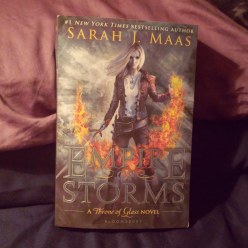
Empire of Storms

Rating: ⭐⭐⭐⭐.5
Author: Sarah J. Maas
Genres: Fantasy
Pub date: Sep. 2016 (re-read Oct. 2018)
Series: Throne of Glass #5

It’s pub day for Kingdom of Ash! I finished my re-read of Empire of Storms in perfect timing (last night) and I already picked up a copy of Kingdom of Ash this morning! Here’s my review for Empire of Storms and I’ll be posting my review of Tower of Dawn in the next day or two while I read my way through the finale!


This book destroyed me. Even though I’ve already read it and I’ve had that cliffhanger hanging over me for the last two years, it still killed me. I am now dead, thanks Maeve.

In all seriousness though, with the exception of the ending, I barely remembered anything from this book aside from a rough outline of events. I forgot so many of the details that it was almost like reading a brand new book! I feel like this series keeps getting more and more convoluted, but I kind of love it. I don’t know if the way everything has come together was intentional from the beginning, or if Sarah has just somehow been able to make it all work out as she writes each new book, but I really hope it’s the former. I love smart plots. It’s what makes Harry Potter such a beloved classic. Sure, it’s fun and creative and heartbreaking, but it’s also insanely detailed and super clever. Empire of Storms has a crazy large cast of characters, and while I’m not super crazy about each of them, together it makes for smart and well developed story.

I really can’t guess at how Maas is going to resolve all this drama in the final book. I wonder if we’ll get some new character perspectives. In some ways I hope not because it’s hard enough keeping track of the 800 million characters we already have, but I also don’t think I could resist getting Ansel’s internal monologue.

What I loved about this book was that this is the first time we actually get all of the characters together at once (except for Chaol, not really missed TBH). In previous books the characters have all been doing their own thing, which makes for a dynamic story, but not always a fast paced one. Empire of Storms has a slightly slow start (although barely), but once you reach like… 15 or 20% it is literally impossible to put this book down! I think it has to do with our characters finally meeting up with one another. There are less storylines to follow, more badass-ery, and it just makes the whole plot flow a whole lot quicker. Like the entire final 30% of this book is just one huge nail-biter.

I definitely think this is one of the best books in the series. I’m still on the fence for which is better, Empire of Storms or Crown of Midnight, but it’s hard to compare them since they are very different in structure. CoM is more of a traditional fantasy with just 3 viewpoints, whereas EoS is undoubtedly epic fantasy. I love them both. The stakes are so high in this book and we finally get to see the full might of Aelin’s power. I know there are people out there that don’t like Aelin because it’s like she can do no wrong, but I think that in the first 3-4 books (at least), she makes a million mistakes and Queen of Shadows and EoS are the first books where she starts finally pulling her life together. Should she have held her secrets so close to her chest in this book, maybe not, but her whole life has revolved around secrecy up to this point and she does start bringing some of the members of her court into her plans. Not all of them, but hey, it makes for more dramatic reveals!

I have to talk about Lysandra first. I expressed my love for Lysandra in my QoS review and my love for her continues to grow in this book. I would argue that Aelin trusts Lysandra more than anyone, maybe even Rowan. She entrusts Lysandra with so many things in this book and with the greatest task of all at the end of the book. It’s so refreshing to see their female friendship amongst all these possessive male relationships. And I like her (mostly) non-interest in romantic relationships. Lysandra has been taken advantage of by men her entire life and I think it’s very accurate that she would have little interest in pursuing anything with men and I’m really glad Maas didn’t just impulsively hook her up with Aedion, even though that’s obviously where things are headed. Either way, Lysandra is BADASS. I can’t decide what I love more, sea dragon or ghost leopard.

Second, I have to talk about Elide. I did not love Elide in QoS. I didn’t dislike her, she was just kind of boring, but I am totally into her in EoS and think she’s actually one of Maas’ most important characters. Every other character Maas has written has been extremely physically powerful. They all have either magic or insane battlefield skills. I love that Elide has none of those things, yet she is not powerless. Fighting is not the only kind of strength. Lorcan gets Elide out of a lot of her mishaps, but she saves herself several times too and I loved that she was clever and always planning her next move to get herself out of trouble. One of my favourite scenes is early in when she successfully bluffs her way out of the Ilken attack. I was waiting for Lorcan to swoop in and save her and I loved that she got away on her wits alone. She is a bit of a pawn in the story sometimes, especially at the end, but she offers something very different from the rest of the characters. And yes, I totally ship her and Lorcan and LOVED Lorcan’s growth in this book.

Dorian’s storyline is interesting in EoS and I can’t decide if I like it or not. He is very passive for most of this book and to be honest, a lot of the time I kind of forgot he was there. He’s broken and recovering from what happened to him in QoS, so that’s to be expected, and I’m excited for where the story might take him in KoA. I like that Dorian ends up with the keys at the end of EoS because he has always deferred to Aelin in the past and I think it’s finally time for him to be one of the heroes of the story. I couldn’t decide whether I liked his darker side in this book or not though. He is definitely changed as a result of the Valg Prince and has a much darker side, portrayed most often with Manon, which I thought was realistic that he might have been a little corrupted by the valg prince, but I do miss the sweet Dorian from the first few books.

Try as I might though, I just don’t like Aedion. I find it hard to pinpoint what it is I don’t like about him. He’s too arrogant for me and I don’t like the emotional responses he has to things that upset him. He is a total asshole to Gavriel – I mean I can understand why he’d be pissed – but as far as I can tell Gavriel never really knew who he was and is blood-sworn to a psycho, so it’s not like there’s much he ever could have done about it. Plus Aedion does a 180 from QoS in his feelings about Aelin. In QoS, it’s like she could do no wrong, but in EoS he’s totally pissed at her all the time and I don’t like how he always reacts with anger. And then when he freaks out at Lysandra at the end for no one telling him about hers and Aelin’s plans – like you are not entitled to know everything or to everyone’s trust. When Lysandra was like, “I serve Aelin, not you”, I was like, “Yaaas girl, tell him”! He supposedly loves Lysandra and claims that he just wants her to be happy, whether it’s with him, someone else, or no one at all, but I still feel like he feels he’s entitled to her and it just irks me.

Anyways, I wasn’t planning to go through a detailed character portrait of everyone, but it’s hard not to because they are all such interesting people and it’s fun seeing how they’ve grown over the past few books. I won’t get into them all. I don’t think I have a whole lot to say on Rowan. The sex scenes are a little cringe-y, but overall I thought Rowan was toned down a lot in this book from the last and I liked him a lot more. PLEASE FIND AELIN FOR US ROWAN.

I also don’t have a whole lot to say about Manon. She was obviously BALLER in this book and I’m so glad to see her re-united with the thirteen. They are like the ultimate in girl power and I can’t wait to see what havoc they’re going to wreak in KoA.

In conclusion, my wish list for KoA is as follows:
– Rowan please find Aelin ASAP and save us all from the extended torture that has been the last two years. My heart has been trapped in an iron box all this time.
– More Ansel, maybe even an Ansel perspective? Love that fiery redhead!
– Dorian kicking some ass, becoming a hero in his own way and hopefully re-uniting his kingdom under a better banner than his father represented
– Manon and Asterin, I don’t care what they’re doing, I just think this is such a fun pair
– Happy Lysandra. Yes, Aelin made a huge sacrifice for her friends and her kingdom, but so did Lysandra. She is giving up everything and more than anything I just want to see her happy.
– Elide saving the day through some feat of wits, not strength. Also, even though I think Lorcan is a total coward for crawling after Maeve at the end of EoS, I hope these two can work it out because I love them together.
– Some alternative to “the queen that was promised” that doesn’t make us all blubbering messes at the end of this book

That’s all, it’s really a pretty simple wish list Sarah, my bad for not sending it to you earlier, please accommodate in tomorrow’s book release. JK, we all know we’re gonna be dead tomorrow because Sarah J Maas is going to kill us all with this finale.

Queen of Shadows

Rating: ⭐⭐⭐⭐
Author: Sarah J. Maas
Genres: Fantasy
Pub date: Sep. 2015 (re-read Oct. 2018)

I’m five books in and still going strong! I’ve decided not to re-read Tower of Dawn since it’s just too soon since I last read it and I’m not ready to sit through it again. That said, Tower of Dawn is the only book I have already written a review for (prior to my re-read), so I will post that review on my blog before Kingdom of Ash comes out in case anyone is interested. So I’ve got 10 days to read Empire of Storms, which should be a breeze because I remember Empire of Storms being SUPER INTENSE.

Back to Queen of Shadows. Everyone rags on this book and I’ve never really understood why. Heir of Fire was definitely the dud of the series for me on my first read through and I thought Queen of Shadows picked up the pace again by bringing all our beloved characters back together. However, on the re-read I absolutely loved Heir of Fire and while I still liked Queen of Shadows, it wasn’t quite as good as I remembered it. I disagree with anyone who says this book is slow – I thought it had so much action, but I did notice a few slower parts between action scenes the second time around. Maas gets more indulgent with each book and because of her popularity, her editors seem to let her. I thought this book had a small case of overindulgence where some parts could have been shortened up.

My favourite part of this book is the resolution of Sam’s murder and Aelin finally being reunited with Arobynn. We’re introduced to this juicy origin story in The Assassin’s Blade and it is then suspended for 3 entire books. I loved watching Aelin return from Wendlyn stronger and ready to confront her demons. Lysandra is pure brilliance and I’m so glad Maas brought her back into the story and created a new female friendship for Aelin. She’s constantly surrounded by petty, possessive men and she definitely needs a female friend. Plus, Lysandra is hilarious and my hero and I LOVE HER.

Arobynn makes me cringe. In my opinion he is a textbook abuser. Everything is about power and dominance for him. He tries to control Aelin with gifts and affection, seeking influence over her as a sort of creepy father figure, but it is all about power for him. He is a great antagonist though and I thought Maas wrote Aelin and Arobynn’s reunion and resolution so well. It was clever and I loved how it tied in to the greater plot of the series.

I can’t help but dig Rowan. In my first read of the series I still harboured feelings for Celaena and Chaol and hoped they’d make things work. But my second re-through of the series has just totally changed the way I feel about Chaol, even in the first two books. I’m just going to say it – Chaol sucks in this book. I appreciated that through Chaol’s inner monologue, Maas raises moral questions on who will keep magic wielders in check if magic returns. It really is an important question. Aelin threatens to burn a city to the ground in Heir of Fire and she’s proven again and again that she’s not the most emotionally stable individual, so the idea of there being no checks on her power should be a concerning one. But Chaol is just so whiny and ‘woe is me’ that I really just didn’t have a lot of sympathy for him. He lets his guilt and shame rule his life when he really needs to come to terms with it and forgive himself and forgive Aelin.

As for the other characters, Dorian breaks my heart in this book. He’s controlled by a valg prince, so he’s more or less absent from the story and I did really miss him. He has become one of my favourite characters in my re-read and it was actually heartbreaking to see him broken in this book. He is just so pure and precious and it’s upsetting to know he’ll never really be that way again after what has happened to him. Manon’s mostly just doing her thing in this book, being angst-y and unforgiving, but she finally grew a backbone towards the end upon learning the truth about Asterin and I am so ready for her to kick some ass in Empire of Storms. Elide is an interesting character, but I find her kind of boring. Elide is to Queen of Shadows what Manon was to Heir of Fire. She’s the newest character being introduced to us, but she doesn’t serve a whole lot of purpose to the plot at this point and is mostly just there for character development. Lysandra is new to the series in this book too, but she carries plot and development – she’s easy to love quickly, whereas with Elide and Manon, it takes longer to really care about them when they are first introduced (or at least that’s how it was for me).

What didn’t I like about this book? Aedion, Rowan, and Aelin’s weird little love/power triangle. I hate how Maas talks about fae dominance and power struggle. I don’t like how Rowan and Aedion were always competing with one another over Aelin and who treated her better, should be her protector, take the blood oath, yadda yadda yadda. She can take care of herself and make her own freaking decisions! She’s been looking out for herself for like 8 years before either of these sods came along, so give it a break already. I also hated how they would constantly refer to her as ‘the queen’ and treat her like a god. She is a human being and Rowan and Aedion are the backbone of her court. If anyone should treat her like a normal person, they should. She doesn’t need groveling and deference from them, she needs a friend and someone who will respect her decisions, but call her out on her bullshit.

I have to admit though… Aelin and Rowan’s flirting in this book was kind of sexy. I know all the weird ‘mate’ and ‘claiming’ business is coming up in the next book, but I was kind of into Aelin and Rowan in this book. I just think they’re kind of bad at actually treating each other like equals. Rowan (and Aedion) give Aelin too much license, while at the same time being too controlling about what she does on her own. I’m not really sure what the right balance is, but it’s off in this book, between both Aelin and Aedian and Aelin and Rowan.

But overall, still a great read. I’m pumped to read Empire of Storms and to be honest, slightly terrified of how Maas is going to end it all in Kingdom of Ash. A Court of Wings and Ruin was a bit of a disappointment for me as a series conclusion and I’m nervous about how this series is going to play out as well. But only one way to find out – so it’s on to the next book and then finally the epic conclusion!