 Rating: ⭐⭐
Author: Chanel Cleeton
Genres: Historical Fiction, Romance
Pub. date: Feb. 2018 (read Apr. 2019)
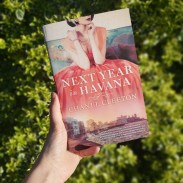
Well that was the most disappointing book I’ve read in a while. I was really expecting to like this. I’ve been really into romances lately and I love historical fiction. I haven’t read any books about Cuba, so I thought this was a great opportunity to learn something new. This is my book club’s selection for April, but it immediately got off to a bad start because my co-chair finished the book before I even started it and gave it 1 star! We usually have the same taste in books, but I was still determined to like Next Year in Havana because it has such great reviews and I was so optimistic about it.
But alas, it was not meant to be. I really tried, I kept telling myself I was liking it, but eventually I had to admit to myself that I really just didn’t like it. It took me over two weeks to read and if it hadn’t been for my looming book club deadline, it probably would have taken a lot longer. It was just really boring and I never wanted to pick it up. The topic should have been super engaging, but the author’s writing and dialogue left a lot to be desired and I didn’t believe in any of her characters.
Next Year in Havana follows the classic historical fiction narrative where one storyline is set in the past and one set in the present. Overall, I’m a bit tired of this narrative. I think it’s overdone and the modern day timeline is almost always less engaging than the historical one. However, this was one book where I thought the decision to tell two timelines actually made sense. The modern day timeline is set in 2017, right after Castro’s death, when US-Cuban relations are finally starting to thaw and change. The historical storyline is set in 1958/9 around when Castro was coming to power. Eliza grew up as part of the wealthy Perez family and the change in government results in the exile of her family to America. In 2017, her granddaughter, Marisol, decides to travel to Cuba to spread her grandmother’s ashes under the guise of writing a tourism article (she is a journalist).
I thought the split timeline worked well because both settings are historically important and mark the changes in Cuba’s politics. It was interesting to see the two factions of Cubans: those who stayed and those who left, and how those decisions played a role in how they viewed Cuba into the future. So the setting definitely had lots of potential and demonstrated the differences between the wealthy and the poor and the locals and the exiles.
But I had a lot of problems with the book. The first was with the romance(s). The story starts with Eliza meeting and falling in love with a revolutionary, Pablo, and Marisol being infatuated with her tour guide, Luis. It’s a lot to carry two romances in a book like this and I thought the author did justice to neither. They were both classic insta-love romances and I have very little interest in those types of love stories. I didn’t understand what was attracting any of the characters to each other and there was very little development of them falling in love. Definitely not a slow burn romance type book. I had a little more sympathy for Eliza because of the era she was living in, but Marisol needs to get a grip.
My second problem with the book was the way in which the author conveyed historical information. This whole book was just a huge history info dump and it was extremely un-engaging to read about. Having one of your characters be a journalist is such an uninspired way to communicate history. It’s easy to have a tour guide that explains everything, but it’s boring. At times I felt like I was reading a history book. I’d much rather be shown the history through Eliza’s eyes or through stories she shared with Marisol. I don’t want to listen to a history professor drone on and on about the author’s obviously biased opinions on Cuba.
‘Show don’t tell’ was probably one of the main problems with this book. Cleeton tells us her characters are in love, she tells us about Cuba’s history, she tells us about the conflict Marisol feels between the exiles and those who stayed, but she doesn’t show us any of it. Sometimes it was hard to tell the difference between her two protagonists because they constantly just cycled through the same thoughts. “he’s a revolutionary, we can’t be together”, “I’m American, we can’t be together”, “it sucks to lose your home and fear for you life”, “it sucks not to have freedom of speech”, “Castro is bad, Castro is bad, Castro is bad.” Honestly, it got so repetitive.
My understanding is that Cleeton’s family basically lived Eliza’s exile, so she’s definitely coming at this story from the perspective of the exiles. I liked that she included a revolutionary, because I really wanted to see and understand both sides of Cuba’s history. Castro represented a lot of bad things to the Americans, but he represented a lot of good things to a lot of Cubans. I feel like the author tried to cover both sides of the story, but her storytelling was still extremely biased and it was not what I was looking for from this story.
This is where my biggest problem with the novel was. I feel like the author took Cuba’s history and its pain and used it to write a drama for the purpose of entertainment. Frankly, I was insulted by Marisol’s character. When she refers to the injustices that have been perpetrated against Cubans, she repeatedly includes herself in that narrative. She refers to Cubans using the collective ‘we’, as if she really understands how Cuban’s have suffered since 1959. I agree that the Cuban-Americans absolutely know their own kind of pain, but she does not understand Luis or what he has been through. She doesn’t get to come back 60 years later and insert herself into Cuba’s story. I know immigrants face their own kind of pain and hardship with the loss of their culture and the diaspora of living in another country. But portraying Marisol as someone who understood what Cubans went through totally erases them from their own story.
It was just so irritating how oblivious Marisol was to much of Cuba’s history and suffering (as evidenced in every single conversation where Luis is explaining some part of Cuba’s history to her). Yet she was so indignant and self-righteous about it. It was the typical “American-comes-to-save-the-oppressed” type of story. Luis was a revolutionary in his own right. He was incredibly intelligent and politically-savvy, so I struggled to believe that he would give an entitled journalist like Marisol the time of day. I hated the ending. I thought it belittled everything Luis had worked for. Cuba’s history is Cuba’s history. You can’t write it into some perfect little historical romance. I felt like this did no justice to Cuba or to Cubans. Am I super knowledgeable about Cuba? Hell no, but I get the feeling its history is a lot more nuanced than this book is able to portray. Sometimes you can’t have nice little endings. Privileged people feel like they can fix everything. But they can’t and sometimes it’s not their responsibility to. Cuba will ultimately be transformed by its own people.
So yeah, I did not enjoy this book. I still learned something from it, but I would much prefer to read about Cuba from a different perspective. I felt like this was very much the Westernized view of Cuba, and I would have preferred to read about it from the point of view of someone who has lived Cuban history first-hand. Mostly I was just insulted that the author took Cuba’s history and used it to write a dramatic, historical romance. It was belittling.
 Jean Kwok’s
  I know K.A. Tucker has a million other books that I could have read after finishing (and LOVING) her latest book,
 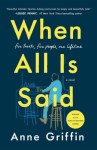 Good news! This book is already out! When All is Said takes place at a bar over the course of a single night as Maurice Hannigan toasts 5 influential people in his life. This book has been getting rave reviews and the idea of reflecting on those that had the most impact on your life sounds like a really compelling story. In the same way that I love a good family drama – I love character-driven stories about relationships. I’ve ordered a copy of this one from book depository and I’m just waiting for it to show up so I can dive in!
 Another book that’s already been released! I started this book recently and I’m about 50 pages in (at the time of writing this post). Amy Harmon has a lot of books, but I’ve only read her one fantasy series, The Bird and the Sword. Most of her other books are romances that haven’t appealed to me that much, but this one is historical fiction about the Irish uprising and the struggle for independence. Our story centers on Anne Gallagher, who inadvertently travels back in time to Ireland 1921. It sounds a bit like ‘Irish Outlander’ to me, but Harmon’s writing is so gorgeous and lyrical that I’m anticipating a thoughtful and sensitive take on this piece of Ireland’s history (something I’m woefully uneducated on, so definitely a learning opportunity for me!).
 This book stands in contrast to most of the others on this list, but somehow I forgot it on my
 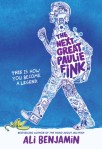 This was a recent discovery for me, but 4 years after her beautiful debut novel, The Thing About Jellyfish, Ali Benjamin is publishing a new book! Benjamin is a middle grade writer and her new book is about 7th grader Caitlyn Breen who is starting a new school in Vermont. As if it’s not hard enough starting a new school, Caitlyn’s classmates are reeling from the loss of their beloved class clown, Paulie Fink and decide to run a competition to replace him (he’s left the school, not died or anything!). The Thing about Jellyfish had the most gorgeous writing and in this second novel I’m expecting another beautiful story about growing up and finding yourself.
 A Woman is No Man was one of Book of the Month’s featured picks, so of course, I keep seeing it popping up everywhere now! This is Rum’s debut novel and focuses on 18-year old Arab-American teenager, Deya. Though she’s only 18, her grandparents are forcing her into an arranged marriage, not unlike the marriage that was forced onto her own mother, Isra. This has been getting rave reviews and the premise sounds fascinating to me! Another family drama I can’t wait to get my hands on (I’m also intrigued by what the title means).
 My book club pick for this month is Next Year in Havana, which Chanel Cleeton published last year, I haven’t even started it yet, but I’m really excited to read it and then even more excited to hear it was getting a second novel. My understanding is that When We Left Cuba will be a companion novel, with each book focusing on one of the Perez sisters. I don’t want to get too into the plot having not read the first book yet, but they’re both set in Cuba in the late 1950’s, early 1960’s and focus on Cuba’s political climate at that time. I’m thinking I might read these two back to back before my book club meeting!
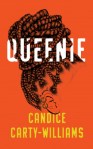 Queenie was just released and is being called a “modern day Bridget Jones”. It’s about a 25 year old Jamaican-British woman living in London (New Adult books representing on this list!) and her quest for love and to deal with her anxiety. All the reviews I’ve read said that this has the humour you would expect from a book being compared to Bridget Jones, but that it has a lot more depth. I love that more and more books like this are being published and I really hope this trend continues!
 The Paperback Princess