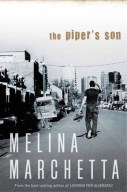
The Piper’s Son

Rating: ⭐⭐⭐⭐
Author: Melina Marchetta
Genres: Fiction
Pub. date: Mar. 2010 (read May 2019)

I am getting lax in my reviews lately. I finished The Piper’s Son about a week and a half ago and I’ve been putting off writing my review about it. I just re-read Saving Francesca and I was really excited to read The Piper’s Son, which is the only Melina Marchetta book I haven’t read, save for her newest book, which just came out.

I liked but didn’t love Saving Francesca on my first read through, but loved it when I recently re-read it. I’m wondering if I might have a similar experience with The Piper’s Son. I definitely liked it, but I did struggle to get into it for most of the novel. I love Marchetta’s writing style, but sometimes her books are hard to process on the first read through because of her unique style. I feel like Marchetta never starts her story at the beginning. I feel like her characters are already fully realized when she actually starts writing them. She doesn’t waste time on introducing us to her characters and their strengths and flaws, but rather throws them at you in all of their brokenness and let’s you try and sort out the pieces. It’s an interesting style because it is very reminiscent of real life. People are hugely influenced by all of the experiences that came before you and the result that you get is an individual that is flawed in ways you can’t quite understand because you don’t know their story. Eventually those things are teased out as you get to know someone and it becomes easier to understand how they grew into the person they are, but upon first meeting, you have no context for their behaviour.

This is how I felt with Tom and Georgie. Both of them had a lot of history and were obviously broken by it, but I didn’t understand what events happened to them to get them to that point. Tom is drowning his sorrows in things that only make him hurt more and Georgie is stuck in the past. Heartbroken and unable to forgive or move forward with her new reality. Both family members are grieving.

This is exactly the kind of character-driven story that I love. We can’t rely on the plot in this book at all, only on where the characters will take us. They make mistakes, but are human. Stuck in the past and unable to forgive the family members and people who have hurt them. I did struggle with the complete lack of plot and I struggled to feel empathy for Tom or Georgie early in the novel. I did really like the story and the characters, but I think it could maybe have used a little more plot to carry the story.

One thing I still loved though was Marchetta’s unflinching commitment to friendships. I think Marchetta writes friendships better than any author I’ve read. There’s no pinpointing the moment when Marchetta’s characters become friends. They are either already presented as fast friends with a history, or she weaves a brilliant story arc in which subtle, but lasting, friendships develop between her characters. I loved seeing all the characters from Saving Francesca flit through this book and each support Tom in their own way. The way Marchetta writes friendships makes you ache for someone who knows you so well. She’s not afraid to have her characters challenge one another and do ugly things, but those things are always deeply rooted in their character and hurts. She’s not afraid to test her characters and their relationships and I love watching those friendships grow stronger as a result.

So overall I feel like this review is a whole lot of posturing about nothing. I think I may need to pick this book up in another year or so to see what I can glean from it having already gained the perspective about Tom and Georgie’s characters. I can see how this book isn’t for everyone, but it is also largely beloved, so there’s something powerful going on with these characters.

Great Small Things

Rating: ⭐⭐⭐
Author: Jodi Picoult
Genres: Fiction
Pub. date: Oct. 2016 (read in May 2019)

Small Great Things has been on my TBR for a while, but I doubt I would have gotten to it if we hadn’t picked it for our May Book Club meeting. I have very mixed feelings on it – my book club meeting tonight may change that, but right now I’m feeling very middle of the road about the book. I didn’t like it, I didn’t dislike it. I’m probably firmly in the 2.5-3 star range.

Small Great Things is about labour & delivery nurse, Ruth Jefferson. She’s worked hard her entire life to overcome institutionalized racism and succeed as a black woman. She studied nursing at Yale and has been working in L&D for 20 years. She is well respected and has worked hard to give her son Edison the best start in life. For the most part, Ruth looks beyond race. It’s hard not to acknowledge the microaggressions she deals with on a daily basis, but she is not jaded by them. Until two white supremacists, who have just given birth to their first son, ask for Ruth to be removed from their son’s care due to personal prejudices, and the hospital acquiesces. A series of emergency events leave Ruth in an impossible position and before she knows it, she finds herself at the centre of a criminal investigation, making it harder to pretend that her race doesn’t matter.

Ruth is the protagonist of the story, but we also read from the perspective of Kennedy, Ruth’s white lawyer, and Turk, the white supremacist father. I was a little apprehensive going into this book because I’m never sure what to make of white author writing from the perspective of a black person and the last thing I wanted to read was a white saviour narrative. I’m glad the author included her note at the end, it provided an interesting perspective and I was glad to see her acknowledge her own personal shortcomings and privilege. I had questioned (while reading) whether she was the right person to write this book, which she also acknowledged, and I could appreciate that she decided to take the opportunity to target her white audience and get them thinking about racism.

The book has some interesting themes. I struggled with it at first because it’s an extremely heavy topic and I dreaded every time I would have to return to Turk’s chapter because I just hated reading from his perspective. This book is only 3 years old and it’s incredible how much more relatable (by which I mean, less shocking) Turk’s narrative has likely become since Trump came to power. I think this perspective may have shocked me a little more 3 years ago when neo-nazi’s and white supremacists were still mostly hiding in the shadows, but they’ve since become a lot more mainstream and it was exhausting and disgusting to read from Turk’s point of view, understanding there are people that think just like him in America right now.

My initial thought about Turk and Brit was that they were too much. I was sad to see the author take such a blatantly racist couple and make them the main antagonist. I was initially disappointed because I believe that white people need to read about subtle racism so they can better understand the ways in which they unknowingly perpetuate racism. Swinging too far in one direction makes it easy for people to condemn the racists and hide behind the “I’m not that bad” or “I’m not like them” narrative. But props to the author because it turns out she was trying to make the same point. I was really worried about Kennedy fitting into the white saviour narrative, which I think she still did to an extent, especially with her closing argument, but her character served the bigger purpose of drawing attention to the more subtle forms of racism and the way white people indirectly benefit from it.

So I do think the author did some small great things (see what I did there!) with this book, but it still had some shortcomings. Honestly, I just found the plot a little too basic, although maybe it fit just right for some of Picoult’s audience. I was looking for more from the plot and I wanted to challenge my thinking about race more than this book did. This is a great book if you’re just starting to think about race as a white person and you’ve never really questioned your privilege before. It was evident to me while reading that many of Picoult’s ideas came out of Peggy McIntosh’s essay on unpacking white privilege, which I think it a fantastic starting point, but I was hoping for something more thought-challenging. Personally, I’d recommend picking up Patrisse Khan-Cullors book When They Call You a Terrorist, or one of Phoebe Robinson’s books, Everything’s Trash, but It’s Okay or You Can’t Touch My Hair, to better understand what it’s like to be black. (other great memoirs include Trevor Noah’s, Born a Crime or Michelle Obama’s, Becoming)

Overall though, I just thought the book was too long. 500 pages is a lot and I do not feel like this plot warranted it. I wasn’t really impressed with the ending and thought some of the items were really overdone. So all of that leaves me firmly unsure of how to rate this. At the end of the day, I do hope this book challenges the perspective of Picoult’s audience, which is likely mostly white women who relate well with characters like Kennedy. I do applaud the author for taking on a topic like this, but given the choice, I would have preferred to spend my time reading a more thoughtful book written by a black author.

Miracle Creek

Rating: ⭐
Author: Angie Kim
Genres: Mystery, Fiction
Pub. date: Apr. 2019 (read May 2019 on Audible)

I heard really good things about Miracle Creek, which is what inspired me to pick it up, but I was still totally blown away by this book! I like mystery/thrillers,but they don’t normally stand out in the way a good literary fiction or historical fiction book does. Miracle Creek was everything I didn’t know I was looking for in a mystery novel.

What makes this such a great read is that the author weaves so much nuance into the rest of her story. It’s primarily about solving a crime, but there’s so much else going on and the characters are incredibly well developed and have a huge amount of depth. Kim tackles everything from alternative medicine, to parenting less-abled children, to cultural diaspora, to the challenges of simply growing up.

Miracle Creek is primarily about the Yoo family. Pak, Young, and their daughter Mary, moved to the United States from Seoul, Korea. Each character faces their own challenges in moving to America and their new routines start to create a distance between each of the family members. Pak decides to start up a new business called Miracle Submarine, which is all about the healing powers of hyperbaric pressure chambers, or HBOT. HBOT is a pressurized chamber that allows the patients to breathe in pure oxygen, which is touted as having all kind of medical benefits. However, the benefits are not totally proven and it is a controversial practice.

Pak, Young, and Mary’s lives, as well as the lives of their friends, are totally torn apart when one evening, someone lights a cigarette outside the chamber and blows it up, killing two of the patients inside. The rest of the book is a courtroom drama, investigating who was responsible for the explosion and what exactly happened to lead up to that moment.

The courtroom drama is the focus of the novel, but everything else that happens outside the courtroom is really what makes this read so thrilling. We get to experience the trial from a number of different perspectives. We are never really sure who actually committed the crime, with new evidence continuously keeping you guessing. But the decision to tell this story through multiple perspectives is super effective. Kim humanizes every single one of her characters, making it easy to empathize with them, even when some of their actions shock you.

Outside of the courtroom, she explores so many different conflicts that each character is facing. I loved that I got to explore what it was like for Young living within the confines of a traditional Korean marriage and the impact that moving to America had on her family. I sympathized with Pak being a goose father and the perceived loss of his wisdom when he could no longer communicate himself eloquently. I was captivated by Elizabeth and the other autism moms – the level of responsibility that was thrust upon them and the continued heartbreak every day as they had to watch their children be only a fraction of who they knew they could be. The conflict they felt about HBOT and all the treatments they put their children through and whether it was really worth it and who they were doing it for? I felt bad for Janine as she struggled in her relationship with Matt and the fetishization of Asian women and her indignation that being attracted to Asian women could even be considered a “fetish”, like it was something dirty.

Every single character in this book is so nuanced. I constantly marveled at the author for how she played with so many different social issues and commentaries, all while maintaining an equally thrilling courtroom drama. I loved how she played with regret and “what if’s. How things could have been so dramatically different had one character taken a slightly different action. I wasn’t particularly surprised with the solving of the crime, but I was impressed with how Kim decided to end her novel. In the same way that the story was filled with moments of frustration, bitterness, and anger at the hand that had been dealt to each character, the ending carried on the same theme of cold, hard reality. It reminded me at times of a Greek tragedy in that you saw how easily things could have been different, but the characters, blind to their own shortcomings and missing information, barrel into the unknown, only increasing their mistakes. This book had a lot of irony and that’s what really sticks with you. It get’s under your skin and you get caught up in the what ifs.

I can’t believe this is a debut novel and I can’t wait to see what Angie Kim writes next. Highly recommend this thoughtful and thrilling book!

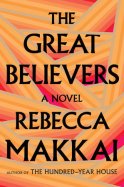
The Great Believers

Rating: .5
Author: Rebecca Makkai
Genres: Historical Fiction, Fiction
Pub. date: Jun. 2018 (read May 2019 on Audible)

I listened to The Great Believers as an audiobook and I feel like I’ve been working on it for a long time. It took me a while to get into it, but once I did, there were parts of the book that I really liked, and other parts that I found kind of boring.

First of all, I will say that the scope of this novel is impressive. Makkai tackles a lot in this book. The main plot of the story (for me anyways), centers on Yale Tishman, who is a gay man living in Chicago in the 1980’s and coming to grips with the HIV/aids crisis completely decimating his entire community. The novel opens with the death of Yale’s friend Nico, which in a round-about way initiates a conversation between Yale and Nico’s great Aunt, Nora, who would like to donate her personal art collection to the university art gallery that Yale works for, which would be a huge acquisition for Yale and the gallery.

At the same time, a second storyline is set in Paris in 2015 as Nico’s sister, Fiona, searches for her adult daughter who she hasn’t seen in 5 years since she disappeared into a cult in America called the Savannah Collective. I would never have thought to pair any of these plotlines together, so I was impressed with Makkai for her creativeness and scope of the book.

That said, I didn’t love all of the plots in this book. I thought some parts were a lot stronger than others and it’s what really drove the rating down for me. I’ve described 3 major things: the HIV/aids crisis in the 1980’s, an art acquisition, and a missing daughter. Yale’s storyline about the HIV/aids crisis was by far my favourite. I’ve been privileged to have not had to give this period in history a whole lot a thought, so it was both sobering and fascinating to read about.

I really liked Yale. I thought he was super relatable and I loved reading about his relationships with all his friends and his perspective on the HIV/aids crisis. I thought his story had a really good balance of history, politics, and emotion. I connected with him a lot and it was devastating to watch his friends die one by one and the government do nothing. Makkai weaves in a lot of social commentary without overpowering her novel with it. This was still very much a novel about characters and relationships, with just the right amount of history and politics.

I thought the art acquisition storyline was mildly interesting. I liked the parallels that Nora drew between the artists she knew in WWI and the war that Yale and his friends were fighting in Chicago. I have never really read anything about the art world, except maybe like, the Da Vinci Code or something (lol), so this was a whole new world for me that was intriguing to learn about.

But Fiona’s story set in 2015 didn’t do much for me and is what really dragged down my rating and enjoyment. I found myself tuning out for entire sections of Fiona’s story and I felt like very little happened in her timeline. It took forever for the story to advance and when I finally realized what the “so what” was of Fiona’s story at the end of the novel, it felt a little anti-climactic. Fiona had a tumultuous relationship with her daughter that was an indirect result of the trauma of losing all her friends in the 1980’s. She talks about how you can’t really describe what it feels like to survive a war that none of your friends make it out of and how that impacts the rest of your life without you even noticing. I thought this was a fascinating topic and I was eager to explore it, but I thought Fiona’s relationship with her daughter was a laboured way of doing it. I liked Fiona, but I just thought the modern day part dragged the book down. I also felt like I didn’t get enough context of Fiona’s relationship with Claire as a young girl and so I didn’t understand why Claire hated Fiona so much

Overall though, I did like the book and I would definitely place it firmly in the category of literary fiction. Makkai writes with depth and I loved the characterization of Yale and all the secondary characters in his timeline. It wasn’t as stand out a book as I was hoping, but I’m definitely glad I read it.

The Turn of the Key

Rating:
Author: Ruth Ware
Genres: Mystery, Thriller
Pub. date: Sep. 5, 2019 (read May 2019)

Let’s just start by saying: I love Ruth Ware. I’ve read everything she’s written and it’s taken me a while to figure out what it is I like so much about her. None of her books are my favourite, yet I always can’t wait to get my hands on her newest book. It took a while, but I’ve come to the conclusion that I love her books because they are just so damn readable. She has this old school Gothic mystery thing going on and her closed-door crimes are very reminiscent of Agatha Christie.

The Turn of the Key has similar elements to some of her other books, but I actually found it quite different. Ware takes a different approach to this book, telling us upfront what the central crime is, just not who is involved or how it happens. Rowan Caine is our main character and has been working as a nanny for the past few years when she takes a position in a private home in remote Scotland looking after the Elincourt family. Sandra and Bill are both wealthy architects and have converted their home from an old estate into a modern architectural marvel, integrating all kinds of fancy technology into the design to make it a “smart home”.

It’s a lucrative position for Rowan, but when Sandra and Bill take off immediately after arriving, leaving her alone in the huge house with their 4 children, she starts to wonder if there may be more secrets about this post than she was made aware. Previous nannies quit the position because of fears of the house being haunted, of which Rowan is skeptical, but as strange things start happening, she can’t help but wonder if the weird things happening are a result of the faulty smart home technology, or something more sinister.

Ware takes an interesting approach by opening the story with Rowan in prison for the death of one of her charges. We don’t know which child has died, or how, but Rowan maintains that she is innocent and recounts her story in a letter to a lawyer requesting he help her. This book is creepy. I could see how some readers might not like it as much as some of her others because it is more of a slow burn mystery, but I really liked it. Ware spends a lot of time developing the atmosphere of the story and drawing us further and further in to this creepy house in Scotland. It does take a while for the action to get going, but I loved how remote the story was and how it made me question every single interaction for potential answers. I also loved her use of smart home technology in the story. Technology has gotten so creepy and this really drew attention to the ways it has invaded our lives and in some cases made things more complicated.

One of the main complaints I’ve had with Ware’s books in the past is that I think she has really weird pacing. She tends to hit the climax at around 70% in the book, the mystery always continues, but when you hit the high point that early it’s hard to stay engaged for the last 30%. That was not the case with this book. She keeps you on edge, with the creepiness continuing to amp up until the very end.

The only thing I will say is that things finish up so quickly at the end and are so easily explained that it was a bit of a let down. I mostly correctly predicted the ending, but it didn’t take away from my enjoyment of the book. The atmosphere was what won this book for me and I really liked the creepiness factor. My only complaint now is that I have to wait 4 months for everyone else to read this and another year or more for her next book!

Special thanks to Simon and Schuster and Edelweiss+ for providing me with a free advance copy of this book in exchange for an honest review.