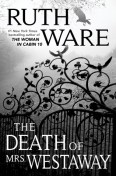
The Death of Mrs. Westaway

Rating: ⭐⭐⭐
Author: Ruth Ware
Genres: Mystery
Pub Date: May 29, 2018 (read Apr. 2018)

Thank you to NetGalley and Simon and Schuster Canada for providing me with a free electronic copy of this book in exchange for an honest review. 

Okay, first off I love Ruth Ware and I don’t know why! I generally give her books 3 stars and yet I find them so compulsively readable that I always come back for more. I should probably start rating them higher because I cannot say no to a Ruth Ware mystery.

The Death of Mrs. Westaway was quite different from all of her other novels. It still features a young English woman as the protagonist, but the mystery element was structured differently in this book and I wouldn’t call this one a thriller. At times the central mystery seems quite obvious, but you’re never really sure what is going on or if you have it right.

The Death of Mrs. Westaway tells the story of Hal Westaway and the Westaway family. Hal is just 21 years old and after losing her mother 3 years prior in a hit and run, she is very much alone in the world. She has no family and in her struggle to make ends meet and pay the bills, she has lost contact with any friends she once had. Her mother was everything to her and she takes over her mothers booth as a tarot card reader on the Brighton Pier to survive. But Hal is falling further and further in debt and they are starting to catch up with her.

Then one evening she receives a letter about the death of Mrs. Westaway, her grandmother, and that she has been named in the will and requested at Mrs. Westaway’s estate. The problem is that Hal’s grandparents have been dead for 20 years and she believes she must have received the letter in error. But the promise of a handout is too alluring and Hal wonders if she can trick this estranged family and walk away with enough money from the will to pay off her debts.

Things are definitely off with the rest of the Westaway family though and Hal quickly starts to wonder whether everything is actually as it seems. I think Ware does an excellent job writing Hal in this story. She is totally believable and I could totally empathize with the financial mess she’s found herself in and the desperation of trying to do whatever she can to pay her bills. I enjoyed her story arc and growth throughout the novel.

I didn’t like the rest of the Westaway family though, which I guess is kind of the point because they’re all flawed and their flaws make you wonder what is actually going on with this family and what is their real history. But I found it hard to connect with any of the other characters and I didn’t find the main twist very surprising. It’s more of a “wtf is going on in this book” moment and when the twist is finally revealed it’s not really that shocking – it was totally what I was expecting, I just wasn’t really sure how the author would take me there. I also thought the red herring was super obvious, although still pretty ominous and I do think it added to the story.

Overall not my favourite Ruth Ware book, but don’t doubt for a second that I won’t still be first in line to read whatever she writes next!

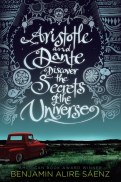
Aristotle and Dante Discovers the Secrets of the Universe

Rating: 
Author: Benjamin Alire Sàenz
Genres: Young Adult
Pub date: Feb. 2012 (read Apr. 2018)

Yay! I loved this!

I’ve been having a lot of success with YA lately. For awhile I thought I’d maybe finally outgrown the genre, but there’s still some really great contemporaries out there! This was the second book in my monthly challenge to read 3 award winning books. This was one of the soft spoken books that isn’t very plot driven, but develops some really beautiful characters.

Aristotle and Dante Discover the Secrets of the Universe is set in 1987 in El Paso, Texas. It’s summer and Ari, who has never been very good at making friends, is trying to pass away the time on his own when he meets Dante at the local pool. Dante seems to get a long with everyone and is well liked, but he’s never really been great at having friends either and the two boys strike up a friendship. Ari struggles to connect with people and is frustrated by his parents refusal to talk about his older brother who has been in prison for most of his life. Dante has a close relationship with his parents, but he struggles with his identity – who he is, what he loves, and what it means to be Mexican.

Like I said, it’s not a plot driven novel, although it does have some shocking plot elements that push the story forward. But ultimately it’s a coming of age story about friends, family, and identity. I love YA books that have a strong family element, especially one that built around understanding and love, rather than conflict and rebellion, which I’d say is probably more popular in YA. I love Ari and Dante’s parents in this book and the relationships that they all built with one another, how they developed and grew over the course of the book. In some ways it felt like a slow-build kind of book, but at the same time I found it hard to put down.

I don’t want to give any of the story away, I think it’s a good book to go into blind. I did and I really enjoyed the experience.

The Underground Railroad

Rating: .5
Author: Colson Whitehead
Genres: Historical Fiction, Re-imagined History
Pub Date: Aug. 2016 (read Apr. 2018)

This book is breaking my heart…. because I didn’t love it…. I didn’t even really like it.

I picked this for my April Challenge to read 3 award-winning books. This won the Pulitzer Prize and the National Book Award for fiction, so I had high hopes that I would enjoy this. It’s definitely a good book, I won’t debate that, but it’s just so unbelievably SLOW! It’s only 300 pages and it took me 2 and a half weeks to read. On average I read a book every 3 days, so this felt like the longest slog ever and I actually had to take a break in the middle to read my book club selection because I wasn’t going to finish this in time.

The Underground Railroad re-imagines the network of people and safehouses that helped black people to escape the south and slavery as an actual underground railroad. It’s an interesting concept, but personally I didn’t really think the railroad had any real impact on this story. Whitehead tells the story of Cora, a young slave in Georgia who after being beaten by her masters, decides to try and escape the cotton plantation where she’s lived her entire life. The plantation has a long and sorry history of slaves escaping the plantation, but they were always caught and returned to the plantation to be killed for trying to escape, except for Cora’s mother Mabel, who abandoned her when she was just a girl and was never re-captured.

Cora begins a journey through many states and is pursued by Ridgeway, a slave catcher who still can forget about Mabel, the one the got away, and is determined to catch Cora to right his past failings. She travels through several states and is witness to the kindness and hate of the people around her, sometimes catching a glimpse of like as a free-woman, and other times forced back into hiding as she continues towards her ultimate goal of escaping to the North.

This is an interesting story, as difficult as it sometimes was to read (content wise, which is sometimes disturbing). But I couldn’t get past the pace of the book and like I said, I thought the whole idea of the underground railroad fell flat. It serves to move our story around, but I didn’t actually find the concept that engaging. I would have liked to know more about the railroad and how it came to be – it was obviously built by slaves, like everything else in America at that time – but we don’t learn that much about it. I understand that this is part of the mystery, but I kind of wondered what the point was. Cora could have travelled between states hidden in the back of a cart and the story wouldn’t have really been any different.

There’s not very many high points in the story. The format was interesting, with Whitehead separating each chapter by a different state and separating the states with short chapters from the points of view of some of the minor characters. I had no idea what the point of the grave digger chapter was, but some of the other chapters were interesting. I was intrigued by Ridgeway’s character and found his and Cora’s relationship interesting.

Maybe I’m too dense for this book, but I just can’t get on board. I appreciate what Whitehead did with this book, but I’m not convinced it was worthy of all the awards. I wanted to love it, but it was just so slow and boring. It had some faster paced parts where I would finally get into the story, but then the chapter would end and everything would change up and be boring again. The story just had no momentum – a disappointing read.

The Humans

Rating: ⭐.5
Author: Matt Haig
Genres: Science Fiction
Pub Date: May 2013 (Read Apr. 2018)

I have mixed feelings about this book. The author definitely provided some interesting social commentary on humans and some of our eccentricities and social norms, but I thought the story was flawed and there were a lot of things that bothered me.

The Humans is a sci-fi novel very reminiscent of Douglas Adams’ writing. Hitchhiker’s Guide to the Galaxy isn’t one of my favs, but I did appreciate some of the humour in this book. The book starts with an alien who has taken over the body of professor Andrew Martin. Martin worked at Cambridge University as a mathematician and had a breakthrough in his work with prime numbers that could have changed everything for humans and greatly accelerated their technological advancements. The aliens are apparently threatened by this and send an unnamed alien to inhabit Martin’s body and destroy all evidence of his discovery (and anyone he might have told).

The alien is confident in his mission, but he quickly becomes baffled by humans and their emotions and begins to develop feelings for Andrew’s wife and son. He had thought the humans were a primitive race and is confused by many of their social norms and customs, but he starts to learn there are more to humans than meets the eye and that their ability to love and care for one another is actually one of their greatest strengths.

Like I said, this did have some interesting social commentary and made me think about how odd we can actually be. Humour is an effective way to highlight shortcomings and I thought the author did this well. But I just got so hung up on some of the inconsistencies in this book that I couldn’t love it. Minor spoilers below.

First of all, why do the aliens care about earth at all? They live a million light years away and I couldn’t understand why they would care if earth started to become more advanced. I kind of pictured things like star trek, but where humans are the primitive species that hasn’t yet progressed enough to be invited to join the federation, so the rest of the galaxy just leaves us to our ignorance. If there’s so many galaxies and other life forms, I don’t see what the big deal would be with earth advancing. We’d probably just accelerate the destruction of the planet knowing humans. So I thought the story was incredibly flawed for this reason.

Second, there were too many inconsistencies in what part of our culture the alien just inherently understood and didn’t understand. He can extrapolate the entire english language from one reading of Cosmo magazine, but he doesn’t understand why it might be imperative that he find himself some clothes so as not to draw attention to himself? Likewise, he knows to hit up a bar to drown his sorrows in alcohol, but he doesn’t understand that infidelity is not an acceptable thing? He read Cosmo! He should know better!

I get the whole not understanding emotions, but I feel like the author was just picking and choosing what would make sense to this alien to try and make the points he wanted to make. I was too frustrated by what was the point of it all to be enamoured with the author’s writing and I couldn’t suspend my disbelief that the alien would adapt to earth so quickly. If this alien came from a race without emotions, would he really start to develop emotions so quickly? Wouldn’t he be more like the vulcans and just not understand emotion at all? And don’t get me started on the “advice to a human” chapter. I’m sorry, but this was one giant eye-roll for me. This alien has been on the planet for like 2 weeks, no way he understands complex human emotions or is able to offer any meaningful insight about it that writers, artists, philosophers, and psychologists haven’t already observed.

So this wasn’t a win for me, but sci-fi isn’t really my genre. I don’t like being beaten over the head with social commentary and prefer for it to be woven into a story in a more meaningful way. This storytelling was more, ‘I’m going to tell you want’s wrong with humanity and what’s impressive about it’, vs telling me an emotional story that is going to indirectly lead me to the same conclusions. I can understand why some people like this, but overall not for me. Just taking the time to reflect and write this review has already lowered my opinion of this book, but I have a book club meeting about it on Friday, so I’ll see if maybe they can drag me back up on this one. (spoiler: they didn’t)