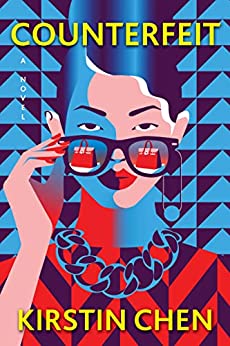
Thanks to Harper Collins Canada and Netgalley for gifting me with an e-arc copy of Counterfeit, coming out June 7, 2022.
I heard about this one at HCC Frenzy’s summer book preview event and thought it sounded really fun! It’s about new(ish) mom Ava Wong, who is struggling with her child’s emotional needs and being away from work indefinitely. When she runs into her old college roommate, Winnie Fang, she is surprised that the Stanford drop-out appears to be oozing money with her expensive handbags and accessories. She doesn’t plan to re-kindle the friendship, but when she runs into a tight spot financially, Winnie recruits Ava to her counterfeit handbag scheme and soon Ava is in deeper than she ever wanted.
The most striking thing about this book for me was the storytelling style. The majority of the book is Ava recounting to a detective how she re-connected with Winnie and got caught up in her scheme. The detective doesn’t have any dialogue and is a passive character, but the whole book is narrated to this detective, which makes for an interesting dilemma on what to think of our protagonist. Ava seems innocent enough, but given the context, it’s hard to know how much we can trust her recount of what happened. We know the two women must have eventually been caught, but we’re left to try and guess at how Ava gets involved and how the whole thing ultimately disintegrates.
It’s definitely a promising debut. I liked the writing style and I thought the author had great ideas, creatively she just didn’t take it quite as far as I was hoping. There are a few twists and turns in the storytelling, but overall I was hoping for something more shocking and it didn’t quite deliver. It’s a fun story and scheme, but I found the main themes to be pretty surface level and I wanted more depth all around, from the plot, to the characters, to the overarching ideas. The synopsis talks about “interrogating the myth of the model minority”, which I guess this book does to an extent, but I found the plot to dominate over everything else and while it was a fun story, it didn’t have the depth to make it memorable. But it was a very promising debut and it makes for a very quick read, so I did still enjoy it!
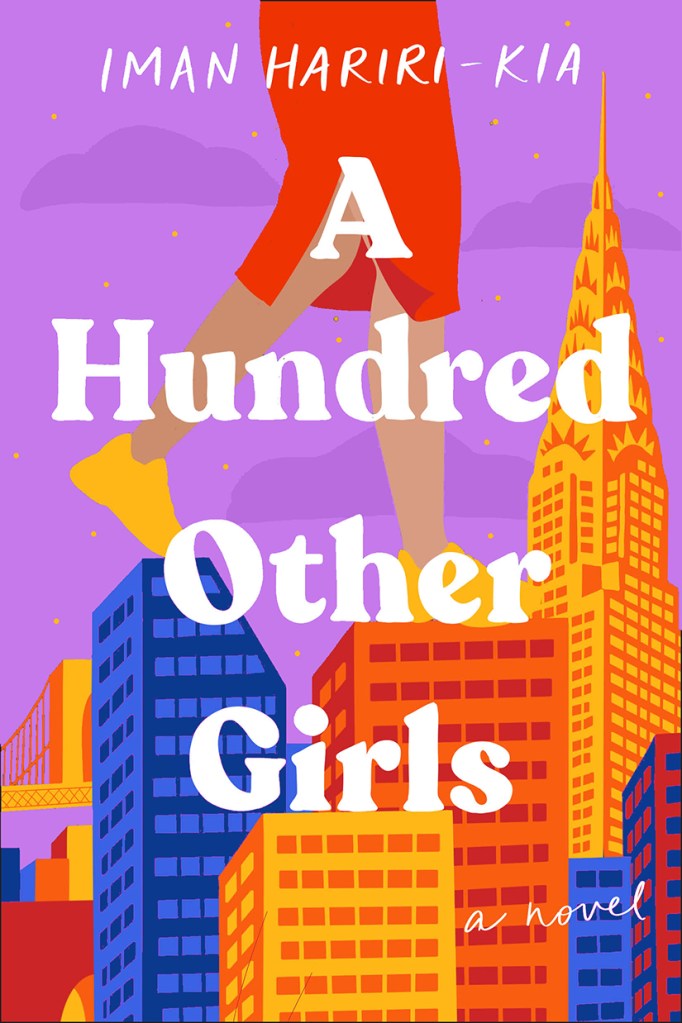
Thanks to Harper Collins and Netgalley for gifting me with an early e-copy of this book. I attended HCC Frenzy’s first adult fiction preview on upcoming new releases for summer 2022 and was stoked to receive an arc of A Hundred Other Girls, which was really hyped up.
It’s impossible to talk about A Hundred Other Girls without comparing it to The Devil Wears Prada. Granted, it’s been MANY years since I read The Devil Wears Prada, but the similarities are immediately obvious. A Hundred Other Girls is definitely a much more contemporary version of this classic and I loved that it features a Persian-American protagonist and displays all kinds of minority identities and relationships throughout the story.
Noora is an aspiring writer not long out of college who lives in New York and runs her own moderately successful lifestyle and culture blog. She wants to be a journalist and aspires to one day write meaningful think pieces for magazines, of which Vinyl is at the top of her list. She’s a bit down and out on luck and is currently sleeping on her sister’s couch to help make ends meet when she interviews for an executive assistant position with none other than the Editor-in-Chief of Vinyl, Loretta James.
As you can probably guess from the comparisons to The Devil Wears Prada, Noora lands the job and Loretta turns out to be a certifiable nightmare. Vinyl is currently in the midst of an internal war between the digital and print versions of the magazine and Noora’s job quickly becomes her entire life as she gets constantly dragged by Loretta, motivating her to get naively involved in the underground war taking place at Vinyl.
First off, I should state up front that I didn’t like The Devil Wears Prada, so I’m not sure why I was so motivated to read this one. I think it was mostly because of Noora and I wanted to experience New York through the eyes of a Persian-American protagonist. I wanted to love A Hundred Other Girls, but I have to admit that I didn’t. I feel like the author had all the right elements, but overall I thought the plot was just a bit basic. I wanted this to challenge my thinking and provide new perspectives, but I thought it was a bit oversimplified and not as revolutionary as I’d hoped.
Loretta was really the worst and I felt like the author kept trying to make us somehow empathize with her despite her terrible actions. I don’t care how much Loretta might have championed certain causes or impacted the print industry – she was an asshole and it’s never okay to rationalize treating people like shit. I understood why Noora kept working there (money and exposure), but I lamented for her mental health because being treated this way could not be worth it.
I will say that the author is a pretty good story teller. Despite being frustrated with the content, I did not struggle to read this book and was engaged throughout the entire story. The writing flows well and Noora is still a very relatable character. I just wanted more from it. I didn’t buy that Noora would get such a good reception after writing one think piece (that’s really just not how the world works) and I would have loved to be more engaged in the piece that she wrote.
I picked this book up because I wanted to understand the prejudice and micro-aggressions Noora had been working against her entire life. I would have loved for the writing of her think piece to be more central to the novel. To understand her own lived experiences and get insight into how she interviewed and developed the piece into something so meaningful. As a reader, it was hard for me to be impressed by her work without getting the opportunity to experience it. I understand the point the author was trying to make, but I feel like she only just scratched the surface of the issue and that body hair should have been a lot more central to the story if that’s the first piece that Noora decides to write.
I did like the ending of the book, I felt like it was a bit unconventional, but I was glad to see Noora stand up for herself. Like I said, I think all the elements were there, I just wanted the author to develop stronger themes. It was a compelling story, but I finished the book questioning what my key takeaways are supposed to be. But as always with a book like this, I want to acknowledge that this perspective may mean the world to someone else and that there is always value in telling diverse stories. I didn’t love it, but it’s a fresh take on a modern classic and I still liked it better than The Devil Wears Prada, so don’t be deterred from checking it out!
Rating: ⭐⭐⭐⭐ Author: Malinda Lo Genres: Historical Fiction, Young Adult, LGBTQIA+ Pub. Date: Jan. 2021 (read Feb. 2022)
This book has it all! A queer young adult, historical romance featuring an Asian-American teenager! I don’t read much YA anymore, but this is exactly the type of book that keeps me reading the genre. It’s a story that’s just as impactful for adults as it is for teenagers and covers a really interesting part of American history that I didn’t really know very much about. I’ve read a few books on Japanese internment camps and anti-Japanese sentiments during and after WWII, but I haven’t read very much about the red-scare, which was about anti-Chinese sentiments during the rise of communism post WWII.
Last Night at the Telegraph Club isn’t really about the red scare, but it does greatly influence the setting of the story. The book centers around 17 year old Lily Hu, a science and space loving teenager working hard to finish school and get into a good university so that she can continue to study science. At the same time, Lily is questioning her burgeoning sexuality when she meets Kath Miller and they discover a common interest in the Telegraph Club, a bar featuring a male impersonator that is heavily frequented by women. It’s the 1950’s, so there’s never a good time to be gay, and Lily’s worries are further exacerbated by the threat of deportation that hangs over every Chinese family due to the paranoia about communism.
I loved the writing in this book and found Lily to be an extremely relatable character. She just wants to be a “good girl” in the eyes of her parents, teachers, and friends, but their view of what is “good” is so narrow and when her friends start dating boys, she is also understandably curious about Kath and the Telegraph Club. She is very nervous and suffers from so much doubt – I felt like I was right there with her. Whether you’re queer or not, I feel like any teenager can relate to Lily’s insecurity as she explores her sexuality and the world suddenly opens up into this even bigger and scarier place. Add in all of the familial and cultural expectations that she also had to contend with, I really empathized with her.
What I think makes this book so unique is that there was no easy solution for Lily. It’s 1954, it’s not like it’s going to suddenly be okay for her to be gay or that she could expect her sexual orientation to be accepted by either her friends or family. There’s a lot of homophobia in the book, which was accurate to the time period. It was heartbreaking to me that all the lesbians in the book pretty much had to come to terms with separating from their friends and family to be with the person they loved. It was impossible to expect that things would turn out well for Lily given the time period and setting, so I really liked how the author chose to end the book as well. It’s hopeful, yet realistic. Definitely recommend this book to everyone!
Rating: ⭐⭐.5 Author: Rebecca Serle Genres: Fiction, Romance Pub. Date: Mar. 2022 (read Mar. 2022)
This book was a bit of a bummer for me. I’ve seen some really excellent (and some not so excellent) reviews, so I was a bit on the fence, but impulsively decided to give it a go. The book did improve throughout, but I knew almost as soon as I started reading it that I wasn’t going to love it.
One Italian Summer tells the story of 30 year old Katy Silver, who has just lost her mother to cancer and has in turn, lost a piece of herself. Her Mom was her best friend and she doesn’t know how to move on without her. The two women were supposed to take a trip to Positano, Italy together, a place that was special to her mother Carol, but unfortunately she passes away before the trip and Katy decides to go to Italy alone to try and heal her broken heart. However, while in Positano, something magical happens and the 30 year old version of Carol stumbles into Katy’s holiday, bringing truths to light that Katy never realized about her mother.
It’s a book about love and grief, so I was ready for an emotional and moving read, but sadly, the writing style just didn’t work for me. I don’t want to totally slam on the book because I can see how some people might love this, Serle definitely crafts a very vivid portrayal of Italy in her writing, but the style was so straight forward and matter of fact that I was left feeling like I was reading a dull travel diary rather than the emotional, grief-stricken self discovery story that I was hoping for.
To put it simply, the writing is boring. Everything about this was a classic example of telling instead of showing. It’s overwritten and I thought we got so many details that were just unnecessary. If you’re looking for a good detailed itinerary of what to do in Positano, this is great, but I wanted to go on an emotional journey with Katy and that just wasn’t happening. I found it extremely hard to relate with Katy and the whole narrative was a bit insufferable. Everything about Positano is incredibly beautiful, from the scenery, to the sunsets, to the food, to the luxury hotels – so it’s hard to empathize with a bunch of faux-sad white people living a dream holiday. We’re told about Katy’s grief, but we don’t really experience it.
It also comes down to Katy being a pretty unlikeable character. There’s nothing wrong with a good unlikeable character, but Katy is not intentionally unlikeable. I believe we’re supposed to like and empathize with her, but it’s very hard because she seems totally unaware of her privilege and it’s hard to buy that a 30-year old woman would be this out of touch with reality. One of the key themes is centered around how Katy and Carol are best friends and Katy’s discovery that, surprise, her mother actually had a life before and outside of her. She’s shocked by this 30 year old version of her mother and spends so much time in awe of the ways in which her mother is both the same and different. I’m sorry, but what 30 year old woman is unable to imagine that their mother might have had a vibrant life before them? Plus I thought the whole my-mom-is-my-best-friend thing was a little tired.
A lot of women love their moms and would consider them a best friend. But come on, mother-daughter friendships are still going to be based on a totally different foundation than peer-to-peer friendships and I would it extremely unrelatable that Katy didn’t have ANY friends outside of her Mom and husband. She mentions one girlfriend in passing, but as far as I can tell, she has no other friends, so that’s probably why she’s so shocked to find out that her mother actually had a life before her. So mostly Katy just read as juvenile and bit dense to me.
The one thing I did like about this book though was the exploration of the erasure of women through motherhood. It’s something I’ve been thinking about a lot as more and more of my girlfriends have children. I’ve been noticing that some of my friends almost seem to disappear into motherhood. They’re still them, but all of their passions and interests have become secondary to that of being a mother. Their children become their number one priority and personality. I’m not saying it’s necessarily a bad thing, I just personally find it very scary because I have a lot of things that I’m passionate about and the idea of losing or having to give up those things in motherhood is one of the primary reasons I delay it. Some people are able to find a good balance between being a mom and being a woman with your own dreams, but it seems it’s easy for who are before being a mother to get lost in the chaos of parenthood.
What Katy is grappling with more than anything is the loss of who she thought she was and the fear of having to suddenly be her own person. Her mom was a comfort to her because then she never had to think too hard and her suddenly realizing that her mother had her own hopes and dreams is scary for her. The realization that our parents can want things for themselves beyond the hopes and dreams they have for us. I don’t fault children for this, but it’s hard to watch a grown woman suddenly figuring this out.
The other issue I had with this book was with the romance. I won’t get into it to avoid spoilers, but I thought it was an interesting choice to give a married woman a love interest. We’re told Katy and her mother are best friends, but we’re not shown it. Likewise, we’re told at the beginning of the novel that things aren’t really working out between Katy and her husband, but we’re not told why and we’re definitely not shown it either. We’re just told that she’s so depressed over the loss of her mother that she has no interest in any of her other relationships, which is really only her marriage because she has no other friends.
Anyways, the only other thing I’ll say is that the book has a bit of a twist, which I thought was well done. I really should have seen it coming, but I didn’t. Unfortunately, none of the positives were really enough to outweigh the negatives and I wouldn’t recommend this book. But if you like it and Rebecca Serle’s writing, then all the more power to you! It did have some very evocative descriptions of Italy, but the writing style along with Katy’s immaturity make it a pass from me.
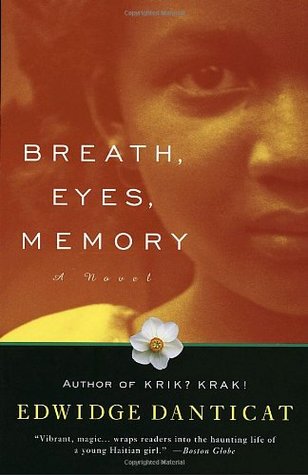
Breath, Eyes, Memory has been on my TBR for a very long time. It’s a modern classic and I finally picked up a copy last year in a second hand bookstore. I put it on my backlist books for this year to finally try and find the motivation to read it.
It blew me away. It was not at all the book I was expecting and I wish I had seen some trigger warnings for it because it is a heavy, emotional book. So TW for rape, sexual assault, eating disorders, and suicide. It was a hard book to read, but I can’t stop thinking about it since I read it and I know it’s a book that will stay with me.
Breath, Eyes, Memory tells the story of Sophie Caco, a young Haitian girl who has grown up with her Aunt while her mother tries to make a living in America. Her mother sends for her at the age of 12 and Sophie leaves behind everything she knows to move to America. I thought it was going to be a straightforward coming-of-age story about immigration, but it was so much more than that. At its core, this is a book about generational trauma.
Sophie grows up in America, but struggles to find herself there. The women in her family have been taught strict ideals about sexual purity that are enforced down from generation to generation. When Sophie has a falling out with her mother, she returns to her homeland to see her Aunt and Grandmother and try to make sense of the trauma that has been passed down from grandmother to mother to daughter. At the same time, her mother is grappling with her own childhood trauma and the two women struggle to be there for one another, despite needing each other.
This is Danticat’s debut and she has a simple writing style, but I still found it to be extremely compelling. She doesn’t get caught up in side stories and every idea has its own place and meaning. It’s quite an emotional punch for how short the book is. It’s a very sad story and I ached for each one of the characters; questioning, but understanding how the cycle of violence always repeats itself. I’ve never heard of the kind of purity test that has been inflicted on the women of Haiti and I think it will forever haunt me, so I can’t imagine what it’s like for the girls who experience it. I don’t think I could re-read this book because it is quite upsetting, but I do feel better for having read it.


 The Paperback Princess