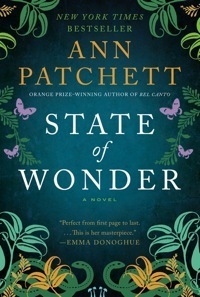
Rating: ⭐⭐⭐
Author: Ann Patchett
Genres: Fiction
Pub. Date: May 2011
It took me ~4 months to read this book, so it’s going to be challenging to write a full review about it because a lot of it is not fresh in my mind anymore, but I have to try because I have very strong feelings about it.
This was only my second Ann Patchett book, but I loved The Dutch House when I read it a few years ago, so I was keen to read more of her work. State of Wonder seems to be one of her more popular books and after reading Lily King’s book, Euphoria, earlier this year (which is often compared to State of Wonder), I decided it was time to pick this one up. Maybe this was a bad idea because I couldn’t help but compare it to Euphoria (which I loved), but even without that book as a reference, I doubt I would ever have liked State of Wonder.
If you’re not familiar, State of Wonder is set in the Amazon – I’m not sure what year, but given that this was published in 2011, I’d guess in the early Aughts sometime. Our main character, Marina Singh, is a research doctor with a pharmaceutical company. One of the company’s biggest projects is a new fertility wonder drug that’s being developed by Dr. Swenson in the Amazon. After the disappearance of Marina’s other colleague, Anders, she is convinced to travel to Brazil to track down Dr. Swenson and report back to the company on the progress of the drug.
Given the project’s remoteness and Dr. Swenson’s total lack of interest in transparency to her employers, she proves difficult to find. When Marina does finally locate her, she is swallowed into an entirely new world and is shocked by her discoveries. The ideas presented in the plot are definitely compelling and we are soon enmeshed in a web of moral dilemmas for which there are no simple solutions. I can see why this would shake up the genre of literary fiction because it is quite an intelligent book and it provides a lot of fodder for the reader to reflect on. My main issue was that the storytelling itself was so incredibly tedious and boring.
It’s a modest 350 page book, but Marina spends more than a third of the book just tracking down Dr. Swenson, and it isn’t until around page 250 before the narrative picks up at all. To be honest, I’m shocked that I didn’t DNF it, which I think is a testament to the idea of the book because the story itself is compelling and I genuinely wanted to know what would happen, it just took soooo long to get there. I’d give Patchett 4 stars for creativity and themes, but 1 star for execution because it was terribly painful to get through it.
That said, the longer I sit and reflect on this book, the madder I get about it, but not for the reason you might expect. The story finally picks up in the last 100 pages to the point that I was suddenly engrossed as it goes completely off the rails. After 4 months of tedious pre-ample, I felt like I was on drugs as the narrative gets more and more unhinged and the morals more and more dubious. All of which culminates in an explosive ending followed by a quick exit from the scene, from which I was left with a huge book hangover.
I hated the ending. It is shocking and upsetting and infuriating all at once. I did not see it coming and I was devastated by it. I understand why Patchett chooses to end the book this way, without this explosive ending I would have been left questioning what was the point of the entire story. The ending is set up to shock you and it drives home a very crucial theme about Westerners and our sense of compassion and responsibility. When is it our duty to intervene and when should we take a step back and not insert ourselves into cultures which we know nothing about? This theme is initially explored through Dr. Swenson’s feelings on the locals and is reiterated when Marina finally makes her departure from the jungle in the final pages.
But the reason why I get madder the longer I reflect on it is that despite genuinely hating most of this book, I can’t stop thinking about the damn thing! Honestly, the plot is good, it just gets lost in such heavy handed writing. I spent so long getting to know everything about Marina, all her character strengths and flaws, to deciding that I liked her, only to have Patchett eviscerate her character in the last 10 pages. It’s really brilliant because we’re presented with these two contrasting characters: Marina and Dr. Swenson, who have very different feelings on the ethics of their work. Yet fundamentally, they’re not that different and the entire book is really a master class in the development of their characters. I almost want to read it again now that I know the ending, I just can’t stand to suffer through it a second time. Although I think I might finally have to pick up Heart of Darkness, which has been on my TBR for over a decade.
So how do I rate this book? I was very settled on two stars when I finished it, but I think I will have to increase it to 3 stars at the end of the day. It’s a smart book, but it leaves me unsure of how to approach Ann Patchett’s books in the future. I don’t think I can read another book with a narrative as thick as this one, but I can’t deny the appeal of the depth of thought and character psyche that goes into each of her stories. I may have to return to audiobook form if I read anything else by her. The Dutch House really worked for me as an audiobook, but I can see how it would maybe read similarly to this in physical form. Either way, I think I will give her older novels (like Bel Canto) a pass, and maybe try some of her newer stuff (commonwealth maybe?) to see how she has developed her storytelling craft.
This was a good story told very poorly. I think if the first third had been tightened up a lot, this would have been a much better book. Either way, it haunts me.
 Rating: ⭐⭐⭐⭐.5
 The Paperback Princess