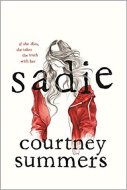
Sadie

Rating: 
Author: Courtney Summers
Genres: Young Adult, Fiction
Pub date: Sep. 4th, 2018 (read July 2018)

I have a copy of one of Courtney Summers other books, All the Rage, that’s been sitting on my shelf waiting for me for awhile, but I’ve been hearing a lot of hype about this book and St. Martin’s Press was so kind as to send me an advance electronic copy in exchange for an honest review, so I decided to read this one first.

As usual, I barely read the synopsis for this one and picked it up mostly based on the hype, so I went into this blind. Sadie is the story of 19 year old Sadie Hunter and her younger sister Mattie. The book starts with Sadie’s disappearance after Mattie is found murdered. The girls mother was a drug abuser and did little parenting of her two daughters. They grew up with their surrogate grandmother, May Beth, but Sadie ultimately took on the responsibility of raising Mattie. She loved her sister with every fibre of her being, even though Mattie sometimes drove her crazy, so her death tears Sadie apart.

Sadie believes she knows who murdered Mattie and runs away from their home in Cold Creek to find him. The story is told from two different perspectives and played a big role in why I liked this book. Half of the story is told from Sadie’s perspective, but the other half is the transcript of an 8-part podcast called the girls, narrated by journalist and radio personality, West McCray. I thought the podcast transcript was brilliant and totally set the scene for this book. I literally never listen to podcasts, but my partner does and this read just like Serial, which I’ve heard him listening to on occasion, and reminded me of the old town crime mystery documentaries that I used to watch on TLC growing up.

So we get two very different perspectives from this novel. Sadie’s perspective is deeply personal and emotional. She is very much a girl who’s entire world has been torn apart and she starts to damn the consequences in her desperation to find her sister’s killer. Then there’s the other perspective from West McCray, who is more clinical about Sadie’s disappearance and is always two steps behind Sadie as he tries to track her down (side note: I know West is a man, but for some reason I pictured him as a woman throughout almost my entire reading. Anyone else get that vibe?). I thought that both narratives were incredibly strong and together made this a strong novel. Most of the double narrative books I read are split timeline historical fiction novels and I almost always find the modern day timeline boring compared to the historical one, but with this book, I found both narratives extremely compelling. Sadie’s story had depth and McCray’s was intriguing. I just felt so transported during every “podcast episode” that I couldn’t help but love it. Plus it was different from anything else I’ve read.

That said, parts of this book are tough to read. “Girls disappear all the time”. It’s a sad statement, but a true one. There is child abuse in this novel and Summers tackles some disturbing topics. I appreciated though that while Summers didn’t hold back the punches, she’s not graphic. “I’ve decided the gruesome details of what was uncovered.. will not be a part of this show,.. it’s violence and brutality do not exist for your entertainment.” Many books and shows are needlessly gratuitous when it comes to describing violence, so I’m glad she left it out. What she’s not afraid to tackle though are Sadie’s brutal thoughts. She shocked me several times, but she was determined that no one else suffer what she and her sister suffered, even if she had to destroy herself in the process.

The ending killed me. I won’t give any spoilers. It’s brutal, but it’s also exactly how it should be. I flew through this book in a single long weekend camping trip and I would definitely recommend it. I’m feeling a bit more of an itch now to finally pick up my copy of All the Rage.

Sadie’s publish date is Sept. 4th, 2018 if you want to pick up a copy!

Girls Burn Brighter

Rating: 
Author: Shobha Rao
Genres: Fiction
Pub date: Mar. 2018 (read June 2018 as audiobook)

This was a super heavy read. At one point I’m sure I read the synopsis for this and thought, a book about disenfranchised women who find power within themselves, how empowering, sign me up. But between reading the synopsis and downloading this book as an audiobook, I totally forgot the plot and was super disturbed at how dark this was!

Girls Burn Brighter is set in India (amongst other places) and focuses on the friendship between two young women, Poornima and Savitha. They are only friends for a short period of time, but they develop a strong relationship during that time and come to realize that the other is the only person to ever truly love and care for them throughout their lives. They are torn apart by the circumstance of being young women of marrying age in India and both suffer some truly atrocious acts of hatred and spite against them.

It’s totally evident if you read the synopsis, but I did not realize this was a book about human trafficking. Human trafficking is one of the great injustices facing our world today and yet there is very little literature devoted to it and it makes for a truly upsetting read. I suffered through this book along with both Poornima and Savitha. It was uncomfortable and hard to read and that’s exactly how a book about human trafficking should be. A few months ago I read a book, A Girl Like That, about the way women are treated in Saudi Arabia and was truly appalled.

For some reason I thought India treated women better (than Saudi at least), but this book shocked me in its malice. The men in this book had so little regard for women and many of the men in the novel truly despised them. Yet I had no problem imagining these men and their cruelty. I did know I was getting myself into a tough read, but this book really made me despair for humanity. It also tells the story of two strong women who, despite all the suffering that has been visited upon them, still yearn and aspire to a better life. They find strength in the love they have for one another and no matter what shit life throws at them, they always continue to pursue something better for themselves, and in Savitha’s case, something better for her family too.

I listened to Girls Burn Brighter as an audiobook, but I’ve since decided to switch back to non-fiction for my audiobooks for a while because this is another book that the audio just didn’t quite do justice to. The writing is quite flowery and I think I would have liked it a lot in written form, but in audio I tended to get a bit distracted by the writing and sometimes would zone out.

The ending is oh so frustrating. I knew I was approaching the end and I was so nervous as to how the author was going to end things and while I don’t fault her for the ending, it was still torture! The plot was a little unbelievable for me, partly because I couldn’t believe so much hardship could be experienced by two people, but also in that the coincidences in this novel were just a little too far past believable for me. But it is a great story about the strength and perseverance of women. Just mentally prepare yourself before you go into this book because it was honestly one of the most emotionally draining books I’ve read it a long time.

I Was Anastasia

Rating: 
Author: Ariel Lawhorn
Genres: Historical Fiction
Pub Date: Mar. 2018 (read June 2018)

I had pretty high expectations of this book and unfortunately it just did not live up to them. Anastasia was pretty much my favourite animated film growing up (even though it is not at all historically accurate) and I was super excited to read a whole book about the lost princess. Plus this book had the added intrigue of being written from two contrasting timelines.

I was Anastasia tells the story of the Romanov’s from two points of view. The first is from the POV of the Grand Duchess Anastasia, commencing at the Russian Revolution and leading towards the execution of the entire Romanov family. The second point of view is from a woman going under the name of Anna Anderson who claims to be the princess Anastasia. Anna’s story is told backwards, starting near the end of her life and chronicling her lifelong struggle to be formally recognized as the Grand Duchess.

I was super excited about the structure of this book, but it ended up not working for me at all. It’s a really interesting concept to tell a story backwards and I was definitely intrigued, but I felt it was very poorly executed. There were way too many names and dates and the timeline was constantly changing, so it was extremely difficult to keep track of what was happening and I eventually gave up. Plus the author would constantly end chapters on cliffhangers, but because the story was being told backwards, you would never re-visit that part of the story and it made everything feel very disjointed and de-valued the story because you were constantly meeting characters that only mattered for a chapter or two. It made character development very difficult and Anna Anderson a pretty unlikable character. Because I found her story difficult to follow, I was really only interested in Anastasia’s timeline and would dread every time I had to switch back to Anna (although to be honest, Anastasia’s story started dragging a little bit towards the end as well.)

There were still parts of this story I found interesting though. I’m going to talk about them below, but if you’re still interested in reading the book, than I would suggest not reading any further and not doing any prior research on the Romanov’s – just read the book. This has the potential to be an interesting read if you go into blind because of the way the author has written the story. So be aware that there are spoilers below and you shouldn’t read any further if you’re still planning to read this book.

So what I did like about this book is that I didn’t know Anna Anderson was actually a real person and this is where I think most of the enjoyment of this novel came from. I thought Anna was an entirely made up character and that the author was telling a fictional story to let us decide whether or not we thought Anna Anderson was actually Anastasia. I think this is the greatest strength of the book and I appreciated the authors note because she tells a story that makes you want to believe that Anna is actually Anastasia.

What I didn’t realize is that Anna Anderson is actually a real person and most of what is written in this novel about her is based on true events. Because there was so much secrecy surrounding the deaths of the Romanov’s, there was a great myth that maybe the youngest daughter had survived. There were many Anastasia impostors over the years, especially when it became known about the great wealth the Romanov’s had stored in the Bank of England. However, Anna Anderson is the most famous Anastasia impostor and she does deserve credit for keeping Anastasia and the Romanov’s legacy alive for many many years. She claimed to be Anastasia for over 50 years and had many supporters, many of who actually knew Anastasia, yet she was never able to successfully prove her claim.

I liked that, while the author did take some liberties, this was a historically accurate book. Both stories told in this book are based in fact and as horrific as they both are, they were very interesting to learn about. I can’t love this book because I did have a lot of problems with the timeline and I honestly just didn’t find the writing or the storytelling that compelling. But I learned a lot and I still appreciate what Lawhorn was trying to do with this book. Not a favourite for me, but an interesting read if you’d like to learn a bit more about Anna Anderson and the Grand Duchess Anastasia in her final year and a half of life.

Fruit of the Drunken Tree

Rating: ⭐
Author: Ingrid Rojas Contreras
Genres: Historical Fiction
Pub Date: July 31, 2018 (read June 2018)

Thank you to Penguin Random House Canada for providing me with a free advanced reader copy of this book in exchange for an honest review. 

I’m not sure where I first heard about this book, but as soon as I found out it was historical fiction about Colombia I was super interested in reading it. I decided to include it in my June Monthly Challenge to read 3 historical novels. I was intrigued with this book because I haven’t read very much historical fiction from South America, much less anything specific to Colombia, and I saw this as a great opportunity to educate myself.

The author did grow up in Colombia and immigrated to America as a result of the violence she experienced. Fruit of the Drunken Tree tells the story of a young girl, Chula, and the relationship she builds with her maid, Petrona. The story is semi-autobiographical, which made it all the more interesting.

There are some interesting class dynamics in this novel. Chula and her sister Cassandra are growing up in Bogota, which experiences a lot of drug and gang violence relating to Pablo Escobar, the looming villain of Chula’s childhood. But Chula and Cassandra grow up in a wealthy, gated neighbourhood and are mostly separated from the violence until it starts slowly infiltrating into their daily lives.

Their father works for a large american oil firm, so he makes good money, but he is away most of the time. Their mother is constantly hiring and firing new maids and when she hires the meek Petrona, no one thinks she’ll last the month. But to their surprise, Petrona does last and Chula starts to develop a relationship with her that ultimately interrupts and changes the lives of everyone around them.

I liked, but didn’t love, this book. I learned a lot about Colombia that I didn’t know, but I did find the novel a bit slow moving and I thought it lacked explanation and balance. I say it lacked balance because it is told from the point of view of a 7 year old, wealthy girl. I know this is part of the charm of the narration, that Chula is a child and ignorant, but she didn’t really understand how different her live was from Petrona’s and I would have liked to see more narration from Petrona and what it was like to grow up poor and heavily influenced by the drug cartels. I found Petrona’s story a lot more engaging than Chula’s, but we don’t get that much from Petrona’s narration. I know the author is writing what she knows, and I think that is super important in literature and I do think she shouldn’t write too much from a perspective she doesn’t really understand. But I was more intrigued in the intricacies of Petrona’s life and the politics of the cartels against the government.

I say it lacked explanation because there’s a lot of political stuff going on in this novel, but I sometimes struggled to understand what was going on because I just didn’t have enough context. I found the author’s note at the end super helpful because I really didn’t understand what was happening in parts of this novel and it only became clear after I read the author’s note. I wasn’t really sure what was motivating Petrona or why her boyfriend was so interested in Chula.

Kidnapping was a large part of the violence perpetrated in Colombia as wealthy individuals and children were often kidnapped and held for a ransom that, if paid out, often still didn’t result in release. I thought this story was a good debut and insight into the author’s experience, but I struggled with the plot, which was a bit meandering and lacked drive. I didn’t feel like there was anything propelling this plot and I often found myself getting a bit frustrated with Chula. That said though, I think novels from the POV of children are hard to write and I often don’t love them. But I do think the author did a good job capturing how confusing it is to be 7 years old and how defining certain events can be on your life.

Fruit of the Drunken Tree will be available in stores July 31, 2018

The Great Alone


Rating: 
Author: Kristin Hannah
Genres: Historical Fiction
Pub Date: Feb. 2018 (read Jun. 2018)

The Great Alone has been haunting my shelf since it first came out and I finally found time to read it as part of my June Challenge to read 3 historical novels. I read The Nightingale in 2015 and while I did like it a lot, I’ve read a lot of WWII historical fiction and had a bit of fatigue reading that genre. The Great Alone has the most gorgeous cover though (don’t pretend it doesn’t matter) and I was intrigued by a story about Alaska and a POW.

I’m so glad I finally read this because it was seriously a pleasure to read from start to finish, even though it broke my heart and tossed me into the pits of despair. The Great Alone has some of the most gorgeous writing and Kristin Hannah breathed so much life into her setting and her characters. Setting is key for this story and the author did a magnificent job a creating a sense of place. Sometimes too much descriptive imagery can bog a story down, but Hannah’s writing made me fall totally in love with a place I’ve never even been.

Alaska in the 1970’s is the last frontier of America. A place where no one really cares who you are or where you came from. A place where everyone is running to something or from something. A place where 5 of every 1,000 people goes missing and is never found. Where you’re only allowed to make one mistake, because the second one will kill you.

Ernt Albright returns from the Vietnam War a broken man. His plane crashed and he was captured early into his tour and spent years being tortured in a POW camp. When he finally returns to his family, he is broken and disillusioned with America. He was in love with his country when he signed up to go to Vietnam, but now all he can see is an America that no longer represents him – corrupt politicians and blind citizens. Between the Watergate scandal and the young girls going missing in Washington, Ernt Albright feels the whole world is just going to shit.

In his frustration, Ernt becomes an angry and volatile man, moving his family all over America before inheriting a cabin in Alaska from his late friend from Vietnam. In a last bid to find peace, he packs up his life and moves his wife, Cora, and their 13 year old daughter, Leni, to Kaneq Town in Alaska.

They arrive in Alaska in the Spring and are enchanted by the landscape. The days are long and Ernt finally has a purpose – repairing the decrepit old cottage and learning how to survive. Leni has never really had a place that she could call home, but something about Alaska calls to her. This is the great alone, where you can be whoever you want to be. There’s a real sense of community – trade is a currency and in a place where survival is all that matters, the neighbours band together to look after each other.

I’ve been living in BC for the last 5 years, and while I know it’s a lot a different than Alaska, I have become totally enamoured with the landscape here, the mountains and lakes. I spend most of my free time in the summer hiking and camping in the mountains. I also grew up in Newfoundland, which again, has little in common with Alaska, but is more remote and you spend a lot of your year suffering through a dark winter. I know the Alaskans wouldn’t be impressed with my measly camping skills when living off the land is their life, but I did feel like I could totally relate with their love of place, even though 8 months of the year that place is trying to kill you.

The author does a fantastic job with the imagery and making you fall in love with Alaska when the Allbright’s first arrive. The days are long and the flowers are in bloom, what’s not to love about Alaska. For the first time in her life, Leni sees a place where they might actually be able to be a happy family. The sun drives away Ernt’s nightmares and being responsible for your own subsistence gives them all a purpose. Plus, Leni makes her first real friend. There’s only 6 students in the tiny school in Kaneq, but Matthew Walker is 13 too and for the first time, they both have a real friend to spend time with. Matthew is the third generation of the Walker family to grow up in Alaska and he shares his love of the land with Leni and they become very close.

However, at the same time that Hannah’s writing has you falling in love with Alaska, there’s this feeling of darker things lurking on the horizon. The townspeople seem to be obsessed with winter. After school lets out, the entire summer is devoted to preparing for a long a dark winter and Leni and her family work from dawn til dusk every day doing their best to prepare. They must til the land, grow a garden, smoke and can salmon, and most important, bag a moose to see them through the long winter. And as the days start to get shorter, the long nights bring the return of Ernt’s nightmares. His temper gets shorter and Leni begins to realize that what can kill her outside the house may be second to what lurks inside their own home.

I think I could talk forever about this book. I thought it was a little slow moving at the beginning, but it didn’t hurt my enjoyment. I learned a lot about Alaska and survival, which I found just as enthralling as the character development and conflict that came later. There’s a lot going on in this book and Kristin Hannah created some truly wonderful characters. It’s hard to read about Ernt and Cora and their volatile love, as well as the heartbreak that befalls the Walker family early in the novel. But I loved watching the relationships grow. The relationships between Leni and her mother and Leni and Matthew are beautiful, as well as the relationships that develop between Leni and her mother with secondary characters like Large Marge and Tom Walker (I love both of these characters!)

This is a coming of age story for Leni and it is wrought with secrets and heartbreak. Leni loves both her parents, but she also knows they are bad for one another and she struggles to understand their love or to follow her mother’s policy of silence. Tom Walker has money and wants to invest it in the community, to promote tourism in their little piece of the world. But Ernt is opposed to change in any form and the two men find themselves at odds with one another and Ernt’s opinions threaten to tear the community apart. Leni’s friendship with Matthew and her fear of her father cause her to get caught in the middle. What matters more, her family or her future.

Like I said, this book tore my heart right out of my chest and stomped all other it. It is deeply sad, but it also makes you feel so much. It’s about the strength of women and the power of community. How some loves are good and important, but others are toxic and dangerous. There doesn’t have to be shame in our deepest, darkest secrets and that sometimes sharing them with someone else can be incredibly powerful. We don’t always have to carry our burdens alone.

This book also shines a light on some of the inequities of the past and how they still exist today. The law is not very accommodating of battered women. This hasn’t really changed. Leaving bad relationships can be the hardest thing and can sometimes even be more dangerous than staying in a bad relationship. Without help for women, sometimes there is no escape. This book will break your heart, but it will also give you that righteous anger about the way women are treated and tricked within the legal system. How in the 70’s women couldn’t even get their own credit card without a male signatory, so how are they supposed to make it on their own? But the Great Alone has some powerful characters and I loved watching Leni grow and find herself. She was forced into some tough decisions, but Alaska taught her to survive against things tougher than just nature.

I can see how this book might not be for everyone, but I absolutely loved it and now I’m dying to go visit Alaska. Recommend to everyone!