The Tea Girl of Hummingbird Lane

Rating: 
Author: Lisa See
Genres: Historical Fiction
Read: July 2017


Where do I start with The Tea Girl of Hummingbird Lane? There was so much going on in this book – the plot was so layered and there were so many interesting themes underlying the story, but somehow it all worked and was immensely compelling. (disclaimer: there may be a few spoilers in here, but I think most of what I talk about is covered in the synopsis, which is pretty detailed)

Goodreads has been selling this book to me hard all year with their advertising, but for some reason I wasn’t sure if I would enjoy it. I read Dragon Springs Road earlier this year, which I liked but didn’t love. It’s probably unfair to compare the two books, just because they happen in China, but I found the pacing slow in Dragon Springs Road and I expected The Tea Girl to have a similar pacing, but I found this one so much more compelling. I don’t know a whole lot about Chinese culture, so I appreciated both novels and learned a lot, but there was a lot more going on in See’s novel.

Starting with the narrator, I absolutely loved Li-yan. She had such ambition, despite the constant belittlement from her family and the refrain that she was unimportant because she was a girl. Li-yan was born into the Ahka culture, which like many cultures, values boys far beyond girls. The Akha are a very tight knit people and view the village more as a collective than group of individuals. They believe everything has a spirit and they have many customs to protect against bad spirits and encourage good spirits. They believe it is everyone’s job to bring more children into the community and everyone always hopes for the birth of healthy sons.

I appreciated See’s writing because in the beginning the Ahka seemed so backwards to me and some of their practices were extremely horrifying. But throughout the course of the novel See was able to make me really appreciate their way of life and they did progress to abandon some of their more troubling customs (namely the killing of “human rejects”).

But I loved Li-yan because despite being told she was worth nothing, she had such ambition to pursue a better life through education and a desire to be someone. She convinces the village and her father to allow her to pursue her education and becomes the first educated person in the village. She faces so many struggles, but she always persevered and made choices (some of which were very tough) on what she felt was best for herself. Some readers might condemn her for giving up her child, but I didn’t fault her. She really would have had no life if she had decided to keep Yan-yeh. In many cases she was forced into some of her decisions, but I especially loved her decision to leave San-pa. I fully expected her to stick things out no matter how toxic things became, but when she finally recognized what was going on, she made a decision for herself to leave, even though she risked being sold or killed if she was caught.

She made so many wrong choices and at times really disappointed me, but I could sympathize with her decisions and forgive her for them. I was sad when she got distracted from her studies and ignored the advice of her family about San-pa, but she was so young and blinded by love, which I think we’ve all been at the young age of 16. She punished herself for so long after her failed marriage though and I was glad to see her find the strength to love again. 

I thought her relationship with her mother was beautiful. In the beginning I didn’t like A-ma because she was so harsh with Li-Yan, but she really grew on me and it was wonderful to watch their relationship grow and to see the softness in A-ma after the birth of Yan-yeh. I really enjoyed all the mother/daughter relationships in this book and the relationships between all of the women.

I didn’t enjoy the format of Hayley’s story as much (I think I would have preferred 1st person POV), but I learned a lot from her experience as well. I’ve thought about the challenges immigrants face in moving to America/Canada, but I haven’t put much thought into what it must be like to have parents that don’t look like you and to have so many stereotypes forced upon you. You always expect that your parents would be people that you could relate to and take advice from, but when your lived experience is so different from theirs, it must be so difficult not to have that shared experience and reassurance from your parents.

It was also interesting to learn a little bit about the one-child policy. I can’t imagine what that must have been like for Chinese mothers and it’s upsetting to see girls so little valued in a culture. It was interesting to read about Li-yan’s experience giving up her daughter and I’d love to learn more from other perspectives of women who’ve had to make decisions to give up their daughters.

And of course there was the tea. I didn’t think I could find tea so fascinating! I had no idea there was so much history behind tea and I’d never heard of Pu’er tea, so it was interesting to learn about how tea production changed Yunnan province, world tea markets, and became such a phenomenon. What I really liked about this book is that it started in the 90’s. I couldn’t believe there were villages in China that were so remote and unconnected to the world within my lifetime. It was fascinating to see how they evolved and changed as the modern world came to them in search of tea. It gave me a whole new appreciation for tea!

There is so much going on in this novel, but it all worked and was immensely compelling. It was a beautiful novel about the struggles women face, the relationship between mothers and daughters, and the ways in which we change and adapt to the world around us. Would definitely recommend!

Even the Darkest Stars

Rating: 
Author: Heather Fawcett
Genres: Fantasy, Young Adult
Read: Sept. 2017


I can’t decide between 3 and 4 stars, so I’m rounding up.

Yay for Canadian authors and even more yay for a Vancouver author! I absolutely loved the setting in this novel. I live in Vancouver and I’m a little bit obsessed with hiking and mountains (as are a lot of Vancouverites) and I’ve always been fascinated with climbing expeditions, so I was super stoked to read the synopsis for Even the Darkest Stars. Also, the cover art is the most gorgeous thing I’ve ever seen!

Even the Darkest Stars is set in a fantasy version of the Himalayas. Kamzin and her sister Lusha live in a tiny village at the base of Mount Raksha, the biggest and least explored mountain in the empire. All her life Kamzin has dreamed of setting off on an adventure and of being an explorer, so when the Royal Explorer River Shara shows up in her village on an expedition to climb Mount Raksha and retrieve a rare talisman, Kamzin is determined to assist him. When Lusha disappears in the dead of night with one of River’s expeditionary crew to retrieve the talisman first, River hires Kamzin and they race to catch up to Lusha and get to the talisman first.

I liked the narrator and the writing from the start, but it took about half of the book for it to really pick up. There was a lot of journeying in the first half of the book and limited action – and when there was action it often happened very quickly and felt kind of out of place. But I really enjoyed the second half of the book and I definitely want to read the sequel!

I thought the “twist” was a bit obvious, but it didn’t take away from the story. I loved Kamzin and River’s characters and I can’t wait to learn more about River in the next book, but I felt the rest of the cast was a bit lacklustre. I don’t think I really learned enough about Lusha or Tem to really love them. We’re told that Lusha and Kamzin had a contentious relationship growing up, but I would have liked to have learn more about their history to back it up.

But like I said, the setting was really the strongest part of this novel and I’m interested to see what Fawcett does with it in the sequel!

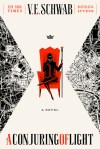
A Conjuring of Light


Rating: ⭐⭐⭐⭐
Author: V.E. Schwab
Genres: Fantasy
Read: June 2017


Yes! This book was everything that I wanted from this series!

This is the third and final book in the Shades of Magic series and disclaimer, there are a few spoilers in here (I can’t figure out how to hide them in wordpress…), so maybe best to wait until you’ve read the series for this review.

For some reason I had a hard time getting into the first two books in the series. I can’t really pinpoint why – I liked the characters and I thought the writing was good, but whenever I’d put the book down I never felt anything compelling me to pick it back up again.

A Conjuring of Light still took me a fair bit longer than normal to read, but it was because I was on vacation and not for lack of suspense! The story starts right where A Gathering of Shadows leaves off and the action completely draws you in right away. I still found the pacing a bit off in places, but overall, a very fast-paced and compelling story.

The characters were everything to me in this installment. Holland has fascinated me from the start and I was thrilled to finally get the full breadth of his backstory. What do other readers think of Holland because I thought the characters were quite hard on him – he had his faults, but I totally sympathized with him and I couldn’t blame him for Osaron. Kell questions whose actions set everything in motion – his decision to smuggle vitari into his own world, his decision to send Holland to Black London, or Holland’s deal with Osaron? I couldn’t condemn either of them, but it’s a powerful testament to the power of our choices, even tiny choices, to change and influence the world.

This story had a lot of depth and boy, was it dark. I never know what to expect from Schwab, she doesn’t hesitate to kill off characters, so it’s hard to predict how things will turn out. For example, she set the story up for us to hope that Holland would be able to trap Osaron in the inheritor, leaving Kell and Lila to pursue their own happy ending. And even though this is what happened, I really didn’t know which way things would go and I wouldn’t put it past her to have had either Lila or Kell take the fall.  I loved how each character had their own strengths and weaknesses. This was consistent in all 3 novels, and I liked that Kell and Lila looked out for each other and both came to each other’s rescue depending who was having a better day.

I’ve got to hand it to Schwab for her diversity of characters, a cross-dresser and a gay love story between two major characters seems like too much to ask for in a fantasy novel, so I loved seeing both of these elements play out in this series. There was a lot of sub-plots happening in this book and it was interesting to learn more about some of the minor characters. Lila is definitely my favourite character of the lot, but I enjoyed Rhy and Alucard’s story, and the insight into Rhy’s parent’s lives as well.

A Gathering of Storms was probably my least favourite of the 3 novels and felt a bit like a filler novel. In the scheme of things I didn’t think the Essen Tach was important and I was bored with the endless fight scenes. It was good character development and relationship building, but offered little in terms of the plot. The final book in the trilogy had it all though – a fast paced plot and a ton of character growth. A redeeming novel for me!

Beneath a Scarlet Sky


Rating:
 .5
Author: Mark T. Sullivan
Genres: Historical Fiction
Read: July 2017 on audiobook

Ugh, this book.

This is a challenge to rate because it really is a fascinating story that deserves to be told, but oh my god, the writing was brutal. I really wish this story could have been told by someone like Markus Zusak, Anthony Doerr, Kristen Hannah, or literally anyone who knows how to better write emotions and dialogue.

Beneath a Scarlet Sky is the fictional telling of Pino Lella’s true story. Lella is an 17 year old Italian from Milan who comes of age at the height of World War II. His parents send him out of Milan and he ends up guiding jews and other people looking to escape Italy through the snowy alps to neutral Switzerland. He does this until just before his 18th birthday, when his parents call him back to Milan and force him to enlist with the Germans to avoid being drafted to what would likely be sure death with the Italian Army. This is a huge source of shame for Pino and when he finds himself assigned to be the driver for German General Hans Leyers, he seizes the chance to redeem himself by turning spy for the Allies. Oh, and along the way he falls in love with this girl Ana.

This was an incredible true story, but the writing failed on so many levels for me. Disclaimer, this was my first audiobook, so it’s possible that maybe audiobooks are just not the right format for me, but I really think it’s the writing. First of all, the dialogue was awful – it didn’t feel at all natural. Secondly, it was not dynamic. I know this book is based on a true story, but it’s still supposed to be fiction. As an author you can take some liberties on a true story, to infuse emotion into the story and make it more palatable to your readers. Historical fiction writers do this all the time.

I think Sullivan should have just written a biography because this novel was way too precise. I felt like I was reading a boring chronology of Pino’s life. “Pino did this, and then he went here, and then he saw this, etc…” It was way too long and Sullivan tried to make every single event seem so intense, he spent so much time detailing each alpine crossing and everywhere Pino went as a driver. It was weird how precise he was with everything, even down to the specific distances Pino hiked and specific time he did something. I didn’t need to know how many metres Pino traversed for every part of his mountain crossings and I didn’t need to know where exactly he took General Leyers at 2, 4, and 6pm.

Sullivan conducted extensive interviews with Pino Lella and I felt like he didn’t give enough voice to the character and tried to stay too close to Lella’s story. Pino’s narrative felt like that of an 80 year old man recounting what happened to him during the war rather than that of a 17 year old actually living these experiences. This experience happened to Pino 70 years ago and I’m sure it was hard for him to articulate his emotions about it, which is where I had the biggest issue with Sullivan’s writing.

Sullivan didn’t know how to emote. Pino felt like the most basic character ever. He’s constantly talking about how he “feels”, but it had no depth for me. I think Sullivan should have taken a bit more liberty with the story to better connect with or imagine what Pino really would have felt. This book was an example of telling your audience instead of showing them. Sullivan obviously admires Pino (as do I), but it got in the way of his writing because Pino didn’t really have many flaws. I feel like Sullivan didn’t imagine what it would really have been like for Pino to enlist with the Nazis and the struggle he would have faced being shunned by his brother and best friend. Sure he was “sad” or “angry”, but his emotions were so basic and lacked depth.

This went for all the characters. Most upsetting for me was Ana. She had no personality whatsoever and her relationship with Pino was so romanticized. I mean, Pino was 18 at the time, so I could believe his fawning over her, but ugh, there were way too many descriptions of Pino being intoxicated by her “female scent”. Bletch. Seriously, what did Pino like about her besides her beauty? We never learn anything of substance about her except a quick flashback to her father’s tragic death.

But enough about the writing, on to the story: it was so heartbreaking! Pino was a busy teenager during the war and made a truly incredible contribution to the war. The synopsis gives no indication about the time Pino spent in the alps guiding refugees across the border, which I found even more fascinating than his spy work under General Leyers. It’s wild how many historical events he bore witness to and I really liked learning about Italy’s occupation. I’ve read a lot of WWII fiction about the camps and what it was like during the war in England, France, Germany, Poland, Russia, and even Hungary, but I’ve never read any WWII fiction about Italy.

The ending and epilogue were some of the most meaningful parts of the book for me. I don’t want to spoil it for anyone, but there was one death (it’s war, there’s obviously going to be deaths) at the end of the story that was actually one of the most horrifying things I could ever imagine and I was extremely disturbed reading it. Honestly, everything about the end of the war in Italy was disturbing: the civil war in Milan, the revenge killings, the desecration of Mussolini’s body in the square. Death is so unpredictable and it was one thing that Sullivan did a good job of demonstrating towards the end of the book. 

Sullivan’s depiction of the aftermath of the war in Italy was also meaningful because it really showcased the hardships the people of Milan had experienced and their anger at the Nazis and the fascists. It’s a frightening look at the depravity of humans and how even after suffering so much, we can still want to see others suffer. Can revenge actually soothe your soul after bearing witness to so much pain? Pino was so detached emotionally at the end of the novel that I thought this was the one scene where Sullivan actually showed us his pain instead of just telling us about it. Pino was numb inside, so Sullivan stopped narrating his internal emotions and we were able to discern them from his actions rather than being told how he felt.

After finishing this book, I’m not surprised that Pino kept his experiences to himself. I don’t think him a coward, but I understand now why he thought himself one. He was shamed and shunned by a lot of people when he joined the Nazis and when he becomes a spy, he’s frustrated by not being able to share it with his family or Carletto and hates for them to think of him as a traitor Nazi. But to an extent, he was. He did join the Nazi party and it was only by fate that he ended up as a driver to Hans Leyers. I’m glad he was able to rebel under the Nazi regime and secretly fight against the Nazis, but the story could easily have gone another way if he had had no opportunity to fight for the Allies and ultimately, the winners.

But in a time of war we can’t know how things will turn out. Pino was young and not equipped for the situations he was put in. It’s impossible to predict how we will act and react in extreme situations and how the bounds of right and wrong can become blurred and confused by the people and events around you. I can see how Pino would be haunted by his experiences for the rest of his life and how war can really change the trajectory of your entire life and character.

I am very glad that Mark Sullivan has created a record of Pino’s life so that history will remember him, but don’t expect a well-written book.

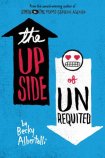
The Upside of Unrequited


Rating: ⭐⭐⭐⭐
Author: Becky Albertalli
Genres: Young Adult
Read: July 2017


This was a cute book and it definitely surpassed my expectations. I thought it sounded a bit juvenile when I read the synopsis, but it was just so relatable! I have almost nothing in common with Molly, who is a twin, has two moms, a bi-racial family, and is fat, and yet I could totally remember what it was like being a teenager and thinking everyone has grown up and left you behind.

Molly’s the only one in her friend group who has never kissed anyone, but it never really bothered her until her twin sister, Cassie, gets her first girlfriend and Molly begins to feel like she’s been left behind. She’s had dozens of crushes over the years and Molly desperately wants a boyfriend, but she’s afraid to put herself out there and what people might think of her.

Every little thing matters when you’re a teenager. Your friends are your lifeline and the most important people in the world to you. But teenagers are really bad at balancing friends and boyfriends/girlfriends and I could absolutely relate to Molly’s fears that she was slowly losing her sister. Your romantic partner does eventually become the most important person in your life, but when only half of a friendship is having the experience of falling in love, it can be really hard to watch and it can make you feel really lonely.

It can also make you feel really uncomfortable when the people around you are having their first sexual experiences and you can’t relate with them. I liked that Albertalli addressed that a lot of teenagers exaggerate their sexual experiences to try and fit in. Molly felt so out of her depth when her friends started talking about sex and Reid expresses that he thinks half of them are just making things up to fit in. Molly is surprised to learn later that even though Cassie’s girlfriend Mina talked a big game, Cassie was the first person she had ever had any kind of romantic relationship with.

There was a lot going on in this novel and the sister relationship reminded me a little of Fangirl, but healthier. It’s a quick read and I enjoyed watching Molly grow and how her relationships changed. I could see people being upset that she ultimately resolves her issues by finding love (why couldn’t she just love herself?), but I thought that Molly actually did love herself already and that she needed to believe that other people could love her too. There was no antagonizing over how she was fat and trying to lose weight – she loved to eat and generally seemed happy with her body. It was more that she was worried that society tells us that fat girls are unlovable and that boys wouldn’t be able to see beyond her weight to who she actually is.

Side note, I also loved that Molly took medication for anxiety, but that it wasn’t part of the story. There wasn’t a sub-plot about her overcoming anxiety, she just takes medication and that helps her, end of story. Overall, I thought this was a sweet, coming-of-age story that had a ton of diversity! I know everyone is obsessed with Albertalli’s other book, Simon vs. the Homo Sapiens Agenda, but I actually found that one a little heavy handed and preferred the Upside of Unrequited!