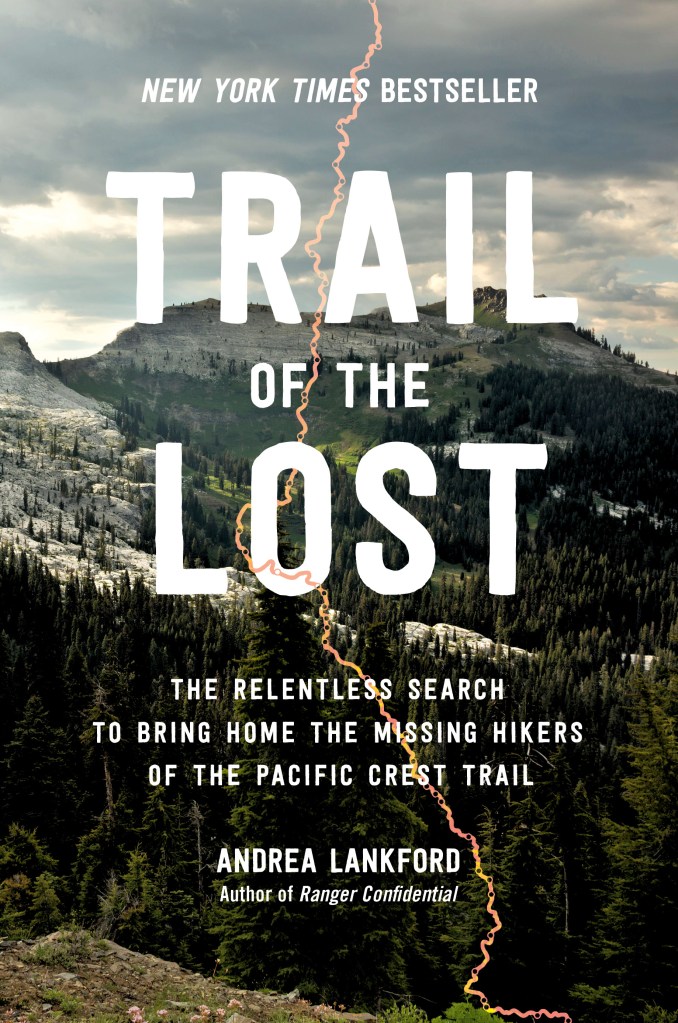
Rating: ⭐⭐⭐
Author: Andrea Lankford
Genres: Non-fiction
Pub. Date: Aug. 2023
I’m not sure what to make of this. It’s a well researched and pretty well written book. Andrea Lankford has clearly been heavily involved in the missing cases of all 3 hikers featured in this book for quite some time. She covers each missing person in great detail, explains a lot of the quirks of thru hiking, and highlights different search techniques that are being used to try and find missing persons and the merits of each.
It’s an interesting enough read and it mostly worked as an audiobook. The only real complaint I had about the audiobook is that two of the missing persons are called Chris/Kris. It would be a lot easier to tell them apart reading it, but listening to it was a bit confusing and hard to know who she was talking about and I couldn’t keep straight what happened in each case.
Fundamentally, the problem I had with this book is that it’s become evident to me over the past few years that I don’t believe in extended searches for missing hikers. It’s a personal opinion. As someone who hikes a lot, I have given this a lot of consideration and I personally have told my husband to please search for me for 1-2 months if I go missing, but to then move on with his life. It’s morbid, and I understand the need for closure, especially for parents of the missing, but I feel that an extended search only extends the pain of family members and prevents people from moving on. There’s a very real possibility the missing will never be found. (for clarity, I’m only opposed to extended searches for missing hikers, not those who have potentially been abducted, kidnapped, or murdered – there are very different implications and risks between the two).
This is a very personal decision and I don’t fault parents for not being able to let go. But where I consistently get hung up on the idea of an extended search is when it puts volunteer searchers at risk. No missing person is ever truly abandoned by search and rescue. I do think their initial searches are often a bit on the short side, but they do regularly re-visit missing person cases, even years after the fact, and dedicate resources to searching. Which I’m totally in support of because they are professionals. But extended and self-organized searches can and do put the volunteer searchers at risk, which is why I personally oppose them. The only thing I can imagine that would be worse than getting lost and dying in the woods, would be other people trying to find my body and also becoming lost, injured, or dying.
I was extremely frustrated with the author when she went on a solo reconnaissance trip in dangerous terrain. Yes, she is a former SAR member, but she did become injured and it didn’t appear that she even carried at satellite device, just a phone. I thought if anyone would know better, it would be her. In addition, Pam got lost, Cathy continually put herself at risk, and who knows how many others got in sticky situations searching for lost hikers. This book just solidified for me that I’m opposed to this kind of initiative.
To be fair, Lankford does examine this train of thought in her book. She questions if all the work she and the other searchers have done has only extended the parents period of mourning and inability to move on. She questions whether putting herself and others at risk really justifies her work. She ultimately concludes that neither her or her core collaborators are able to just walk away from the grieving parents as they are, in many cases, the only individuals still searching for these missing hikers.
What I did like is the exploration of different means of searching, primarily, how technology can be used to support recovery missions. The group has had considerable success flying drones in remote locations and having “squinters” study the images to look for clues. It removes a lot of the danger of searching in person throughout extended areas, allowing on-the-ground searches to only investigate specific areas of interest. They have found several missing persons this way.
The book also highlights the many ways in which we’ve let down the missing. Most notable for me was the woman whose husband went missing in the snow and she couldn’t convince anyone to even search for him. A lot of missing people are ignored by the authorities who delay searching until it becomes too late to rescue someone alive. Most people can’t survive very long in the wilderness and postponing the start of their search only makes it much more likely that they will never be found alive.
Fortunately, we have more tools at our disposal these days, both as hikers and as searchers. I did find this to be a compelling read, though it was extremely disappointing that none of the 3 main cases were resolved. If you’re a hiker, it’s a good read, but I question how much our obsession with missing people (both related to hiking and from true crime) is really a productive or healthy use of time.




 The Paperback Princess