The Smell of Other People’s Houses

Rating: 
Author: Bonnie Sue Hitchcock
Genres: Historical Fiction, Young Adult
Pub Date: Feb. 2016 (June 2018)

I picked this up on book outlet because a) it was super cheap, and b) look at how gorgeous that cover is!!! But it was a mistake to read this right after reading The Great Alone by Kristin Hannah. The Great Alone is gorgeous perfection and made me fall totally in love with Alaska, so after having never read a book about Alaska in my life, I decided to follow it up with the only other book in my possession about Alaska. And they just happen to both be set in the 1970’s (what are the odds?!)

To be fair, whatever I read after The Great Alone was probably going to pale in comparison, but reading another book set in the same place and time period was poor choice on my part. I really wanted to love this, but I’ve come to the conclusion that it was just too short. Hitchcock has created 4 protagonists and a huge cast of secondary characters that just totally overwhelm this short 200 page book.

This was way too ambitious and the author tries to create this heavy cathartic response at the end of the story which just fell totally flat for me because the author did not spend enough time developing any of these characters. If you’re going to have each chapter focus on 1 of 4 characters and only write 200 pages, that’s only 50 pages per character, you’re just not doing to be able to do any of them justice. I felt like I barely knew any of the characters and then they’re all suddenly having epiphanies and learning all these deep things about themselves, but I never went on any journey with them to get there, so it wasn’t meaningful for me and felt way too forced.

Plus I didn’t even find most of these stories engaging. I really liked Ruth and her story arc, which makes sense because the author started and ended with Ruth, so her story feels a little more developed than the others, but I still thought it was lacking overall. A whole novel on just Ruth may have done her justice, but I felt like she barely did anything at Our Lady of Perpetual Sorrow and now she suddenly has this brand new perspective of her grandmother? I didn’t get it. Her gran was straight up abusive in my opinion and I didn’t really learn anything about her to change my mind. Sure it’s devastating to lose your own child and I know it’s hard raising 2 girls when you’re old, but people literally do this all the time without emotionally abusing their grandchildren.

Dumpling intrigued me, but I found Dora, Alyce, and Hank’s stories pretty boring. This book has so much potential with so many native characters in it and with the whole set up about how many Alaskans didn’t want to become a State and how many of them fought actively against it. But the book doesn’t really delve into this conflict at all, instead focusing on juvenille issues. I thought the whole thing between Alyce and her dad and the ballet audition was laughable. Like what was even the point of that whole story line, it totally lacked any kind of antagonist. I also thought Hank’s reaction to what happened to him early in the story (don’t want to spoil it) was totally unbelievable and lacked any emotional response. I would have loved to get some more background about what their life was like before running away, but apparently context isn’t that important to the author.

It was definitely an intriguing concept and this book had potential, but it really suffered from a lack of development. There were way too many characters and way too few pages for me to care about any of them. It tried to evoke emotion, but without context and proper development, it felt forced and lacked meaning.

The Great Alone


Rating: 
Author: Kristin Hannah
Genres: Historical Fiction
Pub Date: Feb. 2018 (read Jun. 2018)

The Great Alone has been haunting my shelf since it first came out and I finally found time to read it as part of my June Challenge to read 3 historical novels. I read The Nightingale in 2015 and while I did like it a lot, I’ve read a lot of WWII historical fiction and had a bit of fatigue reading that genre. The Great Alone has the most gorgeous cover though (don’t pretend it doesn’t matter) and I was intrigued by a story about Alaska and a POW.

I’m so glad I finally read this because it was seriously a pleasure to read from start to finish, even though it broke my heart and tossed me into the pits of despair. The Great Alone has some of the most gorgeous writing and Kristin Hannah breathed so much life into her setting and her characters. Setting is key for this story and the author did a magnificent job a creating a sense of place. Sometimes too much descriptive imagery can bog a story down, but Hannah’s writing made me fall totally in love with a place I’ve never even been.

Alaska in the 1970’s is the last frontier of America. A place where no one really cares who you are or where you came from. A place where everyone is running to something or from something. A place where 5 of every 1,000 people goes missing and is never found. Where you’re only allowed to make one mistake, because the second one will kill you.

Ernt Albright returns from the Vietnam War a broken man. His plane crashed and he was captured early into his tour and spent years being tortured in a POW camp. When he finally returns to his family, he is broken and disillusioned with America. He was in love with his country when he signed up to go to Vietnam, but now all he can see is an America that no longer represents him – corrupt politicians and blind citizens. Between the Watergate scandal and the young girls going missing in Washington, Ernt Albright feels the whole world is just going to shit.

In his frustration, Ernt becomes an angry and volatile man, moving his family all over America before inheriting a cabin in Alaska from his late friend from Vietnam. In a last bid to find peace, he packs up his life and moves his wife, Cora, and their 13 year old daughter, Leni, to Kaneq Town in Alaska.

They arrive in Alaska in the Spring and are enchanted by the landscape. The days are long and Ernt finally has a purpose – repairing the decrepit old cottage and learning how to survive. Leni has never really had a place that she could call home, but something about Alaska calls to her. This is the great alone, where you can be whoever you want to be. There’s a real sense of community – trade is a currency and in a place where survival is all that matters, the neighbours band together to look after each other.

I’ve been living in BC for the last 5 years, and while I know it’s a lot a different than Alaska, I have become totally enamoured with the landscape here, the mountains and lakes. I spend most of my free time in the summer hiking and camping in the mountains. I also grew up in Newfoundland, which again, has little in common with Alaska, but is more remote and you spend a lot of your year suffering through a dark winter. I know the Alaskans wouldn’t be impressed with my measly camping skills when living off the land is their life, but I did feel like I could totally relate with their love of place, even though 8 months of the year that place is trying to kill you.

The author does a fantastic job with the imagery and making you fall in love with Alaska when the Allbright’s first arrive. The days are long and the flowers are in bloom, what’s not to love about Alaska. For the first time in her life, Leni sees a place where they might actually be able to be a happy family. The sun drives away Ernt’s nightmares and being responsible for your own subsistence gives them all a purpose. Plus, Leni makes her first real friend. There’s only 6 students in the tiny school in Kaneq, but Matthew Walker is 13 too and for the first time, they both have a real friend to spend time with. Matthew is the third generation of the Walker family to grow up in Alaska and he shares his love of the land with Leni and they become very close.

However, at the same time that Hannah’s writing has you falling in love with Alaska, there’s this feeling of darker things lurking on the horizon. The townspeople seem to be obsessed with winter. After school lets out, the entire summer is devoted to preparing for a long a dark winter and Leni and her family work from dawn til dusk every day doing their best to prepare. They must til the land, grow a garden, smoke and can salmon, and most important, bag a moose to see them through the long winter. And as the days start to get shorter, the long nights bring the return of Ernt’s nightmares. His temper gets shorter and Leni begins to realize that what can kill her outside the house may be second to what lurks inside their own home.

I think I could talk forever about this book. I thought it was a little slow moving at the beginning, but it didn’t hurt my enjoyment. I learned a lot about Alaska and survival, which I found just as enthralling as the character development and conflict that came later. There’s a lot going on in this book and Kristin Hannah created some truly wonderful characters. It’s hard to read about Ernt and Cora and their volatile love, as well as the heartbreak that befalls the Walker family early in the novel. But I loved watching the relationships grow. The relationships between Leni and her mother and Leni and Matthew are beautiful, as well as the relationships that develop between Leni and her mother with secondary characters like Large Marge and Tom Walker (I love both of these characters!)

This is a coming of age story for Leni and it is wrought with secrets and heartbreak. Leni loves both her parents, but she also knows they are bad for one another and she struggles to understand their love or to follow her mother’s policy of silence. Tom Walker has money and wants to invest it in the community, to promote tourism in their little piece of the world. But Ernt is opposed to change in any form and the two men find themselves at odds with one another and Ernt’s opinions threaten to tear the community apart. Leni’s friendship with Matthew and her fear of her father cause her to get caught in the middle. What matters more, her family or her future.

Like I said, this book tore my heart right out of my chest and stomped all other it. It is deeply sad, but it also makes you feel so much. It’s about the strength of women and the power of community. How some loves are good and important, but others are toxic and dangerous. There doesn’t have to be shame in our deepest, darkest secrets and that sometimes sharing them with someone else can be incredibly powerful. We don’t always have to carry our burdens alone.

This book also shines a light on some of the inequities of the past and how they still exist today. The law is not very accommodating of battered women. This hasn’t really changed. Leaving bad relationships can be the hardest thing and can sometimes even be more dangerous than staying in a bad relationship. Without help for women, sometimes there is no escape. This book will break your heart, but it will also give you that righteous anger about the way women are treated and tricked within the legal system. How in the 70’s women couldn’t even get their own credit card without a male signatory, so how are they supposed to make it on their own? But the Great Alone has some powerful characters and I loved watching Leni grow and find herself. She was forced into some tough decisions, but Alaska taught her to survive against things tougher than just nature.

I can see how this book might not be for everyone, but I absolutely loved it and now I’m dying to go visit Alaska. Recommend to everyone!

The Underground Railroad

Rating: .5
Author: Colson Whitehead
Genres: Historical Fiction, Re-imagined History
Pub Date: Aug. 2016 (read Apr. 2018)

This book is breaking my heart…. because I didn’t love it…. I didn’t even really like it.

I picked this for my April Challenge to read 3 award-winning books. This won the Pulitzer Prize and the National Book Award for fiction, so I had high hopes that I would enjoy this. It’s definitely a good book, I won’t debate that, but it’s just so unbelievably SLOW! It’s only 300 pages and it took me 2 and a half weeks to read. On average I read a book every 3 days, so this felt like the longest slog ever and I actually had to take a break in the middle to read my book club selection because I wasn’t going to finish this in time.

The Underground Railroad re-imagines the network of people and safehouses that helped black people to escape the south and slavery as an actual underground railroad. It’s an interesting concept, but personally I didn’t really think the railroad had any real impact on this story. Whitehead tells the story of Cora, a young slave in Georgia who after being beaten by her masters, decides to try and escape the cotton plantation where she’s lived her entire life. The plantation has a long and sorry history of slaves escaping the plantation, but they were always caught and returned to the plantation to be killed for trying to escape, except for Cora’s mother Mabel, who abandoned her when she was just a girl and was never re-captured.

Cora begins a journey through many states and is pursued by Ridgeway, a slave catcher who still can forget about Mabel, the one the got away, and is determined to catch Cora to right his past failings. She travels through several states and is witness to the kindness and hate of the people around her, sometimes catching a glimpse of like as a free-woman, and other times forced back into hiding as she continues towards her ultimate goal of escaping to the North.

This is an interesting story, as difficult as it sometimes was to read (content wise, which is sometimes disturbing). But I couldn’t get past the pace of the book and like I said, I thought the whole idea of the underground railroad fell flat. It serves to move our story around, but I didn’t actually find the concept that engaging. I would have liked to know more about the railroad and how it came to be – it was obviously built by slaves, like everything else in America at that time – but we don’t learn that much about it. I understand that this is part of the mystery, but I kind of wondered what the point was. Cora could have travelled between states hidden in the back of a cart and the story wouldn’t have really been any different.

There’s not very many high points in the story. The format was interesting, with Whitehead separating each chapter by a different state and separating the states with short chapters from the points of view of some of the minor characters. I had no idea what the point of the grave digger chapter was, but some of the other chapters were interesting. I was intrigued by Ridgeway’s character and found his and Cora’s relationship interesting.

Maybe I’m too dense for this book, but I just can’t get on board. I appreciate what Whitehead did with this book, but I’m not convinced it was worthy of all the awards. I wanted to love it, but it was just so slow and boring. It had some faster paced parts where I would finally get into the story, but then the chapter would end and everything would change up and be boring again. The story just had no momentum – a disappointing read.

Before We Were Yours


Rating: ⭐⭐⭐⭐
Author: Lisa Wingate
Narrated By: Emily Rankin
Genres: Historical Fiction
Pub Date: June 2017 (read Mar. 2018 as an Audiobook)

I listened to Before We Were Yours as an audiobook. It reminded me a lot of The Alice Network, which I also listened to as an audiobook and had a similar format, alternating back and forth between a present day and historical perspective based on true events. I thought The Alice Network told a fascinating story about a real-life individual, Louise de Bettignies, who ran a spy network in World War I, but I found the second narrative boring, poorly written, and unnecessary to the story. Fortunately I felt differently about Before We Were Yours and while I still thought the writing was a little cliche in places, I thought this story was better done overall.

The whole present day narrator investigating the past is such a common troupe in historical fiction and a lot of the time it’s just not well done (also thinking of The Life She Was Given) but I didn’t mind it too much in this book. In my opinion, this troupe doesn’t always add something meaningful to the story, but I do think this element worked in this book because of the way that families were torn apart and how it took many families generations to reunite, if at all. Audiobooks also tend to make the writing seem a little cheesy and there were definitely parts where I rolled my eyes, but overall this translated well in audiobook and I thought the narrator was fantastic.

Let’s get into the plot. Before We Were Yours focuses on a little known piece of American history that is both fascinating and horrifying. The story starts in Tennessee in 1939 and looks at real-life individual Georgia Tann and her work with the Tennessee Children’s Home. Rill Foss and her 4 siblings have grown up as river gypsies, living in a house boat, running their way up and down the Mississippi River. At the beginning of the novel, their mother is about to give birth with the help of a midwife, but things become complicated when they discover she’s actually pregnant with twins and the midwife forces her to go to a hospital to deliver the babies. The rest of the children spend the night on the river boat with Rill in charge.

However, the following day the police show up and basically kidnap them before dropping them off at the Tennessee Children’s Home. Rill has no idea what happened to her parents or why they’ve been forced to stay at the Children’s Home, but does her best to keep her siblings together, despite the horrors they start to experience.

At the same time, we’re learning about Avery Stafford. A wealthy young lawyer who has returned to her childhood home in South Carolina to be groomed to take over her father’s role as a senator. On a political visit to a senior’s home, she bumps into a old woman named May who seems to know her grandmother and is drawn into a decades old mystery of how these women are connected and what threat this mystery might pose to Avery and the Stafford family in her bid for senator.

Georgia Tann is a real life woman who is often known as the “mother of modern adoption”. She ran the Tennessee Children’s Home, which took care of orphans and children whose parents were too poor to properly take care of them or who turned them over to the state for care. Tann oversaw the care of the children and worked to find them all loving homes (for a price). But what was not known until later is the horrifying conditions the children were forced to live in, the ways they were abused, how they were exploited for financial gain, and the horrifying circumstances through which many of the children were obtained.

While Tann did undoubtedly (indirectly) rescue many children from poor conditions and abusive families and place them in loving wealthy families, she also obtained a lot of the children through shocking means. Some children were kidnapped out of their family homes or off the street, like Rill and her siblings, while others were obtained by tricking the birth mother or parents who were often poor or illiterate. Tann had workers in hospitals who would tell mothers that their newborns had died or trick them into signing papers giving up their children to the state, while Tann would take the children and sell them to wealthy buyers. The extent of the network that Tann had set up is actually shocking and it’s hard to believe that so many people were able to turn a blind eye to the suffering of the children and the birth parents.

Many victims on Tann’s schemes were abused or died while in her care. She did everything to ensure that the children’s families would never be able to find or reunite with their children and separated many siblings, destroying any paper trail that might enable to birth parents to try and get their children back. Equally shocking was that she would sometimes later even harrass the adoptive parents to get further payments from them under the guise of lawyer fees.

Unfortunately Tann was never prosecuted for her crimes as she was very old and sick before they were ever discovered and people generally were of the opinion that the wealthy adoptive families were more fit to raise the children than the poor families would have been anyways. I thought this was a fascinating opinion, although Wingate didn’t explore it very extensively in the novel. I think it’s a question that is still relevant today. Do poor parents not deserve the right to raise their own children just because someone else could better financially provide for their children? Is money all that matters when it comes to raising a child? What is the long term impact on a child who has been stolen away from their biological parents, whether they can remember it or not?

It was a really interesting story and I did find myself engrossed in both May’s story and Avery’s story. Audiobooks aren’t my favourite way to read because I find they are very exposing of an author’s writing, which can sometimes detract from the story. Like I said, this still had some cliche writing, but overall, I did like this book and was fascinated by the piece of history that it exposed.

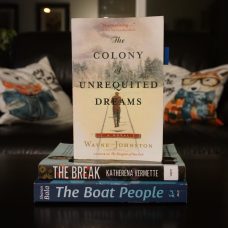
The Colony of Unrequited Dreams


Rating: 
Author: Wayne Johnston
Genres: Historical Fiction
Read: Feb. 2018

Where to start? This was a very long book that took a lot of motivation to pick up off my shelf, but that I ended up having a lot of opinions about. I was worried that it was going to be really dense, but fortunately, it turned out to be a very well written and engaging book about Newfoundland.

The Colony of Unrequited Dreams is historical fiction about Joey Smallwood, Newfoundland’s first premier who helped to usher Newfoundland into confederation with Canada. He is both a well liked and disliked premier, depending on who you talk to. Johnston definitely takes a lot of liberties with Smallwood’s character in this novel, but the story is still pretty accurately based on his life in terms of what he accomplished.

The story starts with Smallwood as a child in the early 1900’s. His family were shoe salesmen in St. John’s and he lived up on the Brow looking over the Harbour until his uncle decided to pay to send him to Bishop Feild, the prestigious boy’s boarding school of the day. At Bishop Feild, he meets Prowse, grandson of a noted historian, and Fielding, a girl who attends the nearby sister school, Bishop Spencer.

Fielding is the other main character in this story and unlike Smallwood, her character is completely fabricated. Fielding has a cane, walks with a limp, has a wry sense of humour, with sarcasm and irony being her preferred mediums. She’s a bit of an outcast who goes on to work as a reporter for The Telegram, publishing critical articles about all branches and parties of the government. Fielding marches to the beat of her own drum and I really liked her. I loved that she wasn’t afraid to speak her mind and I loved her sense of humour.

This book actually had a lot more humour in it than I was expecting and it had me laughing out loud early in the novel. Below is one of my favourite quotes from the book, which is an argument Smallwood has with his mother, and had me laughing because I also grew up in St. John’s while my parents grew up in rural outport communities. This is pretty much the exact same thing my parents would say to me growing up and the biggest way you could offend my parents would be to call them townies.

“I’m a Newfoundlander, but not St. John’s born, no, not St. John’s born,” he said.
“You’re a bayman and you always will be,” my mother said.

I’ve been living on the West Coast for the last 4 years, so this was super nostalgic for me. Wayne Johnston is not even describing my St. John’s in this novel because it’s set between 1900 and 1950, but there’s something really special about still being able to vividly picture the setting of a story, especially when it’s a place like Newfoundland, which I hold so special in my heart.

I didn’t love Joe Smallwood’s character, but I did like the writing. This was one of my monthly challenge books and I’m glad I challenged myself to read it because I probably never would have gotten around to it otherwise. Johnston does a really great job with the setting. I don’t know how non-Newfoundlanders might feel about this book, but I loved the setting and the atmosphere Johnston created. Especially towards the end when we finally get to the whole business of confederation and the end of independence. I felt like Johnston did a good job of not taking a side and presenting both sides of the story. It really makes you reflect on what Newfoundland gained, what it lost, and what may or may not have been.

I read Greg Malone’s Don’t Tell the Newfoundlanders several years ago and I felt that this book was a good contrast to that. Greg Malone is very clearly anti-confederation, as well as a bit of a conspiracy theorist. While I really liked Don’t Tell the Newfoundlanders, because it has some great history in it and I learned a lot, it is very speculative and I liked that Wayne Johnston presented a more balanced version of history and I feel he left his personal feelings out of it.

For those of you not well versed in Newfoundland’s history, we we’re an independent country up until 1933 when we had a commission of government forced on us by the British as a result of our war debt (even though A LOT of Newfoundlanders lost their lives fighting for Great Britain in WWI – I am a little bitter, yes). I’ve written an entire blog post about Don’t Tell the Newfoundlanders if you’re interested in our fascinating history (to me anyways), but basically we were supposed to get back our independence when we became self-sustaining once more, which we did after WWII. However, instead of just turning governance back over to Newfoundland, it was decided to hold a referendum to let the people choose if they wanted to join Canada instead.

Joe Smallwood wanted nothing more than to do something for which he would be remembered. He dropped out of Bishop Feild and failed at making a life for himself in New York, so he was desperate to have an influence in Newfoundland’s future. He was an avid socialist in his youth, but upon realizing that Newfoundlanders were never going to buy into socialism, he turned his talents to the Liberal government. He helped former Prime Minister Sir Richard Squires with his re-election campaign in hopes of winning the nomination to run himself, but he is jilted by Squires again and again and struggles to get into politics.

In this novel, he is a huge supporter of unions, walking across the entire provincial railroad line to start a rail-workers union, and he later travels all around Newfoundland’s most remote islands, trying to start a fisherman’s union. This really gave me an appreciation for how Smallwood became so popular and influential and why he supported Confederation. He really cared about Newfoundlanders and he spent an inordinate amount of time speaking with the poor throughout his life. He was also the host of a popular radio show that focused on sharing stories of Newfoundland and about Newfoundlanders.

The fisherman were not nationalists of any sort…They would vote for Confederation to get the mother’s allowance and would live by Confederation exactly as they had before…They had starved through a depression that had ended when the war began. Now, they were terrified that another decade like the thirties was on its way.

The crowd from St. John’s, the merchants and the wealthy, were all big supporters of independence. But Smallwood understood from his travels around Newfoundland that the majority of Newfoundlanders were poor fisherman, struggling to keep food on the table. They didn’t care about the government of the day and it rarely affected them. Confederation wouldn’t really change anything for them, except they’d be able to profit from access to Canada’s established public services.

The anti-confederates must have wondered how they lost…They had been to London and they had been to New York, but they had never been to Bonavista or La Poile, and that was why they lost.

Don’t Tell the Newfoundlanders leaves you feeling angry and riled up, but The Colony of Unrequited Dreams gave me an appreciation of what it was really like for Newfoundlanders. Forget the politics and the conspiracies, rural fishermen just wanted to catch a break and this was something I never really understood before. Yet Johnston still presents the other side of the story and makes you feel very nostalgic for what might have been. Personally, I wish we could have seen what might have been had we re-gained our independence, but I do also think it’s likely that we might have ended up joining Canada anyways and I’m proud to be both a Newfoundlander and a Canadian. I think this must be one of the reasons why Newfoundlanders always retain such a keen sense of home no matter where they go. There is something unique about Newfoundland culture that does not come from Canada because we have not always been Canadian.

The ending of this book was heartbreaking for me though. I was a little bit disappointed that Johnston chose to end this book about Fielding. I really liked her, but as a fictional character, I don’t think her story was quite as powerful and it felt very anti-climatic to suddenly jump back into Fielding’s past.

“You all but gave away Churchill Falls, which you had hoped would crown your career as Confederation had crowned Mackenzie King’s”

Johnston touches very briefly on Churchill Falls and I wish he’d explored it more. If this book had been written 10 years later, I’m sure he would have because the Lower Churchill is such a hot topic in Newfoundland right now. But I found this so heartbreaking because Churchill Falls was meant to be Smallwood’s swan song – his legacy – and instead it turned out to be one of the worst deals every made and a real sore spot for Newfoundlanders. Smallwood did not have a successful start as Premier and Johnston portrays him running out of time in office and chasing after Churchill Falls as his last chance to see Newfoundland transformed.

That said, my favourite part of this book is easily the way Johnston writes about Newfoundland. You can tell he has a great love and reverence for the island. I’m sure any Newfoundlander can relate as there’s just something that makes Newfoundlanders have this deep attachment to their homeland. She’s a rocky isle in the ocean, and she’s pounded by winds from the sea, but you just can’t help but love her ruggedness and her people. Smallwood was relentless and he really did want to do something good for Newfoundland. His whole life was dedicated to making Newfoundlander better and I do really think he cared about the poor Newfoundlanders and that they are what ultimately motivated him to chase after confederation.

I have often thought of that train hurtling down the Bonavista like the victory express. And all around it the northern night, the barrens, the bogs, the rocks and ponds and hills of Newfoundland. The Straits of Belle Isle, from the island side of which I have seen the coast of Labrador.
These things, finally, primarily, are Newfoundland.
From a mind divesting itself of images, those of the land would be the last to go.
We are a people on whose mind these images have been imprinted.
We are a people in whose bodies old sea-seeking rivers roar with blood.